

Understanding Developer Land Assemblies and Strategic Seller Positioning in the Fraser Valley 2026: How Market Saturation, Assembly Timelines, and Hold-Out Leverage Actually Work When Developers Target Your Neighbourhood
By Mohamed Mansour, MBA and Associate Broker | Mansour Real Estate Group | Published: May 13, 2025 | Geography: Fraser Valley — Fleetwood, Cloverdale, Guildford, Surrey BC
If a developer has approached you about your home in Fleetwood, Cloverdale, or Guildford, you are not alone. Active assembly programs are underway in all three neighbourhoods, driven by publicly announced transit, hospital, and mixed-use projects. The question is not whether your property has development value — it almost certainly does. The question is whether you are positioned to capture it.
This article explains how land assemblies work in BC, what drives premium pricing at different stages of an assembly, how to benchmark your property's true value, and what sellers in these specific Fraser Valley corridors need to understand before responding to a developer's first offer.
Short Answer
When a developer targets your neighbourhood for assembly, the offer you receive is not based on residential market value — it is based on land economics, density potential, and how critical your parcel is to completing the assembly. Sellers who accept initial offers without an independent development-land appraisal typically leave 15 to 25 percent of their net proceeds on the table. Your leverage increases significantly as the assembly nears the 85 to 95 percent completion threshold developers require before proceeding.
Who This Applies To
- Homeowners in Fleetwood, Cloverdale, or Guildford who have received a direct developer approach or letter of intent
- Owners in Surrey OCP-designated transit-oriented or mixed-use corridors, including the Fleetwood SkyTrain corridor and Cloverdale hospital district
- Sellers who have been offered a premium above current asking price and are unsure whether it reflects true development land value
- Homeowners considering selling in the next 12 to 36 months in an area where assembly activity is visible
- Executors or estate trustees managing properties in active assembly zones
When This Advice May Not Apply
If your property is not within a municipally designated development corridor, or if the developer approach is speculative rather than backed by a formal assembly program, the leverage dynamics described here are different. This article focuses on active, publicly announced assembly zones. Always confirm corridor designations with Surrey's Official Community Plan before assuming development-land pricing applies to your parcel.
Key Takeaways
- Early sellers in assembly zones often accept 10 to 15 percent below maximum value; final hold-outs can command 20 to 40 percent above fair market value as completion risk rises for the developer.
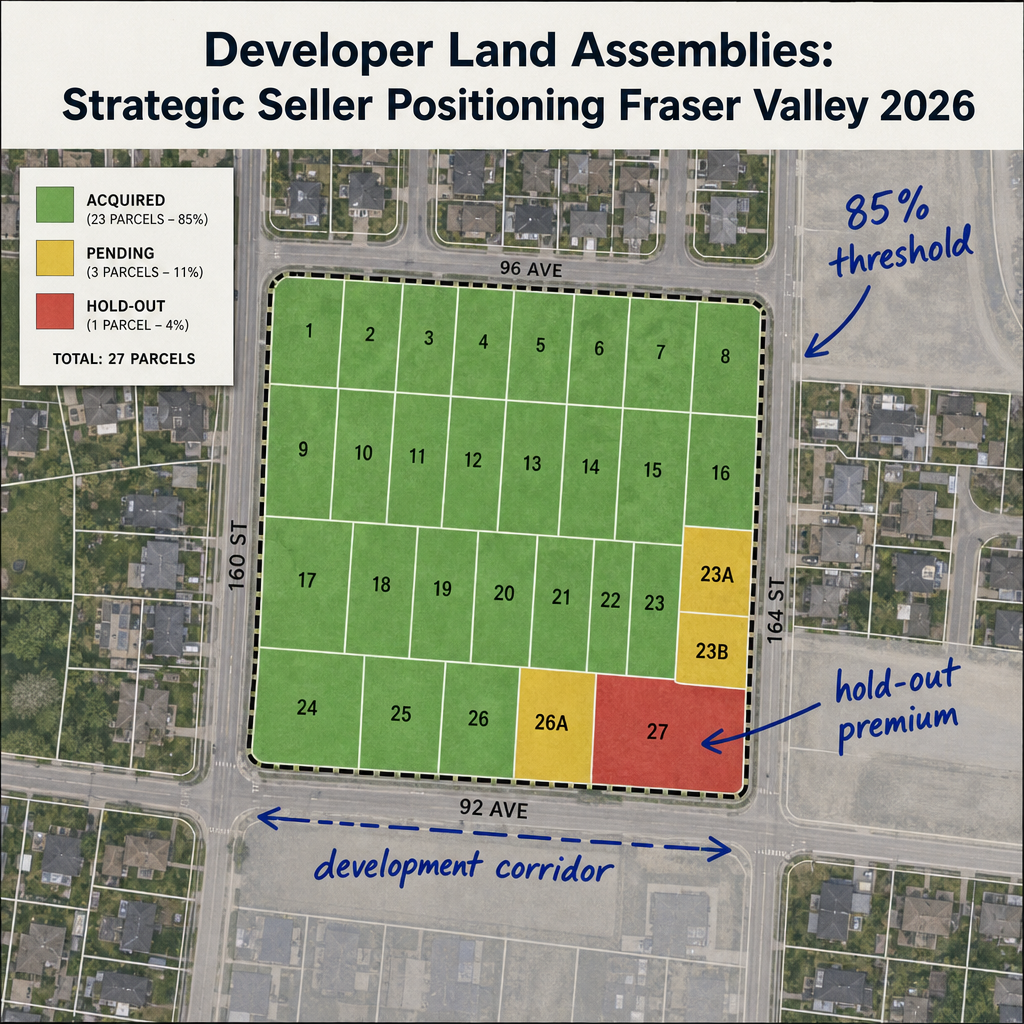
- Developers require 85 to 95 percent of a targeted assembly before proceeding — the sellers closest to that threshold hold disproportionate negotiating leverage.
- Standard residential comparables do not reflect development-land value; a dual appraisal covering both residential market value and land-extraction value is the correct benchmark.
- Fleetwood, Cloverdale, and Guildford are in active pre-development phases with publicly announced timelines, meaning sellers in those zones should expect formal approaches within 12 to 24 months.
- April 2026 FVREB data shows entry-level homes in Fleetwood and Cloverdale trading below benchmark, which creates a misleading impression that developer offers are generous when they may still be under true development value.
Data Used in This Article
- FVREB April 2026 Neighbourhood Reports — Fleetwood, Cloverdale, Guildford benchmark pricing and sales activity (Official board data)
- Surrey Official Community Plan 2024–2026 — Transit-oriented and mixed-use corridor designations (Municipal official document)
- BC Ministry of Housing and Municipal Affairs — Cloverdale hospital project and SkyTrain extension timelines (Provincial government)
- Appraisal Institute of Canada — Land assembly and development property valuation standards (Professional regulatory body)
- Mansour Real Estate Group transaction data 2024–2026 — Developer offer analysis and assembly negotiation experience (Internal professional observation)
Why Assembly Pricing Is Not the Same as Market Pricing
When a developer makes an offer on your home, they are not buying a place to live. They are acquiring land for density. The value they assign is based on the number of units the site can support after rezoning, the per-unit land cost they can absorb while maintaining project viability, and how much risk they carry if the assembly is incomplete.
According to the Appraisal Institute of Canada's valuation standards for development properties, the correct approach involves extracting land value from total project value, applying zoning density multipliers from the approved or anticipated OCP designation, and discounting for soft costs including rezoning timelines, financing carry, and municipal approval uncertainty. This process often produces a land value 30 to 50 percent higher than standard residential comparables for the same property.
In April 2026, FVREB data showed entry-level single-family homes in Fleetwood and Cloverdale trading between $750,000 and $850,000, while neighbourhood benchmarks sat between $825,000 and $900,000. A developer offering $920,000 on a $780,000 residential comp may appear generous. But if the land extraction analysis supports $1.05 million, the seller has accepted a discount of roughly 12 percent relative to true development value — without knowing it.
This is the core problem sellers face when they treat a developer offer like a residential transaction. The benchmarks are different, the math is different, and the leverage dynamics are completely different depending on where in the assembly timeline the offer arrives.
The Three Positions in an Assembly — and What Each One Means for Your Leverage
Assembly leverage is not fixed. It shifts depending on how many parcels the developer has already secured, how many remain, and how close the project is to the threshold required for rezoning applications to proceed. Understanding where you sit in that timeline is the single most important factor in your negotiating position.
Early-stage sellers (developer has under 50% of required parcels)
At this stage, the developer is establishing a foothold. Offers tend to reflect a modest premium — typically 10 to 15 percent above residential market value — with an emphasis on speed and certainty. The developer faces low completion pressure and can walk away from any individual parcel. Sellers who accept at this stage are trading leverage for certainty. That may be appropriate depending on personal circumstances, but it is important to understand the trade-off explicitly.
Mid-assembly sellers (developer has 50–85% of required parcels)
This is where leverage increases most sharply. The developer has committed capital, engaged financing, and in many cases moved toward a rezoning pre-application. Each remaining parcel carries increasing strategic weight. Sellers in this window who are aware of the assembly status can reasonably support premiums of 15 to 25 percent above independently verified development-land value. According to Mansour Real Estate Group's transaction experience from 2024 to 2026, mid-assembly sellers who entered negotiation with dual-appraisal documentation consistently outperformed those who accepted initial offers.
Final hold-outs (developer needs fewer than 3–5 parcels to proceed)
Hold-out premiums are real, but they carry risk. Developers at this stage face maximum completion pressure — a single missing parcel can invalidate years of capital deployment. Published case data from BC assembly projects shows hold-out premiums of 20 to 40 percent above fair market value in completed transactions. However, hold-out strategies also carry legal exposure: if a developer believes a seller is acting in bad faith, applications for statutory land assembly processes exist under BC legislation, though they are rarely used. The more practical risk is that an assembly collapses entirely, removing the premium and leaving the seller with a standard residential market outcome in a neighbourhood that may now carry stigma from a failed development program. Holding out is a legitimate strategy — but it requires legal and real estate counsel, not just negotiating instinct.
Fleetwood, Cloverdale, and Guildford: What Is Actually Happening in 2026
All three neighbourhoods are in confirmed pre-development phases, with publicly announced projects creating transparent assembly windows. Sellers in these areas should treat developer approaches as expected, not exceptional.
Fleetwood: The Fleetwood SkyTrain extension and the proposed hospital district near 84th Avenue and 166th Street have created overlapping assembly targets. According to the Surrey OCP 2024–2026, the Fleetwood corridor is designated for transit-oriented development with increased density permissions. BC Ministry of Housing and Municipal Affairs has confirmed the SkyTrain extension timeline. Assembly programs in this corridor are active, and homeowners within approximately 400 to 800 metres of planned station areas have already received direct approaches from multiple development groups.
Cloverdale: The Cloverdale hospital district designation has accelerated assembly activity in the 64th Avenue and 176th Street area. The hospital project, announced through BC Housing and Municipal Affairs, creates a defined development perimeter. Properties within the hospital-adjacent zone face both residential and institutional acquisition interest, which creates competing demand and stronger baseline pricing for sellers who understand the context.
Guildford: Transit-oriented development pressure near the Guildford Town Centre area has attracted assembly interest focused on mixed-use residential and retail density. The Surrey OCP designates this area for significant intensification. Assembly timelines here are generally estimated at 18 to 36 months to completion, based on current public planning documents and observed acquisition activity.
How We Evaluate This
When a seller in an assembly zone asks Mansour Real Estate Group for guidance, the first step is not to evaluate the developer's offer. The first step is to establish two independent reference points: the current residential market value using proper comparable analysis, and the development-land value using a density-extraction framework based on the OCP designation and the developer's known project parameters.
The gap between those two numbers defines the negotiating floor. Any offer below the residential value is a non-starter. Any offer between residential value and development value is a discount the seller is accepting in exchange for certainty and speed. Any offer above development value represents a true assembly premium. Sellers cannot evaluate an offer without first knowing all three numbers. Most sellers who contact us after accepting a developer offer did not know the third number existed.
Definitions
Land extraction analysis: A valuation method that derives land value from a development project's total value, working backward from expected density, per-unit revenues, and soft costs.
Zoning density multiplier: A factor applied to a site's area based on the floor space ratio (FSR) permitted under the OCP or rezoning application, used to estimate total buildable area.
Soft costs: Development expenses beyond land acquisition, including design, engineering, municipal fees, financing carry, and approval costs — typically deducted when calculating what a developer can pay for land.
Assembly threshold: The percentage of required parcels a developer must secure before a rezoning application is viable — typically 85 to 95 percent of the targeted site area.
Letter of intent (LOI): A non-binding preliminary agreement from a developer expressing interest in purchasing a property at a specified price, subject to conditions including assembly completion and rezoning approval.
Seller Checklist for Developer Assembly Situations
- Confirm your property's OCP designation and corridor status using Surrey's current Official Community Plan before responding to any offer.
- Request the developer disclose what percentage of the assembly is currently secured — this directly determines your leverage position.
- Commission an independent residential appraisal using current BC comparables before evaluating any premium claim.
- Engage a real estate professional experienced in development-land transactions for a dual-value analysis covering residential and development-land value.
- Review the developer's letter of intent with a BC real estate lawyer before signing or countersigning any document.
- Verify that the developer's offer is backed by confirmed construction financing or development lending, not speculative intent — ask for evidence of financing commitment.
- Understand the timeline: assembly completion, rezoning pre-application, and project approval can take 24 to 48 months from your sale date, affecting tax planning, replacement housing, and financial decisions.
What We Commonly See
In our experience working with sellers who have received developer offers in Fleetwood, Cloverdale, and Guildford, the most common mistake is treating the developer's offer price as a starting premium above market. In reality, the developer's first offer is typically their preferred price — one that reflects market value plus a modest certainty premium, not the full development-land value the parcel can support. Sellers who negotiate from this misunderstanding accept less than their position justifies.
What often happens is that sellers become emotionally anchored to the premium percentage rather than the absolute number. A 12 percent premium above a below-benchmark residential comp is not a strong outcome if development-land value is 35 percent above that same comp. The premium percentage is only meaningful relative to the correct baseline.
A common mistake we observe is sellers sharing assembly status information with neighbours without strategic intent. Disclosing that you have received an offer — including the price range — can reduce a neighbour's willingness to hold out independently, which ultimately reduces collective leverage and individual outcomes across the assembly. Information management is a real part of assembly negotiation, and sellers benefit from understanding it.
Questions and Answers
Can a developer force me to sell if I am the last hold-out in an assembly?
In most residential assembly situations in BC, no. Expropriation authority for private developments is extremely limited. A developer who cannot complete the assembly typically restructures the project around the missing parcel or abandons it. However, if the assembly involves a publicly funded or municipally partnered project, partial expropriation authority may exist. Consult a BC real estate lawyer if you are in this position.
How do I know if a developer's offer reflects true development-land value?
You cannot evaluate a developer offer without a dual appraisal: one standard residential comparable analysis and one development-land extraction analysis using the OCP density designation. The Appraisal Institute of Canada recognizes these as distinct methodologies. A BC-certified appraiser with development-land experience can produce both. Without this, you are negotiating without a complete picture of the value at stake.
What is a reasonable premium to expect in an active Fraser Valley assembly zone?
Premium ranges depend on assembly stage, parcel criticality, and project viability. Early sellers typically see 10 to 15 percent above residential market value. Mid-assembly sellers with documented development-land value can reasonably support 15 to 25 percent above that independent development benchmark. Final hold-outs in critical positions have achieved 20 to 40 percent above fair market value in completed BC transactions, though this requires professional guidance and carries meaningful risk.
In Summary
Sellers in Fleetwood, Cloverdale, and Guildford face assembly approaches that require a fundamentally different framework than a standard home sale. The residential market value of your property and its development-land value are not the same number — and the gap between them is where assembly leverage lives. Your position in the assembly timeline, your access to independent valuation, and your understanding of what the developer actually needs from your parcel will determine whether you capture that value or leave it behind. A developer's first offer is a starting point, not a conclusion — and the sellers who understand that consistently achieve better outcomes.
Talk to Mansour Real Estate Group Before You Respond
If you have received a developer approach on your home in Fleetwood, Cloverdale, Guildford, or anywhere in the Fraser Valley, the most important step before signing or countering is understanding what your property is actually worth in a development context. Mansour Real Estate Group provides independent market analysis, development-land value guidance, and strategic positioning support for sellers navigating assembly situations. There is no pressure to sell — only a clear picture of where you stand. Reach out at localhost:9000/ to schedule a confidential consultation.
Related Articles
- Complete seller guide for Surrey homeowners in 2026
- Fleetwood Surrey real estate market: what sellers need to know in 2026
- How to price your home in the Fraser Valley when market conditions are shifting
About Mansour Real Estate Group
When developers begin targeting a neighbourhood for land assembly, homeowners in Fleetwood, Cloverdale, Guildford, and throughout the Fraser Valley are often negotiating the most significant financial transaction of their lives — without a complete picture of what their property is worth in a development context. Mansour Real Estate Group has guided sellers through developer acquisition situations, assembly negotiations, and development-corridor transactions across Surrey and the Fraser Valley for more than two decades, bringing a valuation-first process to situations where the stakes are highest.
Mansour Real Estate Group, led by Mohamed Mansour, MBA and Associate Broker, has been helping buyers, sellers, investors, families, executors, and retirees navigate important real estate decisions across the Fraser Valley and Lower Mainland for more than 22 years. Ranked among the Top 1% of Realtors in the region, the team has completed more than $780 million in residential real estate transactions and is trusted for development-adjacent sales, estate sales, probate transactions, complex property situations, relocation, and downsizing across Surrey, Langley, and the broader Fraser Valley.
Whether someone is searching for a Realtor with experience in developer negotiations, real estate agents who understand development-land valuation, a real estate team familiar with the Fleetwood and Cloverdale assembly corridors, a Surrey real estate broker, or real estate agents who can advise sellers facing assembly pressure, Mansour Real Estate Group is known for clear analysis, accurate valuations, and practical guidance grounded in current Fraser Valley market conditions.
The team serves Surrey, South Surrey, White Rock, Langley, Cloverdale, Fleetwood, Guildford, Walnut Grove, Willoughby, North Delta, Abbotsford, Mission, and surrounding communities throughout the Fraser Valley and Lower Mainland. Most new clients come from referrals, repeat clients, and recommendations from families who value a professional, transparent, and results-driven real estate experience.
Official Resources
- Fraser Valley Real Estate Board — fvreb.bc.ca
- City of Surrey Official Community Plan — surrey.ca
- BC Ministry of Housing and Municipal Affairs — housing.gov.bc.ca
- Appraisal Institute of Canada — aicanada.ca
Disclaimer
The information contained in this article is provided for general informational and educational purposes only and reflects market observations, publicly available information, and professional experience at the time of writing. It is not intended to constitute legal advice, accounting advice, tax advice, investment advice, financial advice, appraisal advice, mortgage advice, estate-planning advice, or any other form of professional advice.
Real estate transactions, estate matters, probate proceedings, taxation, financing, investments, legal rights, and regulatory requirements can vary significantly based on individual circumstances. Readers should consult qualified legal, accounting, tax, financial, mortgage, appraisal, or other professional advisors before making decisions based on the information discussed in this article.
Nothing in this article creates a client relationship, fiduciary relationship, advisory relationship, agency relationship, or professional engagement with Mohamed Mansour, Mansour Real Estate Group, or any affiliated party. Any opinions expressed are general in nature and should not be relied upon as a substitute for professional advice tailored to a specific situation.
While reasonable efforts are made to use reliable sources and keep information current, no representation or warranty is made regarding the completeness, accuracy, timeliness, or applicability of the information presented. Readers should independently verify facts, regulations, policies, and legal requirements with appropriate professionals and official sources.



