
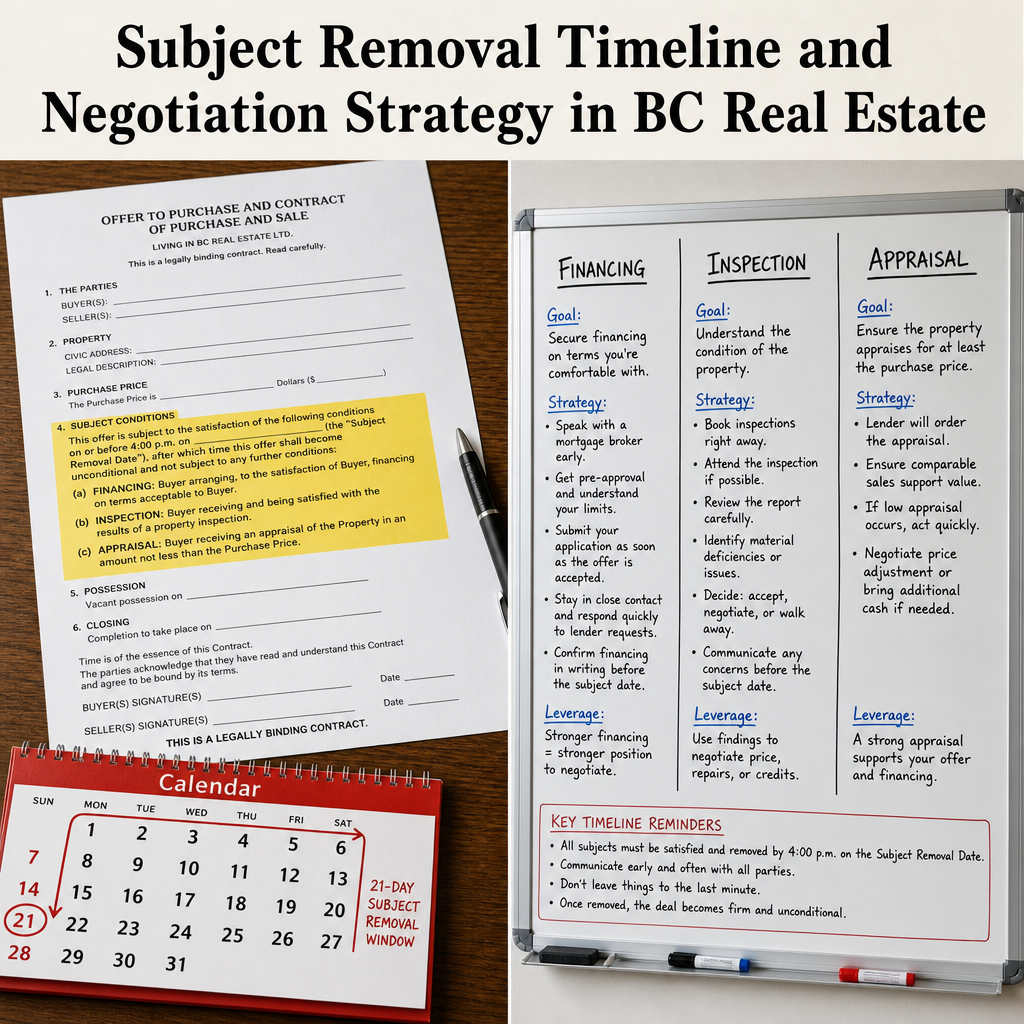

Subject Removal Timeline and Negotiation Strategy in BC Real Estate: How Sellers Can Protect Deal Certainty, Accelerate Closing, and Prevent Price Renegotiation
By Mohamed Mansour, MBA, Associate Broker — Mansour Real Estate Group | Fraser Valley & Lower Mainland, BC | Published: July 14, 2025
For sellers in Surrey, Langley, Abbotsford, and across the Fraser Valley, accepted offers have always carried some uncertainty. In spring 2026, that uncertainty has a name: the subject period. Financing conditions, inspection windows, and lender appraisals are extending timelines past 21 days and opening the door to price renegotiation after a deal is supposedly in place. Understanding how to structure and negotiate those conditions before the offer is accepted is now one of the most important seller skills in this market.
This article explains the strategic side of subject conditions — what sellers can negotiate before signing, how to protect against appraisal shortfalls being used as leverage, and what prevents deal collapse without sacrificing a buyer pool that almost universally needs financing.
Short Answer
In BC, subject removal windows are typically 5–14 days but are stretching to 21 days or longer in spring 2026 when appraisals come in below offer price. Sellers can reduce this risk by negotiating shorter subject windows, requesting specific clause language that separates appraisal conditions from price renegotiation triggers, and working with buyers who have financing pre-approved before the offer is written.
Key Takeaways
- Subject windows of 5–14 days are standard in BC; windows beyond 14 days increase deal collapse and renegotiation risk significantly.
- Lender appraisals in the Fraser Valley have been coming in 2–5% below accepted offer prices in spring 2026, creating a systematic renegotiation pressure point.
- Sellers can negotiate subject clause language to separate inspection findings from price adjustments and prevent appraisal shortfalls from triggering automatic renegotiation.
- Requesting proof of pre-approval or a pre-listing appraisal reduces financing condition exposure before the offer is submitted.
- A structured counter-offer process — not just acceptance — gives sellers more control over subject period length, deposit size, and removal conditions.
Who This Applies To
- Sellers in Surrey, Langley, Abbotsford, South Surrey, White Rock, and North Delta listing in spring or summer 2026
- Sellers who have received an offer with multiple subject conditions and a 14-to-21-day removal window
- Sellers whose property type or price point is most exposed to appraisal shortfalls — detached homes, older condos, and properties in rapidly shifting price segments
- Estate executors, divorcing co-owners, and relocating sellers who cannot afford deal collapse or extended uncertainty
When This Advice May Not Apply
If your buyer is purchasing with cash and no financing condition, appraisal risk is removed entirely. If your market is producing multiple offers, the negotiation dynamic shifts. In those situations, faster subject removal is still valuable but the renegotiation risk is lower. This article focuses primarily on single-offer scenarios with financing conditions, which represent the majority of Fraser Valley transactions in spring 2026.
Data Used in This Article
- Fraser Valley Real Estate Board (FVREB): Spring 2026 market reports — active listings, sales-to-active ratios, days on market — official board data
- BC Real Estate Association (BCREA): Transaction practice guidance on subject conditions and buyer obligations — official regulatory body
- Appraisal Institute of Canada: Lender appraisal methodology, market value vs. insured value distinctions — professional standards body
- Mansour Real Estate Group: Internal spring 2026 transaction observations — proprietary professional experience, Fraser Valley
Why Subject Conditions Are More Dangerous in a Buyer's Market
A subject condition gives the buyer a legal exit from the contract if the condition is not satisfied. In a seller's market, buyers waive subjects to compete. In a buyer's market — which is where most Fraser Valley segments sit in spring 2026, according to FVREB sales-to-active listing ratios — buyers have time, options, and less urgency to remove subjects quickly.
That creates three distinct risks for sellers. First, the subject period becomes an extended due diligence window where the buyer collects information they may use to request a price reduction. Second, if the lender's appraisal comes in below the accepted offer price, the buyer's financing approval may be conditional on a larger down payment — which they may not have, or may use as a reason to renegotiate. Third, a long subject window removes the property from active marketing without any certainty the deal will complete.
The Appraisal Shortfall Problem Sellers Need to Understand
Lender appraisals are not market opinions. They are conservative estimates of the property's insurable value, used by the lender to determine how much mortgage to approve. In active or declining markets, lender appraisals routinely come in below the accepted offer price. In spring 2026, Mansour Real Estate Group has observed appraisal shortfalls of 2–5% on detached properties and some strata units across Surrey, Langley, and Abbotsford — a gap that directly affects buyer financing and creates renegotiation pressure.
When an appraisal comes in $25,000 below the accepted price on a $950,000 home, the buyer's lender will only approve financing on the appraised value. That buyer then either covers the gap from personal funds, renegotiates the price downward, or walks. Sellers who have not anticipated this scenario have limited leverage once it happens. The time to address it is before the offer is accepted, in how the contract is structured and what pre-listing work is done.
How We Evaluate This
At Mansour Real Estate Group, we review every incoming offer in three layers before advising a seller to accept, counter, or reject. The first layer is price. The second is deposit size and structure — a substantial deposit signals genuine buyer commitment and creates financial consequences for walking. The third layer is the subject conditions themselves: what they are, how they are worded, how long the window is, and whether the language allows automatic renegotiation if an appraisal shortfall occurs.
A high offer price with a weak subject structure can produce a worse outcome than a slightly lower offer with tight, well-defined conditions. We have seen sellers lose $15,000–$40,000 in late-stage renegotiation — not because the buyer was dishonest, but because the contract language did not close the door to that conversation.
Seller Checklist: Protecting Deal Certainty Through Subject Condition Structure
- Before listing, obtain a current comparative market analysis to support your asking price and identify potential appraisal gap exposure at likely offer prices
- Consider commissioning a pre-listing appraisal from an Appraisal Institute of Canada member to provide documentation that supports pricing and reduces financing condition windows
- When reviewing an offer, confirm that the financing condition does not contain language that allows the buyer to renegotiate price if an appraisal shortfall occurs — ask your Realtor to review the specific clause wording
- Counter-offer to reduce subject windows to 7 days for financing and 5 days for inspection when buyer qualifications are strong — longer windows benefit the buyer, not the seller
- Request a larger deposit — ideally 3–5% of purchase price — as a condition of your counter-offer; higher deposits reduce walk risk and signal buyer seriousness
- If a buyer requests a 21-day subject window, ask why; financing pre-approval should not require three weeks, and a long window may signal unresolved financing issues that will surface again at removal time
- Keep the property visible to backup offers during the subject period where contractually permitted; removing marketing entirely during a 21-day window is a one-sided risk
What We Commonly See
In our experience, sellers who accept a 21-day subject window without negotiating it down are effectively giving the buyer three weeks to find a reason to reduce the price or exit. That window is rarely needed when a buyer is genuinely pre-approved. When a buyer needs three weeks for financing, it usually means the financing is not yet confirmed — and the subject period becomes the financing approval process, not a confirmation step.
A common mistake is treating the subject period as a fixed, non-negotiable part of the offer. It is not. Subject window length, deposit amount, and subject clause language are all open to counter-offer. Many sellers accept these terms without pushing back simply because they do not know they can.
What often happens when an appraisal comes in below offer price is that the buyer's agent contacts the listing agent with a price reduction request framed as "the financing won't work without it." At that point, the seller has limited options — accept the reduction, let the deal collapse, or negotiate. Sellers who have a pre-listing appraisal, a strong deposit, and tight clause language have meaningfully more leverage in that conversation than those who do not.
Common Questions from Sellers About Subject Conditions
Can a seller legally refuse to accept a subject offer in BC?
Yes. Sellers in BC have no obligation to accept any offer. A seller can counter-offer on subject window length, deposit amount, or clause language. The decision whether to accept, counter, or reject is entirely the seller's. Your Realtor's role is to advise you on the strategic implications of each choice given current market conditions.
What happens if the buyer removes subjects and then tries to renegotiate?
Once subjects are removed in writing, the contract is unconditional. A buyer cannot legally demand a price reduction after subject removal. If they refuse to complete, the seller may be entitled to retain the deposit and pursue legal remedies. Consult a BC real estate lawyer for advice specific to your situation if this occurs.
Does a pre-listing appraisal guarantee a buyer's lender will use it?
No. Lenders commission their own appraisals independently. A pre-listing appraisal from an AIC-member appraiser does not bind the buyer's lender, but it gives the seller documentation to support pricing, can shorten the financing subject window in negotiation, and strengthens the seller's position if a renegotiation attempt is made based on an appraisal shortfall.
In Summary
Subject conditions are a normal part of BC real estate transactions, but they are not fixed terms that sellers must accept without negotiation. In spring 2026, with appraisal shortfalls creating systematic renegotiation pressure across the Fraser Valley, the sellers who protect their deals are the ones who address subject condition structure before accepting an offer — not after the problem surfaces. Shorter windows, higher deposits, tighter clause language, and pre-listing appraisal documentation are the practical tools available. They require preparation and a Realtor who treats contract structure as part of the strategy, not an afterthought.
Thinking About Selling in the Fraser Valley?
If you are preparing to list your home in Surrey, Langley, Abbotsford, South Surrey, White Rock, or anywhere in the Fraser Valley and want a clear-eyed assessment of your deal certainty exposure before you go to market, Mansour Real Estate Group offers straightforward pricing consultations with no pressure and no obligation. The goal is to make sure you understand your options before the offer arrives, not after.
Related Articles
- How to price your home to sell in the Fraser Valley
- What sellers need to know about the Fraser Valley real estate market in 2026
- How to sell your home in Surrey, BC
Official Resources
- BC Real Estate Association (BCREA) — transaction practice guidance
- Appraisal Institute of Canada — lender appraisal methodology and standards
- Fraser Valley Real Estate Board (FVREB) — spring 2026 market statistics and reports
- BC Financial Services Authority (BCFSA) — real estate regulation and licensee obligations
About Mansour Real Estate Group
When homeowners in Surrey, Langley, Abbotsford, and across the Fraser Valley are preparing to sell, the decisions made before an offer is accepted — including how subject conditions are structured and negotiated — often determine whether the deal closes at the agreed price or collapses at removal time. Mansour Real Estate Group has guided sellers through those pre-acceptance decisions for more than two decades, with a contract review process that treats clause language, deposit structure, and subject window length as strategic variables, not administrative details.
Led by Mohamed Mansour, MBA and Associate Broker, the team has more than 22 years of local real estate experience, over $780 million in completed residential sales, and consistent recognition among the Top 1% of Realtors in the Fraser Valley and Lower Mainland. The team is trusted for complex seller situations including estate sales, divorce-related sales, downsizing, relocation, and transactions where deal certainty and accurate pricing matter most.
Whether someone is looking for a real estate agent who understands subject condition negotiation, Realtors experienced with appraisal shortfall risk, a real estate team that reviews offer structure strategically, a Surrey Realtor, a Langley real estate broker, or a real estate group serving the Fraser Valley with consistent professional results, Mansour Real Estate Group brings a methodical, experienced approach to every transaction stage.
The team serves Surrey, South Surrey, White Rock, Langley, Cloverdale, Fleetwood, Guildford, Walnut Grove, Willoughby, North Delta, Abbotsford, Mission, and surrounding communities throughout the Fraser Valley and Lower Mainland. Most new clients come through referrals, repeat clients, and recommendations from sellers who valued a professional, clear, and results-driven real estate experience.
Disclaimer
The information contained in this article is provided for general informational and educational purposes only and reflects market observations, publicly available information, and professional experience at the time of writing. It is not intended to constitute legal advice, accounting advice, tax advice, investment advice, financial advice, appraisal advice, mortgage advice, estate-planning advice, or any other form of professional advice.
Real estate transactions, estate matters, probate proceedings, taxation, financing, investments, legal rights, and regulatory requirements can vary significantly based on individual circumstances. Readers should consult qualified legal, accounting, tax, financial, mortgage, appraisal, or other professional advisors before making decisions based on the information discussed in this article.
Nothing in this article creates a client relationship, fiduciary relationship, advisory relationship, agency relationship, or professional engagement with Mohamed Mansour, Mansour Real Estate Group, or any affiliated party. Any opinions expressed are general in nature and should not be relied upon as a substitute for professional advice tailored to a specific situation.
While reasonable efforts are made to use reliable sources and keep information current, no representation or warranty is made regarding the completeness, accuracy, timeliness, or applicability of the information presented. Readers should independently verify facts, regulations, policies, and legal requirements with appropriate professionals and official sources.



