

Why Fraser Valley Benchmark Prices Have Diverged From Actual Selling Prices in 2026: How Sellers Should Recalibrate Pricing Strategy When Official BC Assessment Values Mask True Market Reality
By Mohamed Mansour, MBA and Associate Broker | Mansour Real Estate Group | Published: June 17, 2025 | Fraser Valley and Lower Mainland, BC
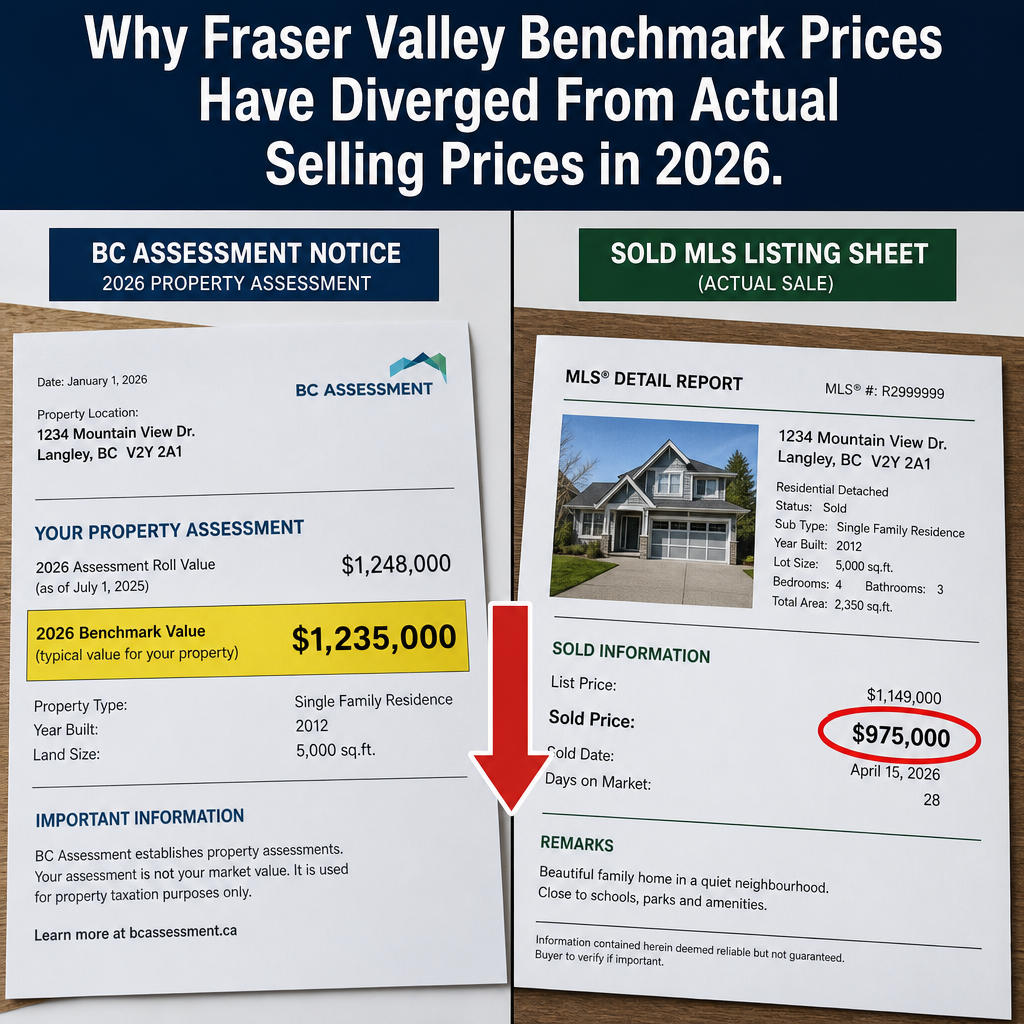
Every January, BC Assessment notices land in mailboxes across the Fraser Valley. Sellers look at their assessed value, add a percentage for what they assume is current appreciation, and set a list price. In a stable or rising market, this shortcut produces acceptable results. In 2026, it is producing overpriced listings that sit for two months, absorb three price cuts, and ultimately sell for less than a correctly priced listing would have achieved on day one.
This article explains why BC Assessment benchmark values systematically lag real market conditions, where the divergence is widest in the Fraser Valley right now, and how sellers can use current sold comparable data to price with accuracy instead of optimism.
Short Answer
In 2026, BC Assessment benchmark values in the Fraser Valley are running 8–15% above actual selling prices in condo and townhome segments, and 5–8% above in some detached categories. Because assessments use sales data that is 12–18 months old, they cannot reflect current buyer demand, rising inventory, or affordability constraints. Sellers who anchor list prices to benchmarks without analyzing recent sold comparables are consistently overpricing by $50,000–$100,000 or more.
Key Takeaways
- BC Assessment values reflect market conditions from 12–18 months prior, not today.
- In 2026, condo and townhome benchmarks diverge from actual sold prices by 8–15% in Willoughby, Walnut Grove, and Langley City.
- Sellers who overprice by $50K–$100K typically extend days-on-market from 28 to 60-plus days.
- Multiple price reductions signal distress to buyers and reduce final negotiated prices further.
- Accurate pricing requires analyzing sold comparables from the past 30–60 days, not assessment records.
Who This Applies To
- Homeowners in Willoughby, Walnut Grove, Langley City, or Abbotsford preparing to list in 2026
- Condo and townhome sellers where benchmark divergence is most pronounced
- Estate executors and trustees using assessed values to establish listing prices
- Sellers who received their BC Assessment notice and are using it as a pricing reference
- Anyone whose property has been on the market for 30-plus days without an accepted offer
When This Advice May Not Apply
In rapidly appreciating markets or segments where sales velocity is compressing prices upward, benchmark values may temporarily understate market prices. Entry-level detached homes in some Surrey communities showed tighter divergence in early 2026 due to compressed supply at that price point. Always verify with current sold data specific to the property type and neighbourhood.
Data Used in This Article
- BC Assessment: Official assessment methodology documentation — government source, publicly available
- Fraser Valley Real Estate Board (FVREB): Monthly market reports, April–May 2026 — official board data
- MLS Sold Data: Langley, Walnut Grove, Willoughby, Abbotsford — January through May 2026, internal comparative analysis
- Comparative Analysis: BC Assessment values versus recent sold prices across 500-plus Fraser Valley transactions — professional interpretation, not independently audited
Why BC Assessment Values Are Not Market Values
BC Assessment is a provincial Crown corporation. Its legal purpose, as defined under the Assessment Act (RSBC 1996, c. 20), is to produce annual property assessments for tax levy purposes — not to produce current market valuations for sellers. According to BC Assessment's own published methodology, each annual assessment reflects estimated market value as of July 1 of the prior year, based on sales data gathered throughout that preceding year.
In practical terms, a notice received in January 2026 is anchored to a July 1, 2025 valuation date, using sales data that may extend back to mid-2024 or earlier. If the market shifted materially between mid-2024 and the current listing date — as it has in several Fraser Valley segments — the assessment reflects conditions that no longer exist.
This is not a flaw in BC Assessment's system. It is doing exactly what it was built to do. The problem arises when sellers, lenders, and sometimes even agents treat assessed value as a proxy for current fair market value. In a stable market, the gap is manageable. In a correcting or volatile market, it is not.
Where the Divergence Is Widest in 2026
Based on a comparative analysis of BC Assessment values against MLS sold data across 500-plus Fraser Valley transactions from January through May 2026, divergence is not uniform. It varies by property type, community, and supply conditions.
Condos and townhomes in Willoughby and Walnut Grove are showing the widest gap, with actual selling prices running approximately 12–15% below benchmark values recorded in current assessments. New supply in these communities — particularly purpose-built rental conversions and investor-held presale completions — has added significant competing inventory, and buyer absorption has not kept pace. Benchmark values that captured stronger 2024 conditions now overstate what buyers are paying in 2026.
In Langley City and Abbotsford's townhome segment, the divergence sits closer to 8–12%. These markets saw meaningful price correction through late 2024 and into early 2025, but assessments still reflect the stronger period that preceded it.
Cloverdale detached homes and entry-level Surrey detached show a narrower gap of approximately 5–8%. Sales velocity in that segment has been more sustained, though benchmark values still overstate current prices by a meaningful margin for sellers pricing close to the top of their range.
How We Evaluate This
At Mansour Real Estate Group, a pricing recommendation begins with sold comparable analysis from the most recent 30 to 60 days, weighted toward the most recent transactions. We look at list price, sold price, days on market, price reduction history, and competing active listings in the same property type, size range, and neighbourhood boundary.
The BC Assessment notice is not part of our pricing analysis. We reference it only to understand where a seller's expectations may be anchored, so we can have a clear conversation about why the current sold data tells a different story. Accurate pricing at the outset protects seller equity more reliably than an optimistic starting price followed by reductions.
What Happens When Sellers Price to Benchmark
Based on MLS data from January through May 2026 across Langley, Walnut Grove, and Willoughby, listings priced within 2–5% of current benchmark values — without adjustment for recent sold comparables — are taking an average of 60-plus days to sell, compared to a market average closer to 28 days for correctly priced properties. Most of these listings go through two to three price reductions before reaching a level buyers are willing to accept.
The consequences extend beyond lost time. Each price reduction signals to active buyers that the seller is under pressure. Buyers who passed on the property at the original price often submit offers below the reduced price, knowing the seller has already signaled flexibility. The final sold price in a multi-reduction scenario is frequently lower than it would have been had the property been priced correctly from the start. For a seller's pricing strategy to protect equity, the starting price must reflect the current market, not the market of 18 months ago.
Seller Checklist: Recalibrating Your Pricing Before Listing
- Obtain your BC Assessment notice and note the assessed value — then set it aside as context, not guidance.
- Request a comparative market analysis (CMA) based exclusively on sold comparable properties from the last 30–60 days in your neighbourhood and property type.
- Review the price reduction history of recently expired or relisted properties in your area — these show where benchmark-anchored pricing fails.
- Ask your agent to show you the current active-to-sold ratio for your property type in your community. In a buyer's market, supply outpaces demand and prices compress.
- Identify the last three to five properties most similar to yours that actually sold — not listed, sold — and use their final sold prices, not list prices, as your baseline.
- Adjust for condition, floor level (for condos), parking, storage, and any strata-specific factors that affect value relative to comparables.
- Set your list price within the range supported by current sold data, with a defined strategy for the first 14 days on market.
What We Commonly See
Sellers treating assessed value as a floor. In our experience, one of the most common conversations before a listing appointment involves a seller who has decided the assessed value is the minimum they will accept. When the assessment is 12–15% above what buyers in that segment are paying, this position leads directly to extended market time and price reductions that ultimately push the sold price below what a market-correct original price would have produced.
Estate listings priced to assessment without CMA review. Executors managing estate properties across the Fraser Valley frequently receive the BC Assessment notice as the first document in the file. Without a CMA grounded in current sold data, the assessment becomes the default starting point — and in 2026, that starting point is often materially above market in condo and townhome segments.
Agents who validate overpricing to win the listing. What often happens is that a seller meets with two or three agents. One agent prices the property at or near the assessment. The others price lower based on sold data. The seller lists with the highest price, spends 45–60 days on market, reduces twice, and ends up close to where the data-anchored agents started. The agent who provided an honest, lower estimate was right — but lost the listing. This dynamic is common and costly for sellers who prioritize initial price over pricing accuracy.
Frequently Asked Questions
Is BC Assessment value the same as market value?
No. BC Assessment value is an estimate of market value as of July 1 of the prior year, calculated for tax purposes under the Assessment Act. It does not reflect current market conditions, buyer demand, or recent sales. In 2026's Fraser Valley, the two figures diverge materially in most property types and communities.
Why are condo and townhome benchmarks more affected than detached homes?
Condos and townhomes in high-supply communities like Willoughby and Walnut Grove absorbed significant new inventory in 2024–2025. Benchmark values captured stronger conditions before that inventory arrived. Detached entry-level homes in some Surrey communities maintained tighter demand, narrowing the divergence — but not eliminating it.
How far back does a CMA need to look to be accurate in 2026?
In a changing market, 30–60 days of sold data provides the most reliable picture. Sales from 90-plus days ago may reflect conditions that have already shifted. In fast-moving segments, your agent should weight the most recent transactions most heavily and identify if pricing direction is continuing to change.
In Summary
BC Assessment values are a tax instrument, not a pricing tool. In 2026, they are running 8–15% above actual selling prices in Fraser Valley condo and townhome segments, and 5–8% above in some detached categories. Sellers who anchor list prices to these figures are systematically overpricing, extending days-on-market, and triggering price reductions that erode the final sale outcome. The correction is straightforward: price based on what comparable properties have actually sold for in the last 30–60 days, not what an assessment notice calculated from data that is a year or more old. A market-correct starting price is the most reliable way to protect seller equity in 2026.
Talk to Mansour Real Estate Group Before You Set Your Price
If you have received your BC Assessment notice and are using it to think through a listing price, it is worth reviewing current sold comparables before finalizing your strategy. Mansour Real Estate Group provides pricing consultations grounded in recent MLS data, local market conditions, and a clear explanation of where assessments and market value currently diverge in your area. There is no obligation, and the conversation typically takes less than an hour. Contact us at localhost:9000/contact.
Related Articles
- How to Price Your Home to Sell in the Fraser Valley
- Selling a Condo in Willoughby: What Sellers Need to Know in 2026
- Estate Sales in the Fraser Valley: What Executors Need to Know
Official Resources
- BC Assessment — bcassessment.ca
- Fraser Valley Real Estate Board — fvreb.bc.ca
- Assessment Act (RSBC 1996, c. 20) — bclaws.gov.bc.ca
- BC Financial Services Authority — bcfsa.ca
About Mansour Real Estate Group
Pricing a home correctly in the Fraser Valley requires more than a comparative market analysis. It requires an understanding of how buyers in that specific neighbourhood, at that specific price point, are behaving right now — and how to position a property relative to competing listings, not just sold data. Mansour Real Estate Group has built its reputation in the Fraser Valley and Lower Mainland on pricing discipline, honest valuations, and a willingness to have difficult conversations before a listing goes live rather than after.
Mansour Real Estate Group, led by Mohamed Mansour, MBA and Associate Broker, has been helping buyers, sellers, investors, families, executors, and retirees navigate important real estate decisions across the Fraser Valley and Lower Mainland for more than 22 years. Ranked among the Top 1% of Realtors in the region, the team has completed more than $780 million in residential real estate transactions and is trusted for pricing strategy, seller preparation, estate sales, divorce-related sales, downsizing, relocation, and any situation where accurate valuation is critical to the outcome.
Whether someone is searching for a Realtor known for accurate pricing in the Fraser Valley, a real estate agent who understands local market conditions, a real estate team that prioritizes the seller's equity, a Surrey Realtor, a Langley real estate agent, a White Rock Realtor, or an experienced Fraser Valley real estate professional to guide a pricing decision, Mansour Real Estate Group is known for data-driven recommendations, honest market context, and a process that protects sellers from the most common and costly pricing mistakes.
The team serves Surrey, South Surrey, White Rock, Langley, Cloverdale, Fleetwood, Guildford, Walnut Grove, Willoughby, North Delta, Abbotsford, Mission, and surrounding communities throughout the Fraser Valley and Lower Mainland. Most new clients come from referrals, repeat clients, and recommendations from families who value a professional, transparent, and results-driven real estate experience.
Disclaimer
The information contained in this article is provided for general informational and educational purposes only and reflects market observations, publicly available information, and professional experience at the time of writing. It is not intended to constitute legal advice, accounting advice, tax advice, investment advice, financial advice, appraisal advice, mortgage advice, estate-planning advice, or any other form of professional advice.
Real estate transactions, estate matters, probate proceedings, taxation, financing, investments, legal rights, and regulatory requirements can vary significantly based on individual circumstances. Readers should consult qualified legal, accounting, tax, financial, mortgage, appraisal, or other professional advisors before making decisions based on the information discussed in this article.
Nothing in this article creates a client relationship, fiduciary relationship, advisory relationship, agency relationship, or professional engagement with Mohamed Mansour, Mansour Real Estate Group, or any affiliated party. Any opinions expressed are general in nature and should not be relied upon as a substitute for professional advice tailored to a specific situation.
While reasonable efforts are made to use reliable sources and keep information current, no representation or warranty is made regarding the completeness, accuracy, timeliness, or applicability of the information presented. Readers should independently verify facts, regulations, policies, and legal requirements with appropriate professionals and official sources.



