
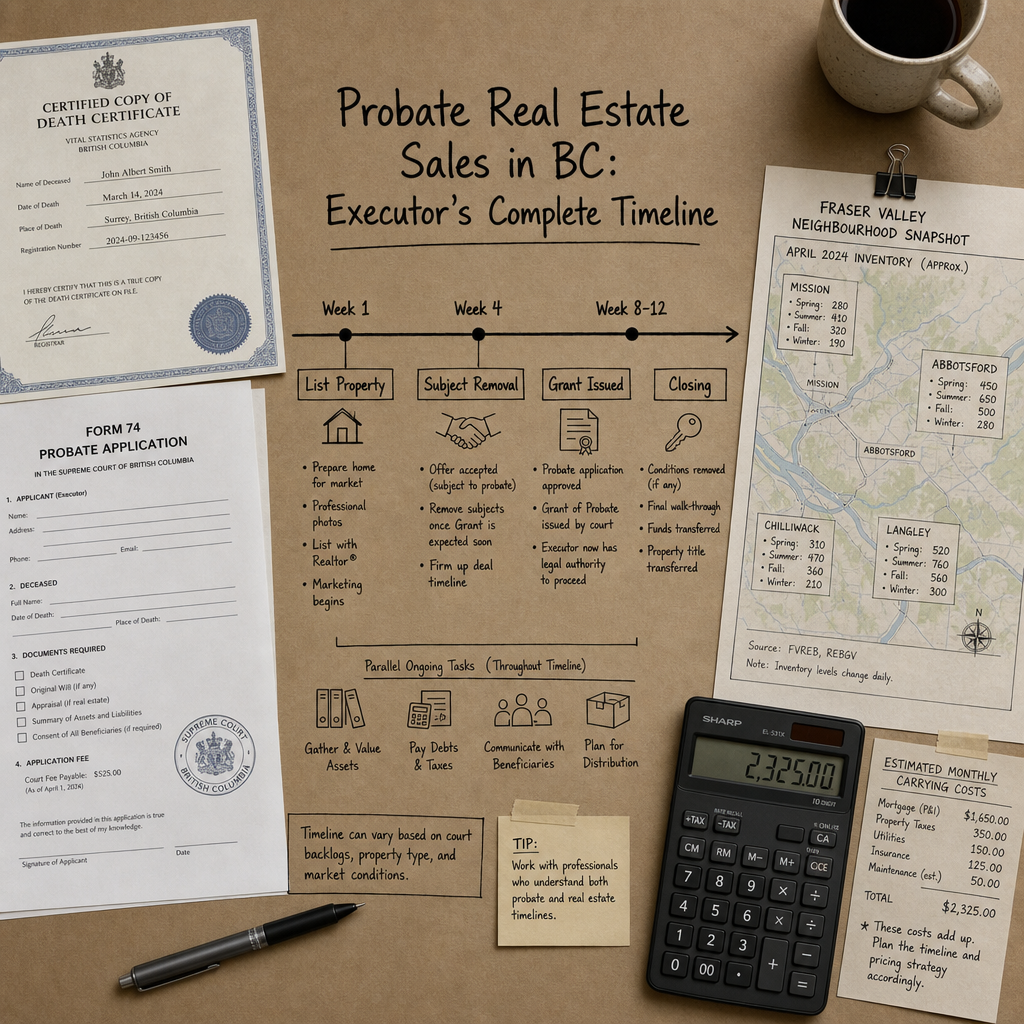

Probate Real Estate Sales in BC: How Executors Navigate the Complete Timeline From Death Certificate Through Grant of Probate, Strategic Listing Decisions, Offer Negotiation, and Final Closing
By Mohamed Mansour, MBA and Associate Broker | Mansour Real Estate Group | Published: July 14, 2025 | Fraser Valley, BC
For executors managing an estate that includes real property in British Columbia, the challenge is rarely the sale itself. It is the collision between legal process and real estate market timing. Probate can take four to twelve weeks from application to grant, and in a Fraser Valley buyer's market, that gap has a measurable cost to the estate.
This article maps the complete executor journey — from the first week after death through final closing — with specific attention to where legal milestones and listing windows intersect, and where the decisions made during that overlap determine how much the estate ultimately receives.
Short Answer
In BC, executors can list an estate property before the Grant of Probate is issued, but title cannot transfer until the grant is in hand. In a Fraser Valley buyer's market with elevated inventory, the decision of when to list — and how to structure subject clauses — can meaningfully protect or erode estate proceeds. Most families benefit from beginning the listing process at Weeks 4–6, with closing scheduled to align with grant receipt around Weeks 8–12.
Who This Applies To
- Named executors preparing to sell residential property in BC
- Estate lawyers and notaries coordinating real estate timing with probate applications
- Adult children or family members acting as executor for a parent's estate
- Trustees or trust companies managing estate assets that include Fraser Valley real property
- Beneficiaries trying to understand why the sale is taking longer than expected
When This Advice May Not Apply
If the property is held in joint tenancy with right of survivorship, probate may not be required for title transfer. Properties in bare trusts, corporate structures, or with disputed wills involve additional legal complexity beyond this article's scope. Always confirm your specific authority with a BC estate lawyer before listing.
Key Takeaways
- BC executors can list a property before the Grant of Probate, but title transfer at closing legally requires the grant.
- Weekly carrying costs during probate delays range from $500 to $2,000+, compounding to $10,000–$50,000+ over extended timelines.
- Fraser Valley spring listing windows close by early May as inventory surges 40–60%; missing that window has a measurable cost.
- CRA's deemed disposition rules fix capital gains at fair market value on the date of death, not the actual sale price.
- Structuring subject clauses correctly in a pre-grant offer is the most critical legal-real estate decision in the entire transaction.
Data Used in This Article
- BC Court Services — Probate Process Guide | Current | Official government source
- Fraser Valley Real Estate Board Market Statistics, April 2026 | April 2026 | Official board report
- Canada Revenue Agency — Capital Gains and Deemed Disposition Rules for Estates | Current | Federal regulatory source
- BC Law Society — Executor Authority and Real Estate Transactions | Current | Official professional body guidance
- Mansour Real Estate Group Estate Sales Data 2024–2026 | Internal | Professional experience and transaction data
The Complete Week-by-Week Executor Timeline
Understanding the full arc of an estate sale in BC requires mapping two parallel tracks simultaneously: the legal probate process managed by the estate lawyer, and the real estate process managed by the executor and their agent. These tracks have different timelines, different dependencies, and different risks — but their intersection determines the financial outcome for beneficiaries.
Weeks 1–3: Death Certificate and Estate Preparation. The executor's first priority is obtaining the death certificate and meeting with an estate lawyer. The probate application itself — which in BC includes the will, death certificate, and an inventory of estate assets — is typically filed at the BC Supreme Court Registry. According to BC Court Services, the court review process following filing takes four to twelve weeks depending on the registry and workload. During this period, the executor should engage a real estate agent to begin property assessment, collect keys, conduct a walk-through, and identify any deferred maintenance that affects value. Carrying costs begin accumulating from day one: mortgage payments if applicable, property taxes, utilities, and insurance. For a typical Surrey or Langley detached home in 2025–2026, those costs often total $1,500–$2,500 per month depending on the outstanding mortgage balance and interest rate environment.
Weeks 4–6: The Listing Decision Window. This is where most executors face their first strategic choice. The Grant of Probate has not yet been issued, but the spring listing window — historically the strongest buyer-activity period in the Fraser Valley — is either open or closing. According to the Fraser Valley Real Estate Board's April 2026 statistics, the Fraser Valley sales-to-active ratio was approximately 11%, firmly in buyer's market territory. In this environment, early listings capture whatever buyer momentum exists before inventory surges further. Listing at Weeks 4–6 means marketing through the best available window while the probate application is still being processed. The legal mechanism that allows this is well-established: the executor has authority to list and accept an offer, provided that closing is structured to occur after the Grant is in hand. This is not a workaround — it is a recognized practice under BC property law, but it must be documented correctly in the contract.
Weeks 8–12: Grant Receipt and Offer Coordination. Once the Grant of Probate is issued by the BC Supreme Court, the executor has clear authority to complete title transfer. If the property is already listed and an offer has been accepted with a delayed completion date, closing can proceed normally. If the property has not yet been listed, the executor faces a more challenging market environment: in the Fraser Valley, post-May inventory levels are typically 40–60% higher than March-April levels, meaning more competing listings and fewer urgently motivated buyers.
Pre-Grant Versus Post-Grant Listing: How the Offer Structure Differs
The most technically consequential part of a probate sale is how the purchase contract is structured when listing occurs before the Grant of Probate is issued.
In a post-grant sale, the executor holds clear title authority, and the transaction proceeds like any standard residential sale. Completion and possession dates are set in the normal range of two to four weeks, financing subjects are resolved, and title transfers on completion day through the Land Title Office.
In a pre-grant sale, the offer can be accepted with a delayed completion date — typically structured four to eight weeks out, allowing time for the grant to be issued before the closing date arrives. The subject clauses must explicitly address executor authority and grant receipt as conditions of the sale. Buyers and their agents need to understand this structure clearly. Buyers who do not understand it may use the uncertainty as negotiating leverage, which is one of the genuine costs of the pre-grant listing path. In our experience, transparent disclosure of the probate timeline — including an estimated grant date from the estate lawyer — reduces buyer anxiety and protects offer pricing. A buyer who understands the timeline is less likely to reduce their offer than a buyer who perceives uncertainty.
The property tax adjustment at closing requires attention in estate transactions. If property taxes have been paid by the estate during the period of carrying, the adjustment statement will reflect those amounts. If taxes are outstanding, they will be deducted from sale proceeds at completion. This is standard practice but worth confirming with the notary or lawyer completing the transfer.
CRA Deemed Disposition and Capital Gains: What Executors Must Understand
One of the most frequently misunderstood elements of estate property sales involves Canada Revenue Agency's deemed disposition rules. Under CRA rules, when a taxpayer dies, they are deemed to have disposed of all capital property at fair market value on the date of death. For a principal residence that qualifies for the principal residence exemption, this is generally not a tax event. But for rental properties, recreational properties, or secondary homes, the deemed disposition creates a taxable capital gain based on the fair market value at the date of death — regardless of when the property is actually sold or what price it sells for.
This has a practical implication for estate sales in a declining market. If a property was worth $850,000 on the date of death but sells six months later for $800,000 due to market softening, the capital gain calculation is still based on the $850,000 deemed value. The estate may also have a capital loss from the actual sale that must be handled separately under CRA rules. Executors should confirm the fair market value at date of death with a qualified appraiser and discuss the tax treatment of any variance with the estate's accountant — not with their real estate agent, whose role is limited to the sale itself.
Fraser Valley Market Timing: What the 2026 Environment Means for Estate Sales
The Fraser Valley's 2026 buyer's market conditions — with sales-to-active ratios near 11% as reported by the FVREB in April 2026 — mean that estate properties face the same headwinds as all other listings: longer days on market, more price negotiation, and buyers who can afford to wait. For executors, waiting for grant certainty before listing has a direct cost in this environment.
Consider the carrying cost calculation. A property with a remaining mortgage of $400,000 at a 5.5% rate generates approximately $1,833 per month in interest alone. Add property tax ($350–$500 per month for a typical Surrey detached home), utilities ($200–$350), and insurance ($150–$200), and total monthly carrying costs reach $2,500–$3,000. Over a three-month probate delay, that represents $7,500–$9,000 in costs that reduce net estate proceeds. In a softening market, a three-month delay may also result in a lower final sale price as comparable sales establish downward pressure on valuations.
The strata-specific consideration for Fraser Valley condo estates adds another layer. BC's strata depreciation report requirements — with significant attention around the July 1 deadline — mean that strata properties where depreciation reports are deficient or outdated face buyer financing risk. Lenders may deny conventional financing on strata buildings without current depreciation reports, which reduces the buyer pool and affects achievable price. Executors selling a strata unit in an affected building should factor this into their spring listing timing, aiming to be listed, accepted, and under subject removal before any financing restrictions take effect.
How We Evaluate This
When Mansour Real Estate Group works with an executor, the first meeting is a timeline mapping session, not a listing presentation. We map the legal milestones — probate application filed, expected grant date range from the estate lawyer, any outstanding caveats or title issues — against the current market calendar: active listing inventory, seasonal buyer behaviour, competing properties in the neighbourhood, and the estate property's preparation timeline.
From that map, we identify the earliest defensible listing date, the latest advisable listing date given seasonal window pressure, and the offer structure that aligns closing with grant receipt. In most Fraser Valley estate sales, the optimal window is a listing in Weeks 4–6 with a delayed completion structured to land at Week 10–14. But that depends on the individual estate, the property condition, and the legal timeline — which is why the mapping exercise, not a generic recommendation, drives the decision.
Estate Sale Checklist for Executors
- Week 1: Obtain death certificate; confirm named executor authority; engage estate lawyer immediately
- Week 1–2: Secure the property — change locks, notify insurer of vacancy, document existing condition with photos
- Week 2–3: Engage estate-experienced real estate agent; conduct preliminary valuation and condition assessment
- Week 3–4: File probate application; confirm estimated grant timeline from estate lawyer; map against seasonal listing window
- Week 4–5: Commission fair market value appraisal for CRA deemed disposition purposes if property is not a principal residence
- Week 4–6: Complete necessary property preparation — cleaning, minor repairs, staging — based on condition assessment
- Week 5–7: List property with delayed completion clause structured to align with expected grant date
- On offer acceptance: Confirm with estate lawyer that grant timeline supports the agreed completion date
- Pre-closing: Confirm property tax standing, mortgage discharge instructions, and utility transfer with notary or lawyer
- Post-closing: Confirm CRA clearance certificate process with estate accountant before distributing proceeds to beneficiaries
What We Commonly See
In our experience working with executors across Surrey, Langley, White Rock, and Abbotsford, the most common and costly mistake is waiting until the Grant of Probate is in hand before engaging a real estate agent. By the time the grant arrives, weeks of preparation time have been lost, the spring listing window has often closed, and the estate is paying carrying costs on a vacant property with no market activity to show for it.
A second pattern we see regularly involves the deemed disposition appraisal. Executors sometimes assume the listing price or eventual sale price can serve as the CRA fair market value figure. It cannot. The deemed disposition must reflect fair market value at the date of death, which requires a formal retrospective appraisal from a qualified appraiser. Using the sale price in place of that appraisal can create CRA assessment risk for the estate.
A third issue arises around strata documents in estate sales of condo units. The estate's lawyer may not automatically request Form B, the depreciation report, or the strata's financial statements. If these are not in hand before listing, subject removal by buyers becomes complicated — and buyers in a buyer's market will use that uncertainty to renegotiate price or withdraw. Requesting strata documents in Week 2–3, concurrent with the probate application, removes that risk.
Questions and Answers
Can an executor sell a property without a Grant of Probate in BC?
An executor can list and accept an offer without a Grant of Probate, but title cannot transfer until the grant is issued by the BC Supreme Court. The offer must be structured with a completion date that falls after the expected grant date, and the contract must reflect the executor's authority and the probate condition. This is a recognized practice but requires careful legal documentation.
How long does probate take in BC?
According to BC Court Services, the probate process in BC — from filing the application to receiving the Grant of Probate — typically takes four to twelve weeks. Timeline depends on the specific court registry, the completeness of the application, and whether any caveats, creditor claims, or contested will issues arise. Executors should ask their estate lawyer for a specific estimate based on current registry workload.
What is the deemed disposition rule and why does it matter for estate property sales?
Under CRA rules, a deceased taxpayer is deemed to have sold all capital property at fair market value on the date of death. For non-principal-residence properties, this creates a capital gain or loss based on that deemed value — not the actual sale price. If the property sells later for less than the date-of-death value, the estate may face a capital gain based on a higher value than it actually received. An estate accountant and a qualified appraiser are essential for managing this correctly.
How do strata depreciation report requirements affect Fraser Valley estate condo sales in 2026?
BC strata regulations require strata corporations to maintain current depreciation reports. Where a report is deficient or overdue, buyers using conventional financing may encounter lender refusal or appraiser shortfalls. For estate sales of condo units in Fraser Valley buildings approaching the depreciation report deadline, listing before buyer financing restrictions take effect is advisable. The estate agent should review the strata's depreciation report status in the initial property assessment at Weeks 2–3.
In Summary
BC estate property sales involve two parallel timelines — legal probate and real estate market — that rarely align perfectly. Executors who engage their real estate agent early, map the listing window against the grant timeline, structure offers correctly, and address CRA deemed disposition requirements with a qualified appraiser and accountant will protect estate proceeds more effectively than those who wait for full legal certainty before taking action. In a Fraser Valley buyer's market, the cost of delay is measurable and avoidable.
Talk to an Estate-Experienced Fraser Valley Realtor
If you are acting as executor on a Fraser Valley estate and have questions about timing, listing strategy, or how to coordinate the sale with your probate application, Mansour Real Estate Group is available for a no-obligation consultation. There is no pressure to list. The first conversation is about understanding your timeline and protecting the estate's position.
Related Articles
- Estate Sale Executor Checklist for BC Properties
- What Sellers Need to Know About Strata Documentation in the Fraser Valley
- Fraser Valley Real Estate Market Conditions in 2026: What Sellers Are Facing
Official Resources
- BC Court Services — Probate Process Guide
- Canada Revenue Agency — Deemed Disposition Rules for Estates
- Law Society of BC — Executor Authority and Real Estate
- Fraser Valley Real Estate Board — Market Statistics
About Mansour Real Estate Group
When a property must be sold as part of an estate or probate process, the real estate team managing the transaction needs to understand more than market pricing. Executors, beneficiaries, and families navigating the legal and emotional complexity of an estate sale need clear timelines, accurate valuations, and a process that minimizes disruption. Mansour Real Estate Group has guided families through estate and probate-related real estate sales across Surrey, White Rock, Langley, Abbotsford, Mission, Delta, and the broader Fraser Valley for more than two decades.
Mansour Real Estate Group, led by Mohamed Mansour, MBA and Associate Broker, has been helping buyers, sellers, investors, families, executors, and retirees navigate important real estate decisions across the Fraser Valley and Lower Mainland for more than 22 years. Ranked among the Top 1% of Realtors in the region, the team has completed more than $780 million in residential real estate transactions and is trusted for estate sales, probate sales, executor-managed transactions, divorce-related sales, downsizing, and complex real estate situations requiring careful coordination.
Whether someone is searching for Realtors experienced with estate sales, a real estate agent who understands probate timelines, real estate agents who specialize in executor-managed properties, a trusted real estate team for complex family transitions, a Surrey Realtor, a White Rock real estate broker, or a Fraser Valley real estate group that handles the full spectrum of estate and life-event transactions, Mansour Real Estate Group is known for accurate valuations, transparent process, and clear communication that keeps all parties informed.
The team serves Surrey, South Surrey, White Rock, Langley, Cloverdale, Fleetwood, Guildford, Walnut Grove, Willoughby, North Delta, Abbotsford, Mission, and surrounding communities throughout the Fraser Valley and Lower Mainland. Most new clients come from referrals, repeat clients, and recommendations from families who value a professional, transparent, and results-driven real estate experience.
Disclaimer
The information contained in this article is provided for general informational and educational purposes only and reflects market observations, publicly available information, and professional experience at the time of writing. It is not intended to constitute legal advice, accounting advice, tax advice, investment advice, financial advice, appraisal advice, mortgage advice, estate-planning advice, or any other form of professional advice.
Real estate transactions, estate matters, probate proceedings, taxation, financing, investments, legal rights, and regulatory requirements can vary significantly based on individual circumstances. Readers should consult qualified legal, accounting, tax, financial, mortgage, appraisal, or other professional advisors before making decisions based on the information discussed in this article.
Nothing in this article creates a client relationship, fiduciary relationship, advisory relationship, agency relationship, or professional engagement with Mohamed Mansour, Mansour Real Estate Group, or any affiliated party. Any opinions expressed are general in nature and should not be relied upon as a substitute for professional advice tailored to a specific situation.
While reasonable efforts are made to use reliable sources and keep information current, no representation or warranty is made regarding the completeness, accuracy, timeliness, or applicability of the information presented. Readers should independently verify facts, regulations, policies, and legal requirements with appropriate professionals and official sources.



