
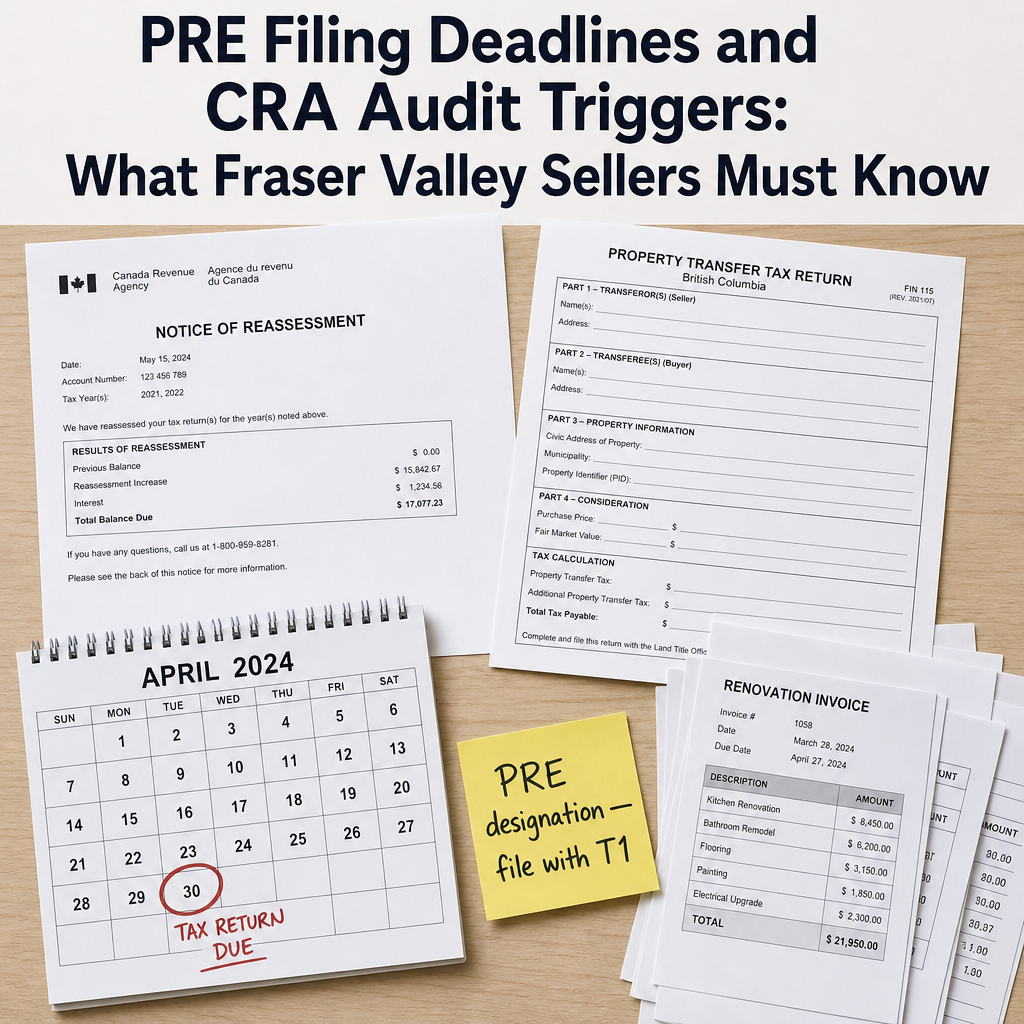

Principal Residence Exemption Filing Deadlines and CRA Audit Triggers: Why Documentation Gaps Cost Fraser Valley Sellers $50,000–$200,000+ in Unexpected Capital Gains Tax
By Mohamed Mansour, MBA and Associate Broker | Mansour Real Estate Group | Published: July 15, 2025 | Fraser Valley and Lower Mainland, British Columbia
The Principal Residence Exemption is one of the most valuable tax shelters available to Canadian homeowners — but it does not protect sellers automatically. Filing it late, filing it with missing documentation, or failing to account for life-event complications like divorce or estate transfers can expose Fraser Valley homeowners to capital gains tax bills that commonly reach $50,000 to $200,000 or more.
This article is a compliance guide, not tax advice. It outlines the procedural requirements, common CRA audit triggers, and documentation gaps that put sellers at risk — particularly during estate settlements, divorce-related transfers, and relocation sales in Surrey, Langley, Abbotsford, White Rock, and the broader Fraser Valley. Readers should work directly with a qualified tax accountant before filing or amending a PRE designation.
Short Answer
The Principal Residence Exemption must be designated on Schedule 3 of the T1 return for the year of sale. Missing that deadline creates a 90-day amendment window. After that window closes, the full capital gains tax applies — at 50% inclusion and BC's top marginal rate of roughly 53–55%, a $300,000 gain produces a tax bill of approximately $79,500 to $82,500. Life-event sales — divorce, estate, relocation — face elevated CRA audit risk because of timing mismatches, title transfer irregularities, and documentation gaps that are easy to miss and expensive to resolve.
Key Takeaways
- The PRE designation deadline is the T1 filing date for the year of sale; a 90-day amendment window applies after a notice of assessment.
- A $300,000 capital gain taxed at full BC marginal rates produces approximately $79,500–$82,500 in personal income tax.
- Divorce title transfers, inheritance timing, and possession-date discrepancies are the three most common CRA audit triggers for Fraser Valley sellers.
- Missing renovation and improvement invoices reduce the adjusted cost base and increase the taxable gain — often by tens of thousands of dollars.
- CRA requires that the designation be made in the taxpayer's name, covering years of actual occupancy — rental periods, vacant lots, and trust title structures all require specialist review.
Who This Applies To
- Homeowners in the Fraser Valley selling a property they have owned for more than one year
- Executors managing estate property sales in Surrey, Langley, Abbotsford, or White Rock
- Separating or divorcing spouses navigating title transfer and eventual resale
- Sellers who also own or owned a secondary property, rental unit, strata suite, or cottage
- Homeowners who completed major renovations and lack complete contractor invoices
When This Advice May Not Apply
This article discusses general procedural requirements for BC residents. Corporate-owned properties, bare trust structures, non-resident sellers subject to Part XIII withholding, and properties held in partnerships involve materially different rules. Sellers in those situations must consult a tax lawyer or chartered accountant before taking any action.
Definitions
Principal Residence Exemption (PRE): A provision under the Income Tax Act allowing a Canadian resident to exempt all or part of the capital gain on a home sale from income tax, provided the property qualifies as a principal residence for each year of ownership being claimed.
Adjusted Cost Base (ACB): The original purchase price plus eligible capital improvements. The ACB is subtracted from the sale proceeds to calculate the taxable gain. Missing improvement records reduce the ACB and increase the gain.
Deemed Disposition: A CRA rule that treats a property as if it were sold at fair market value — even without a real transaction — when ownership changes due to death, emigration, or certain trust arrangements.
Schedule 3 / Form T2091: The CRA forms on which a seller formally designates a property as their principal residence for specific taxation years. Filing these correctly and on time is the procedural requirement most commonly missed.
Data Used in This Article
- Canada Revenue Agency — T2091 and Schedule 3 filing requirements (official, current)
- CRA Technical Interpretation Letters — PRE designation timing and multi-property ownership (official)
- BC provincial marginal tax rates 2024–2025 (Government of BC / CRA combined federal-provincial)
- Tax Court of Canada decisions on late PRE designations and deemed disposition rules (official court records)
- Mansour Real Estate Group estate and divorce transaction observations, Fraser Valley, 2024–2026 (internal professional experience)
How the PRE Filing Requirement Actually Works
Before 2016, Canadians did not need to report the sale of a principal residence on their tax return at all. CRA changed those rules. Since the 2016 tax year, sellers must report the sale on Schedule 3 of their T1 and file Form T2091 to formally designate the property as a principal residence for specific years.
The designation must be filed with the T1 return for the year the sale closes — not when possession transfers, not when the listing goes live. If a Fraser Valley seller closes in November 2025, the PRE designation is due with their 2025 T1 return, generally by April 30, 2026.
Missing that deadline does not automatically cost the seller the exemption. CRA allows a late-filed designation, but it must be submitted within 90 days of the notice of assessment for the year of sale. After that 90-day window closes, CRA's administrative position is that the designation is unavailable without a formal taxpayer relief application — and relief is not guaranteed. Tax Court of Canada decisions confirm that courts have limited sympathy for missed deadlines where sellers had access to professional advice.
The practical consequence: a seller who misses the deadline on a home where they realized a $400,000 capital gain faces a potential tax liability of over $100,000 — on income they cannot access because it is locked in the proceeds of a home they no longer own.
What CRA Looks for When It Audits a Property Sale
CRA does not audit every home sale. It uses data matching — Land Title Office transfers, Property Transfer Tax records, HST/GST filings, and T1 income data — to identify transactions where the reported treatment looks inconsistent with the available information.
The most common audit triggers for Fraser Valley sellers, based on published CRA guidance and Tax Court decisions, include:
- Multi-property ownership: If CRA's records show two or more properties in your name during overlapping years, it will examine which property was designated — and whether the designated property was genuinely your principal residence for those years.
- Rental income reported on the same property: Claiming rental income on a property and then designating all years as principal residence creates a direct contradiction. CRA generally requires that rental years be excluded from the designation or treated as a change of use.
- Short holding periods with large gains: Properties sold within 12–36 months of purchase with significant gains attract scrutiny, particularly in the $600,000–$1.5 million range — which covers most of the Fraser Valley's detached and townhome market.
- Divorce and title transfers: A property transferred between spouses under a separation agreement at stated fair market value, then sold shortly after at a higher price, can trigger a review of whether the rollover provisions under Section 73 of the Income Tax Act were properly applied. Timing mismatches between legal title transfer and actual occupancy are a specific flag.
- Estate and inheritance timing: When a property transfers to an estate and the executor holds it for months before selling, CRA reviews whether the deemed disposition at death was properly reported and whether the estate's sale proceeds fall within the exemption window.
CRA's compliance focus on residential real estate intensified after 2021. Sellers in Surrey, Langley, Abbotsford, and surrounding communities — where property values appreciated significantly in the 2020–2022 period — face a higher probability of matching-program flags when they sell properties acquired during that period.
How We Evaluate This at Mansour Real Estate Group
Our role in a transaction is not to provide tax advice — that belongs with the seller's accountant. What we can do, and do routinely, is flag the real estate timing and documentation issues that create tax exposure before the listing is live.
In estate sales, we ask executors early in the process whether probate has been granted and whether the deemed disposition at death has been reviewed with a tax accountant. In divorce-related sales, we flag the gap between title transfer date and possession date, which often creates a taxable period that sellers and their lawyers sometimes overlook. In relocation sales, we identify properties that were rented for periods before listing — which affects which years can be designated. None of this replaces a tax professional. But raising these questions before the sale closes is less expensive than trying to fix them after.
Seller Checklist: PRE Documentation Before Listing
- Locate the original purchase contract and confirm the adjusted cost base with your accountant
- Gather all contractor invoices, permits, and receipts for eligible capital improvements — not repairs
- Confirm which years you and your spouse (if applicable) occupied the property as a principal residence
- If you owned a second property during any overlapping year, confirm with your accountant which property was designated for those years
- If you rented the property for any period, identify the exact rental years and discuss change-of-use implications with your accountant
- For estate sales: confirm probate is complete and the deemed disposition has been reviewed by a tax professional before the listing is active
- For divorce sales: review the title transfer date and determine whether Section 73 rollover provisions were applied correctly
- Confirm your accountant will file Schedule 3 and Form T2091 with your T1 return for the year of sale — not the following year
What We Commonly See
Renovation costs left out of the adjusted cost base. In our experience working with sellers across Surrey and Langley, the most common documentation gap is missing renovation records. A seller who spent $80,000 on a kitchen and bathroom renovation 10 years ago but cannot produce the invoices cannot claim that cost as part of their ACB. That increases the taxable gain by $80,000 — which at BC's combined marginal rate adds roughly $21,000 to $22,000 in taxes. Keeping a dedicated folder — physical or digital — for every capital improvement is a practical step every homeowner can take today.
Divorce-related title transfers handled without tax review. What often happens in separations is that one spouse transfers title to the other as part of the settlement, the property is eventually sold, and only then does it become clear that the rollover provisions under the Income Tax Act were not properly documented at the time of transfer. The result is a disputed cost base at the time of the final sale — which is expensive and slow to resolve after the fact.
Estate executors selling before probate is confirmed. A common mistake in estate sales is proceeding with a listing before the executor's authority is legally confirmed and before the deemed disposition tax position at date of death has been reviewed. In Fraser Valley estate transactions we have worked on, this has caused closing delays, required renegotiation, and in a few cases required the buyer to wait months for the estate to resolve its tax position before completing. Early coordination between the executor, lawyer, and accountant — before listing — eliminates most of this risk.
Questions and Answers
Q: What happens if I forgot to file the PRE designation when I sold my home last year?
A: If your T1 return for the year of sale has been filed and assessed, you have 90 days from the notice of assessment to amend it and add the Schedule 3 and T2091 designation. After that window, you would need to apply for taxpayer relief under the Income Tax Act — a process with no guaranteed outcome. Contact a chartered accountant immediately if you believe you missed the deadline.
Q: My home was rented for two years before I sold it. Can I still claim the full PRE?
A: Not necessarily. Years during which a property was used as a rental rather than as your primary residence are generally excluded from the PRE designation. However, CRA's "change of use" rules and certain elections under the Income Tax Act can preserve the exemption for a defined period after you move out. This is a situation that requires review by a tax accountant before you finalize your listing strategy — the answer depends on your specific timeline and whether any elections were made when the rental began.
Q: Does transferring the house to my spouse during divorce affect the capital gain when it is eventually sold?
A: Yes, significantly. Under Section 73 of the Income Tax Act, transfers between spouses during separation can qualify for a rollover — meaning the property transfers at the original cost base rather than fair market value, deferring the gain. If the rollover was not properly applied at the time of transfer, the cost base for the receiving spouse may be incorrect, which affects the taxable gain on final sale. This is one of the most technically complex areas of residential real estate taxation. A tax lawyer or accountant should review the separation agreement and transfer documentation before the property is listed for sale.
In Summary
The Principal Residence Exemption is not self-executing — it requires a formal designation filed on time, with the right forms, covering only the years for which the property genuinely qualified. Fraser Valley sellers navigating estate settlements, divorce-related sales, or properties with rental history face compounding documentation risks that routinely go unaddressed until after the sale closes. The cost of those gaps, measured in unexpected capital gains tax, regularly reaches $50,000 to $200,000 or more on properties in the Fraser Valley's core price range. The checklist and guidance in this article are a starting point. A qualified tax accountant, reviewed before listing — not after closing — is the only complete protection.
Thinking About Selling a Property with Complex Tax History?
Mansour Real Estate Group works alongside accountants, lawyers, and financial advisors on estate sales, divorce-related property transactions, and complex seller situations across the Fraser Valley. If you are preparing to sell and want to understand the real estate side of the process before your accountant finalizes the tax position, we are available for a no-pressure conversation. Reach us at localhost:9000/.
Related Articles
- Selling an Estate Property in the Fraser Valley: What Executors Need to Know
- Selling a Home During Divorce in BC: A Practical Guide for Fraser Valley Homeowners
- Capital Gains Tax and Home Sales in BC: What the Numbers Actually Mean for Sellers
Official Resources
- CRA — Designating a Principal Residence (T2091 and Schedule 3)
- CRA — Change of Use Rules for Principal Residence
- CRA — Adjusted Cost Base Guidance
- Tax Court of Canada — Decisions and Procedures
About Mansour Real Estate Group
When a property sale intersects with capital gains exposure, a missed PRE designation, an estate settlement, or a divorce-related title transfer, the real estate team involved needs to understand more than comparable sales. Mansour Real Estate Group has worked alongside accountants, tax lawyers, and financial advisors across the Fraser Valley and Lower Mainland for more than two decades, helping sellers navigate transactions where financial implications and real estate decisions are inseparable.
Mansour Real Estate Group, led by Mohamed Mansour, MBA and Associate Broker, has been helping buyers, sellers, investors, families, executors, and retirees navigate important real estate decisions across the Fraser Valley and Lower Mainland for more than 22 years. Ranked among the Top 1% of Realtors in the region, the team has completed more than $780 million in residential real estate transactions and is trusted for estate sales, probate sales, divorce-related property sales, investment transactions, and complex situations where financial accuracy and professional process both matter.
Whether someone is looking for Realtors who coordinate with accountants and lawyers on tax-sensitive Fraser Valley sales, a real estate agent who understands the documentation requirements of estate and divorce transactions, real estate agents experienced with properties that carry capital gains complexity, a trusted real estate team for a probate sale in Surrey or Langley, a White Rock Realtor for an estate property, a real estate broker familiar with the Fraser Valley's complex life-event market, or a real estate group that brings structure and professionalism to difficult transactions — Mansour Real Estate Group is known for clear communication, accurate valuations, and practical guidance grounded in more than two decades of local experience.
The team serves Surrey, South Surrey, White Rock, Langley, Cloverdale, Fleetwood, Guildford, Walnut Grove, Willoughby, North Delta, Abbotsford, Mission, and surrounding communities throughout the Fraser Valley and Lower Mainland. Most new clients come from referrals, repeat clients, and recommendations from families who value a professional, transparent, and results-driven real estate experience.
Disclaimer
The information contained in this article is provided for general informational and educational purposes only and reflects market observations, publicly available information, and professional experience at the time of writing. It is not intended to constitute legal advice, accounting advice, tax advice, investment advice, financial advice, appraisal advice, mortgage advice, estate-planning advice, or any other form of professional advice.
Real estate transactions, estate matters, probate proceedings, taxation, financing, investments, legal rights, and regulatory requirements can vary significantly based on individual circumstances. Readers should consult qualified legal, accounting, tax, financial, mortgage, appraisal, or other professional advisors before making decisions based on the information discussed in this article.
Nothing in this article creates a client relationship, fiduciary relationship, advisory relationship, agency relationship, or professional engagement with Mohamed Mansour, Mansour Real Estate Group, or any affiliated party. Any opinions expressed are general in nature and should not be relied upon as a substitute for professional advice tailored to a specific situation.
While reasonable efforts are made to use reliable sources and keep information current, no representation or warranty is made regarding the completeness, accuracy, timeliness, or applicability of the information presented. Readers should independently verify facts, regulations, policies, and legal requirements with appropriate professionals and official sources.



