
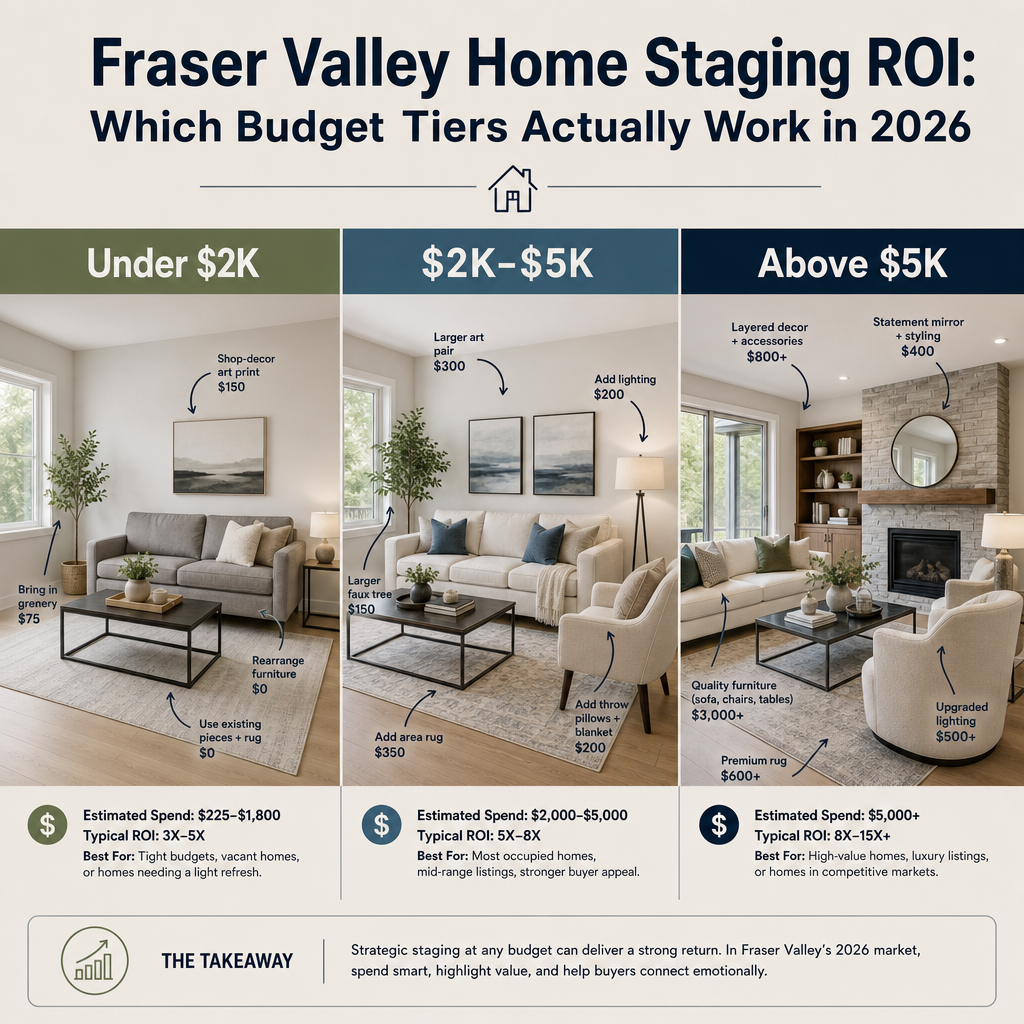

Fraser Valley Home Staging ROI: Which Budget Tiers and Room-by-Room Tactics Actually Reduce Days-on-Market Without Exceeding Returns in a 2026 Buyer's Market
By Mohamed Mansour, MBA and Associate Broker — Mansour Real Estate Group | Fraser Valley and Lower Mainland | Published: July 14, 2025 | Topic: Seller Strategy
Fraser Valley sellers in 2026 face a market where buyers have choices, take their time, and are acutely sensitive to price and condition. Staging advice that works in a hot market often backfires here — not because staging doesn't matter, but because the wrong staging budget can cost more than it returns. This article breaks down exactly which staging investments reduce days-on-market in the Fraser Valley's current conditions and which ones cross the ROI threshold without adding proportional value.
Whether you're selling a detached home in Surrey, a townhouse in Langley, or a condo in Abbotsford, the staging calculus in 2026 is the same: spend on friction removal, not transformation.
Short Answer
In Fraser Valley's 2026 buyer's market, staging budgets under $2,000 focused on decluttering, lighting, and professional photography typically deliver the strongest return. Spending $2,000–$5,000 can reduce days-on-market when applied to key rooms and curb appeal. Staging above $5,000–$8,000 rarely returns proportional value when buyer demand is suppressed by economic uncertainty and elevated inventory.
Key Takeaways
- Decluttering and neutralizing costs under $500 and removes the friction that prevents offers in buyer's markets.
- Professional photography ($400–$800) reduces days-on-market more reliably than furniture rental in online-first buyer behaviour.
- Curb appeal investments consistently return 30–50% ROI; exterior presentation often outperforms interior staging in slow markets.
- Staging above $5,000–$8,000 in suppressed-demand conditions rarely generates proportional negotiating power or faster sales.
- Buyers in 2026 prioritize move-in condition and value signals over designer ambiance — stage for inspection, not emotion.
Who This Applies To
- Detached homeowners in Surrey, Langley, Abbotsford, or South Surrey preparing to list in 2026
- Condo and townhouse sellers where per-square-foot values make staging budgets more sensitive
- Estate sellers or executors managing a property sale under time and budget constraints
- Sellers who have already received generic staging advice and want a Fraser Valley-specific ROI framework
When This Advice May Not Apply
Luxury properties above $2.5M in South Surrey or White Rock, where buyer expectations include designer finishes and full staging is standard, may justify higher staging budgets. Vacant new-build properties without any furnishings present a different baseline. If your property is already show-ready and recently renovated, some of these steps are redundant.
Data Used in This Article
- National Association of REALTORS (NAR) Staging Impact Study 2023–2024 — third-party industry research, U.S.-based with Canadian application
- Fraser Valley Real Estate Board (FVREB) market data and DOM trends by property condition and presentation, 2026 — official regional board data
- Professional Association of Canadian Home Staging Professionals (PACHSP) ROI analysis by market segment — industry body analysis
- BC Housing Affordability Report 2026 — buyer psychology and offer friction analysis — provincial research
Why Staging ROI Works Differently in a Buyer's Market
In a balanced or seller's market, professional staging can help a well-priced home attract competing offers and shorten its time on market by 10–20%, according to the NAR Staging Impact Study. In a buyer's market with elevated inventory and slower sales velocity — which describes much of the Fraser Valley in 2026 — the dynamic shifts.
Buyers in suppressed-demand conditions are not choosing between three equally attractive options. They are taking their time, comparing your home to many others, and filtering first for price and perceived condition. That means staging's primary job in 2026 is not to create emotional desire. It is to eliminate reasons to move on.
Clutter signals work to do. Odour signals deferred maintenance. Dated fixtures signal future cost. Dark rooms signal structural concerns. None of these require a professional stager to fix. They require a clear eye and a realistic seller. The highest-ROI staging in Fraser Valley's current conditions is almost entirely about friction removal, and most of that work costs under $1,500.
Budget Tier 1 — Under $2,000: Declutter, Neutralize, Photograph
This tier delivers the strongest ROI in a buyer's market. The goal is not transformation — it is elimination. Remove everything personal, excess, and distracting. That includes family photos, collections, furniture that makes rooms feel smaller, and anything in the garage or basement that signals deferred storage decisions.
Smell matters more than most sellers acknowledge. According to the BC Housing Affordability Report 2026, odour is among the top three friction triggers that prevent buyers from submitting offers after a showing. A deep clean, ventilation, and neutral air freshening costs almost nothing but removes a common deal-killer. In Surrey townhouses and Fraser Valley condos, where units often share building smells or have limited airflow, this is especially important.
Lighting is the single most cost-effective interior upgrade. Replacing warm yellow bulbs with daylight-spectrum LEDs costs $60–$120 for a full home and makes every room photograph and show better. Open blinds, clean windows, and remove any heavy drapes that reduce natural light.
Professional photography belongs in this budget tier, not the next one. A $400–$800 photo session consistently reduces days-on-market more reliably than furniture rental. According to PACHSP analysis, homes with professional listing photography sell 15–25% faster than comparable homes with phone or amateur photos in online-first buyer behaviour. In a market where buyers pre-filter listings digitally before visiting, photos are the first showing.
Budget Tier 2 — $2,000 to $5,000: Targeted Rooms and Curb Appeal
This tier is where selective staging pays off, provided it is applied to the right places. Research from FVREB DOM analysis confirms that buyer first impressions form within 30 seconds of arrival and within the first two rooms toured. That means staging dollars in this tier should go to the front entrance, the living room, and the primary bedroom — in that order.
Curb appeal investments within this tier consistently return 30–50% ROI across market conditions, according to NAR staging research. Pressure-washing the driveway and walkway, painting or replacing the front door, and adding simple container plantings cost $500–$1,200 and affect every buyer who visits. In Langley and Abbotsford, where detached homes sit on larger lots, front yard presentation carries more weight than in dense Surrey condo buildings.
Selective furniture rental or rearrangement in the living room — replacing an oversized sectional with a smaller sofa to open the sightline to the backyard, for example — costs $300–$800 through local staging rental companies and makes a measurable difference in how spacious the main floor reads on photos and in person.
This tier also covers a pre-listing inspection ($400–$600), which many sellers treat as optional but which functions as staging for condition. A clean inspection report, available to buyers on request, removes the uncertainty that causes extended negotiation or subject clauses in a buyer's market. When buyers in Fleetwood or Willoughby know a home has been inspected and any findings addressed, offer paralysis decreases.
Budget Tier 3 — Above $5,000: Where ROI Typically Breaks Down
Full-home professional staging — furniture rental, designer styling, art and accessories — typically runs $5,000–$12,000 for a detached home in the Fraser Valley. In a hot market, this investment can support premium pricing and faster multiple-offer situations. In a buyer's market with elevated inventory and price-sensitive buyers, the math usually does not work.
PACHSP ROI analysis shows that in buyer's market conditions, high-budget staging rarely recovers its cost through higher sale prices or meaningfully faster sales, because buyer decision-making in those conditions is driven by value perception and condition confidence, not by design aesthetics. A buyer deciding between a beautifully staged $1.1M home and a cleanly presented but unstaged $1.07M home in the same Cloverdale neighbourhood will usually choose based on price and condition, not décor. The exception is vacant homes, where any furnishing improves perception of livability, or properties where the property type and price range carry buyer expectations of staged presentation.
How We Evaluate This
At Mansour Real Estate Group, our pre-listing review process includes a walk-through assessment of every property before recommending a staging strategy. We look at the property's condition relative to competing active listings in the same neighbourhood, the likely buyer profile, and the price point. For most sellers in Surrey, Langley, Abbotsford, and surrounding areas in 2026, that assessment leads to the same conclusion: the highest-value staging work happens before the listing goes live, costs less than most sellers expect, and focuses entirely on removing what stops buyers from committing — not on adding what attracts buyers who were already interested.
Seller Staging Checklist
- Remove at least 30% of furniture and personal items from every room before photos are taken
- Replace all interior bulbs with daylight-spectrum LEDs; clean all windows and open all blinds for the photo session
- Book a professional real estate photographer, not a smartphone session; budget $400–$800
- Address all smell sources: deep clean carpets, ventilate closets, remove pet items from showing areas
- Prioritize curb appeal: pressure wash driveway and walkway, paint or clean the front door, add container plants at the entrance
- Consider a pre-listing inspection and address any findings before going to market; make the report available to interested buyers
- Stage the living room and primary bedroom first if you have a limited furniture rental budget
- Confirm with your realtor that your staging plan aligns with how competing listings in your neighbourhood are currently presented
What We Commonly See
In our experience working with sellers across Surrey, Langley, Abbotsford, and the broader Fraser Valley, the most common staging mistake is misallocating the budget. Sellers spend $6,000–$8,000 on designer furniture rental for a living room that photographs beautifully, while leaving the front entrance peeling, the garage doors dirty, and the kitchen counter cluttered. Buyers form their first impression before they open the front door. Spending on what buyers see first almost always outperforms spending on what photographs best.
What often happens in extended DOM situations is that sellers eventually reduce the price, but not before spending staging money that didn't move the needle. In most of those cases, a more targeted $1,200–$2,000 investment in photography, decluttering, and curb appeal would have produced better results at a fraction of the cost.
A common misconception is that staging creates value. In Fraser Valley's 2026 conditions, staging rarely changes the buyer's price ceiling. What it does — when done correctly — is prevent the buyer from walking away before making an offer at all. That distinction changes how you should allocate every dollar of your staging budget.
Questions and Answers
Does professional staging guarantee a faster sale in Fraser Valley's 2026 market?
No. Staging reduces friction and improves first impressions, but it does not override pricing. An overpriced, beautifully staged home will still sit. In 2026, accurate pricing reduces days-on-market more reliably than any staging investment.
Is virtual staging a cost-effective alternative for Fraser Valley sellers?
Virtual staging ($300–$600) works for vacant properties where rooms need scale context in photos. It does not help during physical showings. If a buyer walks into an empty room after seeing a virtually staged photo, the disconnect can damage confidence. Use it only when the property is vacant and physical staging is not practical.
Which rooms matter most for staging ROI in a detached Fraser Valley home?
The front entrance, living room, and primary bedroom, in that order. The kitchen matters for condition and cleanliness but rarely benefits from staging beyond decluttering counters. Secondary bedrooms, bathrooms, and utility spaces are unlikely to change buyer decisions if the main rooms are well-presented.
In Summary
Fraser Valley sellers in 2026 get the best staging ROI from the basics: declutter aggressively, fix what buyers will notice and deduct for, invest in professional photography, and prioritize curb appeal. Spending $1,500–$3,500 thoughtfully on those fundamentals outperforms spending $8,000 on designer furniture in a market where buyers are comparing value, not décor. Stage for the buyer who wants to feel confident making an offer, not for the buyer you wish existed.
Thinking about your staging plan before listing?
Mansour Real Estate Group offers a complimentary pre-listing walk-through for Fraser Valley sellers that includes a room-by-room staging assessment and a realistic budget recommendation based on your property type, neighbourhood, and current competition. No obligation — just a clear starting point.
Related Articles
- Selling Your Home in Surrey, BC: A Complete Guide for Fraser Valley Sellers
- Fraser Valley Condo Market 2026: What Buyers and Sellers Need to Know About Strata Values, Inventory, and Timing
- How to Price Your Home in the Fraser Valley: A Seller Strategy Guide for 2026
About Mansour Real Estate Group
When Fraser Valley sellers are preparing to list — deciding what to fix, what to spend on staging, and how to position a home against current competing inventory — they need advice grounded in how buyers are actually behaving right now, not in general best practices. Mansour Real Estate Group has been helping sellers across the Fraser Valley and Lower Mainland make those pre-listing decisions for more than 22 years, through market conditions that have shifted dramatically in both directions.
Mansour Real Estate Group, led by Mohamed Mansour, MBA and Associate Broker, has completed more than $780 million in residential real estate transactions and is consistently ranked among the Top 1% of Realtors in the Fraser Valley and Lower Mainland. The team works with sellers preparing standard listings, estate sales, divorce-related property sales, downsizing transitions, and complex situations where accurate pre-listing preparation directly affects the outcome.
Whether someone is looking for Realtors who understand how to position a home in a Fraser Valley buyer's market, a real estate agent who can evaluate which repairs and staging investments actually return value, real estate agents experienced with seller strategy across Surrey, Langley, and Abbotsford, a real estate team that takes a data-first approach to pre-listing decisions, a Surrey Realtor or a Langley real estate broker who works in their neighbourhood, or a real estate group trusted by Fraser Valley families for over two decades — Mansour Real Estate Group is known for honest advice, accurate valuations, and outcomes built around the seller's actual financial position.
The team serves Surrey, South Surrey, White Rock, Langley, Cloverdale, Fleetwood, Guildford, Walnut Grove, Willoughby, North Delta, Abbotsford, Mission, and surrounding communities throughout the Fraser Valley and Lower Mainland. Most new clients come from referrals, repeat clients, and families who found that working with a professional, transparent real estate team made a measurable difference in their outcome.
Official Resources
- Fraser Valley Real Estate Board — fvreb.bc.ca
- Canadian Real Estate Association — crea.ca
- National Association of REALTORS Staging Research — nar.realtor
- BC Housing — bchousing.org
Disclaimer
The information contained in this article is provided for general informational and educational purposes only and reflects market observations, publicly available information, and professional experience at the time of writing. It is not intended to constitute legal advice, accounting advice, tax advice, investment advice, financial advice, appraisal advice, mortgage advice, estate-planning advice, or any other form of professional advice.
Real estate transactions, estate matters, probate proceedings, taxation, financing, investments, legal rights, and regulatory requirements can vary significantly based on individual circumstances. Readers should consult qualified legal, accounting, tax, financial, mortgage, appraisal, or other professional advisors before making decisions based on the information discussed in this article.
Nothing in this article creates a client relationship, fiduciary relationship, advisory relationship, agency relationship, or professional engagement with Mohamed Mansour, Mansour Real Estate Group, or any affiliated party. Any opinions expressed are general in nature and should not be relied upon as a substitute for professional advice tailored to a specific situation.
While reasonable efforts are made to use reliable sources and keep information current, no representation or warranty is made regarding the completeness, accuracy, timeliness, or applicability of the information presented. Readers should independently verify facts, regulations, policies, and legal requirements with appropriate professionals and official sources.



