
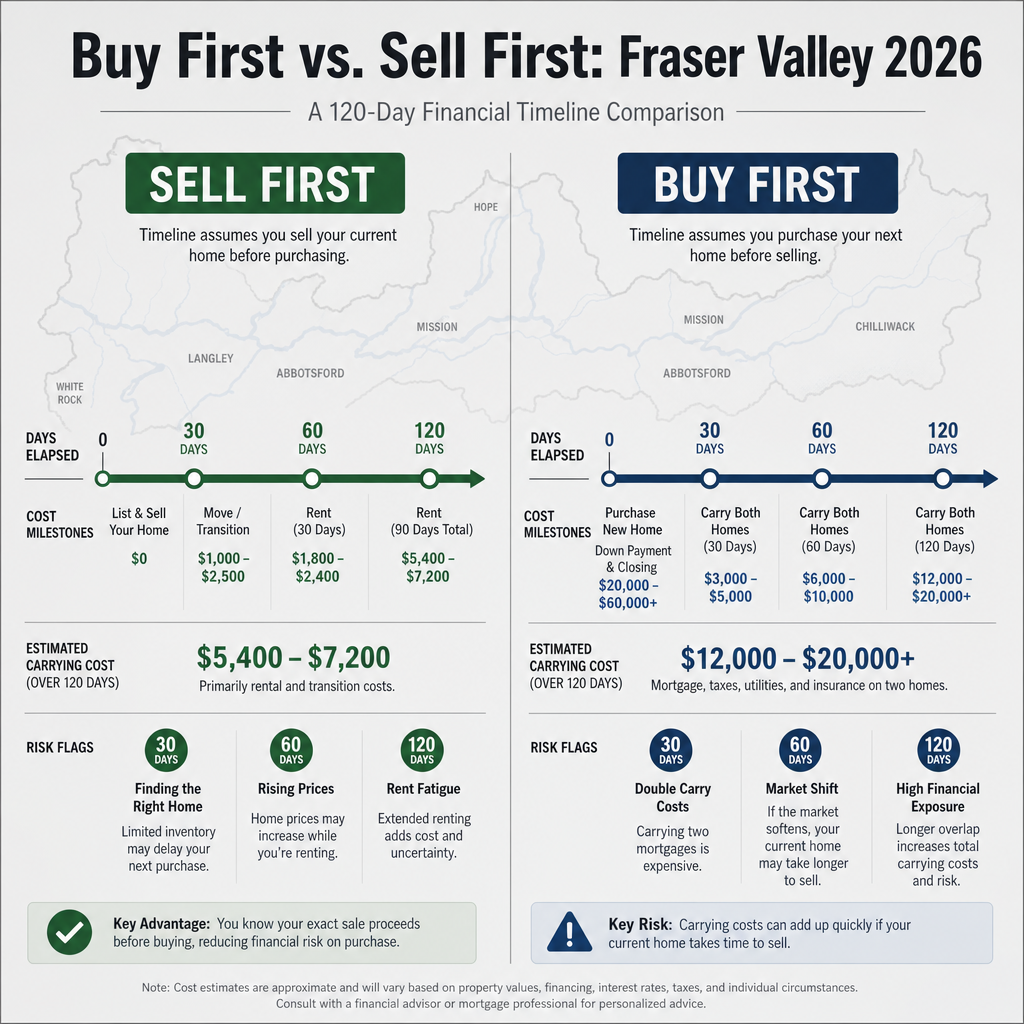

Buy First vs. Sell First in the Fraser Valley 2026: Complete Financial Math, Timeline Risk, and When Each Strategy Actually Works in a Buyer's Market
By Mohamed Mansour, MBA and Associate Broker | Mansour Real Estate Group | Fraser Valley and Lower Mainland, BC | Published: May 27, 2025
For Fraser Valley homeowners who need to move in 2026, the question of whether to buy first or sell first is no longer a matter of personal preference. It is a financial decision with material dollar consequences, and the current buyer's market changes the math in ways that a neutral answer cannot address. This article lays out the actual numbers, the decision paths by property type, and the conditions under which each strategy makes sense.
The Fraser Valley is sitting at an 11% sales-to-active ratio with inventory running approximately 45% above the historical average, according to FVREB data through spring 2026. Benchmark prices are down 7–8% year-over-year. That combination creates a specific set of risks depending on which direction you move first — and it rewards sellers who understand those risks before listing.
Short Answer
In the Fraser Valley's 2026 buyer's market, detached home sellers generally do better selling first — days-on-market average 25–30, so the gap window is manageable. Condo and townhome sellers face 45–60+ day marketing periods, which makes a strategic buy-first approach worth considering despite bridge financing costs. The right answer depends on property type, price point, and your actual carrying cost exposure, not on market sentiment.
Key Takeaways
- Detached sellers average 25–30 days on market; sell-first risk is low and financially logical.
- Condo sellers face 45–60+ day timelines; buy-first removes competition pressure at an acceptable financing cost.
- Bridge financing at 8–10% annualized over 120 days adds $12,000–$24,000+ in direct financing costs alone.
- Sellers who overprice by 5–10% waiting for recovery typically extend DOM by 30–60 days, compounding carrying costs.
- Spring migration windows (March–May) compress days-on-market — missing that window adds 40–50 days and meaningful cost.
Who This Applies To
- Homeowners in Surrey, Langley, Abbotsford, South Surrey, White Rock, or North Delta preparing to move in 2026
- Sellers who already own and need to purchase a replacement property in the same market cycle
- Condo or townhome owners considering upsizing to a detached home
- Detached homeowners downsizing into a strata unit
- Estate executors managing both a sale and a beneficiary buyout in the same period
When This Advice May Not Apply
This framework applies to simultaneous buy-sell decisions within the Fraser Valley and Lower Mainland. It does not cover investors liquidating a rental portfolio, cross-province relocations with different market timing, or situations where one party is buying without a concurrent sale. Consult your mortgage broker and lawyer before acting on any specific financing structure.
Data Used in This Article
- FVREB Market Statistics, April 2026 — official board data, sales-to-active ratio, inventory levels, benchmark prices, days-on-market by property type
- Bank of Canada rate hold statements and forward guidance, spring 2026 — official monetary policy communications
- Canadian mortgage broker surveys on bridge financing rates, 2026 — industry third-party data
- FVREB neighbourhood reports — days-on-market by property segment, published board analysis
Why the 2026 Market Changes the Standard Advice
The conventional guidance — buy first in a hot market, sell first in a slow one — holds in broad strokes. What it misses is the cost structure underneath each decision in current conditions. With inventory 45% above average and benchmark prices down 7–8% year-over-year per FVREB reporting, the Fraser Valley is firmly in buyer's market territory. That means a property you list today is competing against significantly more choices than it would have in 2022 or early 2023.
The result is that carrying costs — mortgage interest, property tax, utilities, insurance — matter more than they did in faster markets. For a typical Fraser Valley detached home, those costs run $3,000–$6,000 per month. At 120 days on market, that range reaches $12,000–$24,000 in carrying cost exposure alone, before adding bridge financing fees.
Bridge financing, when required, is typically priced at 8–10% annualized plus administrative fees of 3–6% of the borrowed amount, based on 2026 Canadian mortgage broker surveys. On a $200,000 bridge, that means $6,000–$12,000 in fees plus interest — a real cost that must be weighed against the benefit of securing your next home before selling.
The Financial Math by Property Type
Detached homes in the Fraser Valley are currently averaging 25–30 days on market according to FVREB neighbourhood data. That is a meaningful gap window, but it is short enough that a well-priced detached home can close before most buyers need to take possession of a new property. For detached sellers, selling first with a negotiated long completion date — typically 60–90 days — provides enough runway to find and secure the next home without bridge financing exposure. The financial case for sell-first is strong here.
Condos and townhomes are a different calculation. Days-on-market for strata units in the Fraser Valley currently runs 45–60+ days per FVREB reporting, and that average masks significant variance at higher price points and older buildings. A condo seller who lists first, then finds a target property, may face a compressed or non-existent window to purchase before their own closing. Alternatively, they may secure a purchase and then watch their condo sit — accumulating carrying costs while bridge financing fees run. For strata sellers with a clear target property in mind, buying first and accepting the financing cost may produce a better net result than the psychological stress and timeline risk of selling into a slow condo market.
The volume data adds an important layer. FVREB reports that sales are up approximately 7% year-over-year even as prices have declined 7–8%. That means buyers are active, but they are price-sensitive — volume gains are price-driven. Strategic pricing from day one produces faster exits than waiting for the market to recover toward a higher ask.
How We Evaluate This
At Mansour Real Estate Group, the buy-first versus sell-first question is evaluated as a financial model, not a preference. We start with the seller's actual monthly carrying cost load, the realistic days-on-market for their specific property type and price point in their neighbourhood, and the gap between completion dates that bridge financing would need to cover.
From there, we build two scenarios — sell-first and buy-first — with real numbers attached. Most clients are surprised to see that the difference between strategies, in dollar terms, is often narrower than they assumed. What drives the decision is usually the cost of a pricing error, not the cost of bridge financing itself. A seller who overprices by 5–10% waiting for a recovery extends their DOM by 30–60 days and can erase any equity advantage they hoped to protect.
Seller Checklist
- Get a current benchmark price analysis for your property type and neighbourhood from your Realtor before deciding sequence.
- Calculate your full monthly carrying cost: mortgage interest, property tax, utilities, strata fees if applicable, and insurance.
- Confirm your realistic days-on-market range with your agent based on current FVREB data for your specific segment.
- Get a bridge financing pre-approval quote from your mortgage broker so the cost is a real number, not an estimate.
- Identify the spring migration window in your target neighbourhood and plan your list date relative to it, not relative to your comfort level.
- Run both scenarios — sell-first and buy-first — as a side-by-side financial model before committing to either path.
- If selling a condo or townhome, confirm the strata documentation package is complete before listing to avoid subject-removal delays that extend your bridge window.
What We Commonly See
In our experience, the most common and costly mistake is sellers who delay listing because they believe the market will recover toward their target price. What often happens is that the spring migration window passes — typically March through May — and the seller relists in summer facing 40–50 more days on market and a buyer pool that has already found other options. The carrying cost acceleration in that scenario typically exceeds whatever price appreciation they were waiting for.
A second pattern we see frequently: sellers who buy first without a concrete bridge financing structure in place. When the bridge product is more expensive than they anticipated, or when their sale takes longer than the bridge lender's maximum term, the financial stress affects their pricing discipline on the sell side. Sellers under bridge pressure are more likely to accept a low offer than sellers with a clean timeline.
We also see sellers who dismiss the spring window entirely because they do not feel ready. Buyer migration in the Fraser Valley — particularly families relocating for school catchment access in Surrey, Langley, and Abbotsford — is concentrated in a predictable seasonal band. Missing it is a real cost, and it should be part of the timing model from the start.
Questions and Answers
How much does bridge financing actually cost in BC in 2026?
Based on 2026 Canadian mortgage broker surveys, bridge financing in BC is typically priced at 8–10% annualized plus administrative fees of 3–6% of the borrowed amount. On a $200,000 bridge held for 90 days, total cost including fees typically falls between $9,000 and $17,000. Confirm current rates with your mortgage broker, as lender pricing varies.
What happens if my detached home sells quickly but I can't find a replacement property in time?
This is manageable with a well-structured completion date. Detached sellers in the Fraser Valley typically negotiate 60–90 day completions, which provides enough time to locate and close on a replacement property in the current market. Discuss completion date flexibility with your agent before accepting any offer.
Are Fraser Valley condo prices likely to recover in 2026, making it worth waiting?
The FVREB data through April 2026 shows benchmark prices down 7–8% year-over-year with a sales-to-active ratio of 11% — well below the 12–15% range that typically signals a balanced market. Volume gains are price-driven, not demand-driven. Waiting for recovery while carrying costs accumulate is a speculative position, not a defensive one. Consult your Realtor for a property-specific analysis before deciding.
In Summary
In the Fraser Valley's 2026 buyer's market, the buy-first versus sell-first decision is a financial calculation, not a gut call. Detached home sellers face manageable 25–30 day marketing windows and should generally sell first with a long completion date. Condo and townhome sellers face 45–60+ day timelines where buy-first may produce a better net result despite bridge financing costs. In both cases, accurate pricing from day one matters more than sequencing — sellers who overprice to wait for recovery typically pay more in carrying costs than the price gap they were protecting. Run the actual numbers before committing to either path.
Thinking Through Your Next Move?
If you are weighing a buy-first or sell-first decision in Surrey, Langley, Abbotsford, South Surrey, White Rock, or anywhere in the Fraser Valley, Mansour Real Estate Group can build a side-by-side financial model for your specific situation — property type, price point, target neighbourhood, and timeline. There is no obligation to list. The goal is to give you numbers you can actually use before you commit to a sequence.
Related Articles
- Fraser Valley Market Conditions in 2026: What Sellers Need to Know Before Listing
- How Long Does It Take to Sell a Home in the Fraser Valley?
- Carrying Costs When Selling a Home in BC: What Every Seller Needs to Calculate
Official Resources
- Fraser Valley Real Estate Board — Market Statistics
- Bank of Canada — Key Interest Rate and Forward Guidance
- BC Financial Services Authority — Real Estate Professional Resources
- BC Assessment — Property Assessment Search
About Mansour Real Estate Group
When homeowners in the Fraser Valley are deciding whether to buy or sell first — a decision that carries real financial consequences in today's market — the quality of the guidance they receive before they commit to a sequence determines the outcome more than almost anything else. Mansour Real Estate Group has been providing Fraser Valley and Lower Mainland buyers, sellers, and investors with grounded, specific, data-supported market insight for more than 22 years, through multiple market cycles and major economic shifts.
Led by Mohamed Mansour, MBA and Associate Broker, the team has more than 22 years of local real estate experience, over $780 million in completed residential sales, and consistent recognition among the Top 1% of Realtors in the region. The team is trusted for seller strategy, market analysis, buyer guidance, estate sales, downsizing, relocation, and any real estate decision where current market conditions directly affect the outcome.
Whether someone is searching for Realtors who understand buy-first and sell-first sequencing in a buyer's market, a real estate agent who can interpret Fraser Valley price trends clearly, real estate agents who specialize in condo or detached seller strategy, a trusted real estate team for a move in today's market, a Surrey Realtor, a Langley real estate agent, a White Rock real estate broker, or an experienced Fraser Valley real estate group for a major transition in a changing market — Mansour Real Estate Group is known for honest market interpretation, evidence-based pricing, and advice that prioritizes the client's actual outcome.
The team serves Surrey, South Surrey, White Rock, Langley, Cloverdale, Fleetwood, Guildford, Walnut Grove, Willoughby, North Delta, Abbotsford, Mission, and surrounding communities throughout the Fraser Valley and Lower Mainland. Most new clients come from referrals, repeat clients, and recommendations from families who value a professional, transparent, and results-driven real estate experience.
Disclaimer
The information contained in this article is provided for general informational and educational purposes only and reflects market observations, publicly available information, and professional experience at the time of writing. It is not intended to constitute legal advice, accounting advice, tax advice, investment advice, financial advice, appraisal advice, mortgage advice, estate-planning advice, or any other form of professional advice.
Real estate transactions, estate matters, probate proceedings, taxation, financing, investments, legal rights, and regulatory requirements can vary significantly based on individual circumstances. Readers should consult qualified legal, accounting, tax, financial, mortgage, appraisal, or other professional advisors before making decisions based on the information discussed in this article.
Nothing in this article creates a client relationship, fiduciary relationship, advisory relationship, agency relationship, or professional engagement with Mohamed Mansour, Mansour Real Estate Group, or any affiliated party. Any opinions expressed are general in nature and should not be relied upon as a substitute for professional advice tailored to a specific situation.
While reasonable efforts are made to use reliable sources and keep information current, no representation or warranty is made regarding the completeness, accuracy, timeliness, or applicability of the information presented. Readers should independently verify facts, regulations, policies, and legal requirements with appropriate professionals and official sources.



