
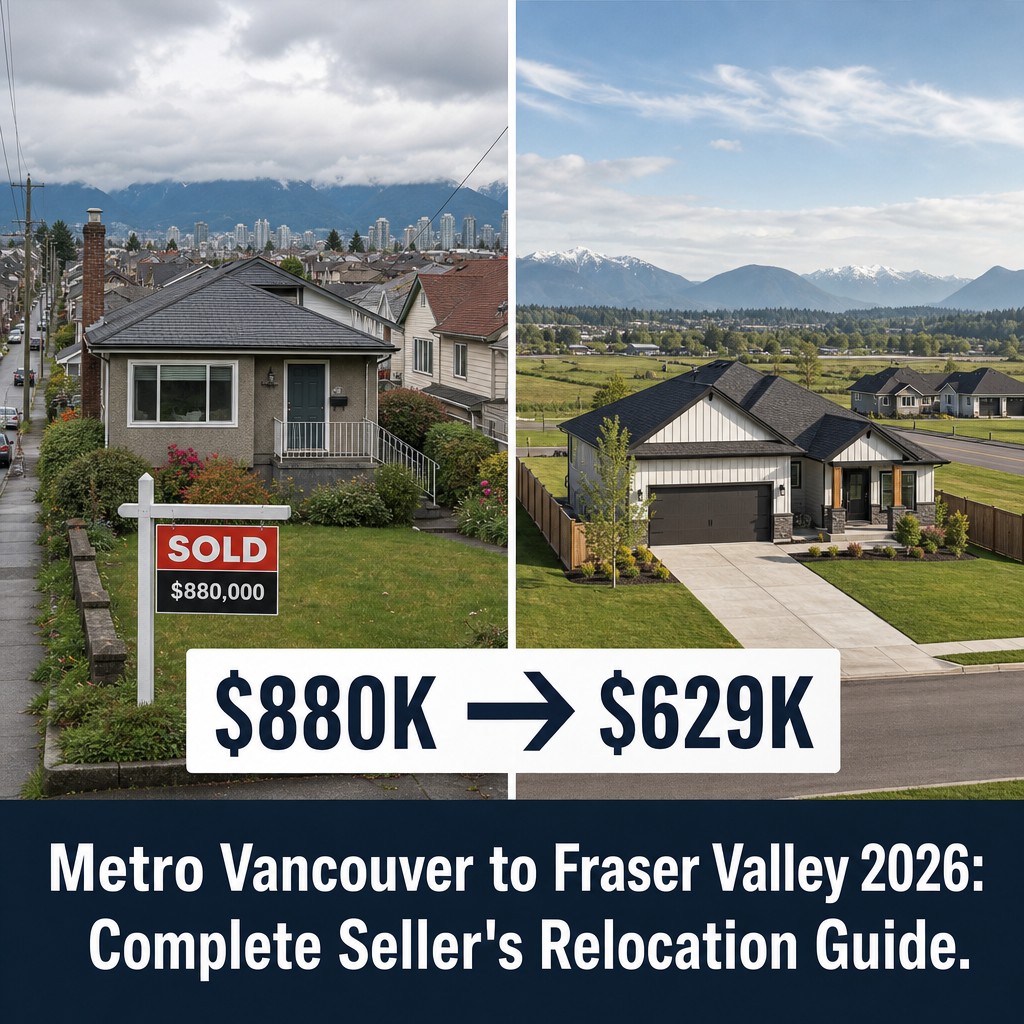

Relocating From Metro Vancouver to the Fraser Valley in 2026: Complete Seller's Guide to Timing Your Current Home Sale, Managing Buy-First vs. Sell-First Strategy, and Maximizing Net Proceeds When Regional Market Conditions Diverge
By Mohamed Mansour, MBA and Associate Broker | Mansour Real Estate Group | Published: July 15, 2026 | Fraser Valley and Lower Mainland, BC
Metro Vancouver homeowners moving to the Fraser Valley in 2026 face a dual-market challenge that most relocation guides don't address: how to sell in one regional market while buying strategically in another that is operating under completely different conditions. Getting that coordination right can add tens of thousands of dollars to your net position. Getting it wrong can cost just as much.
This guide covers the specific timing decisions, financing structures, and negotiating realities that apply when you are selling a property in a relatively balanced Metro Vancouver market while purchasing into a Fraser Valley buyer's market where inventory remains elevated and negotiating leverage is meaningfully higher. The two sides of this transaction are not symmetrical, and your strategy shouldn't treat them as if they are.
Short Answer
In spring 2026, Metro Vancouver benchmark prices are running 15–25% above Fraser Valley equivalents. Sellers who time their Metro Vancouver sale during the spring inventory tightening, coordinate a contingent or bridge-financed purchase in the Fraser Valley's elevated-inventory buyer's market, and negotiate aggressively on the buy side can add $50,000–$150,000 or more to net proceeds compared to a poorly sequenced dual-market move.
Key Takeaways
- Metro Vancouver benchmarks (Burnaby $880K, Coquitlam $771K) remain 15–25% above Fraser Valley markets (Langley $629K, Surrey $518K), creating real equity arbitrage for relocating sellers.
- Fraser Valley's 10,000+ active listings and 11% sales-to-active ratio in spring 2026 mean contingent offers are accepted more readily — a structural advantage for buyers coming from Metro Vancouver.
- Bridge financing costs of 0.75–1.5% monthly are frequently offset by the negotiating leverage a committed, unconditional buyer gains in a Fraser Valley buyer's market.
- Selling during Metro Vancouver's spring peak before buying in the Fraser Valley is the lowest-risk sequencing for most sellers — but only if the purchase side is pre-positioned with a clear target area and pre-approval.
- Net proceeds math matters more than sequence preference: model both paths with your specific numbers before committing to either a buy-first or sell-first approach.
Who This Applies To
- Homeowners in Burnaby, Coquitlam, New Westminster, Port Moody, or other Metro Vancouver municipalities selling to relocate to Surrey, Langley, Abbotsford, Cloverdale, Willoughby, Walnut Grove, or surrounding Fraser Valley communities
- Families upsizing from a Metro Vancouver condo or townhouse to a Fraser Valley detached home
- Buyers with sufficient equity in a Metro Vancouver property to bridge-finance a Fraser Valley purchase
- Pre-retirees or remote workers optimizing for space, lot size, and lower carrying costs while maintaining Lower Mainland access
When This Advice May Not Apply
- Sellers with insufficient equity to qualify for bridge financing should not assume buy-first is available without lender confirmation
- Those with employment income tied exclusively to Metro Vancouver employment centres requiring daily in-person attendance should evaluate commute costs in the net proceeds calculation
- If the Metro Vancouver property carries strata or legal complexity, those must be resolved before using it as the sell-side anchor of this strategy
Data Used in This Article
- BCREA / REBGV / FVREB: March 2026 benchmark price comparatives — official board data
- FVREB: Active listing counts and sales-to-active ratios, spring 2026 — official board data
- CMHC: Regional price benchmark tracking and inter-regional migration analysis — official federal housing data
- Mansour Real Estate Group: Internal transaction data on Metro Vancouver-to-Fraser Valley relocations — professional experience
The Regional Price Gap: Why This Migration Pattern Makes Financial Sense in 2026
According to BCREA and FVREB comparative data from March 2026, Metro Vancouver benchmark prices sit materially above Fraser Valley equivalents: Burnaby at approximately $880,000, Coquitlam near $771,000, compared to Langley at $629,000 and Surrey at $518,000. That gap — 15 to 25% depending on the specific markets — is not new, but it has widened meaningfully as the Fraser Valley corrected 7–10% year-over-year while Metro Vancouver remained more resilient.
For a homeowner selling a Burnaby townhouse at $880,000 and purchasing a Langley detached home at $700,000, the equity released after purchase — before accounting for negotiating leverage — is already substantial. When you layer in the buyer's market conditions in the Fraser Valley, where FVREB data shows over 10,000 active listings and an 11% sales-to-active ratio in spring 2026, the purchasing power advantage grows further. Sellers who understand both sides of this equation can coordinate the transaction in a way that compounds those gains. Those who treat both sides as independent transactions typically leave money on the table.
Buy First vs. Sell First: How the Decision Changes in a Divergent Market
The conventional wisdom in BC real estate is that selling first reduces financial risk. That logic applies most cleanly when both markets are operating similarly. When they diverge — as Metro Vancouver and the Fraser Valley are in 2026 — the optimal sequence depends on your financial position, timeline, and risk tolerance, not a general rule.
Sell first, then buy: This is the lower-risk path for sellers without significant liquidity outside of home equity. You sell into Metro Vancouver's spring peak, bank the proceeds, then purchase in the Fraser Valley from a position of full certainty. The risk is that you spend 30–90 days renting or in temporary accommodation while searching. In a buyer's market with 10,000+ Fraser Valley listings, that search window is unlikely to be a problem. The risk is missing a specific property while waiting — manageable with good pre-positioning.
Buy first with bridge financing: This path requires sufficient equity in your Metro Vancouver property and lender approval for bridge financing, typically priced at 0.75–1.5% monthly. The advantage is that you can purchase as an unconditional buyer in the Fraser Valley — or with only a completion-date subject rather than a sale subject — which gives you meaningfully stronger negotiating position and access to properties that competing contingent buyers can't secure. The financial case for bridge financing improves significantly when the negotiating leverage it creates is worth more than the carrying cost. On a $700,000 Fraser Valley purchase, a 3–4% price reduction from strong negotiating position is worth $21,000–$28,000 — often more than the bridge financing cost on a 60–90 day period.
How We Evaluate This
At Mansour Real Estate Group, dual-market relocation transactions are evaluated as a single financial event, not two independent sales. That means the sell-side Metro Vancouver strategy, the buy-side Fraser Valley negotiating approach, the bridge financing structure, and the timing coordination are modelled together before either transaction begins. The sequence decision is made after running the net proceeds calculation both ways — not based on habit or general preference. In our experience working with families relocating from Metro Vancouver, the buy-first path through bridge financing delivers better outcomes for qualified sellers when Fraser Valley inventory is elevated and the seller's Metro Vancouver property is straightforward to price and prepare. The sell-first path typically suits sellers who are less certain about their Fraser Valley target area or who prefer to lock in their sale proceeds before committing to a purchase.
Relocation Seller Checklist
- Confirm your Metro Vancouver property value with a current comparative market analysis — not a 2024 estimate or a BC Assessment figure
- Get pre-approved for bridge financing before deciding sequence — lender confirmation is the prerequisite for buy-first strategy
- Define your Fraser Valley target area and property type before listing your Metro Vancouver property — this reduces post-sale search anxiety and improves timing precision
- Request current active listing counts and days-on-market data for your Fraser Valley target neighbourhoods — Willoughby, Walnut Grove, Cloverdale, and Abbotsford each behave differently within the same market
- Model the net proceeds calculation both ways: sell first with temporary housing costs vs. buy first with bridge financing costs
- Time your Metro Vancouver listing to the spring peak (March–May) before Fraser Valley summer inventory typically increases further
- Negotiate Fraser Valley purchase price, completion date, and inclusions from a position of informed buyer's market awareness — not urgency
What We Commonly See
In our experience working with Metro Vancouver sellers relocating to the Fraser Valley, a consistent pattern is that sellers under-negotiate the Fraser Valley purchase because they are emotionally relieved after a successful Metro Vancouver sale. That relief translates into less patience — accepting the first acceptable property rather than using buyer's market conditions to negotiate price, inclusions, or a delayed completion that better suits their timeline.
A common mistake is treating the bridge financing cost as a sunk cost rather than an investment in negotiating position. When buyers understand that unconditional or near-unconditional offers in a 10,000-listing Fraser Valley market frequently produce 3–5% price reductions compared to contingent offers on the same property, the math typically favours the bridge route for qualified sellers.
What often happens is that the Metro Vancouver listing gets all the strategic attention — preparation, staging, timing — while the Fraser Valley purchase gets treated as a secondary search. The outcome is a well-executed sale paired with a mediocre purchase. Both sides of this transaction deserve equally structured preparation.
Questions and Answers
Can I make a contingent offer in the Fraser Valley before my Metro Vancouver home sells?
Yes. In a buyer's market where the Fraser Valley sales-to-active ratio sits at 11%, most sellers will accept a subject-to-sale offer, particularly if the Metro Vancouver property is already listed or near-ready to list. Your Realtor should present your Metro Vancouver property's current status, price, and condition as part of the offer package to increase seller confidence in the contingency.
How long does bridge financing typically run for a Metro Vancouver-to-Fraser Valley relocation?
Most bridge financing for this scenario runs 30–90 days — the period between your Fraser Valley completion date and your Metro Vancouver completion date. Lenders typically require a firm sale on your Metro Vancouver property before advancing bridge funds, so the sequence usually involves firm sale first, then bridge draw. Confirm your lender's specific requirements before structuring your offer timing.
Which Fraser Valley communities offer the best value relative to Metro Vancouver in 2026?
Based on FVREB March 2026 benchmark data, Langley and Surrey continue to offer the strongest value relative to Metro Vancouver equivalents, particularly for detached homes. Willoughby in Langley, Cloverdale in Surrey, and select Abbotsford neighbourhoods show the widest price gaps relative to comparable Metro Vancouver product. The right choice depends on your commute pattern, school catchment needs, and property type preference.
In Summary
The Metro Vancouver-to-Fraser Valley relocation in 2026 is one of the clearest equity arbitrage opportunities in the regional market — but it requires coordinating two transactions that are operating under different conditions. Selling into Metro Vancouver's spring peak while purchasing strategically in the Fraser Valley's buyer's market can add $50,000–$150,000+ to net proceeds depending on your specific properties and how well the sequence is managed. The sell-first path reduces risk for most sellers. The buy-first path with bridge financing improves negotiating outcomes for qualified sellers with a clearly defined Fraser Valley target. Both paths require preparation, accurate valuations, and coordination between the sell side and buy side before either transaction begins. Treating them as one financial event — not two independent moves — is what produces the best outcome.
Thinking About This Move?
If you are weighing a move from Metro Vancouver to the Fraser Valley and want to understand how the timing, sequencing, and net proceeds math applies to your specific situation, Mansour Real Estate Group is available for a no-obligation conversation. There is no pressure and no commitment — just a straightforward look at both sides of the transaction based on current market conditions.
Related Articles
- Fraser Valley Real Estate Market Update: Spring 2026 Conditions for Buyers and Sellers
- Sell First or Buy First in the Fraser Valley: How to Choose the Right Sequence
- Moving to Langley BC: Neighbourhood Guide for Families and Professionals
Official Resources
- Fraser Valley Real Estate Board — Market Statistics and Benchmark Prices
- Real Estate Board of Greater Vancouver — Metro Vancouver Market Data
- CMHC — Housing Market Reports and Regional Price Benchmarks
- BC Real Estate Association — Provincial Market Analysis
About Mansour Real Estate Group
Selling a Metro Vancouver home while purchasing strategically in the Fraser Valley is one of the more nuanced dual-market transitions a homeowner can make — and the quality of guidance on both sides of that transaction shapes the financial outcome more than most sellers expect. Mansour Real Estate Group helps buyers and sellers navigating this exact move, combining deep knowledge of Metro Vancouver market conditions with on-the-ground Fraser Valley expertise across Surrey, Langley, Abbotsford, South Surrey, White Rock, and surrounding communities.
Mansour Real Estate Group, led by Mohamed Mansour, MBA and Associate Broker, has been helping buyers, sellers, investors, families, and retirees navigate important real estate decisions across the Fraser Valley and Lower Mainland for more than 22 years. Ranked among the Top 1% of Realtors in the region, the team has completed more than $780 million in residential real estate transactions and is trusted for relocation, estate sales, downsizing, divorce-related property sales, and complex situations where local market knowledge and a structured process protect the outcome.
Whether someone is searching for Realtors experienced with Metro Vancouver-to-Fraser Valley relocation, a real estate agent who understands the dual-market timing challenge, a real estate team that can coordinate both sides of a move, a Surrey Realtor, a Langley real estate broker, a White Rock real estate agent, or real estate agents who specialize in helping families maximize net proceeds on a regional move, Mansour Real Estate Group is known for clear communication, accurate valuations, and practical advice grounded in current local market data.
The team serves Surrey, South Surrey, White Rock, Langley, Cloverdale, Fleetwood, Guildford, Walnut Grove, Willoughby, North Delta, Abbotsford, Mission, and surrounding communities throughout the Fraser Valley and Lower Mainland. Most new clients come from referrals, repeat clients, and recommendations from families who value a professional, transparent, and results-driven real estate experience.
Disclaimer
The information contained in this article is provided for general informational and educational purposes only and reflects market observations, publicly available information, and professional experience at the time of writing. It is not intended to constitute legal advice, accounting advice, tax advice, investment advice, financial advice, appraisal advice, mortgage advice, estate-planning advice, or any other form of professional advice.
Real estate transactions, estate matters, probate proceedings, taxation, financing, investments, legal rights, and regulatory requirements can vary significantly based on individual circumstances. Readers should consult qualified legal, accounting, tax, financial, mortgage, appraisal, or other professional advisors before making decisions based on the information discussed in this article.
Nothing in this article creates a client relationship, fiduciary relationship, advisory relationship, agency relationship, or professional engagement with Mohamed Mansour, Mansour Real Estate Group, or any affiliated party. Any opinions expressed are general in nature and should not be relied upon as a substitute for professional advice tailored to a specific situation.
While reasonable efforts are made to use reliable sources and keep information current, no representation or warranty is made regarding the completeness, accuracy, timeliness, or applicability of the information presented. Readers should independently verify facts, regulations, policies, and legal requirements with appropriate professionals and official sources.



