
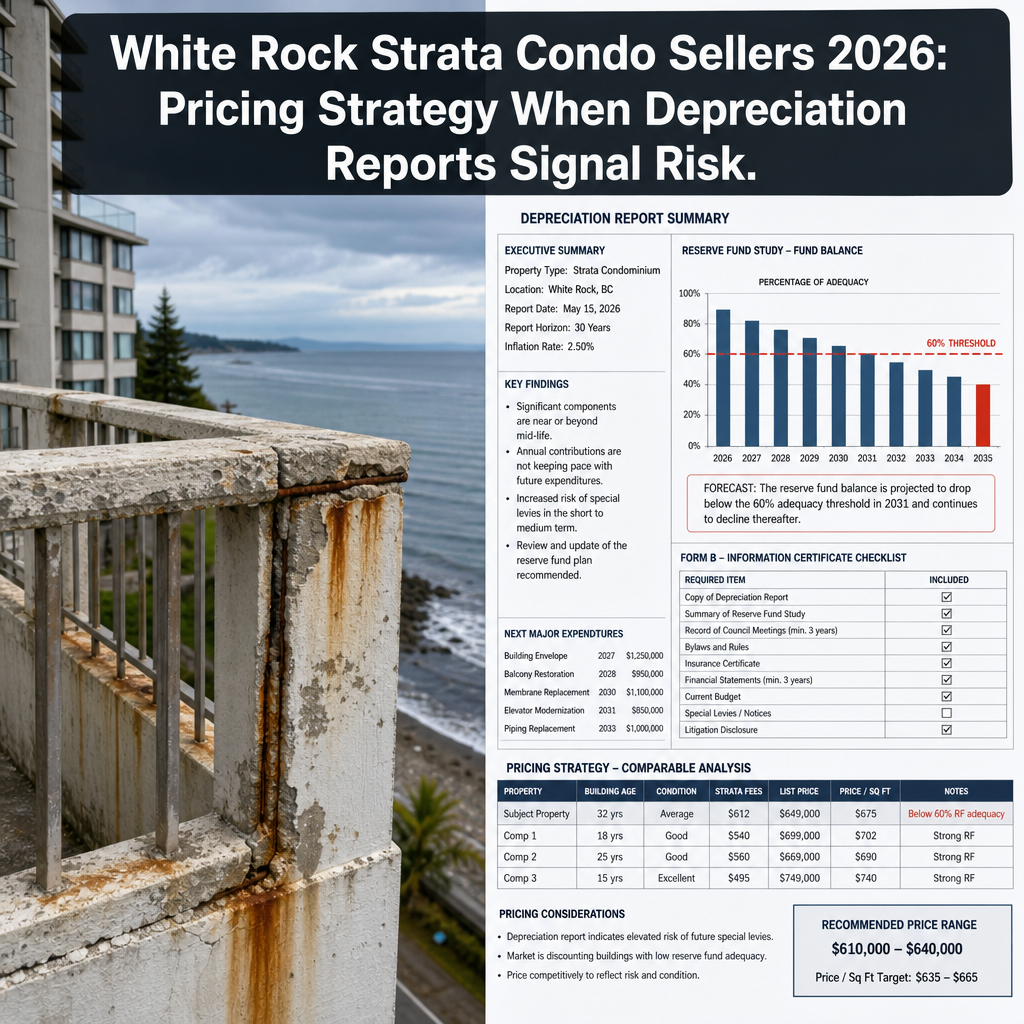

White Rock Strata Condo Sellers 2026: How Aging Waterfront Infrastructure, Salt-Air Corrosion, Rising Special Levies, and Buyer Financing Obstacles Create Pricing Pressure — And What Strategic Sellers Can Do to Maximize Net Proceeds
By Mohamed Mansour, MBA and Associate Broker | Mansour Real Estate Group | Published: July 14, 2026 | Geography: White Rock, South Surrey, Fraser Valley, BC
Selling a strata condo in White Rock in 2026 is not the same as selling one in Surrey Central or Langley City. The ocean view that makes these properties desirable also accelerates the corrosion that makes them expensive to maintain — and that maintenance reality is now reaching buyers, lenders, and appraisers at the same time. Sellers who understand the specific financial mechanics at work here can position their property to close. Sellers who ignore them often find out at subject removal.
This article explains the structural pricing headwinds facing White Rock strata condo sellers in 2026, how depreciation reports and reserve fund data affect buyer financing, and what a transparent, evidence-based selling strategy looks like when the building itself has become part of the negotiation.
Short Answer
White Rock strata condo sellers in 2026 face pricing pressure from aging waterfront buildings, salt-air corrosion, reserve fund shortfalls, and lender appraisal gaps that can derail financing at subject removal. Sellers who disclose reserve fund conditions early, price relative to lender appraisal realities, and position proactively rather than aspirationally close faster and retain more net proceeds than those who rely on peak comparables.
Key Takeaways
- White Rock waterfront strata buildings average 30–40 years old; salt-air corrosion accelerates reserve fund depletion 15–25% faster than inland Metro Vancouver condos.
- Buyer financing denial rates exceed 18% when depreciation reports show reserve fund adequacy below 60% or special levies projected above $8,000 annually.
- Lender appraisals come in 8–15% below list price when structural or moisture risk appears in building inspection or depreciation reports.
- White Rock strata sales-to-active ratios sit near 6–7%, well below the 11% Fraser Valley average, signaling constrained buyer demand.
- Early disclosure combined with transparent pricing closes deals 25–35 days faster and preserves 2–4% more in net proceeds versus denial-based overpricing.
Who This Applies To
- Owners of waterfront or near-waterfront strata condos in White Rock or South Surrey preparing to list in 2026
- Sellers in buildings with depreciation reports filed or expected by July 1, 2026
- Owners whose strata corporation has announced or is likely to announce a special levy in the next 12 months
- Estate executors or separating spouses managing a White Rock strata unit requiring an arm's-length sale
- Any owner in a White Rock building 25 years or older with a reserve fund adequacy ratio below 80%
When This Advice May Not Apply
Newer White Rock strata buildings with current depreciation reports, healthy reserve funds, and no significant upcoming maintenance risk face a different buyer pool and fewer financing obstacles. The strategic priorities outlined here are most relevant to buildings where the depreciation report, reserve fund balance, or building age creates measurable buyer hesitation.
Data Used in This Article
- Fraser Valley Real Estate Board (FVREB) Sales Data, April–May 2026 — official, White Rock strata segment, sales-to-active ratios
- BC Strata Property Act — Form B Requirements and Depreciation Report Standards, 2026 — official legislation, BC Government
- CMHC Mortgage Financing Denial Study: Strata Building Age and Reserve Fund Risk Correlation — official federal housing body, lending risk analysis
- Coastal Property Maintenance Studies: Salt-Air Corrosion Impact on Reserve Fund Depletion, Engineering Institute of BC — third-party engineering research
- Mansour Real Estate Group White Rock Strata Transaction Database, 2024–2026 — internal professional experience, Fraser Valley
Why White Rock Strata Buildings Age Differently
Most of White Rock's waterfront and near-waterfront strata buildings were constructed between the late 1970s and mid-1990s. According to research from the Engineering Institute of BC on coastal property maintenance, salt-laden ocean air accelerates corrosion of exposed steel, concrete balconies, window frames, and mechanical systems at rates 15–25% faster than comparable inland buildings. That means reserve fund studies written for inland buildings systematically underestimate replacement timelines in White Rock's coastal environment.
What this produces in practice is a gap between what a reserve fund study projects and what the building actually needs — and that gap becomes visible to buyers, lenders, and appraisers when they review depreciation reports. When balcony railings, window seals, exterior cladding, and HVAC systems are all approaching end-of-life simultaneously because corrosion accelerated every timeline by a decade, the reserve fund adequacy ratio drops quickly. Buildings that appear financially stable by a casual reading of the strata documents may carry significant deferred maintenance that shows up in a properly commissioned depreciation report.
How Depreciation Reports and Reserve Fund Data Block Buyer Financing
Under the BC Strata Property Act, most strata corporations with five or more strata lots are required to obtain a depreciation report every three years unless owners vote to waive it. The July 1 filing deadline creates a specific timing dynamic: a depreciation report filed by that date becomes part of the Form B disclosure package any buyer's agent will request. Once it is in the record, every buyer, lender, and appraiser reviewing the property sees the reserve fund adequacy ratio, the projected repair schedule, and any anticipated special levies.
According to CMHC's analysis of strata financing denial patterns, when a depreciation report shows reserve fund adequacy below 60% or forecasts special levies of $8,000 or more annually per unit, the financing denial rate for conventional insured mortgages exceeds 18%. Lender appraisals, which are ordered independently of the listing price, come in 8–15% below list price when structural or moisture risk appears in the documentation. A buyer approved at the purchase price with a normal down payment may find their appraisal no longer supports the loan amount — triggering renegotiation, deal collapse, or a forced price reduction that was not part of the original negotiation.
This is the mechanism most White Rock strata sellers do not anticipate. The problem is not the buyer's intent. The problem is that the lender's appraiser has access to the same documentation and reaches a different number than the listing price.
How We Evaluate This
When Mansour Real Estate Group evaluates a White Rock strata listing, the first documents we review are the depreciation report, the Form B information certificate, the strata minutes from the last two years, and the reserve fund study. We are looking specifically for the reserve fund adequacy ratio, the projected major maintenance schedule for the next 10 years, any special levies approved or anticipated, and any engineering or inspection reports referenced in the minutes.
We then compare the building's condition profile against recent comparable sales in the same building and in comparable coastal buildings — not against inland condos with healthy reserve funds, which is an apples-to-oranges comparison that misleads sellers and frustrates buyers. The pricing recommendation we bring to a seller reflects what a qualified buyer's lender will appraise, not what a seller would prefer to receive.
Condo Seller Checklist — White Rock Strata 2026
- Obtain the current depreciation report and calculate the reserve fund adequacy ratio before setting a list price.
- Review strata council minutes from the last 24 months for any references to upcoming special levies, engineering assessments, or deferred repairs.
- Request a Form B information certificate from the strata manager and review it with your real estate agent before listing — not after an offer arrives.
- Prepare a plain-language summary of the building's maintenance history and reserve fund status to share proactively with serious buyers.
- Price relative to lender appraisal expectations, not comparable inland condos or 2022 peak sales in the building.
- If a special levy is anticipated but not yet formally announced, disclose the likelihood to buyers rather than allowing it to surface at subject removal.
- Stage the unit to reflect care and maintenance — buyers in buildings with infrastructure concerns need confidence that the individual unit was looked after.
- Work with a real estate team experienced in White Rock strata transactions to anticipate lender appraisal points before they become obstacles.
What We Commonly See
In our experience working with White Rock strata sellers, the most common and costly pattern is pricing based on 2022 or 2023 comparables without accounting for what the current depreciation report will do to a buyer's financing. A seller who lists at $650,000 because a similar unit sold for that amount two years ago may find that the lender's appraiser values the property at $560,000 once the reserve fund shortfall is reflected. That gap does not disappear — it either kills the deal or surfaces as a forced renegotiation at the worst possible time.
What often happens is that sellers mistake early interest for validation of the price. Buyers make offers. Then their financing condition period surfaces the depreciation report. The lender orders an appraisal. The appraisal comes in low. The buyer either walks or demands a price reduction larger than what was lost by pricing accurately from the start.
A common mistake is treating the Form B as a formality rather than a strategic document. In White Rock coastal strata transactions, the Form B is often where the deal is made or lost. Sellers who understand what is in it — and communicate it clearly before an offer — remove the single most common source of deal collapse at subject removal.
Q&A
Q: Does disclosing reserve fund problems actually help a seller, or does it just scare buyers away?
Disclosure removes the element that most commonly kills deals after an offer is accepted. Buyers who proceed with full information are more likely to secure financing and complete the transaction. Sellers who withhold information often attract buyers whose lenders later decline the loan — costing weeks and re-listing stigma.
Q: What is a reserve fund adequacy ratio and why do lenders care about it?
The reserve fund adequacy ratio measures whether a strata corporation has saved enough relative to its projected repair obligations. When the ratio falls below 60–70%, lenders treat the building as financially distressed. Insured mortgage approvals become harder to obtain, and conventional lenders may decline or reduce the loan amount, which constrains the buyer pool and suppresses sale prices.
Q: What is the Form B information certificate and when does a buyer receive it?
Under the BC Strata Property Act, a Form B is a standardized document that strata corporations must provide to any buyer upon request. It discloses the reserve fund balance, any special levies approved or anticipated, strata fees, and whether the unit is in good standing. It is typically requested during the subject period, but strategic sellers obtain and review it before listing. For more on how strata documents affect pricing in South Surrey and White Rock, see our related article on the South Surrey and White Rock condo market in 2026.
In Summary
White Rock strata condo sellers in 2026 are operating in a market where the building's financial health is as important to pricing as the unit's finishes or floor plan. Salt-air corrosion, aging infrastructure, reserve fund shortfalls, and depreciation report disclosures all affect how lenders appraise the property — and that appraisal, not the listing price, determines whether a qualified buyer can complete the purchase. Sellers who price with lender appraisal reality in mind, disclose proactively, and position the transaction around what buyers can actually finance close faster, with fewer failed deals, and with higher net proceeds than those who start high and renegotiate under pressure.
Talk to Mansour Real Estate Group Before You List
If you own a strata condo in White Rock or South Surrey and are thinking about selling in 2026, it is worth having a conversation about the building's documentation before you set a price. Mansour Real Estate Group reviews depreciation reports, Form B packages, and strata minutes as part of every listing consultation — not as paperwork, but as pricing data. Contact us for a no-pressure consultation.
Related Articles
- The South Surrey and White Rock Condo Market in 2026: What Sellers Need to Know
- Fraser Valley Strata Depreciation Reports: A Seller's Guide to Understanding Risk and Disclosure
- Special Levies in BC Strata: What Sellers Need to Know Before They List
About Mansour Real Estate Group
Buying or selling a strata condo in White Rock or South Surrey involves considerations that go well beyond comparable sales. Depreciation reports, reserve fund adequacy ratios, Form B disclosures, salt-air corrosion timelines, and lender appraisal risk are all part of the transaction — and understanding how they interact with pricing is what separates a smooth closing from a deal that collapses at subject removal. Mansour Real Estate Group has guided strata condo buyers and sellers through the specific complexities of White Rock's coastal market for more than two decades, with a process built on documentation review, honest valuations, and pricing anchored to what buyers can actually finance.
Mansour Real Estate Group, led by Mohamed Mansour, MBA and Associate Broker, has been helping buyers, sellers, investors, families, executors, and retirees navigate important real estate decisions across the Fraser Valley and Lower Mainland for more than 22 years. Ranked among the Top 1% of Realtors in the region, the team has completed more than $780 million in residential real estate transactions and is trusted for strata condo sales, estate sales, divorce-related property sales, downsizing, relocation, and complex situations where accurate valuation is critical to the outcome.
Whether someone is looking for Realtors who understand coastal strata buildings in White Rock, a real estate agent with direct experience in depreciation report analysis, real estate agents who specialize in aging strata transactions, a real estate team that serves White Rock and South Surrey, a White Rock Realtor, a South Surrey real estate broker, or a real estate group that covers the Fraser Valley and Lower Mainland, Mansour Real Estate Group is known for clear communication, evidence-based pricing, and a process that protects sellers from the most avoidable and costly mistakes.
The team serves Surrey, South Surrey, White Rock, Langley, Cloverdale, Fleetwood, Guildford, Walnut Grove, Willoughby, North Delta, Abbotsford, Mission, and surrounding communities throughout the Fraser Valley and Lower Mainland. Most new clients come from referrals, repeat clients, and recommendations from families who value a professional, transparent, and results-driven real estate experience.
Official Resources
- BC Strata Property Act — Government of British Columbia
- Fraser Valley Real Estate Board — Market Statistics
- CMHC Housing Markets, Data and Research
- BC Financial Services Authority — Strata Housing Resources
Disclaimer
The information contained in this article is provided for general informational and educational purposes only and reflects market observations, publicly available information, and professional experience at the time of writing. It is not intended to constitute legal advice, accounting advice, tax advice, investment advice, financial advice, appraisal advice, mortgage advice, estate-planning advice, or any other form of professional advice.
Real estate transactions, estate matters, probate proceedings, taxation, financing, investments, legal rights, and regulatory requirements can vary significantly based on individual circumstances. Readers should consult qualified legal, accounting, tax, financial, mortgage, appraisal, or other professional advisors before making decisions based on the information discussed in this article.
Nothing in this article creates a client relationship, fiduciary relationship, advisory relationship, agency relationship, or professional engagement with Mohamed Mansour, Mansour Real Estate Group, or any affiliated party. Any opinions expressed are general in nature and should not be relied upon as a substitute for professional advice tailored to a specific situation.
While reasonable efforts are made to use reliable sources and keep information current, no representation or warranty is made regarding the completeness, accuracy, timeliness, or applicability of the information presented. Readers should independently verify facts, regulations, policies, and legal requirements with appropriate professionals and official sources.



