
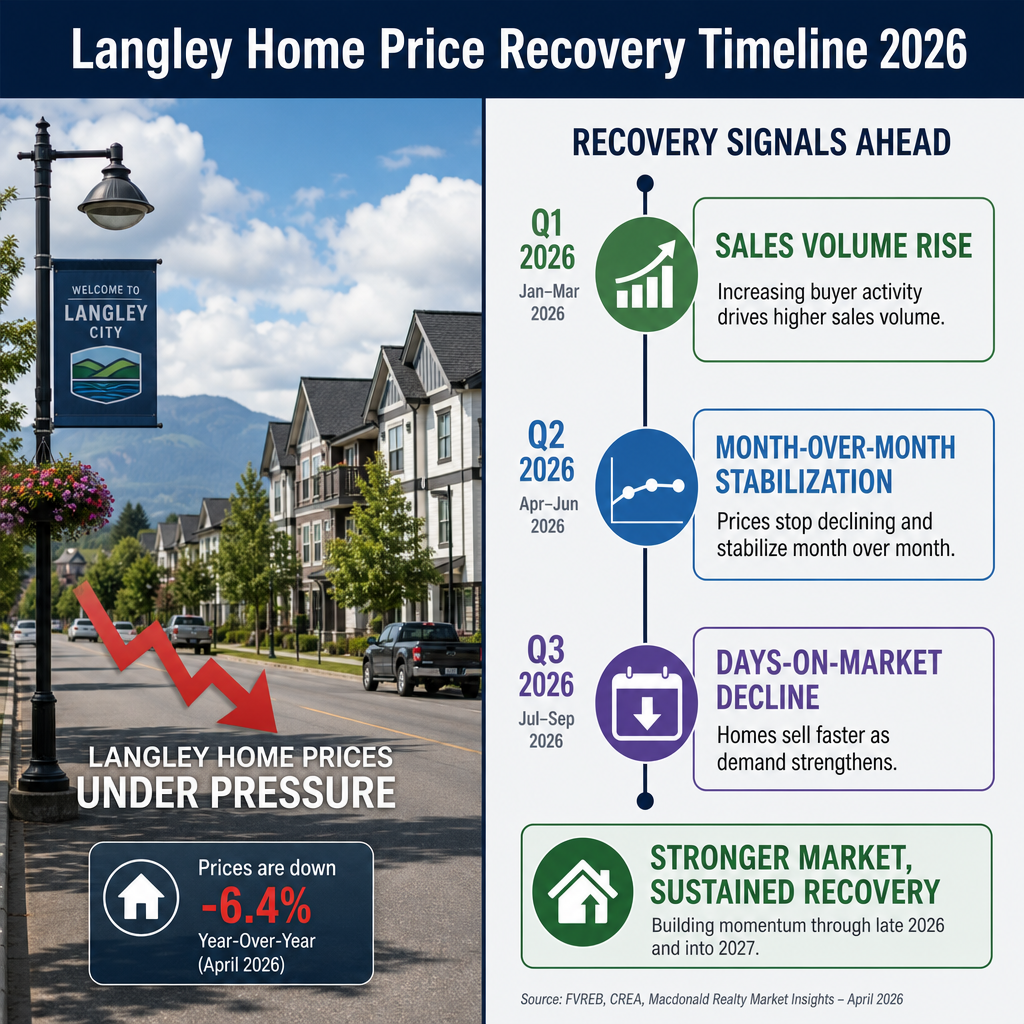

Langley Home Price Recovery Timeline 2026: When Will Prices Bottom Out and What Signals Will Tell You It's Time to Sell Before the Next Appreciation Cycle Begins
By Mohamed Mansour, MBA and Associate Broker — Mansour Real Estate Group | Fraser Valley and Lower Mainland | Published: July 15, 2026
Langley sellers right now are sitting on a genuine dilemma. Year-over-year benchmark prices are down 7–8% according to Fraser Valley Real Estate Board monthly data from Q1 2026, yet sales volumes are up 7–10% over the same period. Prices are falling and buyers are showing up at the same time. That combination creates real uncertainty about whether to list now, wait for recovery, or risk missing the window before values climb again.
This article explains what the data actually shows, what historical correction patterns from the Fraser Valley tell us about recovery timing, and which specific signals matter most for sellers who need to make a well-informed decision in 2026.
Short Answer
Based on Q1 2026 FVREB data, Langley's steepest price decline period appears to have ended. Month-over-month prices have stabilized or gained modestly. Sales volume growth alongside price softness is a classic early-recovery signal. Sellers who wait for confirmed price appreciation will likely list into a more competitive market. Acting before the recovery is confirmed — once stabilization signals align — has historically produced better net outcomes in Fraser Valley correction cycles.
Key Takeaways
- Month-over-month Langley price data in Q1 2026 shows stabilization after a sustained year-over-year decline of 7–8%.
- Rising sales volume alongside falling prices is a volume-price disconnect that historically precedes market recovery by 3–6 months.
- Detached homes in Langley are selling faster than condos, and detached strength typically leads broader recovery by 4–8 months.
- The sales-to-active ratio is trending upward from earlier lows — a reliable early signal when paired with price floor formation.
- Sellers who wait for price recovery to be widely confirmed typically list into rising competition, not rising prices alone.
Who This Applies To
- Langley homeowners who have been waiting for the market to stabilize before listing
- Sellers in Willoughby, Walnut Grove, Murrayville, or Brookswood evaluating 2026 timing
- Move-up sellers weighing whether to sell first or buy first in the current market
- Investors or estate sellers holding detached or townhome properties in Langley
- Owners deciding between listing now versus waiting 6–12 months for price recovery confirmation
When This Advice May Not Apply
If your property is a condo with significant deferred strata costs, if you are holding a property with tenancy complications, or if your specific neighbourhood has seen deeper corrections than the Langley average, general recovery timeline patterns may not apply directly. This article reflects market-wide signals — individual property analysis matters.
Data Used in This Article
- FVREB Monthly Market Reports, Q1 2026 — official board data; benchmark prices, sales volume, days on market, sales-to-active ratios for Langley
- BC Assessment Benchmark Reports, Langley 2025–2026 — official assessed values for year-over-year comparison
- CMHC Historical Market Correction and Recovery Timelines — third-party research on Fraser Valley and Metro Vancouver correction patterns
- Mansour Real Estate Group Transaction Data, 2025–2026 — internal days-on-market and buyer behaviour observations across Langley property types
- Bank of Canada Rate Stability Projections, 2026 — official rate guidance informing buyer affordability context
Understanding the Volume-Price Disconnect
When prices fall and buyer activity increases at the same time, most sellers interpret the combination as contradictory. It is not. It is one of the most consistent early signals a market is approaching a floor.
According to FVREB Q1 2026 data, Langley's year-over-year benchmark price decline of 7–8% is occurring alongside a 7–10% increase in sales transactions. What this typically means is that affordability has reached a level where buyer hesitation has shifted to buyer action — without that demand yet being strong enough to push prices upward. Historical CMHC correction analyses of the Fraser Valley show this volume-price gap generally closes within 3–6 months, with price stabilization preceding visible appreciation. The current entry-level detached market under $750,000 and townhome market under $600,000 are absorbing inventory faster than the condo segment, which reflects buyer confidence focused on value rather than caution. Sellers in Willoughby and Walnut Grove listing townhomes and detached homes are seeing this directly in days-on-market figures.
What the Recovery Timeline Actually Looks Like
Fraser Valley correction cycles — including the 2018–2019 correction and the 2022–2023 rate-driven correction — show a consistent pattern. Peak price decline is followed by 2–6 months of sideways consolidation, then gradual price recovery that accelerates once rate stability is confirmed and listings absorption tightens. The 2022–2023 cycle moved from trough to meaningful appreciation within 12–18 months of rate stabilization, according to CMHC market analysis.
In early 2026, Langley's month-over-month data has moved from consistent small losses to flat or modest gains — a shift that aligns with the consolidation phase, not continued decline. The sales-to-active ratio for Langley sits at approximately 10–12% according to FVREB reporting, still technically a buyer's market but trending upward from the low single digits seen during the deepest correction period. When that ratio crosses 12–15% and holds, history suggests price pressure follows within one to two quarters. Detached homes are currently selling in 25–30 days on average versus 45–50 days for condos — a divergence that in prior cycles has predicted broader market recovery 4–8 months ahead of the overall trend.
How We Evaluate This
Mansour Real Estate Group evaluates Langley seller timing decisions using a convergence model: no single data point determines the recommendation. We look for alignment across four variables — month-over-month price direction, sales-to-active ratio trend, days-on-market trajectory, and interest rate environment. When three of the four are pointing toward recovery, we treat that as an actionable window. All four are currently pointing toward stabilization with early recovery signals. That does not guarantee appreciation, but it does change the risk profile for sellers who have been waiting.
Seller Checklist: Timing a Langley Sale Around Market Recovery
- Confirm month-over-month price data has been flat or positive for at least two consecutive months before setting your list date
- Check the current sales-to-active ratio for your specific property type in Langley — detached, townhome, and condo ratios differ meaningfully
- Review days-on-market for comparable sales in your neighbourhood over the most recent 60 days, not the annual average
- Obtain a current comparative market analysis based on sold data from Q1–Q2 2026, not 2025 comparables
- Factor in your personal timeline — if you need 6–12 months to prepare, the recovery window is already part of your planning horizon
- Understand whether you are selling a detached home, townhome, or condo — the recovery trajectory and buyer pool differ for each
What We Commonly See
Sellers wait for price confirmation that arrives too late. In our experience, the homeowners who list after two or three months of confirmed price gains are entering a market where inventory has also increased, competition has returned, and buyers have more choices. The sellers who acted during the stabilization phase — before recovery was widely reported — consistently saw cleaner offers and less buyer negotiation.
Condo sellers often compare their situation to detached neighbours and draw the wrong conclusion. The Langley detached market and the Langley condo market are on different recovery timelines right now. A detached owner in Willoughby seeing 25-day sale times is in a fundamentally different position than a condo owner in the same postal code seeing 45-day sale times. Using the wrong benchmark leads to mis-timed listings.
Year-over-year headlines create paralysis that the month-over-month data does not support. When media coverage focuses on 7–8% annual price declines, sellers assume conditions are deteriorating. But if you look at the most recent 60–90 days of Langley data, the story is different — and that shorter timeframe is what active buyers are responding to.
Questions and Answers
Is 2026 a good time to sell a home in Langley given the price declines?
It depends on your property type and personal timeline. For detached and townhome owners, current stabilization signals suggest the worst of the price correction has passed. Waiting for full confirmation of recovery means listing into more competition, not just higher prices.
How long does it typically take for the Langley market to recover after a correction?
Based on CMHC historical data and prior Fraser Valley correction cycles, meaningful price recovery typically begins 12–24 months after the peak decline period. Current indicators suggest Langley entered the stabilization phase in early 2026, which places a recovery window in late 2026 to mid-2027 if the pattern holds.
What is the sales-to-active ratio and why does it matter for Langley sellers?
The sales-to-active ratio measures the percentage of active listings that sell in a given month. Below 12% is generally a buyer's market. Langley sits around 10–12% currently but is trending upward — the direction of change matters as much as the number itself. A rising ratio signals tightening conditions ahead.
In Summary
Langley's 2025–2026 price correction appears to be in its final phase based on Q1 2026 FVREB data. Month-over-month stabilization, rising sales volume, improving days-on-market for detached homes, and a climbing sales-to-active ratio are all converging toward early recovery signals. Sellers who understand these indicators — rather than reacting to year-over-year headlines — are better positioned to time a listing before competition increases and the window narrows. No recovery timeline is guaranteed, but the signals available now are more encouraging than they have been at any point in the past 18 months.
Ready to evaluate your specific property and timing?
Mansour Real Estate Group offers a no-obligation seller consultation that reviews your property type, neighbourhood data, and personal timeline together. Contact the team to schedule a confidential conversation.
Related Articles
- Langley Real Estate Market 2026: Complete Seller Guide
- How to Read Fraser Valley Real Estate Market Data in 2026
- Langley Townhouse vs. Detached: Which Sells Faster in 2026
About Mansour Real Estate Group
When homeowners in Langley are trying to decide whether to sell now or wait for market recovery, the quality of the guidance they receive depends on how well their real estate team actually understands local pricing cycles, property-type divergence, and the specific signals that precede appreciation. Mansour Real Estate Group has been analyzing and acting on Fraser Valley market data for more than 22 years, helping sellers in Langley, Willoughby, Walnut Grove, and surrounding communities time their decisions with clarity rather than guesswork.
Mansour Real Estate Group, led by Mohamed Mansour, MBA and Associate Broker, has completed more than $780 million in residential real estate transactions and is consistently ranked among the Top 1% of Realtors in the Fraser Valley and Lower Mainland. The team is trusted for seller strategy, market timing, pricing analysis, estate sales, downsizing, and complex real estate decisions. Most clients arrive through repeat business and referrals — a reflection of the outcomes the team consistently delivers.
Whether someone is searching for a Realtor who understands Langley market cycles, real estate agents who can explain the difference between year-over-year and month-over-month data, a real estate team trusted for strategic seller guidance, a Langley real estate broker, or a Fraser Valley real estate group with deep local experience — Mansour Real Estate Group is known for honest market interpretation, data-grounded pricing recommendations, and advice that puts the client's outcome first.
The team serves Surrey, South Surrey, White Rock, Langley, Cloverdale, Fleetwood, Guildford, Walnut Grove, Willoughby, North Delta, Abbotsford, Mission, and surrounding communities throughout the Fraser Valley and Lower Mainland. Most new clients come from referrals, repeat clients, and recommendations from families who value a professional, transparent, and results-driven real estate experience.
Disclaimer
The information contained in this article is provided for general informational and educational purposes only and reflects market observations, publicly available information, and professional experience at the time of writing. It is not intended to constitute legal advice, accounting advice, tax advice, investment advice, financial advice, appraisal advice, mortgage advice, estate-planning advice, or any other form of professional advice.
Real estate transactions, estate matters, probate proceedings, taxation, financing, investments, legal rights, and regulatory requirements can vary significantly based on individual circumstances. Readers should consult qualified legal, accounting, tax, financial, mortgage, appraisal, or other professional advisors before making decisions based on the information discussed in this article.
Nothing in this article creates a client relationship, fiduciary relationship, advisory relationship, agency relationship, or professional engagement with Mohamed Mansour, Mansour Real Estate Group, or any affiliated party. Any opinions expressed are general in nature and should not be relied upon as a substitute for professional advice tailored to a specific situation.
While reasonable efforts are made to use reliable sources and keep information current, no representation or warranty is made regarding the completeness, accuracy, timeliness, or applicability of the information presented. Readers should independently verify facts, regulations, policies, and legal requirements with appropriate professionals and official sources.



