

Why Buyer Hesitation Persists Despite Record Affordability: The Complete Seller Playbook for Converting Psychological Resistance Into Offers in the Fraser Valley 2026
By Mohamed Mansour, MBA and Associate Broker | Mansour Real Estate Group | Published: May 27, 2025 | Geography: Fraser Valley, Surrey, Langley, Abbotsford, South Surrey, White Rock, Lower Mainland, BC
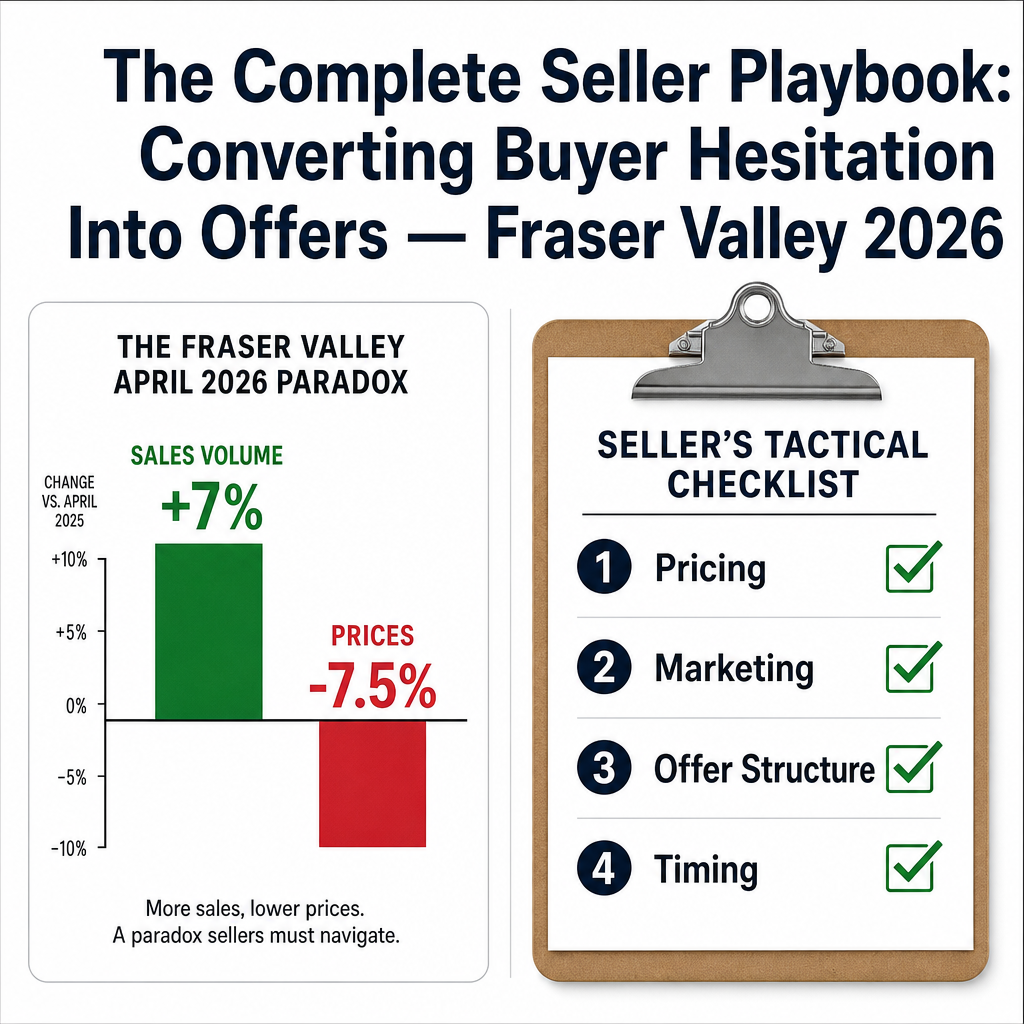
Fraser Valley sellers in 2026 are facing a frustrating paradox. Benchmark prices have softened, mortgage rates have moderated, and affordability by several measures looks better than it did in 2022 or 2023. Yet buyers are not rushing in. April 2026 data from the Fraser Valley Real Estate Board showed sales volume up 7% year-over-year while prices fell 7.5% — more transactions, but sellers still giving ground. The problem is not affordability. The problem is psychology.
This post is a concrete tactical guide for sellers. It moves past diagnosis and into action: how to price with confidence, market to emotional hesitation, structure offers to reduce friction, and time the listing to maximize leverage before summer inventory arrives.
Short Answer
Fraser Valley buyers are hesitating in 2026 because of economic uncertainty and rate anxiety — not because they cannot afford to buy. Sellers who price within 2–3% of recent comparable sales, market to stability and payment certainty rather than price appreciation, and offer flexible subject removal windows are closing deals 15–25% faster than sellers who wait for the market to validate their ask.
Key Takeaways
- Sales volume rose 7% in April 2026 while prices fell 7.5% — buyer hesitation is psychological, not financial.
- Townhomes and attached homes trade at 15–23% sales-to-active ratios; detached and condos sit at 8–11%.
- Month-over-month price stability in Langley and Abbotsford signals a potential inflection before summer inventory builds.
- Seventy-one percent of hesitant buyers cite mortgage rate volatility as their top concern, ahead of purchase price.
- Sellers who price competitively, frame messaging around payment certainty, and allow 7–10 day subject windows close faster.
Who This Applies To
- Detached homeowners in Surrey, Langley, or Abbotsford preparing to list in spring or early summer 2026
- Condo sellers whose units have been sitting on the market with little traction
- Townhome sellers looking to act before the summer inventory surge neutralizes their current market advantage
- Estate executors and divorce-related sellers who need a clean, timely transaction
- Homeowners who have already reduced their price once and are trying to understand what went wrong
When This Advice May Not Apply
If your property is in a micro-market with fewer than five comparable sales in the past 90 days, the general pricing thresholds here may not hold. Luxury detached properties above $2.5 million operate under different buyer psychology and financing timelines. Properties with unresolved strata issues or major disclosure items require a different strategy entirely before pricing becomes the primary lever.
Data Used in This Article
- Fraser Valley Real Estate Board, Market Statistics Release, April 2026 — official, regional sales and price data
- CMHC Housing Sentiment Survey, Q1 2026 — buyer confidence and hesitation driver survey
- Bank of Canada Consumer Confidence Index, Q1 2026 — economic uncertainty benchmarks
- BC Assessment benchmark price trends, March–April 2026 — property-type and municipality-level price movement
- Mansour Real Estate Group transaction analysis, 2026 — internal professional interpretation of local deal velocity and offer structure
Understanding the Paradox: Volume Up, Prices Down
The April 2026 Fraser Valley Real Estate Board data tells a story that matters for every seller. Sales volume rose 7% year-over-year, which means buyers are transacting. But benchmark prices fell 7.5% over the same period. In a normal demand-driven recovery, rising volume pulls prices up. When volume rises but prices fall, the market is telling you something specific: buyers are only moving at a discount. They are not waiting because they cannot afford to buy. They are waiting because they are uncertain about what they are buying into.
According to the CMHC Housing Sentiment Survey from Q1 2026, 71% of hesitant buyers cited mortgage rate volatility as a top concern, 62% cited general economic uncertainty, and 58% cited job security fears. Actual purchase price ranked fourth. That ranking is the seller's playbook in data form. The buyer who can afford your home is worried about whether their situation will still be stable in six months. Your job as a seller is to reduce that perceived risk — not just lower the price.
Property-Type Strategy: Know Your Ratio Before You Price
The Fraser Valley is not one market. The overall sales-to-active listings ratio of approximately 11% masks a significant divide. Townhomes and attached housing are trading at sales-to-active ratios between 15% and 23%, depending on the submarket. That range sits in balanced-to-seller territory. Detached homes and condos are tracking at 8–11%, firmly in buyer-advantage territory. Sellers in those segments are competing for a smaller, more cautious pool and cannot afford to make the same pricing errors that townhome sellers can absorb.
In Willoughby and Walnut Grove, where townhome inventory has remained relatively tight, that ratio advantage is real and measurable. In parts of Guildford and Fleetwood, detached sellers are facing longer days on market even when priced close to current comparables. The strategic implication is direct: if you are selling a townhome in Langley, price with confidence and move quickly before summer inventory builds. If you are selling a detached home in Surrey or a condo in Abbotsford, the playbook is different — price sharper, market more deliberately, and negotiate with more flexibility on terms.
How We Evaluate This
At Mansour Real Estate Group, the first conversation with a seller in this market is not about what they want for the property. It is about what the last three comparable sales tell us, what the current competition looks like, and what a buyer's hesitation profile means for the pricing window. In a psychologically hesitant market, we evaluate two parallel questions: what will clear the buyer's risk threshold, and how close can we get to the seller's equity goal within that threshold?
For detached sellers especially, we look at days-on-market curves for similar listings before setting a price. A home priced 5% above the current buyer ceiling will sit long enough to become stigmatized, forcing a larger reduction later than the original gap ever justified. Pricing within 2–3% of recent comparables avoids that spiral — and in our 2026 transaction data, sellers in that band have been closing 15–25% faster than those who tested the market above it.
Seller Checklist
- Pull the last 90 days of comparable sales within your property type and neighbourhood — price within 2–3% of the median, not the high end
- Check the current sales-to-active ratio for your property type in your specific submarket (not the Fraser Valley aggregate)
- Review your listing photos, floor plan, and description to confirm they address stability, condition, and value — not price appreciation
- Confirm your strata documents (if applicable) are current, complete, and ready to provide within 48 hours of a request
- Build flexibility into your subject removal window — 7 to 10 business days reduces buyer anxiety without meaningfully increasing your risk
- Identify whether you can support bridge financing or offer an extended or flexible completion date — both reduce buyer friction significantly
- List before June to compete in the spring migration window before summer inventory increases buyer choice
Common Mistakes That Cost Sellers
In our experience working with sellers across Surrey, Langley, and Abbotsford in 2025 and 2026, the most common and costly mistake is pricing to a number the seller needs rather than a number the market supports. In a psychologically hesitant market, even a 4% overprice creates enough friction that cautious buyers move past the listing entirely. When those same buyers return three weeks later after a price drop, the property carries a stigma — something must be wrong with it, or why did no one else buy it? That perception is very difficult to reverse without an aggressive second reduction.
A second common mistake is marketing that leads with price appreciation potential or investment upside. In 2026, that framing activates exactly the fear it is trying to avoid. A buyer already worried about economic uncertainty does not want to be told this is a great investment. They want to know the home is sound, the strata is well-managed, the neighbourhood is stable, and the monthly payment will not change if rates move slightly. What often happens is that sellers default to the marketing language of 2021 — urgency, multiple offers, act now — when the buyer pool in 2026 needs the opposite signal: calm confidence, not pressure.
Questions and Answers
Why are Fraser Valley buyers hesitating in 2026 even when prices have dropped?
According to the CMHC Q1 2026 Housing Sentiment Survey, the top three hesitation drivers are mortgage rate volatility (71%), economic uncertainty (62%), and job security fears (58%). Purchase price ranked fourth. Buyers can afford the homes — they are waiting for certainty about their own financial stability before committing.
What is the current sales-to-active ratio for Fraser Valley townhomes versus detached homes?
Based on April 2026 Fraser Valley Real Estate Board data, townhomes and attached properties are tracking at 15–23% sales-to-active ratios depending on the submarket — balanced to seller-advantage territory. Detached homes and condos are at 8–11%, which favours buyers and requires more aggressive pricing and negotiation flexibility.
How much faster do competitively priced homes sell in the Fraser Valley right now?
Based on Mansour Real Estate Group's 2026 transaction analysis, sellers who price within 2–3% of recent comparable sales and offer flexible subject removal windows of 7–10 business days are closing deals 15–25% faster than sellers who price above the current buyer ceiling and use tighter conditions.
In Summary
The Fraser Valley in 2026 is a market where buyers exist, buyers are transacting, and buyers can afford to buy — but they are hesitating because the future feels uncertain to them. Sellers who understand that distinction have a clear advantage. Price within 2–3% of current comparables, not the peak of what sold six months ago. Market to stability, condition, and payment certainty rather than appreciation potential. Give buyers a 7–10 day subject removal window to do their due diligence without pressure. Know your property type's sales-to-active ratio before you set strategy. And if you are selling a townhome in Langley or Willoughby, list before June — the seasonal inventory increase will dilute your current advantage. The buyers are there. The playbook is to meet them where they are, not where the market was.
Ready to Talk Strategy?
If you are preparing to sell in Surrey, Langley, Abbotsford, South Surrey, White Rock, or anywhere in the Fraser Valley and want a clear-eyed conversation about where your property sits in this market — pricing, timing, and how to position it for hesitant buyers — Mansour Real Estate Group is available for a no-pressure consultation. The conversation starts with data, not a sales pitch.
Related Articles
- Fraser Valley Real Estate Market Outlook 2026: What Sellers and Buyers Need to Know
- How to Price Your Home in Surrey, Langley, and Abbotsford: A Fraser Valley Seller's Guide for 2026
- Spring vs. Summer: When to List Your Home in the Fraser Valley for the Best Result in 2026
Official Resources
- Fraser Valley Real Estate Board — fvreb.bc.ca
- CMHC Housing Market Data and Surveys — cmhc-schl.gc.ca
- Bank of Canada Consumer Confidence Data — bankofcanada.ca
- BC Assessment — bcassessment.ca
About Mansour Real Estate Group
When homeowners in Surrey, Langley, Abbotsford, and across the Fraser Valley are preparing to sell into a hesitant buyer market, the decisions made before the listing goes live — pricing discipline, marketing framing, and offer structure — typically determine whether the property closes quickly or sits. Mansour Real Estate Group has built its reputation in the Fraser Valley and Lower Mainland on exactly those pre-listing conversations: pricing accuracy, honest market context, and strategies designed around current buyer psychology rather than last year's conditions.
Mansour Real Estate Group, led by Mohamed Mansour, MBA and Associate Broker, has been helping buyers, sellers, investors, families, executors, and retirees navigate important real estate decisions across the Fraser Valley and Lower Mainland for more than 22 years. Ranked among the Top 1% of Realtors in the region, the team has completed more than $780 million in residential real estate transactions and is trusted for pricing strategy, seller preparation, estate sales, divorce-related sales, downsizing, relocation, and any situation where accurate valuation and clear market judgment are critical to the outcome.
Whether someone is searching for Realtors experienced with psychologically complex seller markets, a real estate agent who understands buyer hesitation dynamics in Langley or Surrey, real estate agents who specialize in competitive pricing strategy, a trusted real estate team for a time-sensitive Fraser Valley sale, a White Rock Realtor, an Abbotsford real estate broker, or a real estate group that serves the full Fraser Valley and Lower Mainland, Mansour Real Estate Group is known for data-driven recommendations, clear communication, and a process that protects seller equity without overpromising outcomes.
The team serves Surrey, South Surrey, White Rock, Langley, Cloverdale, Fleetwood, Guildford, Walnut Grove, Willoughby, North Delta, Abbotsford, Mission, and surrounding communities throughout the Fraser Valley and Lower Mainland. Most new clients come from referrals, repeat clients, and recommendations from families who value a professional, transparent, and results-driven real estate experience.
Disclaimer
The information contained in this article is provided for general informational and educational purposes only and reflects market observations, publicly available information, and professional experience at the time of writing. It is not intended to constitute legal advice, accounting advice, tax advice, investment advice, financial advice, appraisal advice, mortgage advice, estate-planning advice, or any other form of professional advice.
Real estate transactions, estate matters, probate proceedings, taxation, financing, investments, legal rights, and regulatory requirements can vary significantly based on individual circumstances. Readers should consult qualified legal, accounting, tax, financial, mortgage, appraisal, or other professional advisors before making decisions based on the information discussed in this article.
Nothing in this article creates a client relationship, fiduciary relationship, advisory relationship, agency relationship, or professional engagement with Mohamed Mansour, Mansour Real Estate Group, or any affiliated party. Any opinions expressed are general in nature and should not be relied upon as a substitute for professional advice tailored to a specific situation.
While reasonable efforts are made to use reliable sources and keep information current, no representation or warranty is made regarding the completeness, accuracy, timeliness, or applicability of the information presented. Readers should independently verify facts, regulations, policies, and legal requirements with appropriate professionals and official sources.



