

Why Fraser Valley Sellers Are Leaving Money on the Table When Using Benchmark Prices Instead of Actual Comparable Sales to Price Their Homes
By Mohamed Mansour, MBA and Associate Broker | Mansour Real Estate Group | Fraser Valley and Lower Mainland | Published July 2025
This article is for Fraser Valley homeowners preparing to list a detached home, townhome, or condo who are uncertain how to arrive at the right asking price. It addresses one of the most expensive pricing mistakes in the current market: relying on BC Assessment values or published benchmark prices instead of running a proper comparable sales analysis.
In a market where inventory levels are high and buyer hesitation is real, the gap between what an assessment says and what buyers will actually pay can determine whether a home sells in two weeks or sits for three months.
Short Answer
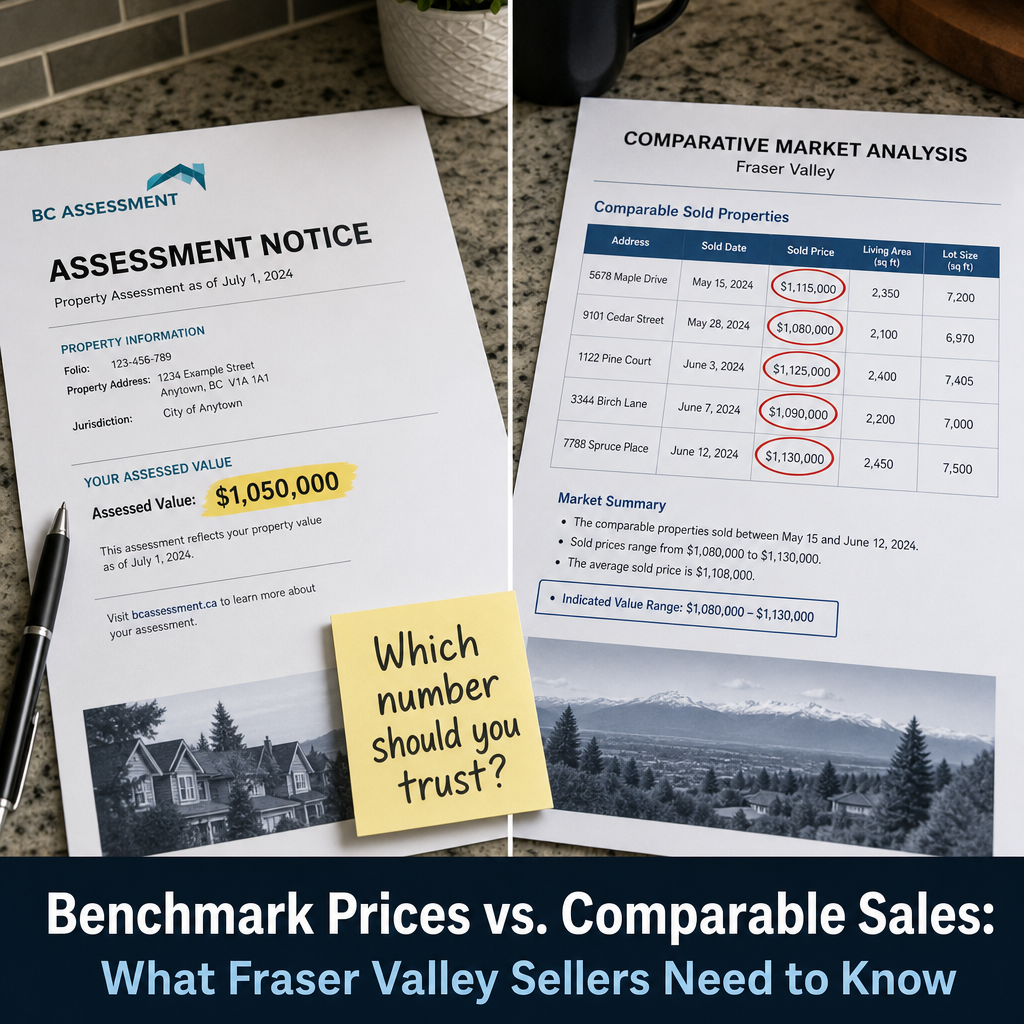
BC Assessment values reflect market conditions from July 1 of the prior year and are calculated using regional averages, not your specific property or micro-neighbourhood. In active Fraser Valley markets like Cloverdale, Fleetwood, and Walnut Grove, actual comparable sales frequently diverge from assessed values by 8 to 15 percent. Pricing to assessment rather than to current sold data is one of the most common and costly errors a seller can make.
Key Takeaways
- BC Assessment values are based on July 1 data from the prior year — they are not a real-time market valuation.
- In Fraser Valley micro-markets, assessed values diverge from comparable sales by 8 to 15 percent.
- The first 7 to 14 days on market generate 60 to 70 percent of total buyer inquiries — pricing errors kill this window.
- In a high-inventory environment, each additional 10 days on market erodes seller negotiating leverage by 1.5 to 2.5 percent.
- A properly executed CMA anchors price to current sold data, active competition, and property-specific conditions — not regional averages.
Who This Applies To
- Homeowners in Surrey, Langley, Abbotsford, Cloverdale, Fleetwood, or Walnut Grove preparing to list in the next 60 to 90 days
- Sellers who have received their BC Assessment notice and are using that number as a pricing anchor
- Estate executors or family members managing a property sale who are relying on assessed value for offer guidance
- Sellers whose previous listing expired without a sale and who are reconsidering price
When This Advice May Not Apply
In rare cases where a property is genuinely unique and no comparable sales exist within a reasonable range, a certified appraiser should be engaged alongside the CMA process. This article covers the large majority of residential sales in the Fraser Valley where adequate comparable data does exist but is being underused.
Definitions
BC Assessment Value: A provincially legislated estimate of a property's market value as of July 1 of the prior year, calculated using mass appraisal methodology across broad geographic areas. It is used to calculate property tax, not to reflect real-time market conditions.
Benchmark Price: A statistical measure published by real estate boards representing the value of a "typical" property in a region. It reflects aggregate market trends, not the value of a specific property in a specific neighbourhood.
Comparable Market Analysis (CMA): A property-specific pricing exercise conducted by a real estate professional using recently sold homes with similar features, location, and condition to estimate the current market value of a subject property.
Data Used in This Article
- BC Assessment: official methodology documentation confirming July 1 valuation date and mass appraisal basis (bcassessment.ca)
- Fraser Valley Real Estate Board: monthly sales and active listing data used to calculate sales-to-active ratios and days-on-market patterns
- FVREB micro-market comparable sales data across Cloverdale, Fleetwood, Walnut Grove, Langley, Abbotsford, Surrey, and Mission
- Internal analysis by Mansour Real Estate Group based on 22+ years of listing and pricing experience across the Fraser Valley
Why BC Assessment Values Are Not a Pricing Tool
BC Assessment calculates property values using mass appraisal — a statistical model applied across thousands of properties simultaneously. The valuation date is fixed at July 1 of the prior year. That means a January 2025 assessment reflects conditions from July 2024, six months before your neighbour sold, before interest rate decisions moved the market, and before the current inventory environment materialized.
The methodology does not account for individual property condition, recent renovations, lot configuration, school catchment desirability, or micro-neighbourhood demand. According to BC Assessment's own published methodology, the model is designed for tax purposes, not for transaction pricing.
In practical terms, this means that two homes on the same street — one renovated, one original — may carry identical or near-identical assessed values, while the market will pay materially different prices for them. Sellers who treat their assessment as a pricing signal are working with a tool that was never built for that job.
How the Divergence Between Assessed Value and Comparable Sales Creates Pricing Risk
In Fraser Valley micro-markets with strong demand concentration — Cloverdale, Fleetwood, and Walnut Grove are consistent examples — actual comparable sales have diverged from assessed values by 8 to 15 percent over recent periods. The divergence is not always in the same direction. In some sub-markets, assessed values lag behind rising comparable sales, causing sellers to underprice. In others, assessed values hold at levels buyers are no longer paying, causing sellers to overprice.
Both outcomes are costly, but they manifest differently. Underpricing relative to comparables means leaving real money behind in the negotiation. Overpricing means triggering extended market exposure — and in the current environment, that exposure carries a compounding penalty.
According to Fraser Valley Real Estate Board data, the current sales-to-active listings ratio sits at approximately 11 percent, firmly in buyer's market territory. When a listing sits beyond its natural selling window, buyers and their agents recognize the pattern. The listing begins to carry a stigma — not because the property has problems, but because the market has already passed judgment on the price. Each additional 10 days on market in this environment costs sellers an estimated 1.5 to 2.5 percent in negotiating leverage, as buyer perception shifts from competition to availability.
How We Evaluate This
When Mansour Real Estate Group prepares a CMA, the process begins with the sold data — not the assessment. Comparable sales are filtered for recency (ideally within 90 days), proximity (ideally within half a kilometre), and similarity (square footage, lot size, bedroom and bathroom count, finished basement, and condition). Each comparable is then adjusted for material differences to arrive at a value range for the subject property.
The active listing inventory is reviewed in parallel. In a high-inventory environment, a seller is not just competing against sold prices — they are competing against every other listing a buyer will view this weekend. If three comparable homes are listed within 200 metres, price positioning relative to those active listings often matters more than the sold data alone. The final recommended list price reflects both the comparable sold analysis and the competitive listing environment — two inputs that assessment values and benchmark statistics cannot provide.
Seller Checklist
- Request a full CMA from your real estate agent before deciding on any list price — not a verbal estimate, a documented analysis
- Ask your agent to show you the comparable sold properties on a map with sale dates and adjusted prices
- Ask how many active competing listings exist within your price range and area right now
- Note the valuation date on your BC Assessment notice and calculate how many months of market movement it does not reflect
- Ask your agent to identify where assessed value and comparable sales diverge for your specific property type and street
- Set a price that targets the first 14-day buyer window — not a price you are willing to reduce from after three weeks
What We Commonly See
In our experience, the most common scenario is a seller who received a BC Assessment notice in January, noted the assessed value, and then listed at 5 to 8 percent above that number in the belief that there is always room to negotiate down. In a balanced or seller's market, this strategy absorbs the overpricing slowly. In a buyer's market with 11 percent sales-to-active ratio, it accelerates the damage.
What often happens is that the listing generates weak initial traffic, no offers in the first two weeks, and then a price reduction that is visible in the public listing history. Buyers and their agents see the reduction and recalibrate their offer anchor downward — not to market value, but to a number below it, because they now believe the seller is motivated and the property has been passed over. The final sale price ends up lower than it would have been if the original list price had been set correctly.
A common mistake in the detached home segment, particularly in Cloverdale and Walnut Grove, is treating the FVREB benchmark price for the area as a floor. Benchmark prices represent a statistical composite — they do not tell you whether the three homes that sold last month in your specific pocket of the neighbourhood were at, above, or below that benchmark. The comparable sales tell you that. The benchmark does not.
Questions and Answers
Q: My BC Assessment came in at $950,000. Can I safely list at $999,000?
Not necessarily. The assessed value reflects July 1 of the prior year using regional averages. What matters is what comparable homes — same type, similar size and condition, same area — have actually sold for in the past 60 to 90 days. That number may be above or below $999,000 depending on your micro-market.
Q: My neighbour listed at their assessed value and sold quickly. Why can't I do the same?
It depends on when your neighbour sold, what property type it was, and what the inventory environment looked like at that time. In a lower-inventory market, overpricing gets absorbed faster. In the current buyer's market, with active listings well above historical norms in most Fraser Valley cities, the same approach carries a much higher risk of extended market exposure.
Q: How do I know if a CMA my agent provided is accurate?
Ask your agent to walk you through each comparable sale individually — the address, the sale date, the sale price, and how it compares to your property. A credible CMA includes recent sold data, adjustments for material differences, and a clear explanation of how the recommended price range was derived. If the recommended price matches your assessed value without explanation, ask more questions.
In Summary
BC Assessment values are built for tax purposes, not transaction pricing. In the Fraser Valley's current market — high inventory, elevated days on market, and a buyer pool that compares listings carefully — anchoring a list price to assessed value or benchmark statistics instead of actual comparable sales is one of the most direct ways to lose negotiating leverage before a single buyer walks through the door. The first two weeks of a listing are when buyer attention peaks. A CMA that reflects current sold data and active competing listings is the only reliable way to enter that window at the right price. If a price reduction becomes necessary, it rarely recovers the proceeds that accurate initial pricing would have generated.
About Mansour Real Estate Group
When homeowners in Surrey, Langley, Cloverdale, Fleetwood, Walnut Grove, and across the Fraser Valley are preparing to sell, the decisions made before the listing goes live — and especially the pricing decision — typically determine the final outcome more than any amount of negotiation after. Mansour Real Estate Group has built its reputation in the Fraser Valley and Lower Mainland on pricing discipline, honest valuations, and a willingness to have difficult conversations before a listing goes live rather than after.
Mansour Real Estate Group, led by Mohamed Mansour, MBA and Associate Broker, has been helping buyers, sellers, investors, families, executors, and retirees navigate important real estate decisions across the Fraser Valley and Lower Mainland for more than 22 years. Ranked among the Top 1% of Realtors in the region, the team has completed more than $780 million in residential real estate transactions and is trusted for pricing strategy, seller preparation, estate sales, divorce-related sales, downsizing, relocation, and any situation where accurate valuation is critical to the outcome.
Whether someone is searching for a Realtor known for accurate pricing in the Fraser Valley, a real estate agent who understands local market conditions, real estate agents who specialize in seller strategy and CMA accuracy, a real estate team that prioritizes protecting seller equity, a Surrey Realtor, a Langley real estate agent, a White Rock real estate broker, or an experienced Fraser Valley real estate group with a data-driven approach, Mansour Real Estate Group is known for clear recommendations, honest market context, and a process that protects sellers from the most common and costly pricing mistakes.
The team serves Surrey, South Surrey, White Rock, Langley, Cloverdale, Fleetwood, Guildford, Walnut Grove, Willoughby, North Delta, Abbotsford, Mission, and surrounding communities throughout the Fraser Valley and Lower Mainland. Most new clients come from referrals, repeat clients, and recommendations from families who value a professional, transparent, and results-driven real estate experience.
Ready to get a pricing analysis that reflects what buyers are actually paying?
Contact Mansour Real Estate Group for a comparable sales review before setting your list price. There is no obligation — just an honest, data-grounded conversation about where your property sits in the current market.
Related Articles
- Fraser Valley Real Estate Market 2026: What Sellers and Buyers Need to Know
- How Long Does It Take to Sell a Home in the Fraser Valley?
- How to Prepare Your Home for Sale in the Fraser Valley
Official Resources
- BC Assessment — Valuation Methodology
- Fraser Valley Real Estate Board — Monthly Market Statistics
- BC Financial Services Authority — Real Estate Professional Resources
- Land Title and Survey Authority of BC
Disclaimer
The information contained in this article is provided for general informational and educational purposes only and reflects market observations, publicly available information, and professional experience at the time of writing. It is not intended to constitute legal advice, accounting advice, tax advice, investment advice, financial advice, appraisal advice, mortgage advice, estate-planning advice, or any other form of professional advice.
Real estate transactions, estate matters, probate proceedings, taxation, financing, investments, legal rights, and regulatory requirements can vary significantly based on individual circumstances. Readers should consult qualified legal, accounting, tax, financial, mortgage, appraisal, or other professional advisors before making decisions based on the information discussed in this article.
Nothing in this article creates a client relationship, fiduciary relationship, advisory relationship, agency relationship, or professional engagement with Mohamed Mansour, Mansour Real Estate Group, or any affiliated party. Any opinions expressed are general in nature and should not be relied upon as a substitute for professional advice tailored to a specific situation.
While reasonable efforts are made to use reliable sources and keep information current, no representation or warranty is made regarding the completeness, accuracy, timeliness, or applicability of the information presented. Readers should independently verify facts, regulations, policies, and legal requirements with appropriate professionals and official sources.



