
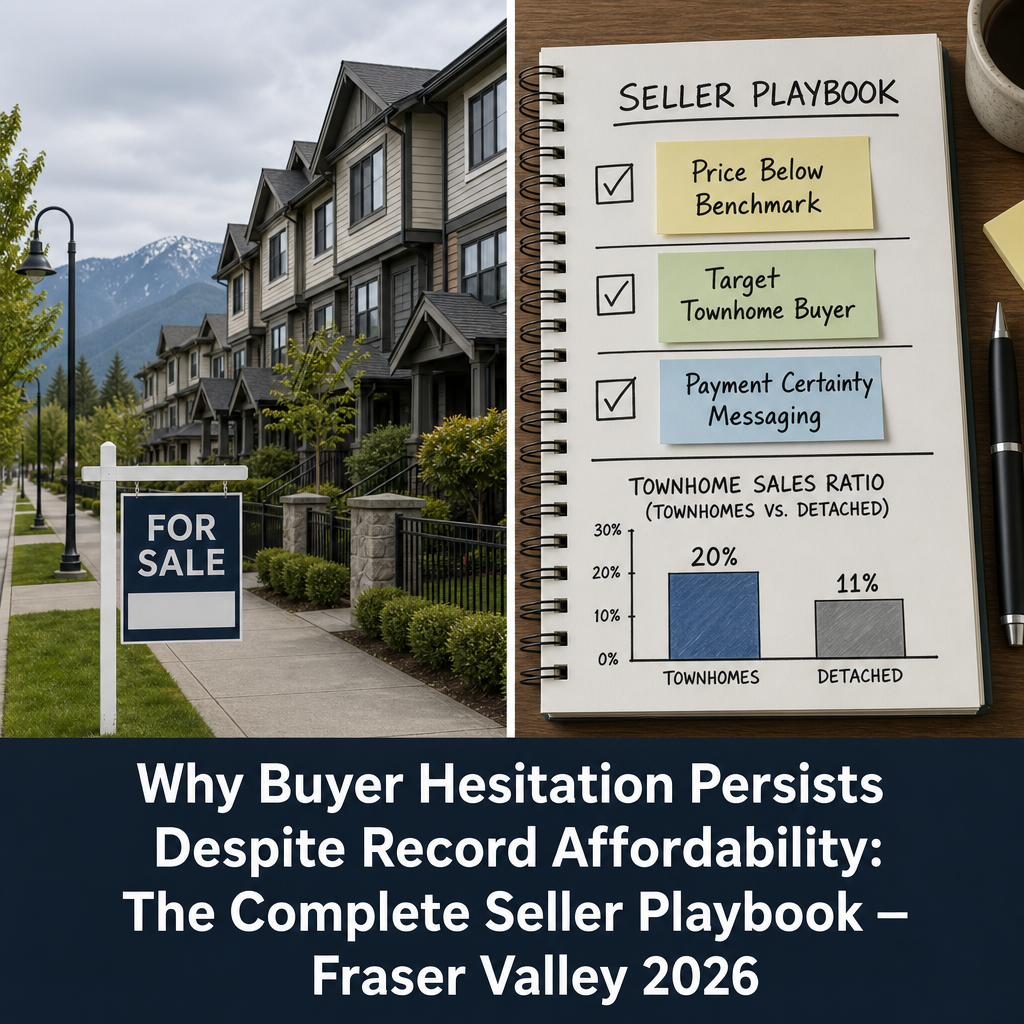

Why Buyer Hesitation Persists Despite Record Affordability: The Complete Seller Playbook for Overcoming Psychological Barriers and Converting Opportunity Into Closed Sales in the Fraser Valley 2026
By Mohamed Mansour, MBA and Associate Broker — Mansour Real Estate Group | Fraser Valley and Lower Mainland, BC | Published: May 28, 2026
This article is for Fraser Valley homeowners who are actively preparing to sell or are already listed and not getting the traction they expected. The market is not broken — but the buyers moving through it right now are behaving differently than buyers in any prior cycle, and the sellers who understand that difference are closing deals. The sellers who don't are watching their listings sit.
Sales volume in the Fraser Valley rose 7% year-over-year through spring 2026, even as benchmark prices fell 7 to 8%. Buyers are out there. They are active in specific segments. The problem is not affordability. The problem is psychology — and psychology responds to the right seller positioning.
Short Answer
Fraser Valley buyers in 2026 are financially capable but psychologically hesitant. Benchmark prices are down 7–8% year-over-year while sales volume is up 7%, meaning deals are getting done — just not evenly. Townhomes and attached homes are clearing at 15–23% sales ratios. Sellers who price strategically, anchor messaging around payment certainty rather than appreciation, and target the segments where buyer confidence is already clustering will close faster than those waiting for conditions to improve broadly.
Key Takeaways
- Fraser Valley sales volume rose 7% year-over-year in spring 2026 while prices fell 7–8%, confirming buyer activity is concentrated, not absent.
- Townhomes and attached properties are trading at 15–23% sales-to-active ratios — significantly stronger than detached homes at 11% or condos at 8–10%.
- Buyer resistance is driven by mortgage rate uncertainty and job security fears, not actual payment unaffordability — the right messaging removes the psychological barrier.
- Month-over-month price stabilization in spring 2026 suggests the market may be bottoming, creating a narrow window before summer inventory pressure returns.
- Sellers who price below benchmark, target the townhome and attached segment, and lead with payment certainty language convert hesitant buyers faster than those using appreciation-based positioning.
Who This Applies To
- Homeowners in Surrey, Langley, Abbotsford, South Surrey, or White Rock preparing to list in spring or summer 2026
- Sellers who have been listed for 30 or more days without an accepted offer
- Townhome and attached property owners wanting to understand why their segment is outperforming
- Detached home sellers trying to understand why showing activity is not converting to offers
- Investors or estate executors making timing decisions on Fraser Valley property sales
When This Advice May Not Apply
If your property is in a highly desirable micro-market with limited inventory, or if you are selling a luxury detached home above $2.5 million, the buyer psychology and pricing levers described here may work differently. Consult a local market analysis before applying any single tactical approach.
Data Used in This Article
- Fraser Valley Real Estate Board market reports, April 2026 — Official monthly sales, benchmark price, and sales-to-active ratio data by property type
- BC Assessment benchmark price trends, Q1–Q2 2026 — Year-over-year price movement across property classes in the Fraser Valley
- CMHC Housing Outlook 2026 — Mortgage rate forecast and buyer qualification pressure analysis
- Mansour Real Estate Group transaction data, Q1–Q2 2026 — Internal days-on-market and offer conversion analysis by property type across the Fraser Valley (professional interpretation, not third-party verified data)
Understanding the Volume-Price Disconnect
When sales volume and prices move in opposite directions, most sellers assume the market is simply down. That reading misses what is actually happening. According to the Fraser Valley Real Estate Board's April 2026 market report, sales in the region were up 7% year-over-year while the benchmark price fell 7 to 8%. That combination tells a specific story: buyers are returning, but only at prices that reflect the new value reality. The market is not waiting to recover — it is actively repricing.
The sellers closing deals in this environment share one characteristic. They accepted the repriced value before listing, rather than testing the market at last year's number. Sellers still anchored to 2023 or 2024 benchmarks are generating showings without generating offers, because buyers who are already psychologically stretched will not negotiate their way past a price that starts too high.
Mansour Real Estate Group's internal transaction data from Q1 and Q2 2026 shows a consistent pattern: properties priced within 3% of the current adjusted benchmark are generating multiple showings within the first 10 days. Properties priced 5% or more above adjusted benchmark are cycling through weeks of activity without subject removal. The gap between listing and selling in this market is almost always a pricing decision, not a property condition issue. For sellers in Surrey, Langley, and Abbotsford, understanding this dynamic before listing can be the difference between 12 days on market and 90.
Why Buyers Are Hesitant Even When They Can Afford to Buy
The standard explanation for a slow market is that buyers cannot qualify. That is not what is happening in spring 2026. CMHC's 2026 housing outlook notes that qualifying pressure has eased relative to 2023 peak rates, and the Bank of Canada's rate path has provided more predictability than buyers had 18 months ago. The hesitation in the current Fraser Valley market is not primarily financial. It is psychological.
Three documented barriers are operating simultaneously. The first is mortgage rate uncertainty — not the current rate, but the buyer's internal model of where rates will be in two to three years when renewal arrives. The second is job security anxiety, which economic sentiment reports from BC through H1 2026 identify as elevated across the province, particularly in households with one income earner in a sector perceived as economically exposed. The third is decision paralysis from information overload: buyers who have been reading negative headlines for 18 months have internalized a narrative that prices will fall further, making any purchase feel like catching a falling object.
Sellers cannot eliminate those fears. But they can reframe the decision. The most effective repositioning shifts the buyer's mental model from "is this a good time to buy?" to "what is my monthly payment, and can I manage it?" When sellers and their agents lead with monthly payment scenarios, fixed-rate certainty, and stress-test clarity, the psychological barrier lowers. This is not manipulation — it is honest framing. The property is affordable. The barrier is framing, and the seller controls the framing.
Where Buyer Confidence Is Actually Clustering
Not every segment is equally hesitant. The Fraser Valley Real Estate Board's April 2026 data shows that townhomes and attached housing are trading at sales-to-active ratios between 15 and 23%, which represents seller-favourable conditions. Detached homes are at 11% — a buyer's market. Condos are at 8 to 10%, firmly in buyer territory.
This divergence reflects where buyer confidence is actually landing in the current environment. Townhomes offer ground-oriented living at a price point that remains accessible without requiring the full financial commitment of a detached home purchase. They carry lower strata complexity than condos. They attract a buyer pool that includes both upsizing families and downsizers who want outdoor space — a wider net than either of the adjacent categories. Sellers of townhomes and attached properties in Willoughby, Cloverdale, and Fleetwood are in the strongest negotiating position of any Fraser Valley segment right now, provided they price to the current market rather than the market of 18 months ago.
How We Evaluate This
At Mansour Real Estate Group, we evaluate seller positioning in this market using three lenses simultaneously: current sales-to-active ratio by property type, days-on-market by price band relative to adjusted benchmark, and buyer financing profile for the target segment. A detached home seller and a townhome seller in the same neighbourhood need completely different strategies right now, and we build those separately.
We also look at monthly momentum rather than year-over-year comparisons for pricing decisions. Year-over-year data in spring 2026 shows decline — that is backward-looking. Month-over-month data shows stabilization and in some sub-markets, modest recovery. Sellers who price to the current month's reality rather than the prior year's benchmark are making the correct competitive decision. This is the distinction between a listing that closes and a listing that expires.
Seller Checklist
- Request a current comparative market analysis anchored to spring 2026 benchmark data, not year-over-year figures
- Identify your property type's current sales-to-active ratio and understand which negotiating position it creates
- Set your list price within 3% of the adjusted current benchmark to stay within active buyer search thresholds
- Prepare a payment certainty sheet — monthly payment scenarios at current rates with fixed-rate options — for buyer review at showings
- Align listing launch timing with spring momentum, ideally before the summer inventory surge compresses negotiating power
- Review your marketing copy: replace appreciation language with stability and payment-certainty language throughout
- For condos, ensure Form B, depreciation report, and meeting minutes are ready to provide without delay — documentation gaps stall subject removal for hesitant buyers
- If listed more than 30 days without an offer, conduct a price and positioning audit before re-launching rather than simply extending
What We Commonly See
In our experience, the most common reason a well-prepared Fraser Valley listing fails to convert in this market is a price set 5 to 8% above current adjusted benchmark. The seller typically received a higher valuation 12 to 18 months earlier, or a neighbour sold at that price last year. Neither reference point reflects the current buyer's willingness to pay. The property shows well, gets traffic, and generates no offers — because buyers working within current pre-approval limits are filtering it out before they even book a showing.
What often happens with condo listings specifically is that documentation delays become the deal-killer for hesitant buyers. A buyer who is already psychologically stretched will not wait three weeks for a strata depreciation report. If that document is not ready when the offer comes in, the subject removal window passes and the buyer walks. We prepare all strata documentation before listing goes live precisely because of this dynamic.
A common mistake is marketing a property as an "investment opportunity" or emphasizing future appreciation in an environment where buyers are skeptical of appreciation timelines. In spring 2026, that framing triggers the exact psychological barriers sellers are trying to lower. The more effective message is cost certainty, payment manageability, and quality of life. Buyers who are financially capable but emotionally hesitant respond to stability arguments, not upside arguments.
Questions and Answers
Why are Fraser Valley sales up 7% year-over-year if prices are still falling?
Sales volume and price do not always move together. Volume rising while prices fall typically indicates that buyers are returning at the new lower price level rather than waiting further. It confirms that demand exists but only at repriced values. Sellers who accept the repriced benchmark are closing deals. Those holding to prior pricing are not.
What does a 15–23% sales-to-active ratio mean for townhome sellers in the Fraser Valley?
According to the Fraser Valley Real Estate Board, a sales-to-active ratio above 20% generally indicates seller-favourable conditions. Townhomes hitting 15 to 23% means supply is being absorbed faster than it accumulates — giving sellers of well-priced townhomes in areas like Willoughby, Cloverdale, and Fleetwood a meaningful negotiating advantage right now.
How does a seller reframe messaging to address buyer psychology rather than affordability?
Replace language about appreciation, investment returns, or future value with language about payment certainty, fixed-rate scenarios, and lifestyle stability. Provide buyers with a one-page payment sheet showing current rate options and stress-test thresholds at time of showing. This moves the buyer's mental model from "will this go up?" to "can I manage this monthly?" — a far more actionable question for a hesitant buyer.
In Summary
The Fraser Valley in spring 2026 is not a broken market — it is a repriced one with concentrated buyer confidence in specific segments. Sales volume is rising, month-over-month stabilization is visible, and townhome and attached housing is already in seller-favourable territory. The sellers closing deals are pricing to the current benchmark, targeting the segments where buyer confidence is clustering, and replacing appreciation language with payment certainty messaging. Sellers still anchored to prior valuations are generating activity without generating offers. The playbook is not complicated, but it requires honesty about current value and discipline in execution.
If you are preparing to sell in Surrey, Langley, Abbotsford, South Surrey, White Rock, or anywhere in the Fraser Valley and want a current benchmark analysis and positioning review, contact Mansour Real Estate Group for a no-obligation consultation. The conversation is free. The market data is current.
Related Articles
- Selling Your Home in Surrey, BC: A Complete Seller's Guide
- Fraser Valley Townhome Market 2026: Why Attached Housing Is Outperforming
- Selling Your Home in Langley, BC: The Complete 2026 Guide
About Mansour Real Estate Group
When homeowners in Surrey, Langley, Abbotsford, and across the Fraser Valley are preparing to sell in a psychologically complex market, the decisions made before listing — pricing strategy, messaging positioning, property-type analysis, and timing — determine the outcome more than any single market condition. Mansour Real Estate Group has guided sellers through exactly these kinds of environments for more than two decades, building a process around honest valuations, market-specific positioning, and the kind of practical advice that protects seller equity when conditions are uneven.
Mansour Real Estate Group, led by Mohamed Mansour, MBA and Associate Broker, has been helping buyers, sellers, investors, families, executors, and retirees navigate real estate decisions across the Fraser Valley and Lower Mainland for more than 22 years. Ranked among the Top 1% of Realtors in the region, the team has completed more than $780 million in residential real estate transactions and is trusted for estate sales, divorce-related property sales, downsizing, relocation, and complex real estate situations where pricing accuracy and strategic positioning matter most.
Whether someone is searching for Realtors experienced with seller strategy in a buyer's market, a real estate agent who understands Fraser Valley pricing psychology, real estate agents who specialize in townhome and attached property sales, a trusted real estate team for a Surrey or Langley sale, a Fraser Valley real estate broker with current market data, or a real estate group serving the Lower Mainland and Fraser Valley with a structured, valuation-first approach, Mansour Real Estate Group is known for clear communication, accurate pricing, and advice that helps sellers close rather than wait.
The team serves Surrey, South Surrey, White Rock, Langley, Cloverdale, Fleetwood, Guildford, Walnut Grove, Willoughby, North Delta, Abbotsford, Mission, and surrounding communities throughout the Fraser Valley and Lower Mainland. Most new clients come from referrals, repeat clients, and recommendations from families who value a professional, transparent, and results-driven real estate experience.
Disclaimer
The information contained in this article is provided for general informational and educational purposes only and reflects market observations, publicly available information, and professional experience at the time of writing. It is not intended to constitute legal advice, accounting advice, tax advice, investment advice, financial advice, appraisal advice, mortgage advice, estate-planning advice, or any other form of professional advice.
Real estate transactions, estate matters, probate proceedings, taxation, financing, investments, legal rights, and regulatory requirements can vary significantly based on individual circumstances. Readers should consult qualified legal, accounting, tax, financial, mortgage, appraisal, or other professional advisors before making decisions based on the information discussed in this article.
Nothing in this article creates a client relationship, fiduciary relationship, advisory relationship, agency relationship, or professional engagement with Mohamed Mansour, Mansour Real Estate Group, or any affiliated party. Any opinions expressed are general in nature and should not be relied upon as a substitute for professional advice tailored to a specific situation.
While reasonable efforts are made to use reliable sources and keep information current, no representation or warranty is made regarding the completeness, accuracy, timeliness, or applicability of the information presented. Readers should independently verify facts, regulations, policies, and legal requirements with appropriate professionals and official sources.



