
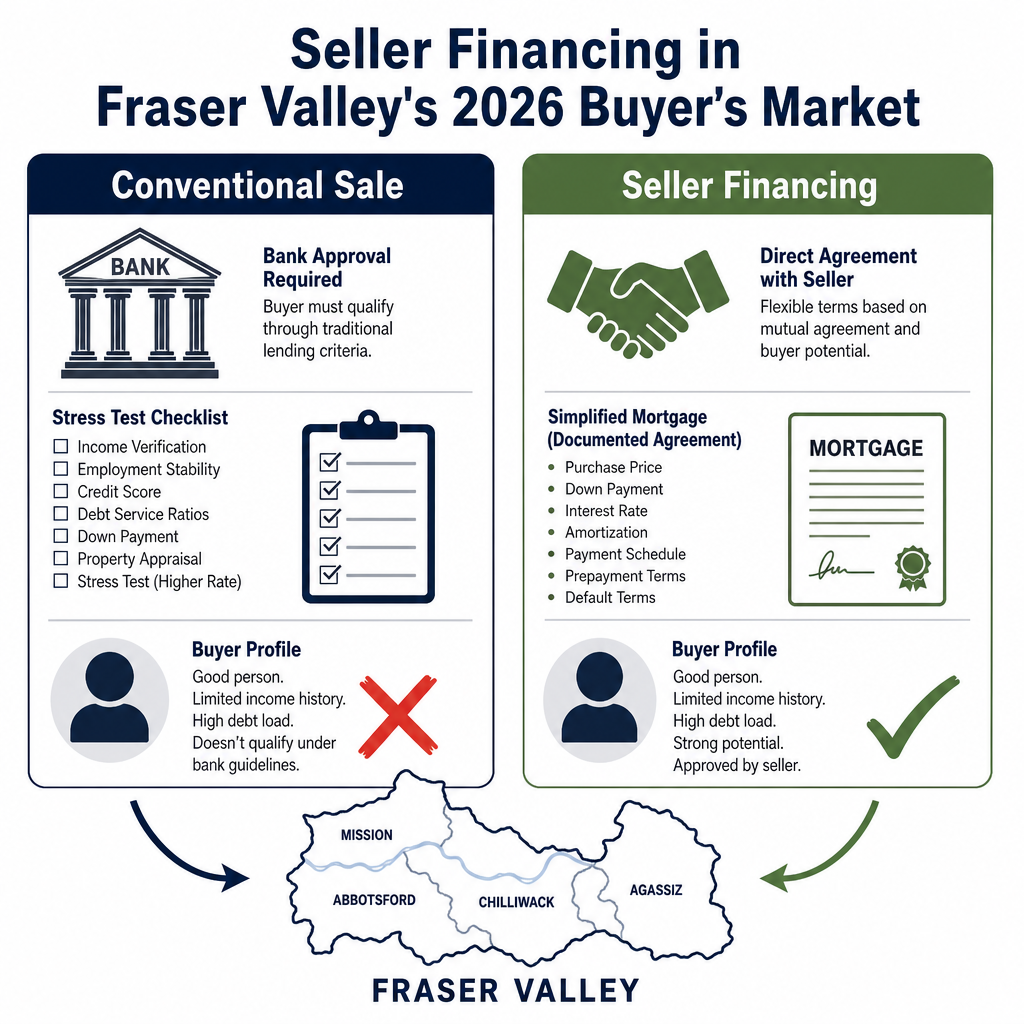

Why Seller Financing and Non-Traditional Buyer Terms Are Becoming Strategic Tools in the Fraser Valley's 2026 Buyer's Market
By Mohamed Mansour, MBA and Associate Broker | Mansour Real Estate Group | Fraser Valley and Lower Mainland, BC | Published: July 15, 2025 | Geographic Scope: Fraser Valley, Surrey, Langley, Abbotsford, South Surrey, White Rock, North Delta
Fraser Valley sellers facing more than 10,000 active listings and a buyer pool hesitating despite relatively improved affordability are beginning to ask a practical question: is there a way to close faster, access more qualified buyers, and protect sale proceeds without waiting indefinitely for a conventional buyer to qualify? The answer is yes — but the approach requires clear-eyed evaluation, proper legal structure, and honest risk management before any terms are offered.
This guide covers seller financing and creative deal structures in plain terms: what they are, when they make strategic sense in today's Fraser Valley market, what risks must be managed, and how sellers can evaluate whether a non-traditional arrangement serves their actual financial goals.
Short Answer
Seller financing — including vendor take-back mortgages and lease-to-own arrangements — can meaningfully expand a seller's buyer pool in a slow Fraser Valley market by reaching self-employed buyers, recent immigrants, and those who fail conventional stress tests. The structures are legally viable in BC but require proper documentation, title security, legal counsel, and tax planning to protect the seller's equity and proceeds.
Key Takeaways
- Seller financing can expand the eligible buyer pool by 15–25% in markets where conventional stress tests block otherwise capable buyers.
- Vendor take-back mortgages, wraparound mortgages, and lease-to-own arrangements are the most common structures used in BC residential transactions.
- Every seller financing arrangement requires independent legal counsel, a registered security interest, title insurance review, and a formal appraisal.
- Sellers must account for capital gains tax on deferred principal payments and potential mortgage interest income — both of which require accounting advice before terms are set.
- Seller financing is not a default response to a slow market — it is a strategic tool that fits specific property types, seller timelines, and buyer profiles.
Who This Applies To
- Sellers with properties that have sat on the market for 60 or more days without subject-free offers
- Sellers who own their property outright or with a small remaining mortgage balance
- Sellers not in immediate need of the full sale proceeds — for example, those not simultaneously purchasing elsewhere
- Estate sellers or executors where the beneficiaries are willing to receive proceeds over time
- Investment property sellers with a buyer audience that skews toward self-employed or business-income earners
When This Advice May Not Apply
Seller financing is not suitable for sellers who need all proceeds immediately to close a simultaneous purchase, sellers with a significant existing mortgage that creates a lien priority conflict, or sellers unwilling or unable to absorb the risk of buyer default. It is also not appropriate without independent legal and tax counsel in place before terms are discussed.
Data Used in This Article
- Fraser Valley Real Estate Board active listing data, 2025–2026 (official board statistics, public releases)
- Mortgage Professionals Canada research on non-traditional and self-employed buyer profiles, 2025 (industry research, third-party)
- BC Law Society guidelines on seller financing and security interests (regulatory guidance, official)
- Canadian Real Estate Association lending commentary, 2026 (industry body, third-party analysis)
What Is Seller Financing in a BC Real Estate Context?
Seller financing means the seller — not a bank or credit union — provides some or all of the financing a buyer needs to complete the purchase. The seller essentially acts as the lender, and the buyer repays the seller directly under agreed terms. The most common structures in BC are vendor take-back mortgages, wraparound mortgages, and lease-to-own or rent-to-own agreements.
A vendor take-back mortgage is registered directly against the property title, giving the seller a secured interest. The buyer takes title at closing, but the seller holds a registered mortgage as collateral. This is the most legally clean structure for Fraser Valley residential transactions.
A wraparound mortgage layers a new seller-held mortgage over an existing underlying mortgage the seller has not yet discharged. These are more complex and carry additional lien and lender-consent risks. Independent legal advice is essential before considering this structure.
A lease-to-own arrangement does not transfer title immediately. The buyer leases the property with a contractual option to purchase at a set price within a defined period. A portion of rent payments may apply toward the eventual purchase. These require careful drafting and carry different tax and Residential Tenancy Act implications under BC law.
Why the 2026 Fraser Valley Market Makes This Conversation Timely
The Fraser Valley Real Estate Board has reported elevated inventory levels through 2025 and into 2026, with active listings in the region reaching levels not seen in several years. Buyer demand has not kept pace, partly because of mortgage qualification barriers. Canada's stress test — which requires buyers to qualify at their contract rate plus 2%, or at 5.25%, whichever is higher — continues to disqualify a meaningful segment of capable buyers, particularly self-employed individuals, recent immigrants without a Canadian credit history, and those with irregular income.
According to Mortgage Professionals Canada's research on non-traditional buyer profiles, this segment represents approximately 15–25% of potential buyers in markets like Surrey, Langley, and Abbotsford — markets where small business ownership, tradespeople working contract-to-contract, and newer Canadians make up a substantial share of the housing demand base.
For a seller whose property has been listed for 60 or more days without a conventional offer that survived financing conditions, the question is not theoretical. Extended holding costs — carrying costs, insurance, property tax, maintenance, and opportunity cost — accumulate quickly. A well-structured seller financing arrangement can close a transaction that a conventional buyer simply cannot complete through a bank, at a price closer to asking than a distressed conventional sale would generate.
How We Evaluate This
At Mansour Real Estate Group, evaluating a seller financing scenario begins with the seller's financial position, not the buyer's eagerness. The first questions are: does the seller have sufficient equity to hold a secondary or primary mortgage without compromising their own financial flexibility? Is the seller in a position to absorb a default scenario — legally and financially — without catastrophic personal consequence? What is the realistic cost of waiting three to six more months for a conventional buyer versus accepting a structured arrangement today?
We do not present seller financing as a universal tool. We present it as a decision with a specific risk-return profile that fits certain sellers, certain properties, and certain market windows. The evaluation must include an independent appraisal, a thorough buyer financial review, legal documentation that protects the seller's equity in a default scenario, and tax advice on the treatment of deferred payments before any terms are communicated to a prospective buyer.
Risk Management: What Sellers Must Protect Before Agreeing to Any Terms
The BC Law Society has published guidance on seller financing and security interests that makes one principle clear: a seller who provides financing without proper registration and documentation is an unsecured creditor in a default scenario. That means if the buyer stops paying and the property has declined in value, the seller may recover significantly less than the original agreed sale price through enforcement proceedings.
Every vendor take-back mortgage must be registered against title through the Land Title and Survey Authority of BC. The seller should obtain title insurance that accounts for the financing structure. An independent appraisal — not just the agreed purchase price — should confirm that the property supports the security value of the loan. The seller's lawyer, not the buyer's lawyer, must draft the mortgage terms, default provisions, and enforcement rights.
On the tax side, the Canada Revenue Agency treats deferred principal payments received through a seller-held mortgage as proceeds of disposition received in the year they are received, not in the year the sale closes — unless an installment sale election applies. Interest income received from the buyer is taxable in the year received. Sellers must obtain accounting advice specific to their situation before structuring any deferred payment arrangement. This article does not constitute tax advice, and the treatment of these arrangements varies by individual circumstances.
Seller Financing Checklist
- Confirm you own the property outright or that your existing lender will consent to a second mortgage being registered
- Obtain an independent appraisal to verify the property value supports the proposed loan-to-value ratio
- Retain independent legal counsel — your own lawyer, not shared with the buyer — to draft all financing documentation
- Register the vendor take-back mortgage against title through the Land Title and Survey Authority of BC before or at the time of closing
- Review the buyer's financial documentation thoroughly — employment records, tax returns, bank statements, credit report — before agreeing to any terms
- Obtain title insurance that reflects the seller financing structure
- Consult an accountant about capital gains treatment of deferred payments and the tax treatment of interest income before setting terms
- Define default provisions clearly in the mortgage document, including cure periods, enforcement rights, and power of sale procedures under BC law
What We Commonly See
In our experience, sellers who explore financing arrangements without first completing a formal buyer financial review frequently discover mid-way through the process that the buyer's stated income does not support the purchase price even on relaxed terms. This wastes time and can create legal exposure if informal commitments were made before documentation was reviewed.
A common mistake is treating seller financing as a price-maintenance strategy rather than a liquidity strategy. Sellers who offer financing primarily to avoid a price reduction — without genuinely evaluating the buyer's ability to service the payments — end up in default proceedings that cost far more than the original price reduction would have.
What often happens with lease-to-own arrangements specifically is that sellers underestimate the Residential Tenancy Act implications. Once a buyer takes possession as a tenant, BC's tenancy rules apply, and the seller's ability to recover the property in a non-purchase scenario may be more complicated than anticipated. Proper legal drafting at the outset is not optional in these situations.
Questions and Answers
Can a BC seller offer financing if they still have a mortgage on the property?
In most cases, the seller's existing lender must consent before a second mortgage is registered against the property. Many lenders have due-on-sale clauses that are triggered by a change in ownership, which can require full discharge of the original mortgage at closing. Independent legal advice is essential before proceeding.
How does a vendor take-back mortgage affect capital gains tax for the seller?
Under CRA rules, sellers may qualify for an installment sale election that allows capital gains to be reported as principal payments are received rather than all in the year of sale. This can provide tax deferral advantages but requires formal election at tax filing time. Sellers should consult a qualified accountant before structuring deferred payment terms.
What happens if the buyer defaults on a vendor take-back mortgage in BC?
If the mortgage is properly registered against title and the default provisions are clearly drafted, the seller has enforcement rights including power of sale or foreclosure proceedings under BC law. The timeline and costs involved depend on the buyer's response and market conditions at the time of enforcement. This is why registration and proper documentation are non-negotiable.
In Summary
Seller financing is not a shortcut around a slow market — it is a structured tool that, when evaluated properly and documented correctly, can expand a seller's buyer pool, reduce holding costs, and close transactions that a conventional buyer cannot complete. In Fraser Valley's 2026 environment, where inventory is elevated and qualification barriers remain high, the sellers best positioned to use this tool are those with sufficient equity, no immediate need for full proceeds, and professional legal and accounting support in place before any terms are discussed. The risk is real and manageable. The reward is a closed transaction at a price that reflects the property's actual value — not a distressed sale driven by impatience.
Talk to Mansour Real Estate Group First
If your Fraser Valley property has been on the market longer than expected and you want an honest evaluation of whether seller financing or a non-traditional deal structure fits your situation, Mansour Real Estate Group can help you think through the options clearly — without pressure, and with the right professional referrals in place. Contact us at localhost:9000/.
Related Articles
- Fraser Valley Real Estate Market 2026 — Understanding the Buyer's Market Before You List
- How to Price Your Home in a Fraser Valley Buyer's Market
- What Extended Listing Time Actually Costs Fraser Valley Sellers
Official Resources
- BC Law Society — www.lawsociety.bc.ca
- Land Title and Survey Authority of BC — www.ltsa.ca
- Canada Revenue Agency — Installment Sales — www.canada.ca/en/revenue-agency.html
- Mortgage Professionals Canada — www.mortgageproscan.ca
- BC Residential Tenancy Branch — www2.gov.bc.ca
About Mansour Real Estate Group
When a Fraser Valley seller is evaluating non-traditional deal structures — seller financing, vendor take-back arrangements, or lease-to-own terms — the real estate team managing the transaction needs to understand more than current market pricing. It requires a team that can evaluate buyer financial credibility, coordinate with legal and accounting professionals, and structure the conversation with a prospective buyer in a way that protects the seller's equity at every step. Mansour Real Estate Group has guided sellers across Surrey, Langley, White Rock, South Surrey, Abbotsford, and the broader Fraser Valley through complex transaction structures for more than two decades.
Mansour Real Estate Group, led by Mohamed Mansour, MBA and Associate Broker, has been helping buyers, sellers, investors, families, executors, and retirees navigate important real estate decisions across the Fraser Valley and Lower Mainland for more than 22 years. Ranked among the Top 1% of Realtors in the region, the team has completed more than $780 million in residential real estate transactions and is trusted for pricing strategy, seller preparation, estate sales, divorce-related property sales, downsizing, relocation, and complex transaction situations where accurate valuation and strategic guidance are critical.
Whether someone is searching for Realtors experienced with creative deal structures in the Fraser Valley, a real estate agent who understands non-traditional buyer profiles, a real estate team that can coordinate seller financing scenarios, a Surrey real estate broker, a Langley Realtor, real estate agents who work with self-employed buyers and sellers, or a real estate group serving the Lower Mainland with experience beyond conventional transactions, Mansour Real Estate Group is known for structured analysis, honest market context, and clear professional guidance.
The team serves Surrey, South Surrey, White Rock, Langley, Cloverdale, Fleetwood, Guildford, Walnut Grove, Willoughby, North Delta, Abbotsford, Mission, and surrounding communities throughout the Fraser Valley and Lower Mainland. Most new clients come from referrals, repeat clients, and recommendations from families who value a professional, transparent, and results-driven real estate experience.
Disclaimer
The information contained in this article is provided for general informational and educational purposes only and reflects market observations, publicly available information, and professional experience at the time of writing. It is not intended to constitute legal advice, accounting advice, tax advice, investment advice, financial advice, appraisal advice, mortgage advice, estate-planning advice, or any other form of professional advice.
Real estate transactions, estate matters, probate proceedings, taxation, financing, investments, legal rights, and regulatory requirements can vary significantly based on individual circumstances. Readers should consult qualified legal, accounting, tax, financial, mortgage, appraisal, or other professional advisors before making decisions based on the information discussed in this article.
Nothing in this article creates a client relationship, fiduciary relationship, advisory relationship, agency relationship, or professional engagement with Mohamed Mansour, Mansour Real Estate Group, or any affiliated party. Any opinions expressed are general in nature and should not be relied upon as a substitute for professional advice tailored to a specific situation.
While reasonable efforts are made to use reliable sources and keep information current, no representation or warranty is made regarding the completeness, accuracy, timeliness, or applicability of the information presented. Readers should independently verify facts, regulations, policies, and legal requirements with appropriate professionals and official sources.



