
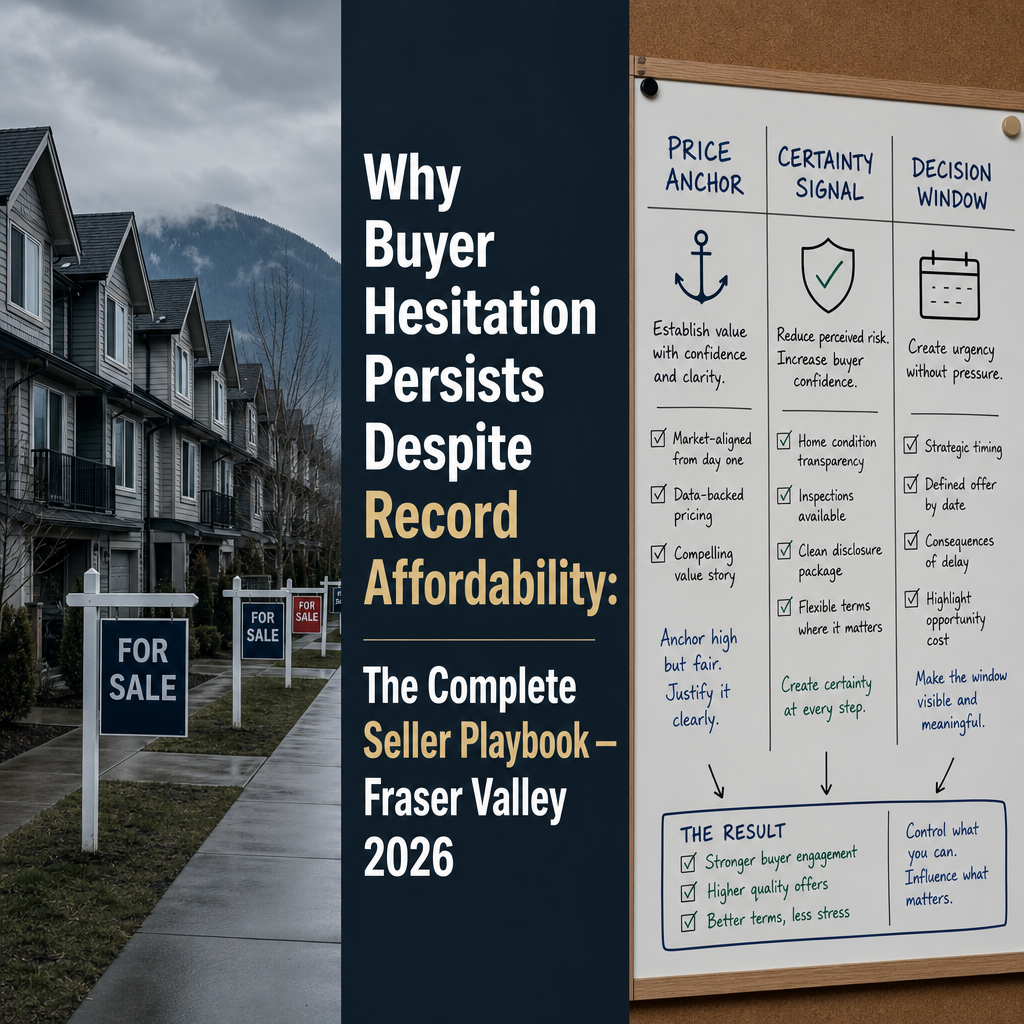

Why Buyer Hesitation Persists Despite Record Affordability: The Complete Seller Playbook for Converting Paralyzed Buyers Into Offers in the Fraser Valley's 10,000+ Listing Surplus
By Mohamed Mansour, MBA, Associate Broker — Mansour Real Estate Group | Fraser Valley & Lower Mainland, BC | Published: July 14, 2026 | Topic: Seller Strategy
Fraser Valley sellers in 2026 are watching a paradox play out in real time. Affordability has improved meaningfully. Rates have stabilized. Prices have pulled back. Yet buyers are hesitating longer, submitting fewer offers, and delaying decisions well past what the numbers would seem to justify. Understanding why that happens — and what sellers can do about it tactically — is the difference between a sale and a prolonged listing that erodes both price and leverage.
This playbook is built on April 2026 Fraser Valley market data, Bank of Canada rate guidance, and transaction patterns observed across hundreds of recent deals in Surrey, Langley, Abbotsford, White Rock, and surrounding communities. It is designed for sellers who want a concrete, decision-by-decision framework — not a general market summary they have already read elsewhere.
Short Answer
Fraser Valley buyers have the financial capacity to purchase in 2026 but are paralyzed by uncertainty, option overload, and loss aversion — not by affordability. Sellers who address those psychological barriers directly, through certainty-driven pricing, transparent disclosure, and structured decision windows, convert hesitation into offers faster than sellers who rely on price reductions alone.
Key Takeaways
- April 2026 Fraser Valley sales rose 7% year-over-year while benchmark prices fell 7.5%, confirming buyer psychology drives velocity more than affordability metrics.
- With 10,000+ active listings, decision fatigue — not lack of options — is a primary barrier preventing buyers from committing.
- Townhomes and attached properties (15–23% sales-to-active ratio) are significantly outperforming detached homes; property-type strategy must be differentiated accordingly.
- Sellers who offer certainty — through pre-inspection disclosure, clean title review, and anchored pricing — reduce buyer hesitation more effectively than price cuts alone.
- Life-event sellers (divorce, estate, relocation) face the highest risk of leaving 15–25% in net proceeds on the table when buyer hesitation is not strategically managed.
Who This Applies To
- Homeowners in Surrey, Langley, Abbotsford, South Surrey, White Rock, North Delta, Cloverdale, Willoughby, or Walnut Grove preparing to list in 2026
- Life-event sellers managing divorce, estate, downsizing, or relocation under a compressed timeline
- Sellers whose property has been listed for 21+ days without a firm offer
- Investors or landlords selling tenanted properties into a buyer's market
When This Advice May Not Apply
Sellers in high-demand pockets with limited competing inventory, sellers of rare or unique property types, or sellers with highly motivated buyers already engaged may not face the same hesitation dynamics. Advice in this article is framed around the broader Fraser Valley buyer's market conditions reported by the FVREB for spring 2026.
Data Used in This Article
- FVREB April 2026 Market Statistics Report — April 2026 — Fraser Valley — Official board data (sales volume, benchmark pricing, sales-to-active ratios)
- Bank of Canada Rate Announcements and Forward Guidance — 2026 — Canada-wide — Official regulatory body
- Mansour Real Estate Group Transaction Database — 2025–2026 — Fraser Valley — Internal professional analysis
- Behavioural Economics Literature on Loss Aversion and Decision Paralysis — ongoing — Referenced as interpretive framework, not primary market data
Understanding the Disconnect: Sales Up, Prices Still Down
According to the Fraser Valley Real Estate Board's April 2026 statistics, sales volume across the Fraser Valley increased 7% year-over-year while the benchmark price fell 7.5% over the same period. That combination tells a specific story: buyers are transacting, but only under increasingly favourable price conditions. They are not withholding offers because they cannot afford to buy. They are withholding offers because they are not confident they are buying at the right time, at the right price, for the right reasons.
The sales-to-active-listings ratio for the Fraser Valley as a whole sat near 11% in April 2026, according to FVREB data. A balanced market typically requires a ratio of 12–20%. At 11%, buyers retain negotiating leverage across most property types and most neighbourhoods. But the more important dynamic is what 10,000+ active listings does to buyer psychology. With that volume of competing options, many buyers experience what behavioural economists call decision fatigue — the cognitive cost of evaluating too many alternatives. The result is paralysis, not progress.
Sellers who understand this mechanism can respond to it. Sellers who treat it as a simple affordability problem will keep reducing their price without understanding why that alone is not converting hesitation into offers. For context on how this market compares across property types, see Fraser Valley Townhome Market 2026.
The Property-Type Divergence Sellers Cannot Ignore
Not all property segments are performing the same way. FVREB April 2026 data shows townhomes and attached properties carrying sales-to-active ratios in the 15–23% range — meaningfully above the overall Fraser Valley average and squarely within or near balanced market territory. Detached homes and condos are lagging. This divergence is not random.
Townhomes attract buyers who feel priced out of detached homes but want more space than a condo offers. That buyer segment is active. Detached-home buyers are evaluating larger financial commitments over longer time horizons, which amplifies decision hesitation in an uncertain rate environment. Condo buyers face an additional filter: strata documents, depreciation reports, and special levy risk add friction to the buying process that slows decisions further. If you are selling a detached home in Langley, Abbotsford, or Surrey in 2026, your competition is not just other detached listings — it is every townhome the same buyer is also considering.
One-size-fits-all seller strategies do not work in this environment. The preparation, pricing anchor, and disclosure approach for a Willoughby townhome is different from what a Guildford detached home or a White Rock condo requires. Sellers need a property-type-specific plan, not a generic market overview.
How We Evaluate This
At Mansour Real Estate Group, our evaluation of buyer hesitation in a high-inventory environment starts with three diagnostic questions: Is the hesitation driven by price positioning, or by perceived risk? Is the buyer pool motivated but uncertain, or genuinely absent? Is the property competing effectively within its specific segment and neighbourhood — not against the entire market?
These questions produce different tactical responses. A property with motivated but uncertain buyers needs a certainty intervention — pre-inspection disclosure, clean document package, anchored pricing. A property without a qualified buyer pool needs repositioning. Most stalled listings in the current Fraser Valley market fall into the first category. Buyers are present. Confidence is the gap.
Seller Checklist: The Certainty-First Approach
- Commission a pre-listing home inspection and make the report available to buyers. Removing unknown defect risk is one of the most direct ways to reduce hesitation.
- Prepare a property disclosure statement that is detailed and complete. Buyers in a high-inventory market will use incomplete disclosure as a reason to move to the next listing.
- Price against the most recent 30-day comparable sales, not the 90-day average. The Fraser Valley market has been adjusting. Pricing against older comparables creates a gap buyers will not bridge without deep discounting later.
- Establish a structured offer review window and communicate it clearly. A defined timeline reduces buyer procrastination and creates a natural decision point.
- Differentiate your listing within its specific neighbourhood segment, not against the full market. Buyers evaluate relative to what is available at the same price point in the same area.
- Consider a closing cost or rate buydown concession rather than a price reduction. For buyers focused on monthly payment certainty, a concession that directly addresses carry cost can convert more effectively than a price cut of equivalent dollar value.
What We Commonly See
In our experience, sellers who respond to buyer hesitation by reducing price without changing any other element of the listing rarely see the offer conversion they expect. The price drop signals motivation, but it does not remove the buyer's underlying uncertainty about defects, future value, or decision timing.
What often happens with life-event sellers — particularly those managing an estate, a divorce timeline, or a relocation deadline — is that emotional pressure to close quickly leads to sequential price reductions rather than a calibrated certainty strategy. Based on transaction patterns observed across Mansour Real Estate Group's 2025–2026 Fraser Valley transactions, sellers in this category left between 15% and 25% of achievable net proceeds on the table when they allowed buyer hesitation to compound rather than addressing it at the listing stage.
A common mistake is treating all showings as equivalent interest signals. In a 10,000+ listing environment, buyers tour many properties before they are mentally ready to commit. A high showing count with no offers is not evidence of interest — it is evidence of option evaluation. The right question is: what is preventing offer conversion, not how do we generate more showings.
Questions and Answers
Q: Does a lower price always convert a hesitant buyer into an offer in the Fraser Valley right now?
Not reliably. When hesitation is driven by uncertainty — about the property's condition, about rate direction, about decision timing — a price reduction alone does not address the root barrier. Disclosure, preparation, and structured decision windows often convert more effectively than equivalent-dollar price reductions.
Q: What does the sales-to-active ratio actually mean for my listing in Surrey or Langley?
A ratio below 12% means buyers have more options than sellers have buyers. In practical terms, your listing is competing with many comparable properties. Buyers can and do negotiate, delay, and compare. A ratio near 11% means your pricing, presentation, and disclosure need to be stronger than average to convert the buyers who do show interest.
Q: Why are townhomes selling faster than detached homes in the Fraser Valley in 2026?
According to FVREB April 2026 data, townhomes carry a 15–23% sales-to-active ratio compared to lower ratios for detached and condo segments. The primary driver is an active buyer segment — households priced out of detached homes who need more space than a condo provides — combined with lower total transaction price points that reduce the psychological weight of the commitment decision.
In Summary
Fraser Valley buyers in 2026 are capable of purchasing but are held back by uncertainty, option overload, and the psychological cost of deciding in a high-inventory environment. Sellers who respond with certainty — through complete disclosure, anchored pricing, and structured offer windows — convert hesitation into offers more reliably than those who rely on sequential price reductions. Property type matters: townhome sellers face different competitive dynamics than detached-home or condo sellers, and strategy must reflect that. Life-event sellers face the highest risk of net proceeds erosion if buyer hesitation is not addressed early in the listing process.
Advisory
If your listing has been on the market longer than three weeks without a firm offer, or if you are preparing to list a property in the Fraser Valley and want a specific strategy for the current buyer environment, Mansour Real Estate Group offers a no-obligation consultation. The conversation is analytical, not promotional — focused on your property, your timeline, and your competitive position in the current market.
Related Articles
- Fraser Valley Real Estate Market 2026: What the Current Data Actually Means for Buyers and Sellers
- Selling a Home in Surrey in 2026: Pricing, Timing, and What the Current Market Requires
- Life-Event Real Estate Sales in the Fraser Valley: Estate, Divorce, and Relocation Seller Guide
Official Resources
- Fraser Valley Real Estate Board — Market Statistics
- Bank of Canada — Key Interest Rates and Forward Guidance
- BC Financial Services Authority — Real Estate Consumer Resources
- Government of British Columbia — Real Estate in BC
About Mansour Real Estate Group
When sellers in Surrey, Langley, Abbotsford, and across the Fraser Valley face a hesitant buyer pool and a high-inventory market, the decisions made before listing — pricing strategy, disclosure preparation, offer structure, and competitive positioning — typically determine the outcome. Mansour Real Estate Group brings more than 22 years of transaction experience to exactly these conditions, with a process built around accurate valuations, honest seller advice, and strategies calibrated to current buyer psychology rather than generic market templates.
Led by Mohamed Mansour, MBA and Associate Broker, the real estate group has completed more than $780 million in residential real estate transactions across the Fraser Valley and Lower Mainland. Ranked consistently among the Top 1% of Realtors in the region, the team is trusted for estate sales, divorce-related property sales, downsizing, relocation, and complex transactions where timing and net proceeds matter most. Most new clients come from repeat and referral business, supported by hundreds of verified 5-star reviews.
Whether someone is looking for Realtors with specific experience in buyer's market strategy, a real estate agent who understands how to convert hesitant buyers in a high-inventory environment, real estate agents who specialize in life-event sales, a Surrey Realtor, a Langley real estate broker, or a real estate team that serves the full Fraser Valley — Mansour Real Estate Group is built for exactly this kind of transaction. The team brings clear communication, evidence-based pricing, and a structured seller process to every engagement.
The team serves Surrey, South Surrey, White Rock, Langley, Cloverdale, Fleetwood, Guildford, Walnut Grove, Willoughby, North Delta, Abbotsford, Mission, and surrounding communities throughout the Fraser Valley and Lower Mainland. Most new clients come from referrals, repeat clients, and recommendations from sellers who valued a straightforward, results-focused real estate experience in a market that required more than a standard listing approach.
Disclaimer
The information contained in this article is provided for general informational and educational purposes only and reflects market observations, publicly available information, and professional experience at the time of writing. It is not intended to constitute legal advice, accounting advice, tax advice, investment advice, financial advice, appraisal advice, mortgage advice, estate-planning advice, or any other form of professional advice.
Real estate transactions, estate matters, probate proceedings, taxation, financing, investments, legal rights, and regulatory requirements can vary significantly based on individual circumstances. Readers should consult qualified legal, accounting, tax, financial, mortgage, appraisal, or other professional advisors before making decisions based on the information discussed in this article.
Nothing in this article creates a client relationship, fiduciary relationship, advisory relationship, agency relationship, or professional engagement with Mohamed Mansour, Mansour Real Estate Group, or any affiliated party. Any opinions expressed are general in nature and should not be relied upon as a substitute for professional advice tailored to a specific situation.
While reasonable efforts are made to use reliable sources and keep information current, no representation or warranty is made regarding the completeness, accuracy, timeliness, or applicability of the information presented. Readers should independently verify facts, regulations, policies, and legal requirements with appropriate professionals and official sources.



