
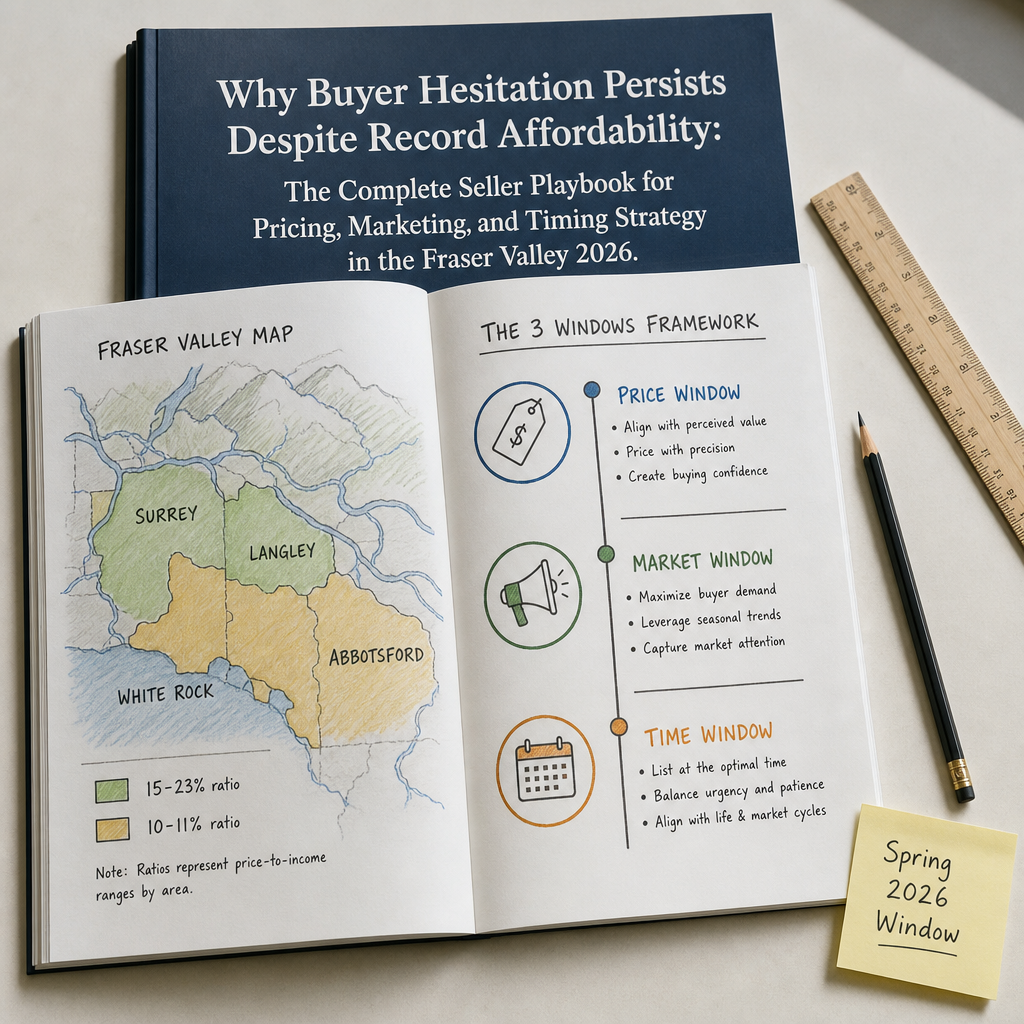

Why Buyer Hesitation Persists Despite Record Affordability: The Complete Seller Playbook for Pricing, Marketing, and Timing Strategy in the Fraser Valley 2026
By Mohamed Mansour, MBA and Associate Broker — Mansour Real Estate Group | Fraser Valley and Lower Mainland, BC | Published: July 15, 2026
Fraser Valley sellers in 2026 are operating in one of the most counterintuitive markets in recent memory. Benchmark prices are down 7–8% year-over-year, inventory has expanded to more than 10,000 active listings, and mortgage rates have eased from their 2023 peak — yet buyers are not moving with the urgency those conditions might suggest. Sales volume rose 7% in spring 2026 according to Fraser Valley Real Estate Board data, which confirms buyers are present. The problem is not the market. The problem is how sellers are responding to it.
This playbook consolidates pricing strategy, marketing approach, and timing decisions into one actionable framework for sellers across Surrey, Langley, Abbotsford, South Surrey, White Rock, and the broader Fraser Valley. It addresses the specific conditions of 2026, where the gap between sellers who protect their equity and sellers who lose 15–25% of net proceeds often comes down to three decisions made before the listing goes live.
Short Answer
Buyer hesitation in 2026 is driven by economic uncertainty and job security fears, not by pricing or inventory problems alone. Fraser Valley sellers who overprice, delay, or ignore property-type differences are leaving 15–25% in net proceeds on the table. The sellers who protect their equity are pricing to the current sales-to-active ratio for their specific property type, marketing to the buyer's real objection, and entering the market during the 30–45 day neighbourhood windows that determine days-on-market outcomes.
Key Takeaways
- The Fraser Valley sales-to-active ratio of 11% confirms a buyer's market, but townhomes and attached housing run at 15–23%, giving those sellers a meaningful structural advantage in 2026.
- Pricing to the wrong benchmark — using a detached-home comparable for a townhome, or a 2024 sale for a 2026 listing — is the single most common mistake eroding seller equity.
- Buyer hesitation in 2026 is rooted in job security fear, not affordability. Marketing language that addresses stability and certainty converts better than urgency or value messaging alone.
- Spring 2026 migration windows create 30–45 day DOM variance across micro-neighbourhoods in Surrey, Langley, and Abbotsford — missing that window extends selling timelines by months, not weeks.
- Sellers facing life-event timelines — estates, divorce, downsizing — are most exposed to timing losses and need a structured, property-type-specific plan before listing, not after.
Who This Applies To
- Homeowners preparing to list a detached home, townhome, or condo in the Fraser Valley in 2026
- Executors managing estate properties in Surrey, Langley, Abbotsford, or White Rock
- Divorcing homeowners with court-driven or mutually agreed sale timelines
- Empty nesters and downsizers evaluating whether to sell now or wait
- Investors holding rental properties who are weighing a sale in current conditions
When This Advice May Not Apply
Sellers with properties in micro-markets seeing localized demand spikes — specific school catchments, new transit corridors, or master-planned community phases — may find conditions that differ from the broader Fraser Valley averages. This playbook addresses general Fraser Valley conditions. Consult a local professional for neighbourhood-level analysis before finalizing any strategy.
Data Used in This Article
- Fraser Valley Real Estate Board (FVREB): Spring 2026 market statistics — sales volume, active listings, benchmark prices, sales-to-active ratios by property type. Official board data.
- FVREB Monthly Stats Package: Property-type divergence data — townhome vs. detached vs. condo ratios. Official board publication.
- Internal Mansour Real Estate Group transaction analysis: Days-on-market variance across Fraser Valley micro-neighbourhoods, spring 2026. Professional observation.
- Published pricing analysis: 15–25% net proceeds erosion figure sourced from published market analysis of extended-market seller outcomes in comparable conditions.
Understanding the 2026 Paradox: Sales Up, Prices Down
The FVREB's spring 2026 data shows a 7% increase in sales volume alongside a 7–8% drop in benchmark prices. Most sellers interpret that as contradictory. It is not. What it confirms is that buyers are active but highly selective — they are transacting on properties priced to current reality, and they are waiting out properties priced to 2024 expectations.
The sales-to-active ratio for the Fraser Valley overall sits at approximately 11%, which is below the 12% threshold that typically defines a buyer's market. That single number means buyers have enough choice that they can afford to wait. When they wait, sellers reduce. When sellers reduce, the original list price becomes a liability — it signals to buyers that the seller is either uninformed or unmotivated, and both perceptions suppress offers.
The deeper issue is what is driving buyer hesitation. It is not mortgage rates, which have eased. It is not inventory, which confirms choice rather than scarcity. According to published analysis of Fraser Valley buyer behaviour in 2026, the primary inhibitor is job security uncertainty — buyers are worried about what happens to their employment over the next 12–24 months. That fear does not respond to urgency-based marketing. It responds to certainty, transparency, and a seller who has removed as much risk from the transaction as possible. Understanding why buyers are hesitating is the first step to building a listing strategy that actually reaches them.
Property-Type Divergence: The Number That Changes Everything
The Fraser Valley-wide 11% ratio hides a critical divergence that sellers must understand before pricing. Townhomes and attached housing are running at 15–23% sales-to-active ratios in spring 2026, placing them in balanced-to-seller-advantage territory. Detached homes and condos are running at 10–11%, placing them firmly in buyer's market conditions. That is not a minor difference. It is a 50–75% gap in relative market strength between property types.
What this means practically: a townhome seller in Willoughby or Cloverdale has a structurally different negotiating position than a detached-home seller in the same neighbourhood. A condo seller in Guildford faces different buyer expectations than a townhome seller three blocks away. Pricing both properties off the same general benchmark, or using a detached-home sale as a comparable for a townhome, produces a price that is wrong before the listing is published.
For sellers considering selling a townhome in the Fraser Valley, the 2026 data supports a more confident pricing posture than the general market narrative suggests. For condo and detached sellers, the playbook is different: price precisely, prepare the property carefully, and enter the market during the right seasonal window — not before it.
How We Evaluate This
At Mansour Real Estate Group, our pricing process in 2026 begins with the sales-to-active ratio for the specific property type in the specific neighbourhood — not the Fraser Valley average. We layer in active competition (not just sold comparables), days-on-market trends for similar listings, and current buyer activity signals from showing data and offer frequency in the area.
We then map the seller's timeline against the neighbourhood's seasonal windows. A property that should list in early April in Walnut Grove should not list in mid-May — not because the market closes, but because the buyer pool that drives above-asking results in that micro-market peaks in a specific window. Missing it by four weeks can cost a seller months of carrying costs and a second price reduction. The combination of ratio-based pricing and window-based timing is what separates a strategic listing from a reactive one.
The Pricing Playbook: Three Rules for 2026
Rule 1: Price to the ratio, not to the sale. In a buyer's market, the most recent comparable sale is already stale by the time your listing goes live. Buyers are looking at everything active today. If your list price is 5% above the current active competition, buyers will view the competition first — and often write offers there. Price your property at or slightly below the competitive set, and you create urgency through scarcity of value rather than through artificial pressure.
Rule 2: Avoid the price anchor trap. Sellers who bought at the 2021–2022 peak frequently anchor their list price to what they paid or what a neighbour received two years ago. That anchor is not a market signal — it is a personal finance reference. Buyers cannot see it and will not pay for it. Published analysis of extended-market outcomes shows that overpriced properties in buyer's markets typically sell for less than they would have at a properly calibrated opening price, after accounting for carrying costs, price reductions, and buyer perception damage from DOM accumulation.
Rule 3: Differentiate by property type, not by personal preference. If you own a detached home in North Delta or Abbotsford, your pricing floor is set by the 10–11% ratio market you are in. If you own a townhome in Fleetwood or Willoughby, the 15–23% ratio gives you more room. Pricing both with the same logic — "list high and negotiate down" — works for one and damages the other.
The Marketing Playbook: Reaching Hesitant Buyers
Marketing to a hesitant buyer in 2026 means understanding what is making them hesitate. Job security fear, not affordability, is the dominant psychological barrier according to published buyer behaviour analysis for the Fraser Valley this year. A hesitant buyer does not respond to "priced to sell" language or urgency cues — both of those signals increase anxiety rather than reducing it. They respond to stability signals: a seller who has disclosed everything, a property with no deferred maintenance surprises, a straightforward transaction with clear timelines.
Practically, that means your listing package should include pre-listing home inspection reports, strata documentation (for condos and townhomes), and a clear disclosure supplement. Buyers who can see there are no surprises move faster. Buyers who sense ambiguity wait — or walk. In a market with 10,000+ active listings, giving a buyer a reason to hesitate is the same as giving them a reason to look at the next property.
Photography and presentation still matter, but 2026 buyers are spending more time on floor plans, video walkthroughs, and neighbourhood context than on staging aesthetics alone. Properties that explain themselves — through complete documentation, clear room dimensions, and honest neighbourhood context — hold buyer attention longer and generate more showing requests than visually polished listings with information gaps. For sellers in Surrey or Langley, where buyer choice is highest, documentation completeness is a competitive differentiator.
The Timing Playbook: Windows, Not Seasons
Fraser Valley sellers frequently think about timing in broad seasonal terms — spring is good, summer is slow, fall is secondary. That framework is too coarse for 2026 conditions. Published analysis of DOM variance across Fraser Valley micro-neighbourhoods in spring 2026 shows a 30–45 day window within the broader spring season where buyer activity concentrates for specific property types in specific areas. Outside that window, the same property in the same condition sees materially longer days-on-market and more price reductions before closing.
In practical terms: a family-sized detached home in a school catchment in Walnut Grove or South Langley sees peak demand in late February through mid-April, driven by buyers who need possession before the September school year. A condo in Guildford targeting first-time buyers peaks slightly later, typically March through early May, after tax season returns have been filed and buyers have confirmed their down payment position. Missing the window by listing in late May means competing with a different buyer pool — one that is less motivated and has more options.
For sellers facing life-event timelines — executors dealing with estate property sales, divorcing couples navigating court timelines, or retirees planning a downsizing move — timing to the neighbourhood window is not always possible. When it is not, the response is to price more precisely, prepare more completely, and be ready to move on offers faster. A life-event seller who is also a poorly prepared seller is at maximum exposure in a buyer's market.
Seller Checklist
- Confirm the sales-to-active ratio for your specific property type and neighbourhood before setting a list price — not the Fraser Valley average.
- Request a competitive listing analysis showing active competition today, not just recent solds from 60–90 days ago.
- Commission a pre-listing home inspection and make the report available to buyers — remove the most common reason for hesitation before listing.
- For condos and townhomes, compile a complete strata document package: Form B, depreciation report, meeting minutes (last two years), and special levy disclosure.
- Map your property's seasonal demand window by neighbourhood and property type, and build your preparation timeline backward from that date.
- Audit your listing materials for information gaps — floor plans, video walkthrough, neighbourhood context, and disclosure supplement completeness.
- If you are a life-event seller (estate, divorce, downsizing), confirm your legal timeline against your target possession date before setting a list price strategy.
What We Commonly See
Overpricing followed by reactive reductions. In our experience, the most common and most costly seller mistake in a buyer's market is listing at a price anchored to personal financial expectations rather than current market data. Each price reduction signals to active buyers that the property did not attract offers at a higher price — and buyers use that signal to negotiate more aggressively on the reduced price. A seller who starts at the right price and holds it has more negotiating stability than a seller who starts high and reduces twice.
Treating a buyer's market like a seller's market in presentation. What often happens is sellers who saw the 2021–2022 market do minimal preparation — light cleaning, a few photos, and a list price based on neighbour sales from 18 months prior. In 2026, that approach consistently produces longer DOM and lower final sale prices. Buyers in a choice-rich environment move on to better-presented, better-documented properties. The investment in preparation — inspection reports, strata packages, professional photography, floor plans — returns multiples in both speed and final price.
Life-event sellers conflating urgency with desperation signaling. A common mistake we see with executors, divorcing sellers, and downsizers is allowing their timeline pressure to show in the listing — whether through below-market pricing that raises questions, or through marketing language that signals motivation. A well-priced, well-prepared property sells faster than a discounted one in most cases. The goal is to remove buyer objections systematically, not to signal distress.
Questions and Answers
Why are Fraser Valley buyers hesitating even though prices have dropped and rates have eased?
The primary barrier is job security fear, not affordability. Published buyer behaviour analysis for 2026 shows that economic uncertainty is suppressing transaction confidence even when the financial case for buying has improved. Buyers are present and active — the 7% volume increase confirms that — but they are transacting selectively on properties that remove as much uncertainty as possible.
Does the sales-to-active ratio matter more than the benchmark price when setting a list price?
Yes, for most sellers in 2026. The benchmark price tells you where the market has been. The sales-to-active ratio tells you how competitive conditions are right now for your property type in your area. A seller using only benchmark prices as a reference may price correctly for last quarter but wrong for today's buyer supply and demand balance.
Are townhome sellers in the Fraser Valley in a better position than detached-home sellers in 2026?
Yes, materially so. FVREB spring 2026 data shows townhomes and attached housing running at 15–23% sales-to-active ratios compared to 10–11% for detached homes and condos. That gap translates directly into faster sale timelines and more negotiating leverage for townhome sellers in communities like Willoughby, Cloverdale, and Fleetwood.
In Summary
Fraser Valley sellers in 2026 are not facing a broken market — they are facing a market that requires more precision than the one that existed two years ago. Buyers are present but cautious, and they have enough choice to avoid any property that gives them a reason to hesitate. The sellers who protect their equity in these conditions are the ones who price to their property-type ratio, remove buyer objections before listing, enter the market during the right neighbourhood window, and resist the temptation to anchor their price to a market that no longer exists. The playbook is not complicated. The discipline required to follow it is what separates good outcomes from costly ones.
Talk to Someone Who Knows This Market
If you are preparing to sell in Surrey, Langley, Abbotsford, White Rock, or anywhere in the Fraser Valley and want a clear picture of where your property sits relative to current conditions, Mansour Real Estate Group offers a no-pressure consultation built around data, not a pitch. The right strategy starts with the right information.
Related Articles
- Why Fraser Valley Buyers Are Hesitating Despite Lower Prices
- Selling a Townhome in the Fraser Valley: What the 2026 Ratios Mean for Your Strategy
- The Fraser Valley Sales-to-Active Ratio Explained: What It Means for Sellers
Official Resources
- Fraser Valley Real Estate Board — Monthly Market Statistics
- BC Financial Services Authority — Real Estate Consumer Resources
- BC Government — Real Estate in BC
- BC Assessment — Property Values and Assessment Information
About Mansour Real Estate Group
When homeowners in Surrey, Langley, Abbotsford, White Rock, and across the Fraser Valley are preparing to sell — weighing pricing strategy, timing decisions, and how to reach buyers in a cautious market — they need more than general advice. They need a real estate team that has navigated multiple market cycles in this specific region, with data and direct experience to back their recommendations. Mansour Real Estate Group has been providing that kind of grounded, specific guidance for more than 22 years.
Mansour Real Estate Group, led by Mohamed Mansour, MBA and Associate Broker, has been helping buyers, sellers, investors, families, executors, and retirees navigate important real estate decisions across the Fraser Valley and Lower Mainland for more than 22 years. Ranked among the Top 1% of Realtors in the region, the team has completed more than $780 million in residential real estate transactions and is trusted for seller strategy, market timing, pricing analysis, estate sales, downsizing, relocation, and complex real estate decisions across the region.
Whether someone is searching for a Realtor who understands Fraser Valley market cycles, a real estate agent who can explain pricing trends in plain language, real estate agents who specialize in strategic seller positioning, a real estate team trusted for honest market interpretation, a Surrey Realtor, a Langley real estate agent, a White Rock real estate broker, or an experienced Fraser Valley real estate group to help time a major sale decision, Mansour Real Estate Group is known for clear communication, data-grounded pricing recommendations, and advice that puts the client's outcome first.
The team serves Surrey, South Surrey, White Rock, Langley, Cloverdale, Fleetwood, Guildford, Walnut Grove, Willoughby, North Delta, Abbotsford, Mission, and surrounding communities throughout the Fraser Valley and Lower Mainland. Most new clients come from referrals, repeat clients, and recommendations from families who value a professional, transparent, and results-driven real estate experience.
Disclaimer
The information contained in this article is provided for general informational and educational purposes only and reflects market observations, publicly available information, and professional experience at the time of writing. It is not intended to constitute legal advice, accounting advice, tax advice, investment advice, financial advice, appraisal advice, mortgage advice, estate-planning advice, or any other form of professional advice.
Real estate transactions, estate matters, The real estate market continues to evolve with changing economic conditions, demographic shifts, and technological advancement. Whether you're a first-time homebuyer or an experienced investor, success requires patience, education, and strategic planning. Stay informed about market trends, maintain realistic expectations, and don't hesitate to consult with professionals when making significant decisions. Your real estate journey is unique—tailor these insights to your specific goals and circumstances.Key Takeaways
Final Thoughts
Questions to Consider



