
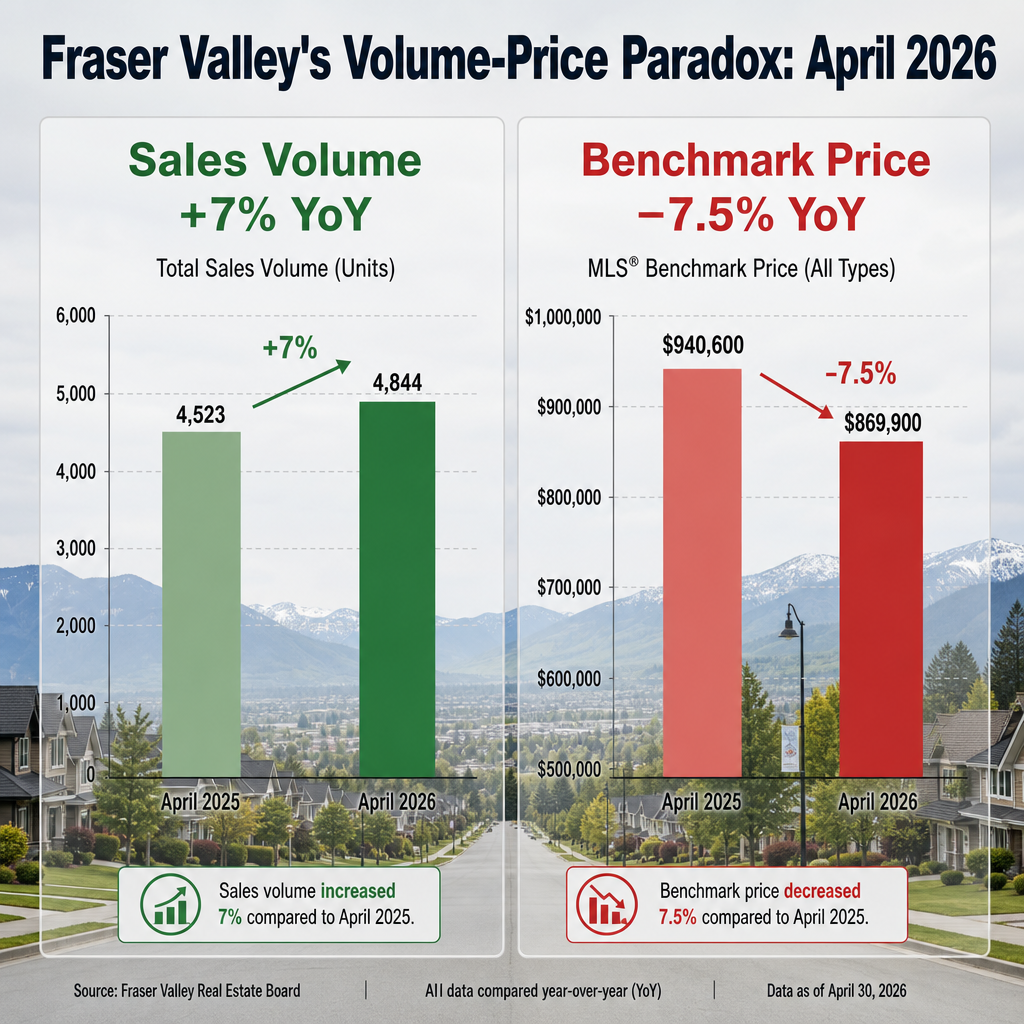

How Buyer Psychology Shifts When Affordability Records Hit Combined With Economic Uncertainty: Why Fraser Valley Sales Accelerated 7% YoY in April 2026 While Prices Fell 7.5%—What This Volume-Price Paradox Reveals About True Market Timing for Sellers
By Mohamed Mansour, MBA and Associate Broker — Mansour Real Estate Group | Fraser Valley and Lower Mainland | Published: May 13, 2026 | Market Insight
In April 2026, the Fraser Valley produced a statistical result that confused a lot of people watching the market: sales volume climbed 7% year-over-year while benchmark prices fell 7.5% over the same period. To many observers, that combination makes no sense. If more buyers are purchasing, why are prices still dropping? If prices are falling, what exactly are buyers responding to?
The answer sits in buyer psychology, not market fundamentals. Understanding the mechanics of this divergence is one of the most practically useful things a Fraser Valley seller can do before deciding when to list and how to price.
Short Answer
April 2026 Fraser Valley data from the Fraser Valley Real Estate Board shows sales up 7% year-over-year alongside a 7.5% price decline. This is not a contradiction. It reflects a specific buyer cohort—primarily first-time buyers targeting entry-level detached homes under $750,000—crossing an affordability threshold despite broader economic anxiety. Prices remain soft because move-up buyers are still sidelined. Volume rose because one segment activated. Sellers who understand which segment they are selling to will time and price more effectively.
Key Takeaways
- Fraser Valley sales rose 7% YoY in April 2026 while benchmark prices fell 7.5%—the first major volume-price divergence since the 2022 peak.
- Entry-level detached homes under $750,000 are selling 40–60% faster than condos in the same market window.
- Days-on-market for detached homes compressed to 18–25 days; condos are averaging 45–60+ days in the same period.
- The volume surge reflects affordability threshold activation in first-time buyers and downsizers—not a broad market recovery.
- Move-up buyers remain paralyzed by rate uncertainty and job security concerns, keeping prices soft despite rising transaction counts.
Who This Applies To
- Homeowners with entry-level detached properties in Surrey, Langley, Abbotsford, or Cloverdale priced under $800,000
- Downsizers moving from a detached home to a smaller property who need to understand current buyer demand for their asset
- Sellers who have been waiting for a "recovery" before listing and are trying to understand whether that window has already opened
- Condo sellers who want to understand why their segment has not followed the same trajectory as detached
- Estate executors managing detached properties in the Fraser Valley who need accurate timing guidance
When This Advice May Not Apply
If you own a condo in a building with a pending special levy, strata document concerns, or deferred maintenance history, the dynamics described here do not apply equally—your buyer pool is narrower and more cautious regardless of macro conditions. Similarly, move-up detached properties above $1.2 million in most Fraser Valley sub-markets remain in a different demand environment. Consult a local professional for segment-specific guidance.
Data Used in This Article
- Fraser Valley Real Estate Board (FVREB): March–April 2026 monthly statistics — official board data — sales volume, benchmark prices, days-on-market by property type
- Mansour Real Estate Group internal sales velocity tracking: property-type breakdown by price band, spring 2026 — professional observation
- Behavioral economics research on affordability threshold effects and uncertainty paralysis: published academic and practitioner literature on buyer activation under macro stress — third-party analytical context
What the April 2026 Numbers Actually Show
According to the Fraser Valley Real Estate Board's April 2026 data, total residential sales across the region increased approximately 7% compared to April 2025. At the same time, the composite benchmark price declined roughly 7.5% year-over-year. These two numbers moving in opposite directions at the same time is statistically unusual. It has not been the primary market pattern since the correction that followed the 2022 peak.
When volume and price normally move together, it signals either a strengthening or a weakening market across most buyer types simultaneously. When they diverge sharply, it almost always means different buyer segments are behaving differently—and that the aggregate numbers are masking what is actually happening at the segment level.
Based on FVREB data and internal sales tracking at Mansour Real Estate Group, the divergence in spring 2026 is primarily explained by one dynamic: entry-level detached home buyers activated while move-up buyers did not. That distinction matters enormously for how sellers should interpret the market and position their property.
Why Entry-Level Detached Homes Are Moving—And Condos Are Not
The days-on-market split is the clearest signal in the current data. Detached homes priced under $750,000 in communities like Cloverdale, Fleetwood, and parts of Langley and Abbotsford are selling in 18 to 25 days based on spring 2026 tracking. Condos in the same markets are averaging 45 to 60 days or longer, with many sitting well past the two-month mark.
That gap does not reflect overall market health. It reflects a specific buyer cohort making a specific calculation. First-time buyers and downsizing households who have been watching prices decline for 18 to 24 months have now reached a point where the math of entry into a detached home, even with current interest rates, looks more manageable than it has in several years. When prices fall sufficiently and household formation needs become pressing enough, a segment of buyers stops waiting for certainty and starts transacting.
Condos are not experiencing the same activation because that buyer segment—typically condo-to-detached upgraders—requires both affordability improvement and job confidence simultaneously. They carry an existing property they need to sell at an acceptable price, they are sensitive to rate changes, and they are more exposed to employment uncertainty than entry-level buyers who are renting and have already built savings. The upgrade decision requires two conditions to be met. The entry decision currently requires only one: enough price correction to make monthly costs bearable.
How We Evaluate This
At Mansour Real Estate Group, when aggregate market statistics show a divergence like the one in April 2026, the first step is to break the data by property type, price band, and geography before drawing any conclusions about what the market means for a specific seller. A homeowner in North Delta with a 1970s rancher priced at $720,000 is operating in a completely different buyer environment than a condo seller in Guildford or a move-up seller in Willoughby. Using the aggregate number to price or time either of those properties would be a mistake in both directions.
The analytical question we ask is not "is the market up or down" but "which buyer type is active right now, what are they responding to, and does this property match what they are looking for?" That segmentation—backed by current FVREB data and our internal velocity tracking by property type and price band—is what produces pricing recommendations that reflect where demand actually exists, rather than where sellers wish it existed.
The Behavioral Economics Behind Affordability Threshold Activation
Published behavioral economics research on housing decisions during periods of economic stress identifies a consistent pattern: buyer paralysis does not dissolve gradually. It breaks at threshold points. When prices have declined enough that a previously inaccessible purchase crosses into financial reach—even in an uncertain environment—a segment of buyers who have been saving, waiting, and watching will begin transacting within a relatively narrow window. They are not acting because the economy feels stable. They are acting because the opportunity cost of continued inaction has grown larger than their fear of economic uncertainty.
This threshold effect is amplified for household-formation buyers: couples entering their late twenties and early thirties who have been priced out for years and now see a price level that, combined with their savings, makes ownership viable before their personal timeline pressures intensify further. That cohort is not reacting to Bank of Canada signals or employment statistics in the same way a move-up buyer with a $400,000 mortgage to manage is. Their calculation is simpler and more personal, and it can activate independent of macro sentiment—but only within a price range. The moment prices move back above their threshold, the activation disappears.
What This Means for Market Timing
For sellers with entry-level detached properties in the Fraser Valley, the spring 2026 window is active. The buyer cohort is present, transaction velocity in the segment is elevated, and days-on-market compression suggests genuine competition for the right properties at the right price. That does not mean any price will work. Buyers activating at an affordability threshold are precisely calibrated—they know what they can qualify for, and they will not stretch above it. Overpricing into this window does not extract more value. It removes the property from the active buyer pool entirely.
For condo sellers and move-up property sellers in Willoughby, South Surrey, and similar sub-markets, the picture is different. The buyer profile needed to absorb those properties is not yet activated. Listing with aggressive expectations in this segment during a period when move-up buyer confidence remains low will result in extended days-on-market, price reductions, and a weaker final outcome than a patient, well-timed strategy. Understanding which side of this bifurcated market your property sits in is the single most important piece of market intelligence you can carry into a listing decision right now.
Seller Checklist — Positioning for the Current Bifurcated Market
- Identify your buyer segment first: Determine whether your property falls in the active entry-level detached cohort or the slower move-up and condo segment before any pricing discussion.
- Benchmark against active sales, not list prices: In a diverging market, list prices are noise. Review only properties that sold and when they sold—days-on-market tells you more than asking price.
- Price to the buyer's qualification ceiling, not your equity expectation: Threshold buyers know their number. Pricing $30,000 above it does not generate negotiation. It generates silence.
- Prepare the property for a first-time buyer audience: Entry-level detached buyers respond strongly to move-in condition, updated mechanicals, and clean presentation. Deferred maintenance items will surface on inspections and reduce net proceeds.
- Do not read condo market data as guidance for your detached listing: The two segments are operating on different timelines in spring 2026. Aggregate statistics will mislead you.
- Understand when the window closes: Affordability threshold activation is temporary. If Bank of Canada rate decisions shift buyer qualification numbers significantly in either direction, the current buyer cohort will change. Get current guidance before committing to a listing timeline.
What We Commonly See
In our experience, the most common mistake sellers make during a diverging market is averaging their expectations across the whole market. A seller with an entry-level detached home in Langley sees headlines about price declines and decides to wait for conditions to improve—not realizing their specific property type is already in the strongest demand window in two years. They wait, the window closes, and they list six months later into a softer environment.
What often happens with condo sellers in the same window is the reverse: they see the sales volume headline, assume the market has turned, price at 2024 levels, and watch the listing go stale. When they eventually reduce, the reduction itself signals distress to remaining buyers, and the final sale price lands below what a correctly priced first listing would have achieved.
A common pattern we observe in bifurcated markets is that sellers and buyers both use the same aggregate statistics to reach opposite incorrect conclusions. Buyers assume prices must still be falling broadly. Sellers assume a recovery is underway broadly. Neither conclusion is accurate. The market in spring 2026 is correct and competitive in one segment, and patient in another. The right response to that reality depends entirely on which segment you are in.
Questions and Answers
Q: If sales volume is up 7%, doesn't that mean prices should be rising too?
Not necessarily. When volume rises in one segment while another segment remains stagnant, the aggregate price can still fall. The detached entry-level segment is seeing increased transactions at corrected price points, while condo and move-up inventory lingers. That mix produces higher volume and lower average prices simultaneously.
Q: What price range defines the entry-level detached segment in the Fraser Valley right now?
Based on FVREB April 2026 data and internal sales tracking, the activation band is primarily below $750,000 for detached properties, with meaningful activity extending to approximately $800,000 in higher-demand sub-markets like parts of Surrey and Langley. Above that range, buyer activation drops off materially.
Q: How long does a buyer psychology window like this typically last?
Based on historical Fraser Valley market cycles and behavioral economics research on affordability threshold activation, these windows tend to be narrow—typically two to four months before rate changes, renewed inventory, or employment data shifts the calculation for threshold buyers. The spring 2026 window opened in March and remains active as of April. Its duration depends on Bank of Canada decisions and broader economic signals in May and June 2026.
In Summary
The April 2026 Fraser Valley volume-price paradox is not a contradiction—it is a segmented market behaving exactly as behavioral economics would predict. Entry-level detached buyers have crossed an affordability threshold and are transacting despite macro uncertainty, compressing days-on-market to 18–25 days in that segment. Condo and move-up buyers remain sidelined, keeping benchmark prices soft across the aggregate. Sellers with the right property type in the right price band are in a genuinely active window right now. Sellers in the wrong segment who read the volume headline as a broad green light will overprice and miss the timing entirely. The practical response is segment-specific analysis, not a market-wide conclusion.
Talk to a Local Expert Before You Decide
If you are trying to figure out whether your property falls in the active buyer window or the patient one, a current comparative market analysis by property type and price band will answer that more clearly than any headline. Mansour Real Estate Group offers candid, data-grounded assessments for sellers across the Fraser Valley — no pressure, no obligation, just honest guidance on where your property sits in the current market.
Related Articles
- Fraser Valley Real Estate Market Outlook 2026
- How to Price Your Home to Sell in the Fraser Valley
- Best Time to Sell a House in Surrey, BC
About Mansour Real Estate Group
Understanding why sales volume and prices move in opposite directions—and what that means for a specific property in a specific price band—is exactly the kind of market interpretation that separates a well-timed listing from one that sits. When homeowners in the Fraser Valley are trying to understand market conditions before making a major sale decision, they need local expertise backed by current data, not a summary that could apply to any Canadian market. Mansour Real Estate Group has been providing that kind of grounded, segment-specific guidance for more than 22 years.
Led by Mohamed Mansour, MBA and Associate Broker, the team has completed more than $780 million in residential real estate transactions across the Fraser Valley and Lower Mainland. Ranked among the Top 1% of Realtors in the region, Mansour Real Estate Group is trusted for seller strategy, market timing, pricing analysis, estate sales, downsizing, relocation, and situations where the right answer depends on reading the market carefully rather than following aggregate headlines. Most new clients come from referrals, repeat clients, and recommendations from families who valued honest, results-driven guidance.
Whether someone is looking for a Realtor who understands Fraser Valley market cycles, real estate agents who can explain the difference between condo and detached demand in plain language, a real estate team trusted for strategic seller decisions in a shifting market, a Surrey Realtor, a Langley real estate agent, a White Rock Realtor, or a Fraser Valley real estate broker with more than two decades of local market experience, Mansour Real Estate Group is known for clear communication, accurate valuations, and practical advice grounded in current conditions. The team includes experienced Realtors and real estate agents who understand how buyer psychology, affordability thresholds, and economic uncertainty interact at the local level.
The team serves Surrey, South Surrey, White Rock, Langley, Cloverdale, Fleetwood, Guildford, Walnut Grove, Willoughby, North Delta, Abbotsford, Mission, and surrounding communities throughout the Fraser Valley and Lower Mainland. Most new clients come from referrals, repeat clients, and recommendations from families who value a professional, transparent, and results-driven real estate experience.
Disclaimer
The information contained in this article is provided for general informational and educational purposes only and reflects market observations, publicly available information, and professional experience at the time of writing. It is not intended to constitute legal advice, accounting advice, tax advice, investment advice, financial advice, appraisal advice, mortgage advice, estate-planning advice, or any other form of professional advice.
Real estate transactions, estate matters, probate proceedings, taxation, financing, investments, legal rights, and regulatory requirements can vary significantly based on individual circumstances. Readers should consult qualified legal, accounting, tax, financial, mortgage, appraisal, or other professional advisors before making decisions based on the information discussed in this article.
Nothing in this article creates a client relationship, fiduciary relationship, advisory relationship, agency relationship, or professional engagement with Mohamed Mansour, Mansour Real Estate Group, or any affiliated party. Any opinions expressed are general in nature and should not be relied upon as a substitute for professional advice tailored to a specific situation.
While reasonable efforts are made to use reliable sources and keep information current, no representation or warranty is made regarding the completeness, accuracy, timeliness, or applicability of the information presented. Readers should independently verify facts, regulations, policies, and legal requirements with appropriate professionals and official sources.



