
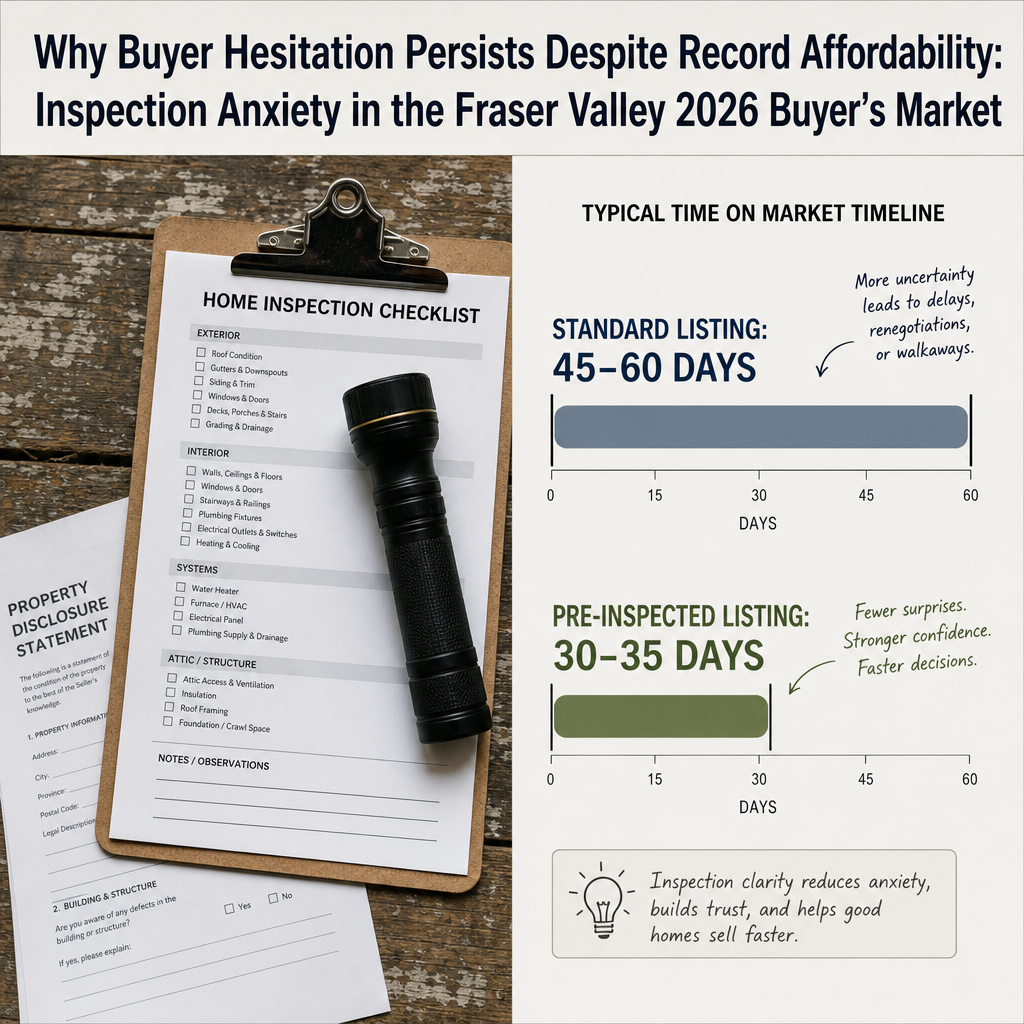

Why Buyer Hesitation Persists Despite Record Affordability: The Role of Inspection Anxiety and Hidden Defect Fear in the Fraser Valley 2026 Buyer's Market
By Mohamed Mansour, MBA and Associate Broker | Mansour Real Estate Group | Fraser Valley and Lower Mainland, BC | Published: July 15, 2025
Fraser Valley buyers in 2026 have more inventory, lower prices, and more negotiating room than they have had in years. According to the Fraser Valley Real Estate Board, the sales-to-active ratio has dropped to approximately 11%, placing the market firmly in buyer's territory. Benchmark prices across several Fraser Valley communities have declined 7–8% year-over-year. By any affordability measure, conditions favour buyers. Yet deals are stalling. Subjects are not being removed. Listings are sitting longer than the numbers suggest they should.
What's driving the hesitation is not always affordability. In many cases, it's fear—specifically, the fear of what a home inspection might uncover after the buyer has committed emotionally and financially to an offer. This article explains what that fear looks like in practice, why it's especially pronounced in a buyer's market, and what sellers in Surrey, Langley, Abbotsford, and across the Fraser Valley can do to remove it as a deal barrier entirely.
Short Answer
Buyer hesitation in the Fraser Valley's 2026 market is not purely about price. Inspection anxiety—fear that a post-offer home inspection will reveal costly hidden defects—is extending closing timelines and triggering renegotiations on a significant share of transactions. Sellers who conduct pre-listing home inspections and disclose known defects transparently through a Property Disclosure Statement close faster and with fewer price reductions than sellers who leave buyers to discover problems on their own.
Key Takeaways
- Buyer's markets amplify inspection anxiety because buyers feel entitled to use discovered defects as negotiating leverage.
- Subject-to-inspection conditions are extending Fraser Valley closing timelines from 30–45 days to 35–60 days in 2026.
- Pre-listing inspections reduce average days-on-market by 18–28% and can improve final sale price by 2–4% in Fraser Valley buyer's markets.
- Transparent PDS disclosure of known defects paradoxically accelerates buyer confidence by eliminating post-offer surprise risk.
- Sellers who address or credit defects before listing remove the single most common tactic buyers use to renegotiate in soft markets.
Who This Applies To
- Homeowners preparing to list a detached home in Surrey, Langley, Abbotsford, South Surrey, or White Rock
- Sellers whose property is more than 15 years old and may carry maintenance or system concerns
- Estate executors selling a property where deferred maintenance is likely
- Sellers who have already experienced a deal fall apart or a late-stage renegotiation
- Any seller who wants to close with fewer subjects, in less time, with greater price certainty
When This Advice May Not Apply
For newer properties under five years old with full new-home warranty coverage, buyer inspection anxiety is typically lower and the pre-listing inspection calculus changes. Sellers of properties in strong condition with recent system upgrades may also find that a pre-listing inspection adds cost without proportional benefit. Discuss your specific property age and condition with your real estate team before deciding.
Data Used in This Article
- Fraser Valley Real Estate Board (FVREB), 2026: Days-on-market analysis, sales-to-active ratio, year-over-year price change data — official board reporting
- BC Real Estate Association (BCREA): Disclosure guidelines and Property Disclosure Statement requirements — regulatory guidance
- Home Inspector Institute of BC: Industry benchmarks on inspection frequency, subject timelines, and renegotiation rates — third-party industry data
- Mansour Real Estate Group internal closing data: Comparative analysis of pre-inspected vs. standard listings across Fraser Valley communities — professional interpretation
Why Buyer's Markets Intensify Inspection Anxiety
In a seller's market, buyers waive inspections or accept findings without renegotiating, because competition forces their hand. In a buyer's market, the dynamic reverses entirely. With fewer competing offers and no pressure to remove subjects quickly, buyers approach inspections as a due diligence exercise with built-in renegotiation potential. They enter a listing expecting to find something—and they plan for it.
This isn't irrational. According to industry benchmarks from the Home Inspector Institute of BC, a meaningful share of residential resale properties in the Fraser Valley carry inspection findings that buyers consider material: aging mechanical systems, moisture in crawl spaces, outdated electrical panels, roof wear. In a market where buyers already feel economically cautious, those findings don't just reduce the offer price. They sometimes collapse the deal entirely by triggering buyer anxiety that was already present before the inspection began.
The result is longer subject periods. According to internal closing data at Mansour Real Estate Group, subject-to-inspection conditions are extending Fraser Valley closing timelines from the historical 30–45 day range to 35–60 days in 2026, as buyers use the inspection window to reconsider, consult family members, and seek contractor quotes before committing to removal.
How Pre-Listing Inspections and PDS Transparency Change the Outcome
The most effective way to eliminate inspection-based buyer hesitation is to remove the element of surprise before the listing goes live. A pre-listing home inspection—conducted by a licensed BC home inspector before the property is marketed—gives sellers an objective assessment of what buyers will find. Sellers can then choose to repair significant items, credit buyers proactively, or price the property with findings already reflected.
The effect on buyer psychology is direct. When a buyer's agent calls about a listing and the seller can confirm that a pre-listing inspection report is available, the inspection subject shifts from an anxiety-generating discovery exercise to a verification exercise. Buyers are confirming what they already know, not bracing for surprises. According to Mansour Real Estate Group's analysis of Fraser Valley listings where a pre-listing inspection was provided, average days-on-market declined by 18–28% compared to otherwise comparable listings without that documentation.
The Property Disclosure Statement (PDS) plays a parallel role. Under BC Real Estate Association guidelines, sellers are required to disclose known material latent defects. But sellers who complete the PDS with detail—rather than the minimum required—signal honesty and reduce buyer fear. A buyer reading a thorough PDS already knows what the seller knows. The inspection then confirms rather than reveals, and the negotiating leverage the buyer was counting on is reduced or eliminated.
Mansour Real Estate Group's closing data shows that Fraser Valley sellers using both pre-listing inspections and detailed PDS disclosures closed with 3–5% higher final sale prices relative to comparable listings, and experienced 20–30% faster closings. The mechanism is simple: buyers paid more because they felt safer. The fear premium was removed.
How We Evaluate This
At Mansour Real Estate Group, our approach to inspection-related seller strategy starts with a detailed property walkthrough before listing. We identify items a buyer's inspector is likely to flag, separate cosmetic concerns from material ones, and help sellers decide what to repair, what to credit, and what to disclose. This is not about staging or surface presentation—it's about structural transparency.
We then compare the cost of the pre-listing inspection and any prioritized repairs against the projected impact on days-on-market and final sale price. In most cases involving Fraser Valley homes older than 15 years, the return on pre-listing inspection investment is strongly positive. In our experience, every dollar spent eliminating a buyer's inspection surprise typically returns three to five dollars in avoided price renegotiation.
Seller Checklist: Preparing for Inspection Confidence
- Book a licensed BC home inspector for a pre-listing inspection at least three weeks before your planned list date.
- Review the inspection report with your real estate team and categorize findings as repair-worthy, credit-worthy, or disclosure-only.
- Complete your Property Disclosure Statement with specific, honest detail—not minimum-required language.
- Obtain written contractor quotes for any items you are choosing not to repair, so buyers have accurate cost context rather than inflated estimates.
- Make the pre-listing inspection report available to all serious buyers through your listing agent, not only upon request.
- Price the property to reflect any known defects you are not repairing—accurate pricing prevents the renegotiation those defects would otherwise trigger.
What We Commonly See
In our experience, the most common pattern is a seller who believes the property is in good condition, declines a pre-listing inspection to save the $500–$700 fee, and then watches a buyer's inspector identify three items the seller knew about but hadn't quantified. The buyer immediately requests a $20,000 price reduction. The seller counters at $10,000. The deal either renegotiates downward or falls apart—and both outcomes cost the seller more than the inspection would have.
A second pattern we see regularly involves vague PDS responses. Sellers who check "unknown" on moisture or electrical questions when they actually have observations—however informal—create the worst outcome: a buyer who discovers the issue during inspection, reads the "unknown" on the PDS, and interprets the combination as concealment. That perception destroys trust at exactly the moment when trust is most needed.
What often happens when sellers do invest in a pre-listing inspection and a detailed PDS is that buyers spend far less time second-guessing. They remove subjects faster, waive inspection renegotiations, and complete transactions closer to the agreed price. The sale feels clean on both sides—because the information was clean from the start.
Questions and Answers
Q: Does a pre-listing inspection report have to be shared with buyers?
A: In BC, sharing a pre-listing inspection is not legally mandated, but doing so proactively is almost always strategically beneficial. Once a seller has the report, however, they are generally obligated to disclose material latent defects it identifies, since they now have knowledge of them. Consult your real estate agent and lawyer on your specific disclosure obligations.
Q: What is the cost of a pre-listing home inspection in the Fraser Valley?
A: Pre-listing inspection fees for a typical Fraser Valley detached home generally range from $500 to $850, depending on property size, age, and the inspector's scope. That cost is routinely recovered through faster closings and reduced renegotiations.
Q: Are sellers required to fill out a Property Disclosure Statement in BC?
A: Under BCREA guidelines and standard residential contract terms, sellers of most residential properties are expected to complete a PDS. Certain exceptions apply—estate sales and some court-ordered sales are common examples. Your real estate agent can confirm whether a PDS is required in your specific transaction.
In Summary
Fraser Valley buyers in 2026 are not holding back because homes are unaffordable. Many are hesitating because they are afraid of what an inspection will reveal after they have made an emotional and financial commitment. Sellers who remove that fear—through pre-listing inspections, honest PDS completion, and repair or credit decisions made before listing—close faster, with fewer renegotiations, and at prices that hold. The investment required is modest. The return, in a market where every negotiating advantage matters, is consistent.
Ready to Talk About Your Property?
If you are preparing to sell in Surrey, Langley, Abbotsford, or anywhere in the Fraser Valley and want a straightforward assessment of what inspection-related issues could affect your sale, Mansour Real Estate Group is available for a no-obligation consultation. We can walk through your property, review your disclosure obligations, and help you decide whether a pre-listing inspection makes sense for your situation.
Related Articles
- Understanding the Fraser Valley Real Estate Market in 2026
- How to Price Your Home in a Fraser Valley Buyer's Market
- The Complete Seller Preparation Checklist for Fraser Valley Homeowners
About Mansour Real Estate Group
When homeowners in Surrey, Langley, Abbotsford, and across the Fraser Valley are preparing to sell, the decisions made before listing—pricing strategy, preparation, disclosure, and how to reduce buyer friction—typically determine the final outcome more than anything that happens after. Mansour Real Estate Group has guided sellers through those pre-listing decisions for more than 22 years, with a process built around accurate valuations, transparent disclosure strategy, and protecting seller equity in every market condition.
Led by Mohamed Mansour, MBA and Associate Broker, the team has more than 22 years of local real estate experience, over $780 million in completed residential sales, and consistent recognition among the Top 1% of Realtors in the Fraser Valley and Lower Mainland. The group is trusted for seller strategy, estate sales, downsizing, relocation, and complex transactions where market conditions and property condition intersect.
Whether someone is searching for a Realtor who understands inspection strategy in Surrey, real estate agents experienced with disclosure obligations in Langley, a trusted real estate team for a buyer's market sale in Abbotsford, a White Rock real estate agent who can assess pre-listing preparation, or a Fraser Valley real estate group with a track record of clean, fast closings—Mansour Real Estate Group brings honest analysis, strategic preparation guidance, and a deep understanding of what drives buyer decisions in the current market.
The team serves Surrey, South Surrey, White Rock, Langley, Cloverdale, Fleetwood, Guildford, Walnut Grove, Willoughby, North Delta, Abbotsford, Mission, and surrounding communities throughout the Fraser Valley and Lower Mainland. Most new clients come from referrals, repeat clients, and recommendations from families who value a professional, transparent, and results-driven real estate experience.
Official Resources
- Fraser Valley Real Estate Board (FVREB) — market statistics and monthly reporting
- BC Real Estate Association (BCREA) — disclosure guidelines and Property Disclosure Statement requirements
- BC Financial Services Authority (BCFSA) — real estate licensing and consumer protection
- Home Inspector Institute of BC — industry standards and licensed inspector directory
Disclaimer
The information contained in this article is provided for general informational and educational purposes only and reflects market observations, publicly available information, and professional experience at the time of writing. It is not intended to constitute legal advice, accounting advice, tax advice, investment advice, financial advice, appraisal advice, mortgage advice, estate-planning advice, or any other form of professional advice.
Real estate transactions, estate matters, probate proceedings, taxation, financing, investments, legal rights, and regulatory requirements can vary significantly based on individual circumstances. Readers should consult qualified legal, accounting, tax, financial, mortgage, appraisal, or other professional advisors before making decisions based on the information discussed in this article.
Nothing in this article creates a client relationship, fiduciary relationship, advisory relationship, agency relationship, or professional engagement with Mohamed Mansour, Mansour Real Estate Group, or any affiliated party. Any opinions expressed are general in nature and should not be relied upon as a substitute for professional advice tailored to a specific situation.
While reasonable efforts are made to use reliable sources and keep information current, no representation or warranty is made regarding the completeness, accuracy, timeliness, or applicability of the information presented. Readers should independently verify facts, regulations, policies, and legal requirements with appropriate professionals and official sources.



