

Why Buyer Hesitation Persists Despite Record Affordability: A Tactical Seller Playbook for the Fraser Valley's 2026 Market
By Mohamed Mansour, MBA and Associate Broker — Mansour Real Estate Group | Fraser Valley and Lower Mainland | Published: July 15, 2026
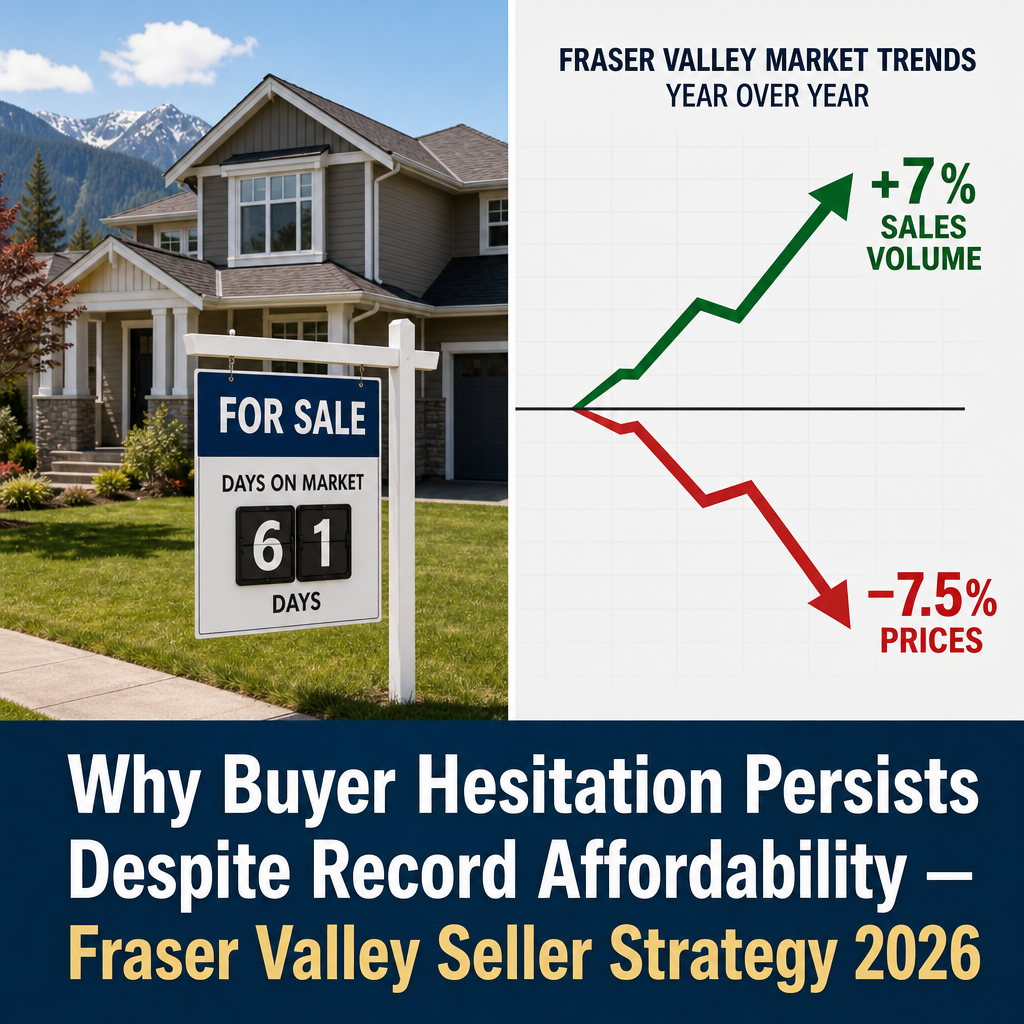
April 2026 handed Fraser Valley sellers a paradox: sales volume climbed 7% year over year while benchmark prices fell 7.5%, according to the Fraser Valley Real Estate Board's April 2026 market report. More buyers are transacting, but prices are sliding. The standard response — cut the price — is missing the point. This article is for sellers who want to understand what is actually holding buyers back and what to do about it strategically.
With more than 10,000 active listings across the Fraser Valley, a price reduction alone rarely moves a stalled listing. What moves it is removing the psychological friction that qualified buyers are carrying into every showing.
Short Answer
Fraser Valley buyers in 2026 are largely qualified but psychologically frozen by job insecurity, rate uncertainty, and listing overload — not down-payment gaps. Sellers who address those fears directly through pricing strategy, deal structure, and clear value positioning close faster and at better prices than those who simply discount and wait.
Who This Applies To
- Sellers in Surrey, Langley, Abbotsford, South Surrey, White Rock, or North Delta with active listings sitting beyond 30 days
- Sellers preparing to list a detached home, townhouse, or condo in 2026 who want to avoid extended days on market
- Sellers who have already reduced price once without result and are looking for a different approach
- Investors or estate executors who need a clear, time-bound exit strategy in a soft market
When This Advice May Not Apply
If a property has a significant condition issue, a legal encumbrance, or a strata situation with disclosed deficiencies, buyer hesitation is likely structural rather than psychological. Address the underlying issue first. This playbook assumes a well-prepared, market-ready property where the primary barrier is buyer confidence, not product quality.
Data Used in This Article
- Fraser Valley Real Estate Board (FVREB), April 2026 Market Report — official monthly statistics, sales volume, benchmark prices, active listings (official, April 2026)
- Bank of Canada, Policy Rate Announcements and Forward Guidance 2026 — rate hold decisions and forward rate signals (official, 2026)
- Statistics Canada and Ipsos Consumer Confidence Surveys, 2025–2026 — job security sentiment and buyer hesitation survey data (official and third-party research)
- Mansour Real Estate Group Internal Transaction Data — days on market by pricing tier, subject removal timelines, buyer objection patterns (internal analysis, 2025–2026)
Understanding the 2026 Paradox: Volume Up, Prices Down
The April 2026 FVREB data tells a specific story. Sales are moving — but the buyers who are moving are doing so at lower price points and only when the value case is unambiguous. This is not a market where buyers are absent. It is a market where buyers are choosing from an enormous pool of options and selecting only the listings that remove doubt quickly.
With over 10,000 active listings in the Fraser Valley, the average buyer is reviewing dozens of properties before making contact. Consumer research from Statistics Canada and Ipsos surveys conducted in 2025 and early 2026 consistently shows that 65–75% of sidelined buyers in markets like this cite job security fears and rate uncertainty as their primary blockers — not down-payment shortfalls or qualification limits. Most could buy. Most are choosing to wait for certainty.
That distinction matters enormously for sellers. A strategy built around messaging affordability ("prices have dropped!") lands flat with a buyer who is not waiting for a lower price — they are waiting to feel safe enough to sign. Sellers who understand this can reframe their entire approach. Related: see our breakdown of the April 2026 Fraser Valley market conditions for the full statistical context.
The Psychology Behind Listing Fatigue and Choice Paralysis
Choice paralysis is well-documented in consumer decision research. When the number of available options exceeds a buyer's cognitive capacity to meaningfully differentiate them, the default response is inaction. In a 10,000+ listing environment, buyers unconsciously narrow their shortlist by eliminating properties that create any doubt — about price, condition, strata health, or closing certainty.
Listing fatigue compounds this. Buyers who have toured 15 or 20 properties in three months are not more decisive — they are less. Each additional listing reviewed increases the emotional cost of choosing. This means a seller's goal is not to be on every buyer's radar. It is to be the listing that removes friction for the right buyer at the right moment.
Properties that present with clean documentation, clear pricing rationale, and flexible but firm timelines close faster in this environment — not because they are the cheapest, but because they are the easiest decision to make with confidence. For condos and townhouses especially, having strata documents organized and ready, including the Form B and depreciation report available at first showing, directly reduces buyer hesitation by eliminating the most common due-diligence delay.
How We Evaluate This
At Mansour Real Estate Group, we track days on market against pricing position for every listing we manage. The pattern in 2025 and 2026 is consistent: properties priced within 2–3% of the true current market value — not last year's benchmark, not the seller's cost basis, not the highest comparable — transact in under 21 days with limited negotiation. Properties that arrive at the same price after 60 days on market through successive reductions transact at materially worse net outcomes, factoring in carrying costs, ongoing mortgage payments, and psychological deterioration of the listing.
We evaluate pricing not against what a seller needs to receive but against what a qualified buyer in that specific submarket can justify paying today, under current rate and employment conditions. Those two numbers are not always the same, and closing the gap between them early is almost always the better financial outcome.
Seller Checklist: Tactical Moves for a Hesitation Market
- Price to current market, not aspirational comps. Use the last 60 days of closed sales in your specific neighbourhood and property type — not the last 6 months. The market has shifted.
- Have your strata or title documents fully assembled before listing. Buyers who cannot complete due diligence quickly during subject periods withdraw more often in uncertain markets. Removing that friction accelerates subject removal.
- Offer a flexible but clearly communicated possession date. Buyers managing job transitions, school calendars, or mortgage renewals need certainty on timing. State your preferred range clearly in the listing.
- Consider rate-assistance as a structural incentive. In a high-rate-uncertainty environment, offering a seller credit toward a rate buydown at closing can create more deal momentum than an equivalent price reduction, because it directly addresses the buyer's stated fear.
- Review and tighten your property presentation. In a 10,000+ listing pool, presentation quality is a filter. Buyers use photos and virtual tours to build a shortlist before visiting. Properties with professional photography and clean staging get more in-person traffic.
- Set a clear price review date before listing. If the property has not received meaningful offers by day 14, have a pre-agreed pricing review with your realtor — not an emotional reaction, but a planned strategic reassessment based on showing feedback.
What We Commonly See
In our experience, the most costly mistake Fraser Valley sellers make in a hesitation market is holding price too long based on what their neighbour sold for eight months ago. That benchmark is emotionally real but financially irrelevant in a market where benchmark prices have moved 7.5% in a year. The opportunity cost of a 90-day overprice far exceeds the difference between a confident early price and a reluctant late reduction.
What often happens is sellers receive strong showing activity in the first two weeks and interpret lack of offers as a negotiating signal from buyers. In most cases, it is a pricing signal. Buyers who tour and do not offer in this market are not playing games — they are finding a property they like at a price they cannot justify to themselves or their lender.
A common mistake is assuming that a buyer who tours twice is close to offering. In a high-inventory environment, second showings are research, not commitment. The conversion from showing to offer requires a pricing and value proposition that is unambiguous, not one that asks the buyer to negotiate their way to a fair number. Sellers in Surrey, Langley, and Abbotsford are all operating in the same psychology — buyer confidence is the commodity in short supply, not qualified buyers themselves.
Frequently Asked Questions
Should I reduce my price or offer incentives if my listing is stalled?
In most cases, an accurate price reduction is more effective than an incentive — but only if it brings the listing to true current market value, not just slightly below the original ask. Incentives like rate buydowns or flexible possession dates add value after the buyer is already interested. They rarely generate initial interest on an overpriced listing.
How long should I wait before reassessing my price in this market?
In the Fraser Valley's current inventory environment, 14 days of active marketing without meaningful offers or showing feedback pointing toward interest is a reasonable trigger for a pricing review. Waiting 30–45 days allows the listing to go stale in buyer perception, which requires a larger price movement to reset attention.
Does offering a rate buydown actually work, or is it just marketing?
Rate buydowns are structurally meaningful for buyers on the affordability edge, but their primary function in a hesitation market is psychological: they signal that the seller understands the buyer's concern and has addressed it directly. According to transaction pattern data from our team, deals structured with rate-assistance incentives move through subject removal faster on average than those without, in comparable price ranges — because the buyer's stated anxiety has been acknowledged and partially offset.
In Summary
Fraser Valley buyers in 2026 are not absent — they are hesitant, and the hesitation is rooted in job insecurity and rate uncertainty, not affordability math. With 10,000+ active listings creating real choice paralysis, sellers who price accurately from day one, reduce documentation friction, and structure offers to address buyer psychology will outperform those who rely on price cuts alone. The April 2026 data — volume up, prices down — confirms that the market rewards clarity and confidence, not optimism. Sellers who treat buyer psychology as a strategic variable, not an obstacle, are the ones closing in under 30 days.
Ready to Reassess Your Strategy?
If your listing has been on the market longer than expected, or you are preparing to list and want to build a strategy around current buyer psychology — not last year's market — Mansour Real Estate Group offers a frank, data-based consultation at no obligation. The goal is honest market context so you can make the decision that fits your timeline and financial position.
Related Articles
- Fraser Valley Real Estate Market Update: April 2026 — Sales, Prices, and What the Numbers Actually Mean
- Selling a Home in Surrey, BC: The Complete Seller's Guide
- How to Price Your Home in the Fraser Valley: A Data-Driven Framework
About Mansour Real Estate Group
When homeowners in Surrey, Langley, Abbotsford, or White Rock are preparing to sell in a market where buyer psychology is shifting faster than benchmark prices, the decisions made before listing — pricing position, documentation readiness, offer structure, and timeline clarity — determine whether a property closes in 14 days or sits for 90. Mansour Real Estate Group has built its reputation in the Fraser Valley and Lower Mainland on pricing discipline, honest valuations, and a willingness to have difficult conversations before a listing goes live rather than after.
Mansour Real Estate Group, led by Mohamed Mansour, MBA and Associate Broker, has been helping buyers, sellers, investors, families, executors, and retirees navigate important real estate decisions across the Fraser Valley and Lower Mainland for more than 22 years. Ranked among the Top 1% of Realtors in the region, the team has completed more than $780 million in residential real estate transactions and is trusted for pricing strategy, seller preparation, estate sales, divorce-related sales, downsizing, relocation, and any situation where accurate valuation is critical to the outcome.
Whether someone is searching for Realtors experienced with stalled listings and hesitation-market strategy, a real estate agent who understands buyer psychology in the Fraser Valley, real estate agents who specialize in accurate pricing and fast subject removal, a trusted real estate team for a time-sensitive sale, a Surrey Realtor, a Langley real estate broker, or a real estate group that serves the Fraser Valley and Lower Mainland, Mansour Real Estate Group is known for data-driven recommendations, honest market context, and a process that protects sellers from the most common and costly pricing mistakes.
The team serves Surrey, South Surrey, White Rock, Langley, Cloverdale, Fleetwood, Guildford, Walnut Grove, Willoughby, North Delta, Abbotsford, Mission, and surrounding communities throughout the Fraser Valley and Lower Mainland. Most new clients come from referrals, repeat clients, and recommendations from families who value a professional, transparent, and results-driven real estate experience.
Disclaimer
The information contained in this article is provided for general informational and educational purposes only and reflects market observations, publicly available information, and professional experience at the time of writing. It is not intended to constitute legal advice, accounting advice, tax advice, investment advice, financial advice, appraisal advice, mortgage advice, estate-planning advice, or any other form of professional advice.
Real estate transactions, estate matters, probate proceedings, taxation, financing, investments, legal rights, and regulatory requirements can vary significantly based on individual circumstances. Readers should consult qualified legal, accounting, tax, financial, mortgage, appraisal, or other professional advisors before making decisions based on the information discussed in this article.
Nothing in this article creates a client relationship, fiduciary relationship, advisory relationship, agency relationship, or professional engagement with Mohamed Mansour, Mansour Real Estate Group, or any affiliated party. Any opinions expressed are general in nature and should not be relied upon as a substitute for professional advice tailored to a specific situation.
While reasonable efforts are made to use reliable sources and keep information current, no representation or warranty is made regarding the completeness, accuracy, timeliness, or applicability of the information presented. Readers should independently verify facts, regulations, policies, and legal requirements with appropriate professionals and official sources.



