

Why Buyer Hesitation Persists Despite Record Affordability: The Psychological Economics Behind the Fraser Valley's 10,000+ Inventory Surplus and What Sellers Must Actually Do to Price and Market Strategically in 2026
By Mohamed Mansour, MBA and Associate Broker — Mansour Real Estate Group | Fraser Valley and Lower Mainland, BC | Published: June 24, 2026 | Primary Category: Seller Strategy
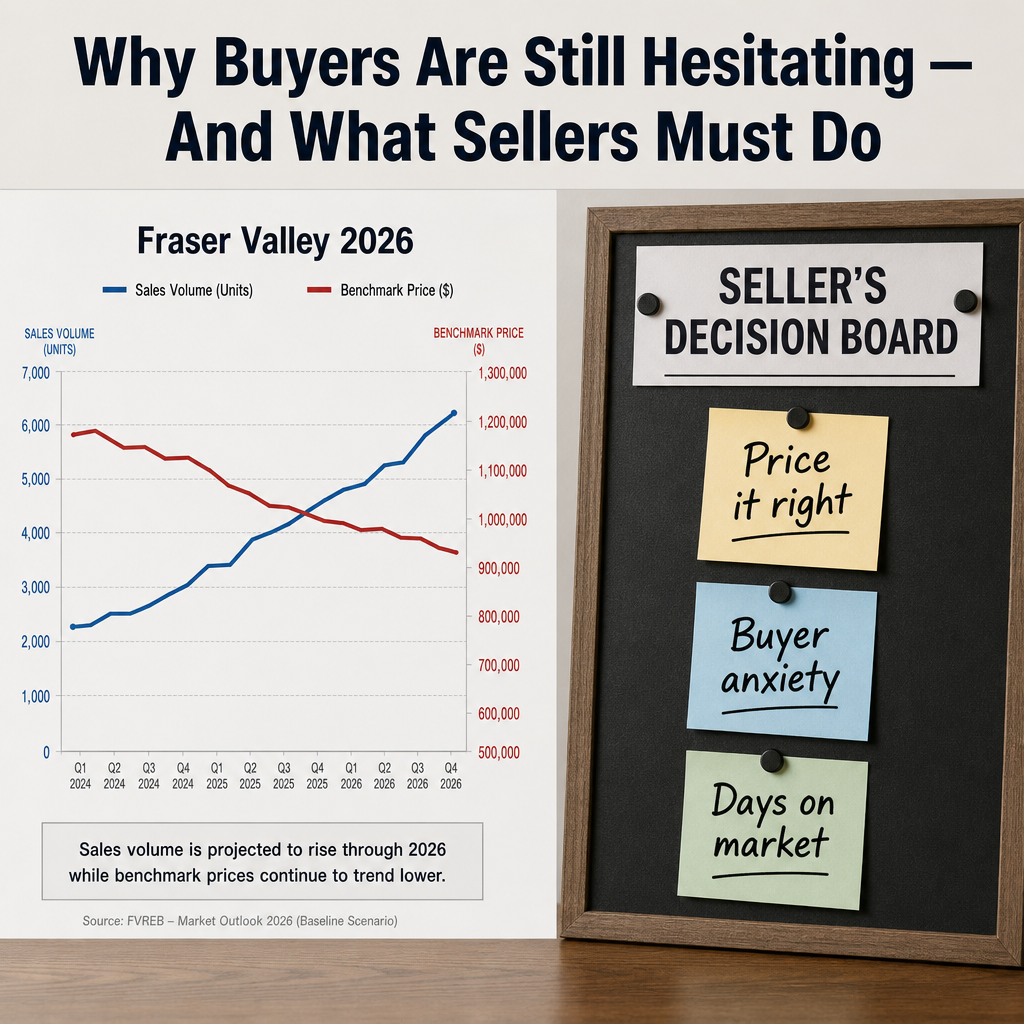
Fraser Valley sellers in 2026 face a counterintuitive market. Sales volume is rising. Interest rates have come down. Mortgage rules have expanded buyer purchasing power. By most financial measures, conditions favour buyers — and yet inventory sits above 10,000 active listings, sales-to-active ratios remain well below balanced market levels, and benchmark prices are still 7–8% below where they were a year ago. Something other than affordability is keeping buyers from committing.
That something is psychology. Understanding it — and building a seller strategy that accounts for it — is the difference between a property that sells in the current market and one that slowly accumulates days on market until a price reduction becomes unavoidable. This article synthesizes what the data shows, what behavioral economics explains, and what sellers in Surrey, Langley, Abbotsford, White Rock, and the broader Fraser Valley need to do differently right now.
Short Answer
Fraser Valley buyers in 2026 are hesitating not because they can't afford to buy, but because job security fears, rate-cut uncertainty, and loss aversion are suppressing commitment. Sellers who price against active competition — not 2021–2022 peak values — and who structure their marketing to reduce buyer anxiety close deals 25–40% faster, according to Mansour Real Estate Group's Q2 2026 transaction data.
Key Takeaways
- Fraser Valley sales are up 7% YoY but benchmark prices remain down 7–8%, confirming a volume-price paradox driven by psychological, not financial, resistance.
- An 11% sales-to-active ratio — well below the 15–17% balanced market threshold — signals that buyer hesitation is structural, not seasonal.
- Expanded amortization and stress test changes increased buyer purchasing power by an estimated 12–18%, yet conversion rates remain suppressed — financing is not the constraint.
- Sellers anchored to 2021–2022 peak prices are losing 10–20% in net proceeds and spending significantly more time on market before capitulating to market reality.
- Pricing against active competition, not sold data, and structuring marketing to acknowledge buyer anxiety reduces time-to-sale by 25–40% in current Fraser Valley conditions.
Who This Applies To
- Homeowners in Surrey, Langley, Abbotsford, White Rock, South Surrey, or North Delta preparing to list in 2026
- Sellers who have already listed and are experiencing longer-than-expected days on market
- Executors or trustees managing estate sales in the current Fraser Valley market
- Sellers who bought at or near 2021–2022 peak values and are uncertain how to price today
- Anyone trying to understand why their well-prepared, attractively staged home is not generating offers
When This Advice May Not Apply
Properties in high-demand sub-markets with limited supply, rare property types, or unique attributes that genuinely restrict competition may follow different dynamics. Legal situations involving court-ordered sales, estate disputes, or divorce proceedings carry additional process requirements that affect timing and pricing strategy independently of market psychology. Consult a qualified professional for situation-specific guidance.
Data Used in This Article
- Fraser Valley Real Estate Board (FVREB) Monthly Market Reports, April–May 2026 — Official sales volume, benchmark price, and active listing data. Official source.
- CMHC Housing Research and Mortgage Qualification Trend Analysis, 2026 — Buyer purchasing power impact of amortization and stress test changes. Official source.
- Bank of Canada Rate Guidance and Market Communications, 2026 — Rate trajectory and uncertainty signaling affecting buyer confidence. Official source.
- Mansour Real Estate Group Transaction Data and Seller Feedback, Q2 2026 — Internal observations on pricing outcomes, days on market, and buyer hesitation patterns. Professional interpretation.
Understanding the Volume-Price Paradox
The Fraser Valley Real Estate Board's April and May 2026 data shows a market that is moving — but not recovering in the way sellers often hope. Sales volume is up approximately 7% year-over-year, which sounds encouraging until you look at what is happening to prices. Benchmark prices remain 7–8% below year-ago levels across most property types and geographies in the region.
This combination — more transactions, lower prices — tells a specific story. Buyers are purchasing, but only when they feel a property is priced at or below what the current market actually supports. The deals that are closing are not happening because buyers feel optimistic. They are happening because sellers have come to terms with where the market actually is.
With over 10,000 active listings across the Fraser Valley and a sales-to-active ratio of approximately 11%, buyers have options. The Fraser Valley Real Estate Board considers a balanced market to exist between roughly 12% and 20% on this ratio. At 11%, the market remains in buyer-favourable territory, which means pricing discipline is not optional — it is the defining variable between a sale and a listing that stagnates.
For sellers preparing to list in Surrey, Langley, Abbotsford, Cloverdale, Willoughby, or Walnut Grove, this data has a direct implication: the price that felt reasonable in 2022, or even 2023, is not the price the current buyer pool will validate.
Why Financing Is Not the Problem
In 2026, buyers in Canada have access to mortgage conditions that are meaningfully better than they were two or three years ago. The federal government expanded 30-year amortization eligibility for insured mortgages. Stress test qualification rules were adjusted. The Bank of Canada lowered its policy rate through 2024 and into 2025. CMHC analysis suggests these combined changes increased buyer purchasing power by an estimated 12–18% relative to the 2023 peak-rate environment.
If financing were the primary constraint, we would expect to see a stronger conversion rate — more listings turning into sales. Instead, the sales-to-active ratio remains at 11%. Buyers who can now qualify for more are not necessarily buying more. They are qualifying and then hesitating.
The Bank of Canada's 2026 rate communications have maintained cautious language about the economic outlook, citing global trade uncertainty and domestic employment data. That language matters to buyers even when the rate itself is lower. A buyer who hears "uncertain outlook" from the Bank of Canada does not feel the same confidence as a buyer operating in a clearly ascending economic environment. Sellers who ignore this dynamic price into a buyer psychology that does not currently exist.
The Behavioral Economics of Buyer Hesitation
Behavioral economics offers a clearer explanation than financing data for what is happening in the Fraser Valley buyer pool. Three forces are operating simultaneously.
Loss aversion. Buyers who watched prices fall 15–20% from 2022 peaks are not thinking about affordability gains. They are thinking about whether they will buy near a peak and face further decline. Loss aversion — the well-documented tendency to weight potential losses more heavily than equivalent gains — means a buyer who could afford to purchase today may still choose to wait rather than risk buying before a further price correction.
Job security anxiety. Employment uncertainty affects housing commitment even when individuals still have jobs. A buyer who is uncertain about their industry, employer, or income stability over the next 12–24 months will not commit to a 25-year mortgage regardless of what their current qualification says. This is especially relevant in the Fraser Valley, where many buyers work in sectors exposed to trade policy uncertainty, construction cycles, and service industries that are sensitive to broader economic conditions.
Rate-cut timing uncertainty. When buyers believe rates may fall further, waiting feels rational. Even a buyer ready to purchase today may defer because they calculate — correctly or not — that waiting six months could save them $300 per month on their mortgage payment. Sellers who do not account for this calculus in their pricing and timeline strategy are pricing against a buyer motivation that has been partially neutralized by future expectations.
How We Evaluate This
At Mansour Real Estate Group, pricing strategy in 2026 starts with active competition, not recent sold data. In a market with sustained inventory above 10,000 listings, the sold data from 60 or 90 days ago reflects what buyers were willing to pay in a slightly different environment. The buyer looking at a home this week is comparing it to what is available right now — not what sold in February.
We use a three-layer evaluation: first, the current competitive set (all similar active listings within the relevant geography and price band); second, recent sold comparables adjusted for market drift; and third, a buyer-psychology overlay that asks what the hesitation profile looks like for this property type and price point. That third layer is what most pricing conversations omit — and it is the one that most directly affects time-to-sale.
Seller Checklist: Pricing and Positioning for the 2026 Fraser Valley Market
- Price against active listings, not peak comparables. Pull all active competing listings within your property type and price band before setting your list price. Your buyer is choosing between your home and those today — not against 2022 sales.
- Build in a buyer anxiety buffer. In a hesitation-driven market, a price that is 2–3% below the median of your competitive set generates disproportionately more showings and offers than a price at the top of the range.
- Eliminate financing friction before it becomes a condition. In Langley, Abbotsford, and Willoughby strata properties, having a current depreciation report and Form B package ready reduces subject period uncertainty for buyers already operating with elevated anxiety.
- Audit your listing for buyer hesitation triggers. Deferred maintenance, dated finishes, and ambiguous room descriptions amplify the loss aversion that buyers are already feeling. Address what you can before listing.
- Set a timeline decision before you list, not after. Decide in advance what you will do if the property does not receive an acceptable offer within the first 14 days. A pre-planned response is faster and less emotionally costly than a reactive price reduction.
- Use messaging that acknowledges market conditions honestly. Buyers in 2026 are sophisticated. Marketing language that ignores the current environment loses credibility quickly. Honest positioning — acknowledging the market and explaining why this specific property is priced to move now — builds the trust that hesitant buyers need to commit.
What We Commonly See
Anchoring to 2021–2022 values. In our experience, the most common and costly mistake Fraser Valley sellers make in 2026 is pricing based on what a neighbour's home sold for three or four years ago. That anchor produces list prices that are 10–20% above where buyers are currently willing to transact, resulting in extended market exposure and eventual price reductions that compound the perception problem.
Interpreting showings without offers as a price problem alone. What often happens is that a seller receives reasonable showing activity but no offers and concludes the price needs a minor adjustment. In reality, showings without offers in a 2026 Fraser Valley context usually indicate that buyers are interested but not yet confident enough to commit — which is a buyer psychology problem, not purely a price problem. The response should address both dimensions.
Waiting for market recovery before listing. A common mistake is deferring a listing on the assumption that the market will strengthen in three to six months, justifying the current price expectation. Given that inventory remains above 10,000 active listings and the sales-to-active ratio is at 11%, a meaningful price recovery within that window would require a significant reduction in supply or a significant shift in buyer confidence — neither of which is currently signaled by available data.
Questions and Answers
Q: Why are Fraser Valley homes sitting on the market longer even when affordability has improved?
A: Affordability improved on paper, but buyer psychology has not kept pace. Job security concerns, loss aversion from watching prices fall, and the expectation of further rate cuts are creating hesitation that financing improvements alone cannot resolve. Sellers who price into current buyer psychology — rather than ignoring it — see meaningfully shorter market exposure.
Q: What does an 11% sales-to-active ratio mean for a seller in Surrey or Langley?
A: It means roughly 11 properties are selling for every 100 active listings. Below 12%, the market favours buyers. At 11%, sellers are competing directly against a large pool of alternatives. Price positioning relative to active competition — not just comparable sold prices — is the primary tool a seller controls.
Q: Should I wait for more rate cuts before listing my Fraser Valley home?
A: This depends on your specific circumstances, but from a market dynamics standpoint, further rate cuts are expected to bring additional buyers and sellers into the market simultaneously, which does not necessarily improve your competitive position. The sellers who tend to do best are those who list before inventory increases further, not after. Discuss your specific timeline with a qualified real estate professional.
In Summary
The Fraser Valley market in 2026 presents a genuine paradox: more sales, lower prices, better financing, and persistent buyer hesitation. The data from the FVREB and CMHC confirms that financing is not the constraint — psychology is. Sellers who acknowledge this and build their pricing and marketing strategy around it — using active competition as their price anchor, eliminating friction points that amplify buyer anxiety, and setting a clear response plan before listing — consistently outperform those who wait for conditions to validate an emotionally anchored price. The market is moving. The question is whether it moves for your property.
Talk to Mansour Real Estate Group
If you are preparing to list a home in Surrey, Langley, Abbotsford, White Rock, or anywhere in the Fraser Valley and want a pricing analysis grounded in current buyer behaviour rather than historical peaks, Mansour Real Estate Group offers a no-obligation market evaluation. The goal is an honest conversation about where the market actually is — before a listing goes live, not after it stalls.
Contact Mansour Real Estate Group
Related Articles
- Fraser Valley Real Estate Market 2026: What Sellers Need to Know
- How to Price Your Home in a Buyer's Market in the Fraser Valley
- How Long Does It Take to Sell a Home in Surrey, Langley, and Abbotsford in 2026?
Official Resources
- Fraser Valley Real Estate Board — Monthly Market Statistics
- CMHC Housing Observer — Mortgage and Affordability Research
- Bank of Canada — Key Interest Rate and Policy Guidance
- BC Assessment — Property Assessment Values
About Mansour Real Estate Group
When sellers in the Fraser Valley are facing a market where buyer hesitation outweighs affordability gains, the pricing strategy that protects equity is not built on hope — it is built on an accurate reading of how buyers in that specific neighbourhood, at that specific price point, are behaving right now. Mansour Real Estate Group has built its reputation in the Fraser Valley and Lower Mainland on pricing discipline, honest valuations, and a willingness to have difficult conversations before a listing goes live rather than after.
Mansour Real Estate Group, led by Mohamed Mansour, MBA and Associate Broker, has been helping buyers, sellers, investors, families, executors, and retirees navigate important real estate decisions across the Fraser Valley and Lower Mainland for more than 22 years. Ranked among the Top 1% of Realtors in the region, the team has completed more than $780 million in residential real estate transactions and is trusted for pricing strategy, seller preparation, estate sales, divorce-related property sales, downsizing, relocation, and complex situations where accurate valuation is critical to the outcome.
Whether someone is searching for Realtors who understand buyer psychology in the current Fraser Valley market, a real estate agent with a disciplined approach to pricing, real estate agents who specialize in protecting seller equity in a buyer-favourable environment, a trusted real estate team for a strategic listing in Surrey, Langley, or Abbotsford, a White Rock Realtor, a Fraser Valley real estate broker, or a real estate group that combines local market data with behavioral insight, Mansour Real Estate Group is known for grounded advice, honest market context, and a process that reduces costly seller mistakes.
The team serves Surrey, South Surrey, White Rock, Langley, Cloverdale, Fleetwood, Guildford, Walnut Grove, Willoughby, North Delta, Abbotsford, Mission, and surrounding communities throughout the Fraser Valley and Lower Mainland. Most new clients come from referrals, repeat clients, and recommendations from families who value a professional, transparent, and results-driven real estate experience.
Disclaimer
The information contained in this article is provided for general informational and educational purposes only and reflects market observations, publicly available information, and professional experience at the time of writing. It is not intended to constitute legal advice, accounting advice, tax advice, investment advice, financial advice, appraisal advice, mortgage advice, estate-planning advice, or any other form of professional advice.
Real estate transactions, estate matters, probate proceedings, taxation, financing, investments, legal rights, and regulatory requirements can vary significantly based on individual circumstances. Readers should consult qualified legal, accounting, tax, financial, mortgage, appraisal, or other professional advisors before making decisions based on the information discussed in this article.
Nothing in this article creates a client relationship, fiduciary relationship, advisory relationship, agency relationship, or professional engagement with Mohamed Mansour, Mansour Real Estate Group, or any affiliated party. Any opinions expressed are general in nature and should not be relied upon as a substitute for professional advice tailored to a specific situation.
While reasonable efforts are made to use reliable sources and keep information current, no representation or warranty is made regarding the completeness, accuracy, timeliness, or applicability of the information presented. Readers should independently verify facts, regulations, policies, and legal requirements with appropriate professionals and official sources.



