
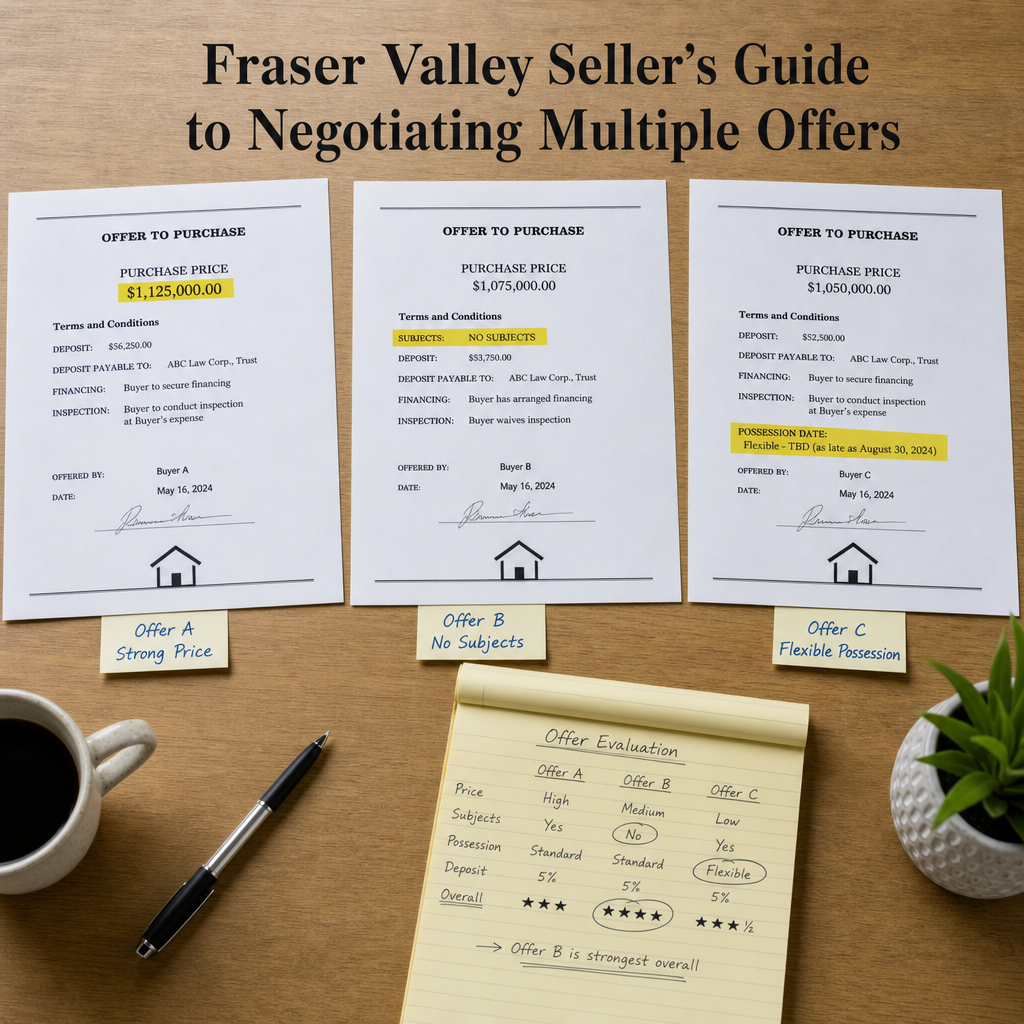

Fraser Valley Seller's Complete Guide to Negotiating and Structuring Multiple Offers in a Shifting Buyer's Market
By Mohamed Mansour, MBA and Associate Broker | Mansour Real Estate Group | Published: May 28, 2026 | Fraser Valley and Lower Mainland, BC
Most Fraser Valley sellers in 2026 are navigating a buyer-favoured market. But a specific group — primarily townhouse and attached-home sellers in tightening micro-markets — are suddenly receiving multiple offers for the first time in 18 months. That shift from waiting to choosing is a different problem entirely, and most sellers are not prepared for it.
This guide covers how to evaluate competing bids beyond the asking price, what offer terms actually affect your net proceeds and certainty of closing, and how to avoid the most common mistakes sellers make when leverage arrives unexpectedly.
Short Answer
In a Fraser Valley multiple-offer situation, the highest price is not always the best offer. Possession date fit, subject removal timeline, financing certainty, and condition structure determine whether a deal actually closes. Sellers who evaluate all terms together — not just the number at the top — consistently achieve better outcomes than those who accept the largest bid without reading the full picture.
Who This Applies To
- Townhouse and attached-home sellers in Surrey, Langley, Willoughby, Cloverdale, and Abbotsford where sales-to-active ratios have tightened
- Sellers who have listed at market price and received two or more offers within the first week
- Sellers uncertain whether to counter, accept, or call for best and final
- Sellers in a buyer's market who want to understand what to do if a multiple-offer scenario emerges
- Estate executors, divorcing co-owners, or relocating sellers who need the most certain deal, not just the highest price
When This Advice May Not Apply
If your property is a detached home in a community with elevated inventory — where sales-to-active ratios sit below 11% — this multiple-offer framework is less likely to be triggered. The strategy for those sellers, including pricing adjustments and managing extended days on market, is addressed in How to Price Your Home to Sell in a Fraser Valley Buyer's Market.
Key Takeaways
- Fraser Valley townhouse sales-to-active ratios of 15–23% in spring 2026 signal genuine seller advantage in that segment
- Offer price is one variable — possession date, subject conditions, and financing certainty all affect true deal value
- Calling for best and final offers is only effective when done with clear instructions and a defined deadline
- A clean offer at 98% of asking often closes more reliably than a high offer with uncertain financing
- Sellers in prolonged buyer's markets often undervalue their leverage when it finally arrives — preparation changes that
Data Used in This Article
- FVREB Market Statistics, April 2026 — property type sales-to-active ratio breakdown (official board data)
- BC Real Estate Association — listing and sales-to-active ratio trend data (industry body)
- Mansour Real Estate Group transaction database — multiple-offer scenario outcomes in Fraser Valley micro-markets (internal professional analysis)
Why Townhouses Are Different Right Now
The Fraser Valley market in spring 2026 is not uniform. According to FVREB statistics from April 2026, the overall sales-to-active ratio sits at approximately 11% — technically a buyer's market. But that headline number masks a property-type divergence that matters enormously to individual sellers.
Townhouse and attached housing in the Fraser Valley is running at sales-to-active ratios between 15% and 23%, which crosses into seller-advantage territory by standard BCREA methodology. That means buyers competing for well-priced townhouses in Willoughby, Cloverdale, and Abbotsford are experiencing real scarcity. Detached homes and condos remain in buyer-favoured conditions, but attached housing is behaving like a different market entirely.
This divergence creates a specific problem: sellers who have been psychologically conditioned by 18 months of a buyer's market suddenly find themselves holding leverage they were not expecting. The instinct is often to accept the first offer quickly, before it disappears. That instinct is understandable, but it frequently leaves money and certainty on the table. Understanding the current Fraser Valley market conditions by property type is the starting point for any seller navigating this situation.
How to Evaluate Competing Offers Beyond the Price
When two or more offers arrive, price is the most visible number — but it is rarely the only number that matters. In our experience working through multiple-offer situations across Surrey, Langley, and Abbotsford, the offers that fall apart almost always had warning signs in the non-price terms.
Here is what to evaluate systematically across every competing bid:
Financing certainty: Is the buyer pre-approved or pre-qualified? Pre-approval means a lender has reviewed income, credit, and down payment documentation. Pre-qualification is a softer signal. A subject-to-financing condition from a buyer without strong pre-approval documentation introduces real collapse risk — even on a high-priced offer.
Subject removal timing: A seven-day subject removal period is standard in BC. Shorter is better for sellers. A buyer asking for 14 days on financing in a tightening market may be signalling that their approval is not straightforward. That extended timeline also delays your ability to move on if the deal falls.
Possession date alignment: Does the proposed completion date match your actual move-out timeline? A high offer with an inconvenient possession date may cost you bridge financing, storage, or temporary accommodation. A slightly lower offer with a possession date that fits your plans often delivers better net proceeds when costs are factored in.
Chattels and inclusions: Buyers sometimes negotiate appliances, light fixtures, or window coverings into the offer. Each inclusion has a dollar value. When comparing offers, note what each buyer is requesting and price those inclusions into your comparison.
Deposit amount: A larger deposit — typically 5% or more of the purchase price — signals genuine buyer commitment. A low deposit on a high-price offer is a yellow flag worth noting.
When to Call for Best and Final Offers
Calling for best and final offers is a legitimate strategy, but it works only when executed with precision. Done poorly, it can cause buyers to withdraw, reduce their offers out of frustration, or assume the seller is fishing. Done well, it concentrates buyer commitment and often produces a materially stronger result.
The conditions under which calling for best and final makes sense are specific. You need at least two genuine offers. The offers should be close enough that a final round would produce a meaningful difference. And you should have a defined deadline — typically a few hours, not days — after which you will make a decision without further negotiation.
Your agent's instructions to buyers' agents should be direct: submit your best offer by a stated time, include your strongest terms, and understand that the seller will accept one offer at that point without further countering. Ambiguity in that instruction produces ambiguous results. Sellers considering this approach should review the timing and listing strategy guide for the Fraser Valley to understand how offer review timing interacts with listing presentation.
What to Do When You Have Only One Offer
Most Fraser Valley sellers in 2026 will not receive multiple offers. The overall market continues to favour buyers in the detached and condo segments. For these sellers, the negotiation framework shifts: the goal is not to choose between competing bids, but to maximize the value of the single offer in front of you without causing the buyer to walk.
Single-offer negotiation requires a different read on buyer motivation. A buyer who has been searching for several months and has finally found your property is more likely to accept a counter than a buyer who made an opportunistic offer on a property they are not committed to. Your agent's knowledge of how long that buyer has been active in the market, their financing status, and whether they have missed other properties matters here.
Common counter-offer adjustments that preserve the deal while improving seller terms include: modest price increases (1–2%), possession date adjustments, removal of specific chattels from the offer, or tightened subject removal timelines. Attempting to change too many terms simultaneously in a counter almost always signals desperation or lack of seriousness to the buyer's agent — and often causes the offer to die. The goal is one targeted adjustment, clearly communicated.
How We Evaluate This
When Mansour Real Estate Group works through a multiple-offer review with a seller, the process follows a structured comparison framework. We build a side-by-side evaluation of every offer across price, deposit, financing type and strength, subject conditions and timelines, possession date fit, chattels included, and any unusual terms or requests. We then calculate an adjusted net for each offer after accounting for possession date impact, included items, and bridge financing cost if applicable.
That comparison almost always changes the initial ranking. The highest headline price is the clear winner in fewer than half the scenarios we have worked through in Fraser Valley micro-markets over the past two years. The "best" offer is almost always the one that closes — and the one that closes is the one where the buyer is qualified, the timeline fits, and the conditions are realistic given the buyer's actual situation.
Seller Checklist: Multiple-Offer Preparation
- Confirm your target possession date range before offers arrive — know your acceptable window
- Identify which chattels and appliances you are willing to include versus exclude, with approximate replacement values
- Ask your agent to request pre-approval documentation alongside any offer involving a financing condition
- Build a side-by-side comparison sheet for every offer received, standardized across all key terms
- Decide in advance whether you will counter individually or call for best and final — do not make that decision under time pressure
- Confirm your bridge financing capacity with your lender before listing, so you can evaluate flexible possession dates without uncertainty
What We Commonly See
Sellers accept the first offer out of market-conditioned fear. After 18 months of a buyer's market, the arrival of any offer triggers an instinct to accept immediately before conditions change. In our experience, sellers who do this in a tightening micro-market frequently leave 3–8% in net proceeds behind. Taking 24 to 48 hours to allow additional buyers to come forward — when market signals support it — is almost always worth the wait.
Sellers fixate on price and ignore subject removal risk. A $20,000 premium over asking from a buyer with a shaky financing approval and a 14-day subject removal period often delivers less certain value than a clean offer at asking. We have seen high-price offers collapse at subject removal with no recourse for the seller beyond relisting — sometimes into a cooler market than when the original offer was received.
Sellers do not account for possession date costs. A buyer requesting completion 30 days earlier than the seller's ideal date can create real costs — temporary storage, short-term accommodation, or bridge financing on the purchase side. What looks like an equal offer often favours the seller significantly once those carrying costs are priced in.
Questions and Answers
Can a seller in BC legally tell each buyer how many offers exist?
Yes. BC real estate rules allow sellers to disclose the number of competing offers to all parties. Sellers are not required to disclose the contents of competing offers. Your agent should communicate the number of offers received clearly and consistently to all buyers' agents involved.
What is the risk of countering multiple buyers simultaneously?
In BC, a seller can only be bound by one accepted offer at a time. Sending simultaneous counter-offers to multiple buyers creates legal risk if more than one accepts. Standard practice is to counter one buyer at a time, or to call for best and final from all buyers under clear instructions.
Should I always push for a higher price in a multiple-offer situation?
Not always. In our experience working through Fraser Valley transactions, pushing for maximum price from a buyer with marginal financing in a tightening but not extreme market often produces a deal that collapses at subject removal. A realistic price with strong buyer qualification typically closes — and a closed deal is always worth more than a collapsed one.
In Summary
Fraser Valley sellers in the townhouse and attached segment are entering a rare window of leverage in spring 2026. That leverage is most valuable when used with a structured evaluation framework — one that accounts for financing certainty, subject removal timelines, possession date fit, and deposit strength alongside price. Sellers who prepare before offers arrive, build a comparison process with their agent, and resist the buyer's-market instinct to accept quickly will consistently achieve better outcomes than those who default to the highest number. The best offer is the one that closes on terms that work for you.
Talk to Mansour Real Estate Group Before Your Offer Review
If offers are arriving and you want a structured second opinion on how to evaluate them, Mansour Real Estate Group can walk you through the full comparison process — no pressure, no obligation, just a clear analysis of what you are actually holding. Reach out through localhost:9000/contact.
Related Articles
- Fraser Valley Real Estate Market Update: Spring 2026
- How to Price Your Home to Sell in a Fraser Valley Buyer's Market
- Fraser Valley Seller Guide: Timing Your Listing for Maximum Buyer Competition
About Mansour Real Estate Group
When a seller in the Fraser Valley is suddenly holding two or three competing offers after months of quiet market conditions, the decisions made in the next 24 hours can add or subtract tens of thousands of dollars from the final outcome. That is precisely where experienced, data-grounded seller strategy matters most. Mansour Real Estate Group has guided sellers through multiple-offer evaluations, counter-offer negotiations, and deal structure decisions across Surrey, Langley, White Rock, Abbotsford, and the broader Fraser Valley for more than 22 years.
Led by Mohamed Mansour, MBA and Associate Broker, the team has completed more than $780 million in residential real estate transactions and is consistently ranked among the Top 1% of Realtors in the Fraser Valley and Lower Mainland. The real estate group is trusted for seller strategy, market analysis, estate sales, downsizing, relocation, and complex transactions where deal structure and negotiation execution directly affect the seller's net proceeds. Most of the team's business comes through repeat clients and referrals from families who experienced the process firsthand.
Whether someone is searching for a Realtor with proven multiple-offer negotiation experience in Surrey, real estate agents who understand offer structure and subject removal risk in Langley, a real estate team with deep knowledge of the Fraser Valley townhouse market, a Willoughby real estate agent, an Abbotsford Realtor, or a real estate broker who can run a structured offer comparison and give a clear recommendation, Mansour Real Estate Group brings the same evidence-based, seller-first approach to every transaction.
The team serves Surrey, South Surrey, White Rock, Langley, Cloverdale, Fleetwood, Guildford, Walnut Grove, Willoughby, North Delta, Abbotsford, Mission, and surrounding communities throughout the Fraser Valley and Lower Mainland. Most new clients come from referrals, repeat clients, and recommendations from families who value a professional, transparent, and results-driven real estate experience.
Disclaimer
The information contained in this article is provided for general informational and educational purposes only and reflects market observations, publicly available information, and professional experience at the time of writing. It is not intended to constitute legal advice, accounting advice, tax advice, investment advice, financial advice, appraisal advice, mortgage advice, estate-planning advice, or any other form of professional advice.
Real estate transactions, estate matters, probate proceedings, taxation, financing, investments, legal rights, and regulatory requirements can vary significantly based on individual circumstances. Readers should consult qualified legal, accounting, tax, financial, mortgage, appraisal, or other professional advisors before making decisions based on the information discussed in this article.
Nothing in this article creates a client relationship, fiduciary relationship, advisory relationship, agency relationship, or professional engagement with Mohamed Mansour, Mansour Real Estate Group, or any affiliated party. Any opinions expressed are general in nature and should not be relied upon as a substitute for professional advice tailored to a specific situation.
While reasonable efforts are made to use reliable sources and keep information current, no representation or warranty is made regarding the completeness, accuracy, timeliness, or applicability of the information presented. Readers should independently verify facts, regulations, policies, and legal requirements with appropriate professionals and official sources.



