
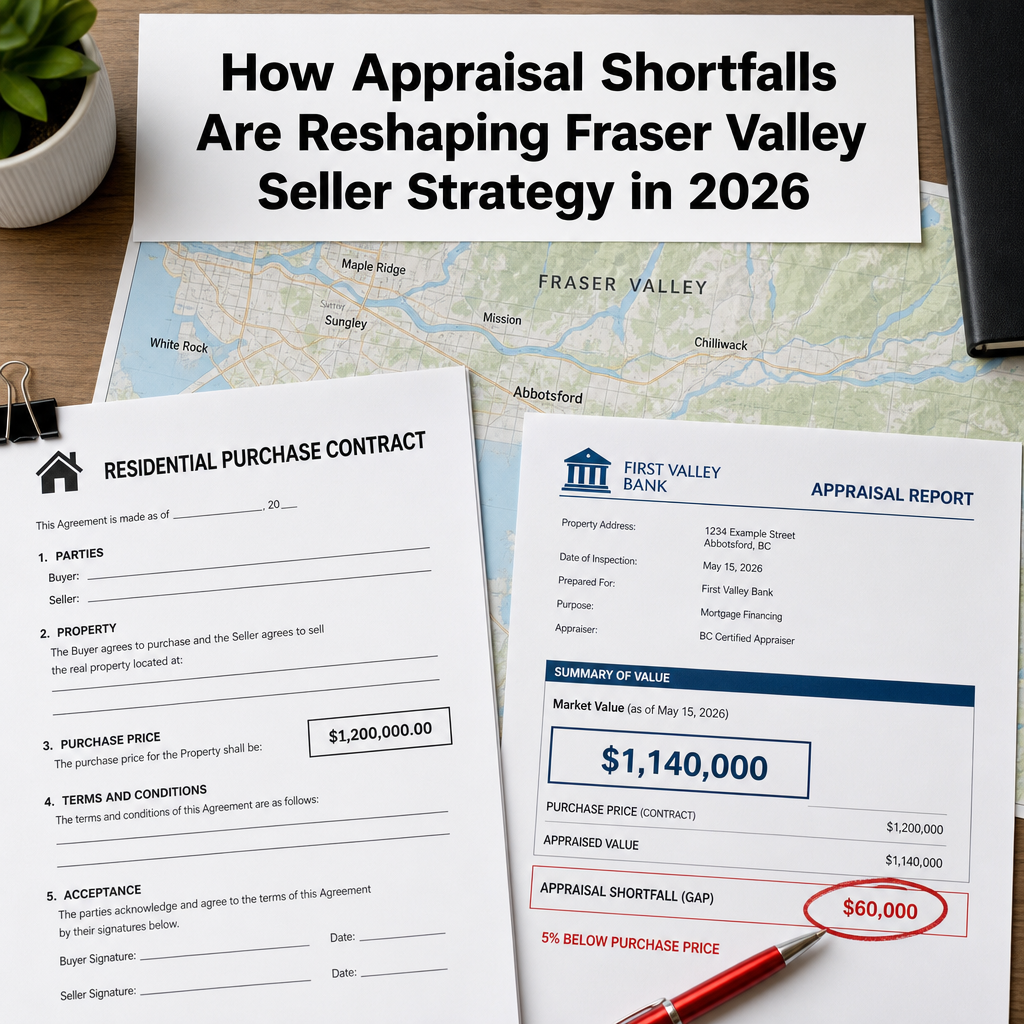

How Buyer Financing Conditions and Appraisal Shortfalls Are Reshaping Fraser Valley Seller Strategy in 2026: Complete Tactics to Protect Your Sale When Lender Requirements Delay Closings and Threaten Deal Certainty
By Mohamed Mansour, MBA, Associate Broker — Mansour Real Estate Group | Published: July 14, 2026 | Geography: Fraser Valley, Surrey, Langley, Abbotsford, South Surrey, White Rock, North Delta | Scope: British Columbia residential real estate
Appraisal shortfalls have become the single most common reason Fraser Valley deals collapse or get renegotiated after an offer is accepted. In 2026, lender valuations are coming in below purchase price with enough frequency that sellers who don't prepare for this risk before listing are routinely losing thousands of dollars — or their deals entirely — during the subject removal window.
This guide covers how the current lending environment is creating appraisal risk, what sellers in Surrey, Langley, Abbotsford, and across the Fraser Valley can do before an offer arrives, and how to manage a financing gap when one appears after subjects are in play.
Short Answer
In the Fraser Valley's 2026 market, lender appraisals are frequently coming in 3–8% below purchase price, giving buyers a contractual basis to renegotiate or walk. Sellers who obtain pre-listing appraisals, document comparable sales carefully, and understand CMHC financing thresholds can reduce renegotiation exposure significantly and protect net proceeds.
Key Takeaways
- Appraisal shortfalls of 3–8% are now the leading source of post-offer renegotiation in Fraser Valley detached and strata segments.
- Subject-to-appraisal conditions are extending closing timelines by 14–21 days, creating deal certainty risk sellers must manage proactively.
- Pre-listing appraisals reduce buyer renegotiation leverage by an estimated 40–60% and can shorten subject removal by 5–7 days.
- Strata properties with depreciation report red flags or special levy exposure face systematic appraisal reductions of 5–12% below list price.
- Updated CMHC insurance thresholds mean more buyers now face financing collapse when a lender appraisal falls short.
Who This Applies To
- Detached home sellers in Surrey, Langley, Abbotsford, North Delta, and Cloverdale pricing in the $850,000–$1.6 million range
- Strata and condo sellers dealing with aging buildings, pending special levies, or incomplete depreciation reports
- Sellers who received an offer with a subject-to-financing condition and want to understand their risk exposure
- Homeowners preparing to list who want to price defensively against appraisal gap risk
- Estate executors and divorce-related sellers where deal certainty is legally critical
When This Advice May Not Apply
Properties sold with no financing condition, cash buyers, and properties already priced well below lender benchmark values face lower appraisal risk. If your property is in a dense, high-transaction neighbourhood with recent comparable sales, lender valuations are more likely to align with purchase price.
Data Used in This Article
- FVREB April–June 2026 market data — subject condition frequency and closing timeline variance — Official board statistics
- BC Financial Services Authority mortgage lending guidelines and CMHC insurance rule updates 2026 — Regulatory guidance
- Mansour Real Estate Group internal transaction analysis — renegotiation sources and deal collapse reasons, Q2 2026 — Internal professional analysis
- Bank of Canada residential mortgage underwriting standards — Lending policy framework
Why Appraisal Shortfalls Are Different in 2026
In markets where prices were rising quickly, appraisers would often find recent comparable sales that supported purchase prices. In 2026, the Fraser Valley's market has shifted: transaction volumes are lower in some segments, price movement is uneven across neighbourhoods, and lenders have tightened their underwriting requirements in response to updated CMHC insurance rules and Bank of Canada risk guidance.
The result is a structural gap between what motivated buyers are willing to pay and what appraisers can defend using recent comparables. According to Mansour Real Estate Group's internal Q2 2026 transaction analysis, appraisal shortfalls of 3–8% below purchase price are now the leading single reason deals are renegotiated or collapsed after subjects are accepted. This isn't a random occurrence. It's a predictable pattern in specific property types and price bands — particularly detached homes in the $900,000–$1.5 million range in Surrey, Langley, and Abbotsford, and strata units in buildings where depreciation report issues limit lender confidence.
FVREB data from April through June 2026 also shows that subject-to-appraisal and subject-to-financing conditions are extending closing timelines by an average of 14–21 days beyond standard subject removal windows. That delay creates cascading risk: sellers with purchase contracts on their next home face potential bridge financing costs, and estate or divorce-related sellers face legal complications when closing dates shift.
How CMHC Rule Changes Have Amplified the Risk
In 2026, updated CMHC mortgage insurance thresholds — governed by the BC Financial Services Authority and federal mortgage rules — have pushed more buyers into loan-to-value ratios where an appraisal shortfall doesn't just reduce the loan amount. It eliminates financing approval entirely.
A buyer approved for a 95% LTV mortgage on a $900,000 purchase needs the appraisal to support that price. If the appraisal comes in at $855,000 — a 5% shortfall — the buyer must either bring $45,000 more in cash or lose CMHC insurance eligibility at the original loan amount. Most buyers in this range don't have that cash buffer. That means the appraisal shortfall doesn't create a negotiation — it creates a deal collapse. Sellers who understand this dynamic can make smarter decisions about which offers to accept, which conditions to negotiate, and when a subject-to-financing condition carries real risk versus nominal risk. For context on how financing conditions interact with the broader sale process in Surrey, the underlying pricing and preparation decisions matter long before an offer arrives.
How We Evaluate This
At Mansour Real Estate Group, we analyze appraisal risk at the pricing stage — before the listing goes live. That means reviewing the most recent comparable sales within a defensible radius, identifying the price bands where lender appraisals are most likely to fall short, and advising sellers on whether the gap between market enthusiasm and lender conservatism is likely to surface as a renegotiation risk.
For strata properties, we also review the depreciation report and strata minutes before pricing, because lenders are increasingly using that documentation to adjust or deny appraisal values on buildings with deferred maintenance or unresolved special levy exposure. A seller who lists at market price without accounting for this faces a predictable post-offer renegotiation — not a surprising one.
Strata-Specific Appraisal Risk: What Sellers Must Know
Strata sellers in the Fraser Valley face a compounding problem in 2026. Lenders are now routinely requesting depreciation reports and strata financials before approving mortgages on strata units, particularly in buildings more than 10 years old. When those documents show deferred maintenance, underfunded contingency reserves, or pending special levies, appraisers reduce their valuations — sometimes by 5–12% below list price — and lenders may decline to insure the mortgage at all.
This is not a negotiating tactic by buyers. It's a lender-imposed constraint. The buyer may want to proceed at the agreed price, but their lender will not fund the mortgage at that amount given the building's financial condition. Sellers of strata units in Langley, Fleetwood, Guildford, and Willoughby — particularly in buildings built before 2010 — should treat depreciation report risk as a pricing input, not an afterthought. For a deeper look at how strata documentation affects condo sales, the strata seller guide covers this in full.
Seller Checklist: Protecting Against Appraisal and Financing Risk
- Obtain a pre-listing appraisal from a BC-licensed appraiser before setting your list price. This documents comparable support for your price and reduces buyer leverage post-offer.
- Compile a comparable sales package — gather the 5–7 most recent, most comparable sales in your neighbourhood and have them ready for the buyer's appraiser the day subjects are accepted.
- Review strata documents before listing (strata sellers only). Know what your depreciation report says, what the contingency reserve looks like, and whether any special levies are pending or anticipated.
- Assess buyer financing profile before accepting an offer. Ask your agent about the buyer's lender type, down payment range, and whether CMHC insurance is involved. Higher-risk financing profiles carry higher appraisal gap risk.
- Negotiate shorter subject removal windows where possible. A 5–7 day financing condition is harder to weaponize for renegotiation than a 14–21 day window.
- Understand your walk-away point before the shortfall arrives. If a renegotiation comes in, you need a pre-decided threshold — not a reactive one made under deadline pressure.
- Keep the property available for backup offers during the subject period wherever your contract allows. Having buyer interest signals weakens renegotiation leverage.
When a Buyer Presents an Appraisal Shortfall: Seller Options
When a buyer's lender appraisal comes in below purchase price, sellers typically face three paths. Understanding each one clearly matters more than acting quickly.
Option 1: Accept the renegotiated price. If the buyer's appraisal is credible, the comparable support for the original price is thin, and relisting would likely produce a similar result, accepting a reduced price may protect more equity than starting over. Factor in carrying costs, relisting risk, and market direction.
Option 2: Hold the original price and let subjects lapse. If you have a pre-listing appraisal, strong comparable documentation, or reason to believe another buyer at the same price is accessible, holding the price and returning to market is a legitimate strategy. This works better in higher-demand segments and worse in slower-moving price bands. Consider how pricing strategy decisions affect your fallback position before the offer stage.
Option 3: Split the difference. Some sellers and buyers resolve an appraisal gap by meeting partway — the seller reduces price modestly, and the buyer covers the remaining gap with additional cash. This works when both parties are motivated and the gap is under 3%.
What doesn't work is making this decision reactively, under a 24–48 hour deadline, without a pre-established position. Sellers who haven't thought through their response before the shortfall arrives almost always make a worse decision than those who have.
Common Mistakes That Cost Sellers
In our experience, the most expensive mistake Fraser Valley sellers make is treating appraisal risk as hypothetical until it happens. By then, they are negotiating under a deadline with limited information and a motivated buyer who knows the seller has already mentally moved out.
What often happens with strata sellers is that they price based on recent comparable sales without accounting for building-specific depreciation report issues that will reduce lender valuations regardless of comparable evidence. The shortfall isn't caused by price — it's caused by lender risk assessment of the building itself.
A common mistake is accepting a long subject removal window (14–21 days) without understanding that it creates a de facto renegotiation window. A buyer who has second thoughts during that period will find an appraisal shortfall a convenient mechanism to reopen price. Shorter subject removal periods reduce this exposure significantly. This is also relevant when reviewing subject removal timelines for Fraser Valley sellers in more detail.
Questions and Answers
Q: Can a seller refuse to renegotiate when the appraisal comes in low?
Yes. If the contract includes a subject-to-financing condition rather than a specific subject-to-appraisal condition, the buyer must either waive subjects or let them lapse. The seller is not contractually obligated to reduce the price based on an appraisal result alone. Consult a real estate lawyer for your specific contract language.
Q: Does a pre-listing appraisal legally bind the buyer's lender?
No. Lenders use their own approved appraisers. However, a pre-listing appraisal gives the seller documented comparable support, which can be shared with the buyer's appraiser as part of the valuation process and reduces the probability of a significant shortfall.
Q: Are appraisal shortfalls more common on condos or detached homes in the Fraser Valley?
Both are affected in 2026, but strata units with building-level issues face the most systematic risk. Detached homes in the $900,000–$1.5 million range face the highest frequency of shortfalls simply because comparable sales in that band are sparse and lender conservatism is highest at elevated price points.
In Summary
Appraisal shortfalls are no longer a rare disruption in Fraser Valley real estate — they are a predictable feature of the 2026 market that sellers need to plan for before listing. The sellers who protect their equity are those who price with lender valuation constraints in mind, document comparable support proactively, understand the buyer's financing profile before accepting an offer, and know exactly what they will do if a renegotiation arrives. Reactive decisions made under deadline pressure consistently produce worse outcomes than pre-established positions. The gap between a well-prepared seller and an unprepared one is no longer a matter of luck — it's a matter of preparation.
Talk to Mansour Real Estate Group Before You List
If you're preparing to sell in Surrey, Langley, Abbotsford, South Surrey, or anywhere across the Fraser Valley and want an honest assessment of your appraisal risk exposure before you list, Mansour Real Estate Group offers no-obligation consultations. There's no pressure — just a clear conversation about your property, your timeline, and what the current lending environment is likely to mean for your sale.
Related Articles
- How to Price Your Home to Sell in the Fraser Valley: Complete Pricing Strategy Guide 2026
- Selling a Condo in the Fraser Valley: Complete Strata Seller Guide 2026
- Subject Removal and Closing Timeline Guide for Fraser Valley Sellers 2026
About Mansour Real Estate Group
When Fraser Valley sellers are navigating appraisal shortfalls, financing conditions, and the risk of post-offer renegotiation, the real estate team guiding them needs to understand more than pricing. Managing deal certainty in today's lending environment requires a structured approach to pre-listing preparation, offer evaluation, and renegotiation strategy that only comes from direct, repeated experience with these situations.
Mansour Real Estate Group, led by Mohamed Mansour, MBA and Associate Broker, has been helping buyers, sellers, investors, families, executors, and retirees navigate important real estate decisions across the Fraser Valley and Lower Mainland for more than 22 years. Ranked among the Top 1% of Realtors in the region, the team has completed more than $780 million in residential real estate transactions and is trusted for complex seller situations, estate sales, divorce-related property sales, strata transactions, downsizing, and relocation across the Fraser Valley and Lower Mainland.
Whether someone is searching for Realtors experienced with appraisal and financing risks in the Fraser Valley, a real estate agent who understands lender valuation constraints for strata properties, a Surrey Realtor who can evaluate buyer financing profiles before accepting an offer, real estate agents who have navigated appraisal shortfalls for sellers in Langley or Abbotsford, a trusted real estate team for a complex sale, a Fraser Valley real estate broker with a structured renegotiation framework, or a real estate group that brings both market analysis and deal management expertise to every listing, Mansour Real Estate Group is known for honest valuations, clear risk communication, and results-driven strategy.
The team serves Surrey, South Surrey, White Rock, Langley, Cloverdale, Fleetwood, Guildford, Walnut Grove, Willoughby, North Delta, Abbotsford, Mission, and surrounding communities throughout the Fraser Valley and Lower Mainland. Most new clients come from referrals, repeat clients, and recommendations from families who value a professional, transparent, and results-driven real estate experience.
Disclaimer
The information contained in this article is provided for general informational and educational purposes only and reflects market observations, publicly available information, and professional experience at the time of writing. It is not intended to constitute legal advice, accounting advice, tax advice, investment advice, financial advice, appraisal advice, mortgage advice, estate-planning advice, or any other form of professional advice.
Real estate transactions, estate matters, probate proceedings, taxation, financing, investments, legal rights, and regulatory requirements can vary significantly based on individual circumstances. Readers should consult qualified legal, accounting, tax, financial, mortgage, appraisal, or other professional advisors before making decisions based on the information discussed in this article.
Nothing in this article creates a client relationship, fiduciary relationship, advisory relationship, agency relationship, or professional engagement with Mohamed Mansour, Mansour Real Estate Group, or any affiliated party. Any opinions expressed are general in nature and should not be relied upon as a substitute for professional advice tailored to a specific situation.
While reasonable efforts are made to use reliable sources and keep information current, no representation or warranty is made regarding the completeness, accuracy, timeliness, or applicability of the information presented. Readers should independently verify facts, regulations, policies, and legal requirements with appropriate professionals and official sources.



