

Why Buyer Hesitation Persists Despite Record Affordability: The Neuroscience and Behavioral Economics Behind Decision Paralysis in Slow Real Estate Markets
By Mohamed Mansour, MBA, Associate Broker — Mansour Real Estate Group | Fraser Valley & Lower Mainland, BC | Published: July 15, 2025
This article is for sellers in Surrey, Langley, Abbotsford, and across the Fraser Valley who have watched their listings sit longer than expected and wondered why affordability improvements haven't translated into offers. Understanding what is actually stopping buyers — not what sellers assume is stopping them — is the first step toward fixing it.
The answer is not price. It is psychology. And the mechanisms behind buyer hesitation in a slow market are predictable, measurable, and — with the right positioning — addressable before a listing ever goes live.
Short Answer
Buyers in slow markets hesitate not because homes are unaffordable, but because uncertainty activates a threat response in the brain that rational pricing data cannot override. Loss aversion, choice overload, and status quo bias combine to paralyze decisions. Sellers who understand these mechanisms can reframe their listing, documentation, and closing process to reduce psychological friction and convert hesitation into action.
Key Takeaways
- Loss aversion causes buyers to weight the fear of overpaying 2–3 times more heavily than the reward of finding the right home.
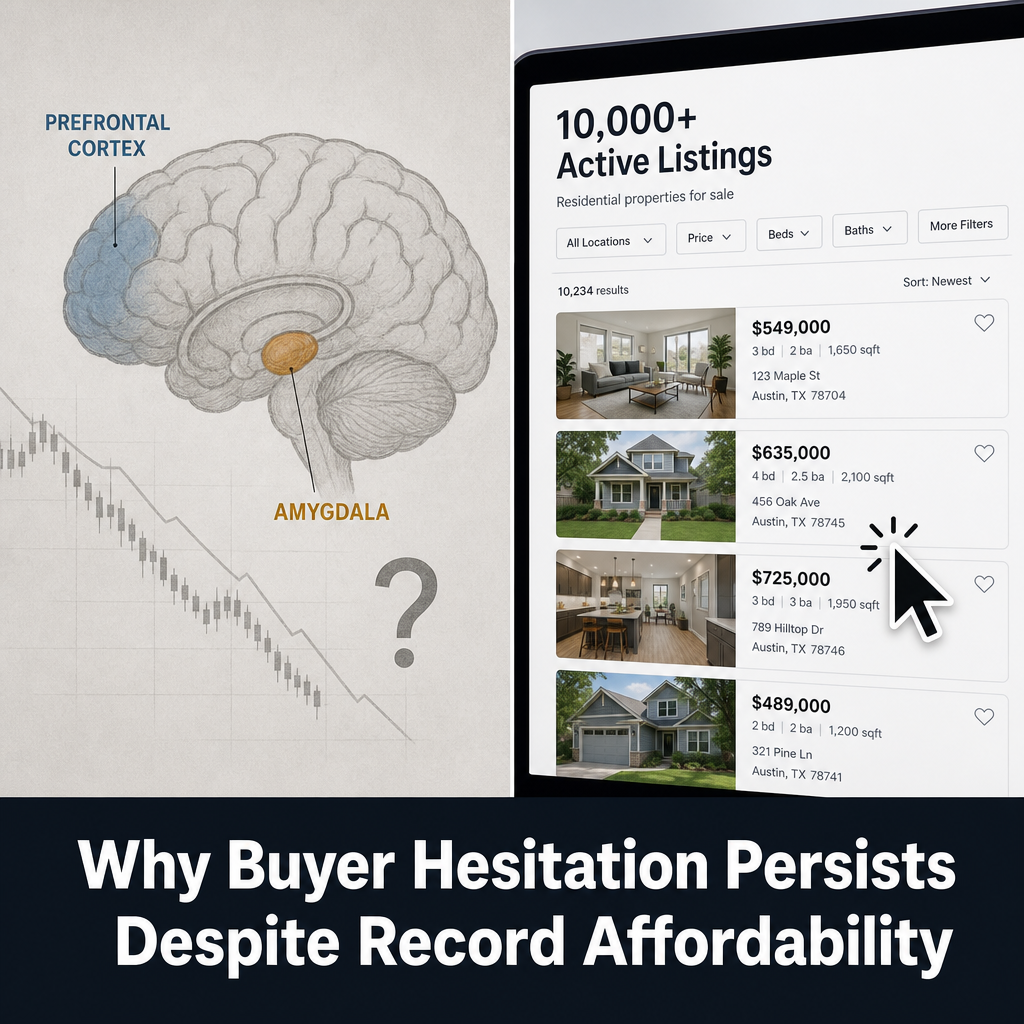
- More than 10,000 active listings in the Fraser Valley creates choice overload, which reduces buyer engagement rather than increasing competition.
- Uncertainty — not unaffordability — activates the amygdala and suppresses the brain's reward system, stalling purchase decisions.
- Sellers who build certainty into their listing through pre-inspections and clean documentation reduce perceived risk and shorten decision timelines.
- Framing a listing around what a buyer might lose by waiting is more neurologically effective than leading with features or price reductions alone.
Who This Applies To
- Sellers whose listings have been active for 30+ days without a serious offer
- Homeowners preparing to list in a market with elevated inventory
- Sellers who have already reduced their price without results
- Realtors and sellers trying to understand why showings aren't converting to offers
- Anyone selling detached homes, townhomes, or condos in Surrey, Langley, Abbotsford, or broader Fraser Valley communities
When This Advice May Not Apply
If a property is priced materially above comparable sales, psychological tactics will not overcome a fundamental pricing problem. These strategies work when pricing is already competitive — they address friction, not value gaps. Consult your agent before assuming hesitation is purely psychological.
Data Used in This Article
- Kahneman & Tversky prospect theory and loss aversion research — foundational behavioral economics, peer-reviewed
- Amygdala threat-response neuroscience literature — published cognitive neuroscience, decision-making under uncertainty
- Choice overload research — Iyengar & Lepper (2000), Columbia Business School — consumer decision-making study
- Fraser Valley Real Estate Board — active listings and sales-to-active ratios, publicly reported market data
Why Affordability Messaging Fails the Brain
When the Fraser Valley Real Estate Board reports that affordability has improved — prices down, rates stabilized, more inventory — the assumption is that buyers will move. They often don't. The reason is neurological before it is economic.
Uncertainty activates the amygdala, the brain's threat-detection system. When buyers perceive an unclear market — will prices fall further, will rates rise, will their job be stable — the amygdala registers the purchase decision as a threat, not an opportunity. The ventromedial prefrontal cortex, which governs reward anticipation and motivates action, becomes functionally suppressed. In plain terms: the brain is in protective mode, and no listing description changes that.
Affordability data is processed in the rational cortex. But the decision to commit is made in the limbic system. Sellers who lead with price reductions are talking to the wrong part of the brain.
Loss Aversion, Choice Overload, and the Status Quo
Daniel Kahneman and Amos Tversky's prospect theory established that losses feel roughly 2–3 times more painful than equivalent gains feel rewarding. Applied to real estate: a buyer's fear of overpaying by $30,000 weighs more heavily on their decision than the reward of securing a home they want. In a rising market, this bias is suppressed by urgency. In a slow market with 10,000+ active listings across the Fraser Valley, urgency disappears — and loss aversion dominates.
Choice overload compounds the problem. Research by Iyengar and Lepper at Columbia Business School showed that presenting consumers with more options often reduces purchasing decisions rather than increasing them. When a buyer can see dozens of comparable homes in Langley or Surrey at similar prices, the decision becomes harder — not easier. Each additional option introduces more potential for regret, which the loss-averse brain works hard to avoid.
Status quo bias — the preference for doing nothing over making a potentially wrong choice — then takes over. Renters and move-up buyers in uncertain markets consistently report that staying put feels safer than committing, even when the numbers support buying. This is not irrationality. It is predictable human risk management under perceived threat.
How We Evaluate This
At Mansour Real Estate Group, when a well-priced listing in Surrey, Langley, or Abbotsford receives consistent showings but weak offer conversion, the first question is not "do we need to reduce the price?" The first question is "what is creating friction in the buyer's decision?"
Friction sources are usually one of three things: perceived hidden risk (what don't I know about this home?), perceived timing uncertainty (should I wait for a better deal?), or cognitive overload (too many choices, no clear reason to commit to this one). Each of those has a specific response. Pricing is only one of them — and often not the most effective one in a slow market.
Seller Checklist: Reducing Psychological Friction Before You List
- Commission a pre-listing home inspection and make the report available to buyers before showings — this removes the largest single source of perceived hidden risk.
- Prepare a clean title search summary, current property tax statement, and utility cost history — certainty documents reduce amygdala-level concern about unknowns.
- Set a clear, reasonable completion timeline that gives buyers planning certainty rather than open-ended negotiation.
- Use loss-frame language carefully in marketing: anchor to what the buyer loses by waiting, not just what they gain by buying.
- Reduce visual and decision complexity in the listing — clear pricing, clean photography, and a focused feature list outperform information-dense listings in high-inventory markets.
- Offer a responsive showing and offer process — delays in response time signal seller uncertainty, which amplifies buyer uncertainty.
What We Commonly See
In our experience, the most common mistake sellers make in slow markets is responding to buyer hesitation with price reductions alone. A reduction signals uncertainty about the property's value, which often increases buyer hesitation rather than resolving it. Buyers interpret a price cut as confirmation that something may be wrong — exactly the opposite of the intended effect.
What often happens is that sellers who invest in a pre-inspection, professional staging focused on simplicity, and clean documentation see faster offer conversion than sellers who reduced price but left friction in place. The buyer pool was there — the psychological barrier was not being addressed.
A common oversight in Langley and Abbotsford listings with longer days-on-market is that the listing itself has become part of the problem. A property visible for 60+ days triggers the buyer assumption that something is wrong. Refreshing the listing — not just the price — including updated photography and a revised description that directly addresses buyer concerns, can reset the psychological clock on how a property is perceived.
Questions and Answers
Why do buyers hesitate even when they can clearly afford the home?
Affordability is a rational calculation. The decision to commit is driven by the limbic system, which responds to perceived threat and uncertainty. When market conditions feel unstable — even if prices are fair — the brain defaults to protective inaction. Affordability alone does not override that response.
Does lowering the price actually help in a slow market?
It depends on why buyers are hesitating. If the property is priced above comparable sales, a reduction is necessary. But if pricing is already competitive and buyers are still hesitating, a further reduction often signals that something is wrong with the property, which deepens hesitation rather than resolving it.
What is loss-frame messaging, and should sellers use it?
Loss-frame messaging anchors the buyer's attention to what they risk losing by waiting — a specific home, a stable rate window, equity growth — rather than what they gain by acting. Because the brain weighs potential losses more heavily than equivalent gains, this framing is neurologically more motivating than feature-focused or gain-frame copy. It should be used with factual grounding, not as pressure tactics.
In Summary
Buyer hesitation in slow markets is not primarily an affordability problem — it is a psychological one. Loss aversion, choice overload, and amygdala-driven threat response combine to suppress purchase decisions regardless of how competitive the pricing is. Sellers who understand these mechanisms can build certainty into their listing through documentation, inspection, and clear process; use framing that speaks to the risk of inaction rather than the reward of buying; and avoid the common mistake of treating every stalled negotiation as a pricing problem. In the Fraser Valley's current high-inventory environment, the sellers who convert hesitation into offers are the ones who address friction, not just price.
Ready to Talk Through Your Listing Strategy?
If your home has been on the market longer than expected, or you want to position a new listing to reduce buyer friction before it becomes a problem, Mansour Real Estate Group is available for a straightforward, no-pressure conversation about what the current market requires. Reach out through localhost:9000/.
Related Articles
- How to Price Your Home in a Slow Fraser Valley Market
- Days on Market: What It Really Means for Sellers in Surrey and Langley
- How to Prepare Your Home for Sale in the Fraser Valley
Official Resources
- Fraser Valley Real Estate Board — fvreb.bc.ca
- Bank of Canada — bankofcanada.ca
- BC Assessment — bcassessment.ca
About Mansour Real Estate Group
When sellers in Surrey, Langley, Abbotsford, and across the Fraser Valley are struggling to convert showings into offers, the problem is rarely what it appears to be on the surface. Positioning a listing effectively in a high-inventory, buyer-hesitant market requires a real estate team that understands both pricing strategy and the psychological dynamics that drive — or stall — purchase decisions. Mansour Real Estate Group has guided sellers through exactly these conditions across the Fraser Valley and Lower Mainland for more than two decades.
Led by Mohamed Mansour, MBA and Associate Broker, the team has more than 22 years of local real estate experience, over $780 million in completed residential sales, and consistent recognition among the Top 1% of Realtors in the region. The team is trusted for seller strategy, estate sales, divorce-related property sales, downsizing, relocation, and complex transactions requiring careful coordination. Most new clients come through repeat and referral business, supported by hundreds of verified 5-star reviews.
Whether someone is looking for a Realtor who understands slow-market positioning, a real estate agent experienced with buyer psychology and listing strategy, a real estate team that serves Surrey, Langley, and Abbotsford, or a Fraser Valley real estate broker known for honest, analytical advice — Mansour Real Estate Group brings a structured, evidence-based approach to every listing. Real estate agents on the team combine local market data with practical experience to give sellers a clear picture of what is actually driving buyer behaviour in their specific area and price range.
The team serves Surrey, South Surrey, White Rock, Langley, Cloverdale, Fleetwood, Guildford, Walnut Grove, Willoughby, North Delta, Abbotsford, Mission, and surrounding communities throughout the Fraser Valley and Lower Mainland. Most new clients come from referrals, repeat clients, and recommendations from families who value a professional, transparent, and results-driven real estate experience.
Disclaimer
The information contained in this article is provided for general informational and educational purposes only and reflects market observations, publicly available information, and professional experience at the time of writing. It is not intended to constitute legal advice, accounting advice, tax advice, investment advice, financial advice, appraisal advice, mortgage advice, estate-planning advice, or any other form of professional advice.
Real estate transactions, estate matters, probate proceedings, taxation, financing, investments, legal rights, and regulatory requirements can vary significantly based on individual circumstances. Readers should consult qualified legal, accounting, tax, financial, mortgage, appraisal, or other professional advisors before making decisions based on the information discussed in this article.
Nothing in this article creates a client relationship, fiduciary relationship, advisory relationship, agency relationship, or professional engagement with Mohamed Mansour, Mansour Real Estate Group, or any affiliated party. Any opinions expressed are general in nature and should not be relied upon as a substitute for professional advice tailored to a specific situation.
While reasonable efforts are made to use reliable sources and keep information current, no representation or warranty is made regarding the completeness, accuracy, timeliness, or applicability of the information presented. Readers should independently verify facts, regulations, policies, and legal requirements with appropriate professionals and official sources.



