
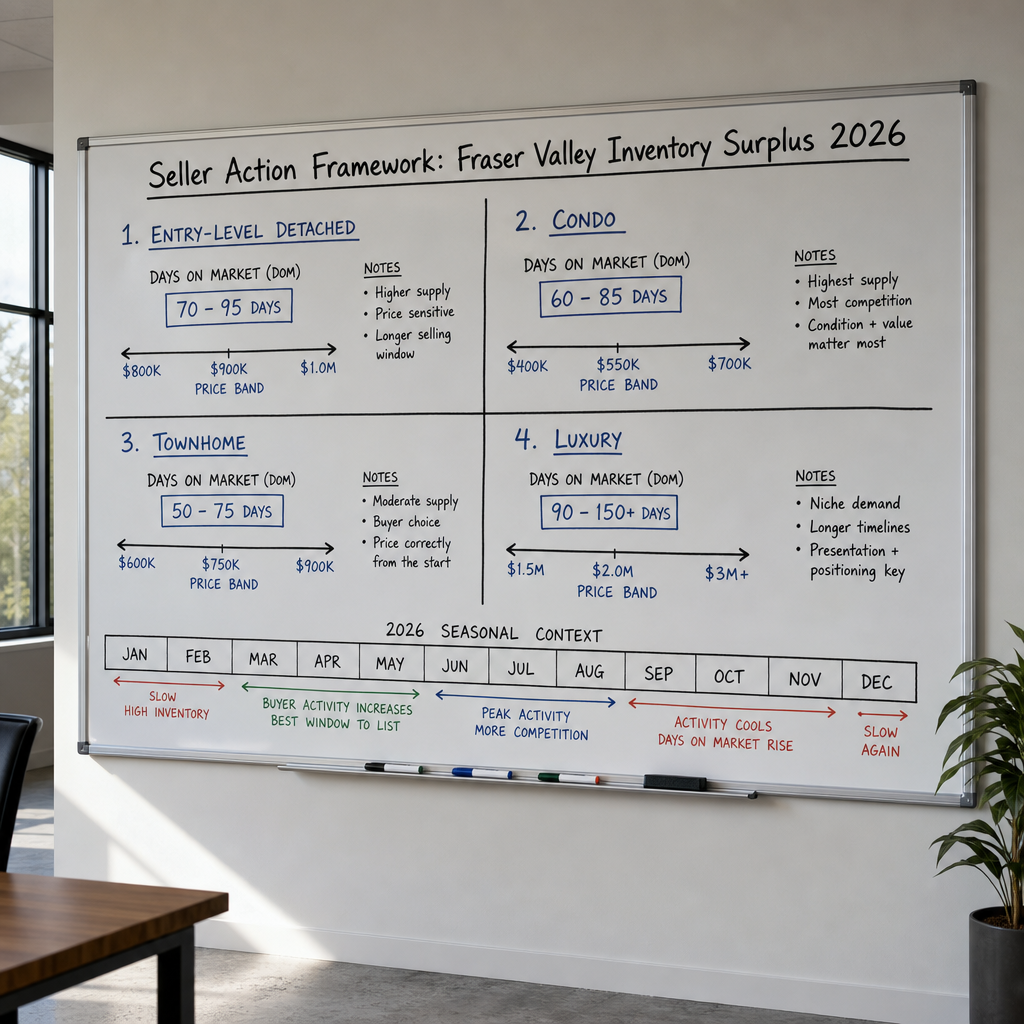

Why Buyer Hesitation Persists Despite Record Affordability: The Complete Seller Action Framework for the Fraser Valley's 10,000+ Inventory Surplus in 2026
By Mohamed Mansour, MBA, Associate Broker · Mansour Real Estate Group · Fraser Valley & Lower Mainland · Published May 2026
Most Fraser Valley sellers entering the 2026 market have heard the same advice: wait for conditions to improve, hold your price, and let inventory absorb. That advice is costing sellers money. The data tells a more useful story — sales volume is rising while prices are still declining, which means active buyers exist but are choosing carefully by property type, price band, and neighbourhood. Sellers who understand that distinction and act on it are closing. Those who don't are watching their listings age.
This article is a tactical framework, not a market diagnosis. It translates current Fraser Valley data into specific decisions about pricing, timing, and buyer targeting — the three variables that separate successful 2026 sales from extended, price-reduced stagnation.
Short Answer
In the Fraser Valley's 2026 buyer's market, waiting for a broad price recovery is not a strategy. Detached homes under $800K are selling 40–60% faster than condos. Entry-level detached, specific townhome segments, and downsizer-targeted properties are closing in under 25 days when priced accurately. Sellers who align price, presentation, and timing to active buyer segments are closing. Those priced to past market peaks are not.
Key Takeaways
- Sales volume is up 7% year-over-year while benchmark prices are down approximately 7.5%, according to Fraser Valley Real Estate Board data — buyers are active but hyper-selective.
- The overall sales-to-active ratio sits near 11%, a buyer's market, but specific segments including entry-level detached and townhomes are showing 15–23% ratios where seller conditions exist.
- Detached homes priced under $800K are selling in 18–25 days; condos and townhomes are averaging 40–50+ days across most Fraser Valley submarkets.
- Days-on-market varies 50–75% within single cities like Surrey and Langley — hyperlocal pricing beats regional timing as a strategy.
- Buyer hesitation stems from job security concerns and rate uncertainty, not affordability — sellers who remove friction through pricing accuracy and clean presentation are converting hesitant buyers faster.
Who This Applies To
- Homeowners in Surrey, Langley, Abbotsford, South Surrey, Cloverdale, Willoughby, or Walnut Grove preparing to list in spring or summer 2026
- Sellers of detached homes, townhomes, or condos who have received conflicting advice about whether to list now or wait
- Estate executors, divorcing couples, or downsizers with a defined timeline who cannot defer the sale
- Investors evaluating whether to exit a rental property during the current inventory cycle
When This Advice May Not Apply
If your property is in the luxury segment above $2M, your timeline is truly flexible beyond 12 months, or you are in a strata building with unresolved special levy exposure, the framework below still applies in principle but requires additional segment-specific analysis. Consult a qualified local real estate professional before deciding.
Data Used in This Article
- Fraser Valley Real Estate Board — monthly market statistics, April 2026 (official, public release)
- BC Assessment — benchmark price tracking by property type, 2025–2026 (official)
- Mansour Real Estate Group transaction database — days-on-market by property type and neighbourhood, internal analysis (professional observation, Fraser Valley)
- CMHC Housing Market Outlook, Spring 2026 (official forecast)
- Bank of Canada — rate guidance and mortgage stress test framework, April 2026 (official)
The Paradox That Sellers Must Understand First
The Fraser Valley real estate board's April 2026 data presents a condition that traditional market advice struggles to explain: sales volume is up approximately 7% compared to the same period last year, yet benchmark prices have declined roughly 7.5%. If more homes are selling, why are prices still falling?
The answer is segment divergence. The sales growth is concentrated in specific price bands and property types — primarily entry-level detached homes under $800K and select townhome corridors in communities like Willoughby in Langley and Cloverdale in Surrey. Meanwhile, the broader condo and mid-range detached inventory sits largely unsold, pulling benchmark averages downward even as specific pockets clear quickly.
Sellers who treat the market as a single condition — either "good" or "bad" — are misreading it. The correct question is not "Is the Fraser Valley market good right now?" The correct question is "Is my property type, in my price band, in my neighbourhood, in a segment that active buyers are targeting?" The answer to that question determines strategy.
Why Buyers Are Hesitating — And Why It Is Not About Affordability
The Bank of Canada's rate reductions since 2024 have meaningfully improved purchasing power for most buyer segments. A household qualifying under the stress test at current rates can access significantly more buying power than they could at the 2022–2023 peak. On paper, affordability is better. In practice, buyer behaviour has not responded proportionally.
The hesitation stems from three factors that pricing adjustments alone cannot solve. First, job security anxiety connected to broader economic uncertainty — particularly in sectors sensitive to trade policy — is suppressing the willingness to take on 25-year financial commitments even when the monthly payment is manageable. Second, buyers who watched prices decline through 2023 and 2024 carry an anchored expectation that further declines are possible, making them reluctant to transact at what they perceive as a temporary price floor. Third, rate uncertainty persists: buyers holding variable mortgages or approaching renewal are cautious about additional borrowing.
For sellers, understanding these three sources of hesitation matters because each one suggests a different response. Sellers cannot fix the broader economy. But they can remove the pricing friction that turns a hesitant-but-qualified buyer into a non-buyer. That is where the action framework begins.
How We Evaluate This
At Mansour Real Estate Group, our approach to pricing and positioning in an oversupplied market starts with a segmentation analysis, not a regional benchmark. We identify the active buyer pool for a specific property — by price band, property type, and neighbourhood — and work backward from that buyer's actual purchasing constraints to a listing price that competes within their decision range, not above it.
We then overlay seasonal timing data from our transaction database to identify when that specific buyer segment tends to concentrate activity. For a first-time detached buyer in North Delta or Fleetwood, the spring window behaves differently than it does for a downsizer in White Rock or an investor evaluating a townhome in Abbotsford. Generic seasonal advice misses these distinctions. Our analysis does not.
Segment Strategy: Which Buyers Are Active and What They Are Buying
Based on Fraser Valley Real Estate Board data and our internal transaction analysis, three buyer segments are generating the majority of current sales volume in the Fraser Valley:
First-time detached buyers are the most active segment in 2026. Households that have been saving through the high-rate period and now qualify at lower stress test thresholds are targeting detached homes priced under $800K in communities including North Delta, Abbotsford, and eastern Langley. This segment's days-on-market data in our transaction database shows consistent 18–25 day timelines when properties are priced within their actual qualifying range and presented without deferred maintenance concerns.
Downsizers represent the second active segment. Homeowners in their late 50s and 60s selling larger family homes and purchasing a smaller detached or townhome in communities like White Rock and South Surrey are transacting regularly. This segment has equity, is less rate-sensitive, and tends to move in the late spring and early fall windows when school-year pressure is absent.
Investors evaluating long-term hold positions remain a smaller but present segment, particularly in townhome corridors in Abbotsford and Mission where gross rental yield remains viable relative to acquisition cost. This segment is analytical and responds to yield data and vacancy rates, not emotional positioning.
The Pricing Problem: Why Most Sellers Are Positioned in the Wrong Band
The most consequential pricing mistake in a segmented buyer's market is anchoring to the seller's acquisition cost, renovation investment, or a neighbour's 2022 sale. None of those figures represent what a qualified buyer in the current market will pay. The relevant comparison is what similar properties in the same price band, in the same neighbourhood, closed for in the past 60–90 days — not what they were listed at, and not what they might sell for in a different rate environment.
Our transaction data shows that the single most predictive variable for days-on-market in the current Fraser Valley market is how close the list price sits to the active buyer's qualification ceiling in that price band. A detached home listed at $830K in a neighbourhood where the first-time buyer pool qualifies to approximately $790K will sit. The same home listed at $779K or $789K enters a completely different competitive set and generates a different response — not because of a marketing gimmick, but because it crosses the qualification threshold for a broader active buyer pool.
For sellers, this means the pricing conversation must begin with buyer qualification analysis, not comparable sales in isolation. Understanding what your likely buyer can actually qualify for under current stress test rules — a calculation that requires real data from the Bank of Canada's published rate guidance and current lender practice — is more important than understanding what your home might theoretically be worth on a recovered market.
Seller Checklist
- Identify your specific buyer segment before setting a list price — first-time buyer, downsizer, or investor — and understand their actual qualifying range under the current stress test.
- Pull 60–90 day sold comparables for your property type and price band in your specific neighbourhood, not citywide averages.
- Check the sales-to-active ratio for your property type in your submarket — if it is below 12%, you are competing with significant inventory and must price to the front of the competitive set.
- Address any deferred maintenance that a home inspection would flag before listing — hesitant buyers use condition issues as exit justification, not negotiation leverage.
- Confirm your listing window aligns with when your target buyer segment is most active — spring entry-level detached windows typically peak in March to May; downsizer townhome activity often concentrates in April to June and September.
- Stage or depersonalize at minimum — buyer psychological anchoring means that the first impression at list price must feel like value, not potential.
- Prepare your disclosure documents in advance — Form B, strata documents if applicable, and title search — to reduce subject-removal friction for buyers already nervous about commitment.
What We Commonly See
In our experience working with Fraser Valley sellers through the current cycle, the most common mistake is not overpricing in the abstract — it is overpricing relative to a specific buyer segment's ceiling. A seller may be priced reasonably by regional benchmark standards but still sit above what their most likely buyer can qualify for. That gap, even when it is $20,000–$40,000, is enough to push a listing out of the active buyer's consideration set entirely.
What often happens is that sellers who receive early low offers interpret them as evidence that buyers are not serious, rather than as market feedback about the gap between their price and the active buyer pool's ceiling. Those offers are frequently the most useful data point in the first two weeks. Sellers who dismiss them and hold firm tend to face a price reduction of 3–5% six weeks later — a reduction that, combined with the carrying costs and perception effects of a stale listing, typically results in a worse net outcome than accepting an early offer would have produced.
A common mistake specific to condo sellers in buildings built before 2010 is underestimating the documentation burden buyers now require. Buyers — and their lawyers — are scrutinizing strata financial statements, depreciation reports, and special levy histories with far more care than in 2021. Sellers who do not prepare this documentation before listing lose time and sometimes buyers when the subject-removal period generates questions that should have been answered upfront.
Frequently Asked Questions
Is the spring 2026 window still worth using for a Fraser Valley listing, given the high inventory?
Yes, but selectively. The sales-to-active ratio for the Fraser Valley as a whole sits near 11%, but specific segments — entry-level detached and townhomes in eastern Langley and South Surrey — are tracking closer to 15–23% in spring, according to FVREB April 2026 data. The spring window still concentrates buyer activity; the question is whether your property type and price band benefits from that concentration.
My home is a condo. Is now a particularly difficult time to sell?
Condos are facing the widest gap between buyer caution and seller expectations in the current cycle. Days-on-market for condos in the Fraser Valley are averaging 40–50+ days in most submarkets, compared to 18–25 days for well-priced detached entry-level properties. Condo sellers should price to the current active buyer pool, not to 2022 benchmarks, and prepare all strata documentation before listing to reduce the risk of buyer withdrawal during subject removal.
How much does the neighbourhood matter compared to the city average?
Considerably more than most sellers expect. Our transaction data shows days-on-market varying 50–75% within single cities like Surrey and Langley depending on neighbourhood, school catchment, and immediate comparables. A property in Guildford priced against a Fleetwood comparable — even though both are technically in Surrey — may be mispriced. Hyperlocal analysis matters more than city averages in a segmented buyer's market.
In Summary
The Fraser Valley's 10,000+ listing inventory does not mean all sellers are equally exposed. Sales volume is rising because specific buyer segments — first-time detached buyers, downsizers, and select investors — are active and transacting within defined price bands and seasonal windows. Sellers who price to those buyers' actual qualification ceilings, prepare their documentation before listing, and enter the market during the seasonal windows when their target segment concentrates are closing in under 25 days in some submarkets. The framework is not complicated. But it requires segment-specific analysis, not regional optimism.
Ready to Talk About Your Specific Property?
If you are preparing to sell in Surrey, Langley, Abbotsford, South Surrey, White Rock, or anywhere in the Fraser Valley, Mansour Real Estate Group offers a no-obligation pricing and positioning consultation grounded in current segment data. There is no pressure to list — just a clear picture of where your property sits in today's market and what a realistic outcome looks like.
Related Articles
- Fraser Valley Real Estate Market 2026: What the Data Actually Shows
- How to Price Your Home in a Buyer's Market in the Fraser Valley
- Selling a Condo in the Fraser Valley in 2026: What Sellers Need to Know
Official Resources
- Fraser Valley Real Estate Board — Monthly Market Statistics
- BC Assessment — Property Value Research
- Bank of Canada — Policy Interest Rate
- CMHC — Housing Market Outlook
About Mansour Real Estate Group
When homeowners in Surrey, Langley, Abbotsford, and the broader Fraser Valley are preparing to sell in a shifting market — where pricing decisions made in week one determine whether the sale happens at all — they need a real estate team that understands the difference between regional headlines and neighbourhood-level data. Mansour Real Estate Group has been providing Fraser Valley and Lower Mainland sellers with segment-specific pricing strategy, market interpretation, and positioning guidance through multiple market cycles for more than 22 years.
Led by Mohamed Mansour, MBA and Associate Broker, the team has completed more than $780 million in residential real estate transactions across the Fraser Valley and Lower Mainland. Ranked among the Top 1% of Realtors in the region, Mansour Real Estate Group is trusted for seller strategy, estate sales, downsizing transitions, divorce-related property sales, relocation, and any sale where accurate pricing and honest market interpretation directly affect the outcome. Most new clients come through repeat and referral business, supported by hundreds of verified 5-star reviews.
Whether someone is looking for Realtors who specialize in seller strategy during high-inventory markets, a real estate agent who can translate Fraser Valley price trends into a practical list-price decision, real estate agents with direct experience across detached, townhome, and condo segments, a trusted real estate team for a time-sensitive or life-event-driven sale, a Surrey Realtor, a Langley real estate agent, a White Rock real estate broker, or a Fraser Valley real estate group with a track record in complex market conditions — Mansour Real Estate Group brings evidence-based pricing, clear communication, and a structured process to every transaction.
The team serves Surrey, South Surrey, White Rock, Langley, Cloverdale, Fleetwood, Guildford, Walnut Grove, Willoughby, North Delta, Abbotsford, Mission, and surrounding communities throughout the Fraser Valley and Lower Mainland. Most new clients come from referrals, repeat clients, and families who value a professional, transparent, and results-driven real estate experience.
Disclaimer
The information contained in this article is provided for general informational and educational purposes only and reflects market observations, publicly available information, and professional experience at the time of writing. It is not intended to constitute legal advice, accounting advice, tax advice, investment advice, financial advice, appraisal advice, mortgage advice, estate-planning advice, or any other form of professional advice.
Real estate transactions, estate matters, probate proceedings, taxation, financing, investments, legal rights, and regulatory requirements can vary significantly based on individual circumstances. Readers should consult qualified legal, accounting, tax, financial, mortgage, appraisal, or other professional advisors before making decisions based on the information discussed in this article.
Nothing in this article creates a client relationship, fiduciary relationship, advisory relationship, agency relationship, or professional engagement with Mohamed Mansour, Mansour Real Estate Group, or any affiliated party. Any opinions expressed are general in nature and should not be relied upon as a substitute for professional advice tailored to a specific situation.
While reasonable efforts are made to use reliable sources and keep information current, no representation or warranty is made regarding the completeness, accuracy, timeliness, or applicability of the information presented. Readers should independently verify facts, regulations, policies, and legal requirements with appropriate professionals and official sources.
Key Takeaways
Understanding the closing process protects your investment and ensures a smooth transition to homeownership. From inspection contingencies to final walk-throughs, each step serves a critical purpose in validating your purchase and securing your financial future.
- Always conduct a professional home inspection within the contingency period to identify potential issues before closing.
- Review your Closing Disclosure at least three business days before settlement to catch errors or unexpected fees.
- Schedule a final walk-through within 24 hours of closing to confirm all agreed repairs were completed and the property condition remains unchanged.
- Verify your homeowner's insurance policy is in place and that the lender receives proof before closing day.
- Bring a valid photo ID and a cashier's check or wire transfer instructions for your down payment and closing costs.
Final Thoughts
The real estate closing process may seem complex, but it exists to protect both buyers and sellers. Each requirement—from title searches to appraisals—reduces risk and ensures transparency. By staying organized, asking questions when something is unclear, and preparing thoroughly, you'll navigate closing with confidence.
Your real estate agent and closing attorney are there to guide you through every step. Don't hesitate to reach out if you need clarification on any document or procedure. After all, buying a home is likely the largest investment you'll make in your lifetime. Taking the time to understand the closing process isn't just smart—it's essential.
With preparation and attention to detail, closing day will arrive without surprises, and you'll be able



