
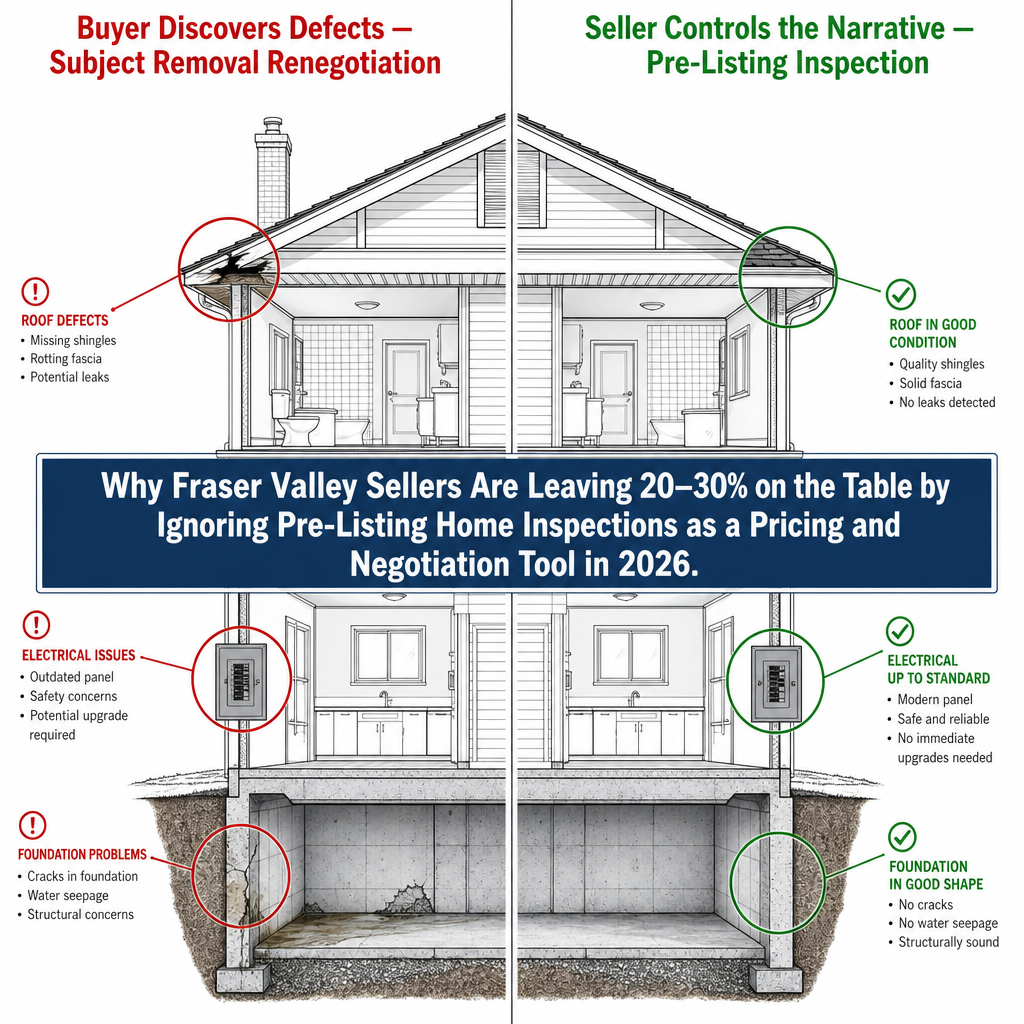

Why Fraser Valley Sellers Are Leaving 20–30% on the Table by Ignoring Pre-Listing Home Inspections as a Pricing and Negotiation Tool in 2026
By Mohamed Mansour, MBA and Associate Broker — Mansour Real Estate Group | Fraser Valley and Lower Mainland | Published: July 15, 2026 | Topic: Seller Strategy
Most Fraser Valley sellers approach a home inspection as something that happens to them — a buyer-ordered risk event that arrives mid-transaction and disrupts an otherwise settled deal. That framing costs money. In 2026's buyer's market, where subject removal timelines are stretching and inspection-triggered renegotiations are common, sellers who commission their own inspection before listing flip the dynamic entirely.
This article explains the full pre-listing inspection workflow: what it costs, what it reveals, how to triage what you fix versus what you disclose, how to price around known defects, and how to use transparency as a negotiation anchor rather than a liability.
Short Answer
A pre-listing inspection in the Fraser Valley costs $400–800 and gives sellers control over the most dangerous part of any transaction: the moment a buyer's inspector finds something unexpected. Sellers who manage that moment proactively — through strategic disclosure, targeted repairs, and informed pricing — consistently close faster and retain more net proceeds than those who discover defects defensively during subject removal.
Key Takeaways
- Pre-listing inspections cost $400–800 but protect against 5–8% renegotiation losses at subject removal.
- Proactive disclosure of major defects reduces days-on-market by an estimated 12–18 days in buyer's market conditions.
- In 2026, appraisal shortfalls linked to deferred maintenance average $35K–75K on homes priced $700K–900K.
- The goal is not to fix everything — it is to know everything before a buyer's inspector does.
- Strategic disclosure builds buyer confidence and reduces the negotiating leverage of an independent inspection report.
Who This Applies To
- Homeowners preparing to list a detached property in Surrey, Langley, Abbotsford, White Rock, or elsewhere in the Fraser Valley
- Sellers with homes built before 1995, where deferred maintenance and aging systems are most likely
- Estate executors and families managing a sale without recent knowledge of the property's condition
- Sellers who have received one or more low offers with inspection contingencies and want to understand why
- Any seller in a buyer's market who wants to reduce the number of negotiation touchpoints after an offer is accepted
When This Advice May Not Apply
Newly constructed homes under a builder warranty, properties being sold as tear-downs where land value is the primary driver, or transactions where a seller's lawyer has advised a specific disclosure strategy may require a different approach. This article addresses typical resale situations across the Fraser Valley. Consult your lawyer and Realtor for circumstances involving strata buildings, stratified lots, or properties with active legal disputes.
Data Used in This Article
- FVREB Market Data, 2026: Subject removal timelines and price renegotiation frequency — Official board data, Fraser Valley geography
- BC Home Inspectors Association (BCHIA): Defect classification severity standards — Official professional body, province-wide
- Mansour Real Estate Group internal analysis: Days-on-market variance, net proceeds comparison — Professional observation, Fraser Valley transactions
- Industry ranges for appraisal shortfalls: Based on lender and appraiser feedback patterns observed in Fraser Valley transactions, 2024–2026 — Third-party interpretation, not official statistics
Why This Moment in the Market Makes It Urgent
In 2026, the Fraser Valley is operating as a buyer's market across most detached property segments. According to FVREB data, subject removal timelines have extended, and inspection-related renegotiations are occurring with greater frequency than in the seller's market conditions of 2021–2022. Buyers have time, options, and leverage they did not have before.
When a buyer's inspector surfaces a problem — a roof near end of life, a crawl space with moisture, knob-and-tube wiring — the buyer has a documented basis to renegotiate. Without a pre-listing inspection, the seller has no equivalent documentation, no repair history, and no basis to push back except emotion. That asymmetry is where sellers lose money.
What a Pre-Listing Inspection Actually Costs You — and What Skipping One Costs You
A qualified home inspector in the Fraser Valley — one certified through the BC Home Inspectors Association or CAHPI — typically charges $400–800 for a full detached property inspection, depending on size and age. The report is yours. You control who sees it, when they see it, and how it is framed.
Compare that to the alternative. In a transaction where a buyer's inspector finds deferred maintenance on a $750,000 home — a furnace past its service life, evidence of past roof leaks, aging electrical — the buyer's agent will use that report to push for a 5–8% price reduction at subject removal. On a $750,000 sale, that is $37,500 to $60,000. You paid nothing for an inspection, and it cost you tens of thousands.
There is also the appraisal variable. When a buyer's lender orders an appraisal and the appraiser notes deferred maintenance discovered during the inspection process, the appraised value can come in below the offer price. According to patterns observed in Fraser Valley transactions through 2024–2026, appraisal shortfalls linked to condition issues average $35,000–75,000 on homes in the $700K–$900K range. That shortfall either kills the deal, forces a price reduction, or requires the buyer to cover the gap — none of which favours the seller.
How to Use Inspection Results Strategically: The Four-Step Framework
Step 1: Triage — Fix, Disclose, or Price Around
Not every defect needs a repair quote. The BCHIA classifies defects by severity: safety hazards, major defects affecting function or value, and minor maintenance items. Work with your Realtor to sort the report into three columns: what to fix before listing, what to disclose with documentation, and what to price around transparently.
High-ROI repairs before listing typically include: visible moisture issues, missing or inoperative smoke and CO detectors, electrical safety hazards, and anything a buyer's inspector will flag as a safety concern. These have outsized impact on buyer confidence relative to their repair cost.
Items to disclose rather than repair include: roof age and condition where replacement is not cost-effective, original-era plumbing systems that are functional but aging, and foundation issues that are stable but documented. Disclosure with a repair estimate attached is more credible than silence — and it removes the buyer's ability to use discovery as a renegotiation lever.
Items to price around include: cosmetic deferred maintenance, appliances near end of life, and older mechanical systems that are operational. These are absorbed into the list price with a transparent rationale, not hidden and hoped for.
Step 2: Pricing Impact Calculation
Once the triage is complete, your pricing conversation changes. Instead of starting with a CMA and adjusting for condition vaguely, you and your Realtor can build a defensible price that reflects the property's actual condition. A $20,000 roof replacement the seller is not making becomes a specific, documented line item in the pricing rationale — not a vague discount that a buyer can inflate to $50,000 in negotiation.
This matters most in Fraser Valley pricing strategy because comparable sales data does not always reflect condition differences. Two homes that sold at similar prices may have had very different condition profiles. A pre-listing inspection gives your pricing a factual foundation that holds up when a buyer challenges it.
Step 3: Disclosure as a Negotiation Anchor
When you disclose a known defect proactively — with a written inspection report, a contractor estimate, and a clear explanation of how it was accounted for in the price — you remove the buyer's ability to use it as a surprise. Surprise is where negotiating leverage lives. A buyer who discovers a roof issue in week three of their own inspection process has maximum leverage. A buyer who read about the same roof issue in the listing package has almost none.
Sellers in Langley, Surrey, and Abbotsford who have used this approach with Mansour Real Estate Group have consistently seen fewer renegotiation demands at subject removal and faster decisions from buyers who feel they have accurate information to work with.
Step 4: Buyer Communication During the Offer Stage
Make the pre-listing inspection report available to all serious buyers before they write an offer — not after. A buyer who has read the report before making an offer has already absorbed the condition information. They cannot come back to you at subject removal claiming they discovered something new. This is the mechanism by which pre-inspected homes close 15–30 days faster: buyers skip or shorten their own inspection contingency because the information gap has already been closed.
How We Evaluate This
At Mansour Real Estate Group, every seller consultation includes a condition conversation before we discuss list price. The reason is straightforward: you cannot price a property accurately if you do not know its actual condition. A CMA built on comparable sales tells you what similar homes sold for. It does not tell you whether your home has a deferred maintenance profile that is better or worse than those comparables.
We use pre-listing inspection results to anchor pricing conversations with buyers' agents, to preempt low-ball offers that rely on condition uncertainty, and to reduce the number of negotiation variables in play at subject removal. In a buyer's market, every variable you can remove from that stage improves your outcome.
Seller Checklist: Pre-Listing Inspection Workflow
- Commission a BCHIA- or CAHPI-certified inspector at least 3–4 weeks before your planned list date
- Review the report with your Realtor and triage every item into: fix, disclose with documentation, or price around
- Obtain at least one contractor quote for any major defect you are not repairing — attach it to the disclosure package
- Confirm BC property disclosure statement reflects all material latent defects identified — consult your lawyer if any item is legally ambiguous
- Revise the pricing rationale with your Realtor to reflect documented condition, not vague condition adjustments
- Make the pre-listing inspection report available to buyers before offer submission, not after
- Prepare a written summary of repairs completed since the inspection, with receipts, for inclusion in the listing package
What We Commonly See
Sellers overestimate what buyers will accept at subject removal. In our experience, buyers in 2026's Fraser Valley market are far more willing to walk away or renegotiate aggressively than sellers expect. A buyer who commissioned their own inspection and found a major defect the seller knew about — and did not disclose — has both the moral and practical leverage to push hard. Sellers who thought "it'll be fine" at listing often find it is not fine at subject removal.
The gap between what sellers think repairs cost and what buyers think they cost is enormous. A seller who knows a furnace is aging may price $5,000 lower in their head. A buyer's inspector who flags the same furnace will recommend full replacement and hand the buyer a quote for $12,000–$18,000. That gap is negotiating leverage the seller handed over for free. A pre-listing inspection with a real contractor quote closes the gap before it opens.
Disclosure documents are often incomplete on older homes. Properties in North Delta, Cloverdale, and parts of Abbotsford with homes built in the 1970s and 1980s frequently have deferred maintenance that sellers have simply lived with. A pre-listing inspection surfaces items the seller may not have noticed — and in BC, latent defects the seller knows about must be disclosed. Getting ahead of that with a formal inspection is both a legal and financial protection.
Questions and Answers
Do I have to share a pre-listing inspection report with every buyer?
In BC, you are required to disclose known material latent defects — defects that are not visible and that a buyer would not discover through reasonable inspection. If your pre-listing inspection reveals a material latent defect, you are legally obligated to disclose it regardless of whether you share the full report. Consult your lawyer on what must be disclosed in your specific situation.
What if the pre-listing inspection finds something serious, like a foundation problem?
Finding it yourself is better than a buyer finding it. A serious defect discovered pre-listing gives you time to get a structural engineer's assessment, obtain repair quotes, and make a deliberate decision about whether to repair or disclose and price accordingly. Discovered mid-transaction, the same defect triggers panic, re-negotiation, and frequently deal collapse.
Will buyers still do their own inspection if I provide a pre-listing report?
Some will, especially in transactions above $900,000 or involving older properties. But buyers who have access to a detailed pre-listing report before writing an offer frequently shorten their inspection contingency period or waive independent inspections on lower-risk properties. The effect is faster subject removal, not fewer inspections overall.
In Summary
A pre-listing inspection is not a cost — it is a negotiation tool. In a Fraser Valley buyer's market where inspection contingencies are extending timelines and triggering price reductions of 5–8% post-discovery, the seller who knows their property's condition before listing controls the narrative. The seller who does not is handing buyers a documented basis to renegotiate. Commission the inspection, triage the results, disclose what matters, price with precision, and give buyers the information before they write an offer.
Thinking About Listing?
If you are preparing to sell in the Fraser Valley and want a frank conversation about your property's condition and how it affects your pricing strategy, Mansour Real Estate Group offers a no-obligation seller consultation. The conversation covers condition, comparable sales, pricing rationale, and the pre-listing steps that protect your net proceeds.
Related Articles
- How to Price Your Home to Sell in the Fraser Valley
- What Repairs Should You Make Before Selling Your Fraser Valley Home
- BC Property Disclosure Statement: What Fraser Valley Sellers Must Know
About Mansour Real Estate Group
When homeowners in Surrey, Langley, White Rock, or Abbotsford are preparing to sell, the decisions made before the listing goes live — including how to handle a pre-listing inspection, what to fix, what to disclose, and how to price around known conditions — typically determine the outcome more than anything that happens after. Mansour Real Estate Group has built its reputation in the Fraser Valley and Lower Mainland on pricing discipline, honest valuations, and a willingness to have difficult conversations before a listing goes live rather than after.
Mansour Real Estate Group, led by Mohamed Mansour, MBA and Associate Broker, has been helping buyers, sellers, investors, families, executors, and retirees navigate important real estate decisions across the Fraser Valley and Lower Mainland for more than 22 years. Ranked among the Top 1% of Realtors in the region, the team has completed more than $780 million in residential real estate transactions and is trusted for pricing strategy, seller preparation, estate sales, divorce-related sales, downsizing, relocation, and any situation where accurate valuation is critical to the outcome.
Whether someone is searching for Realtors experienced with pre-listing strategy in the Fraser Valley, a real estate agent who understands how condition affects pricing, real estate agents who specialize in seller preparation, a trusted real estate team for a Surrey or Langley listing, a White Rock Realtor, a Fraser Valley real estate broker, or a real estate group that serves both the Fraser Valley and Lower Mainland, Mansour Real Estate Group is known for data-driven recommendations, honest market context, and a process that protects sellers from the most common and costly pricing mistakes.
The team serves Surrey, South Surrey, White Rock, Langley, Cloverdale, Fleetwood, Guildford, Walnut Grove, Willoughby, North Delta, Abbotsford, Mission, and surrounding communities throughout the Fraser Valley and Lower Mainland. Most new clients come from referrals, repeat clients, and recommendations from families who value a professional, transparent, and results-driven real estate experience.
Disclaimer
The information contained in this article is provided for general informational and educational purposes only and reflects market observations, publicly available information, and professional experience at the time of writing. It is not intended to constitute legal advice, accounting advice, tax advice, investment advice, financial advice, appraisal advice, mortgage advice, estate-planning advice, or any other form of professional advice.
Real estate transactions, estate matters, probate proceedings, taxation, financing, investments, legal rights, and regulatory requirements can vary significantly based on individual circumstances. Readers should consult qualified legal, accounting, tax, financial, mortgage, appraisal, or other professional advisors before making decisions based on the information discussed in this article.
Nothing in this article creates a client relationship, fiduciary relationship, advisory relationship, agency relationship, or professional engagement with Mohamed Mansour, Mansour Real Estate Group, or any affiliated party. Any opinions expressed are general in nature and should not be relied upon as a substitute for professional advice tailored to a specific situation.
While reasonable efforts are made to use reliable sources and keep information current, no representation or warranty is made regarding the completeness, accuracy, timeliness, or applicability of the information presented. Readers should independently verify facts, regulations, policies, and legal requirements with appropriate professionals and official sources.



