
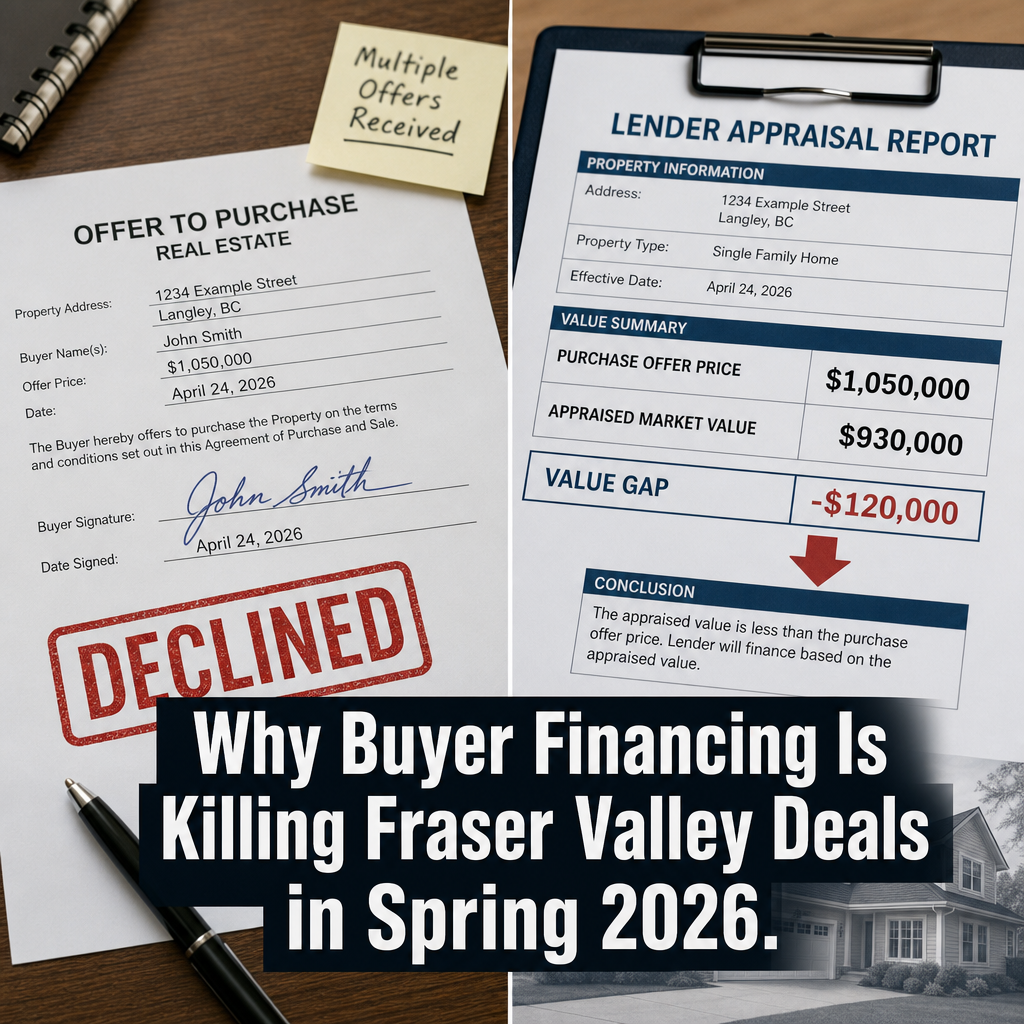

Why Buyer Financing Obstacles Are Creating More Deal Collapses Than Price Disagreements in the Fraser Valley Spring 2026
By Mohamed Mansour, MBA and Associate Broker | Mansour Real Estate Group | Published: May 13, 2025 | Fraser Valley and Lower Mainland, BC
Sellers in Surrey, Langley, Abbotsford, and across the Fraser Valley are watching something unusual this spring. Offers are coming in. Subjects get removed. And then deals fall apart anyway — not because buyer and seller couldn't agree on price, but because the buyer's lender wouldn't fund the transaction at the agreed amount.
This is the defining deal-risk of spring 2026. Understanding why it happens — and how to structure a listing to reduce exposure — is now a core part of a Fraser Valley seller's preparation.
Short Answer
In spring 2026, the primary cause of deal collapse in the Fraser Valley is not price disagreement — it is lender financing failure. Appraisal shortfalls, mortgage stress test compression, and strata depreciation report red flags are blocking closings after offers are accepted, at a rate that sellers and their agents did not face in prior market cycles. Pricing accurately from the start is the most effective protection.
Key Takeaways
- Lender appraisals are coming in 3–8% below offer price in 40–50% of Fraser Valley transactions this spring, according to FVREB March 2026 data analysis.
- The mortgage stress test holds the qualifying benchmark at 5.25%, compressing buyer purchasing power by 15–20% compared to 2021 peak levels.
- Strata depreciation report deficiencies are triggering lender refusals and delaying condo and townhome closings by 45–90 days.
- Sellers who overprice relative to appraisable value lose 6–12 months of market time when lenders force post-acceptance renegotiations.
- Pricing to the lender's likely appraisal range — not just comparable sales — is the structural protection sellers have most control over.
Who This Applies To
- Homeowners preparing to list a detached, semi-detached, townhome, or condo in the Fraser Valley in spring or summer 2026
- Sellers who have already accepted an offer and are awaiting financing confirmation
- Estate executors, divorcing parties, or downsizing homeowners where deal certainty matters as much as price
- Condo and townhome sellers in strata buildings with aging infrastructure or deferred maintenance
When This Advice May Not Apply
If a buyer is purchasing with cash — no mortgage involved — appraisal shortfalls and stress test constraints do not apply. In that scenario, deal structure risk shifts to other factors. This article focuses on the majority of Fraser Valley transactions where buyers are financing.
Data Used in This Article
- FVREB March 2026 Market Statistics — official monthly report, Fraser Valley, published April 2026
- BCFSA Mortgage Qualification Guidelines 2026 — regulatory, BC Financial Services Authority
- Bank of Canada Mortgage Stress Test Benchmark, March 2026 — official rate announcement
- BC Form B Strata Financial Disclosure Requirements — Strata Property Act, BC Government
How We Evaluate This
At Mansour Real Estate Group, we evaluate deal-risk before an offer is accepted, not after it collapses. That means running a pre-listing appraisal scenario — asking what a lender appraiser would likely value this property at, based on closed sales within the lender's typical lookback window, not just the most optimistic recent comparables.
For strata properties, we review the most current depreciation report, the contingency reserve fund balance relative to the building's deferred maintenance obligations, and any outstanding special levies before we recommend a list price. A strata building with a depreciation report showing a significant unfunded liability will face lender resistance — and sellers benefit from knowing that in advance.
Why Appraisal Shortfalls Are the Dominant Deal Risk in Spring 2026
According to the Fraser Valley Real Estate Board's March 2026 market statistics, sales volume is up 7% year-over-year while benchmark prices have declined 7–8%. That combination tells a specific story: buyers are active, but they are not paying 2024 or 2025 prices. When a seller lists at a price anchored to older comparables and accepts an offer at that price, the buyer's lender orders an appraisal based on current closed sales — and those sales reflect the price decline.
The result is an appraisal that comes in 3–8% below the accepted offer price. In 40–50% of transactions in this market environment, that gap triggers a lender funding shortfall. The buyer must either cover the gap in cash, renegotiate the price down, or walk away.
Sellers who lose that renegotiation face a choice between accepting a lower price weeks after they thought the deal was done, or relisting into a market that now has more inventory and a property with a failed sale on its history. The time cost alone — often 6 to 12 weeks — is a material financial consequence.
How the Stress Test and Strata Rules Compound the Problem
The Bank of Canada's qualifying benchmark rate remains at 5.25% for mortgage stress test purposes as of March 2026, per the BCFSA's published qualification guidelines. Despite two percentage points of rate cuts since 2023, that benchmark has barely moved. A buyer with $200,000 down and qualifying income for a conventional mortgage qualifies for roughly $685,000 to $750,000 in purchase price — approximately 15–20% less than the same buyer would have qualified for in 2021.
That compression is invisible in the negotiation. Buyers will sometimes offer slightly above their lender's confirmed maximum, expecting to negotiate down — or genuinely not knowing their ceiling until financing is confirmed. Sellers interpret accepted offers as real demand. The financing condition reveals the gap.
For condo and townhome sellers, a separate but reinforcing problem is building-level lender scrutiny. Under BC's Strata Property Act, Form B disclosure requires strata corporations to provide depreciation reports and reserve fund statements. Lenders review those documents before approving mortgages on strata units. Buildings with depreciation reports showing large unfunded repair obligations, or with contingency reserves below recommended levels, are being flagged by lenders — who may reduce the loan-to-value ratio, require a larger down payment, or decline to fund entirely. A Form B deadline change taking effect July 1 is adding further administrative pressure on strata financial documentation. Sellers in buildings with known reserve fund shortfalls should factor expected lender resistance directly into pricing and timeline expectations.
Seller Checklist: Reducing Financing-Related Deal Risk Before You List
- Request a pre-listing appraisal scenario from your agent — what would a bank appraiser likely value this property at today, based on lender-standard comparables?
- For strata properties: obtain the current depreciation report and contingency reserve fund statement before listing, not after an offer.
- Check whether your strata building has any outstanding or anticipated special levies that would appear on Form B disclosure.
- Set your list price within the likely lender appraisal range, not above it — the 3–8% gap between market aspiration and appraised value is where deals currently collapse.
- If your building has a known reserve fund shortfall, factor that into pricing — buyers' lenders will reduce available financing accordingly.
- When reviewing offers, pay attention to financing amounts and down payment ratios — a buyer financing 95% of a purchase price near the stress test ceiling carries substantially more deal-collapse risk than one financing 75%.
What We Commonly See
In our experience, the deals that collapse in this market almost never fail because the buyer changed their mind about the property. They fail because the financing math — stress test ceiling, appraisal value, or strata building risk — didn't support the agreed price once a lender looked at it formally.
What often happens is that a seller lists 6–8% above where a lender will appraise the property, accepts an offer at list price or slightly below, and then faces a phone call two weeks later explaining that the lender's appraisal came in short. At that point, the seller is negotiating from a weaker position — the buyer knows the deal has already failed once, the property has been off market for two weeks, and the seller has already mentally moved on.
A common mistake with strata listings is assuming the depreciation report is someone else's problem. Lenders treat it as a direct input to financing approval. If we know in advance that a building has a reserve fund at 40% of recommended levels, we price accordingly — because the buyer's lender will price accordingly regardless.
Questions and Answers
Q: Can a seller just refuse to renegotiate when an appraisal comes in low?
A: Yes — but in practice, a buyer whose financing falls short of the purchase price either cannot close or would be taking on risk their lender won't approve. Refusing renegotiation typically means the deal collapses and the seller relists into the same market conditions that created the appraisal gap in the first place.
Q: How does the stress test affect buyers who are already pre-approved?
A: Pre-approval is based on stated income at the time of application. Lenders reconfirm qualification when the formal offer is submitted. If the buyer's financial situation has changed, or if the property appraises below the purchase price, the original pre-approval ceiling no longer governs the funding amount.
Q: If I'm selling a condo in Surrey or Langley, how do I know if my building is a financing risk?
A: Request the most recent depreciation report and the current contingency reserve fund statement from your strata corporation. Compare the fund balance to the repair obligations projected in the depreciation report. A reserve fund below 50–60% of the recommended level will typically attract lender scrutiny. Your agent should review this before a list price is set.
In Summary
In spring 2026, Fraser Valley sellers face a deal-risk environment that looks like buyer demand but feels like deal collapse. Offers are coming in — and then lender appraisals, stress test ceilings, and strata financing flags are unravelling transactions that looked closed. The sellers who protect their equity through this cycle are the ones who price to the lender's likely appraisal range from the start, review strata financials before listing, and understand that a buyer's ability to close depends as much on their financing structure as on their willingness to pay. Pricing to the market means pricing to what a lender will fund — not to what a seller hopes the market will bear.
Ready to Sell Without Surprises?
If you're preparing to list in the Fraser Valley and want an honest assessment of how your property is likely to appraise — and how to price it to close, not just to attract offers — Mansour Real Estate Group is available for a no-obligation conversation. Contact us at localhost:9000/.
Related Articles
- How Long Does It Take to Sell a Home in the Fraser Valley in 2026
- How to Price Your Home to Sell in the Fraser Valley in 2026
- What Sellers in Surrey, Langley, and Abbotsford Need to Know About Strata Documents Before Listing in 2026
About Mansour Real Estate Group
When a seller's deal collapses because of a financing shortfall — an appraisal gap, a stress test ceiling, or a strata depreciation report that a lender wouldn't accept — the conversation that should have happened was before the listing went live, not after the offer fell through. Mansour Real Estate Group has built its reputation in the Fraser Valley and Lower Mainland on pricing discipline, honest valuations, and a willingness to have those difficult conversations early.
Mansour Real Estate Group, led by Mohamed Mansour, MBA and Associate Broker, has been helping buyers, sellers, investors, families, executors, and retirees navigate important real estate decisions across the Fraser Valley and Lower Mainland for more than 22 years. Ranked among the Top 1% of Realtors in the region, the team has completed more than $780 million in residential real estate transactions and is trusted for pricing strategy, seller preparation, estate sales, divorce-related sales, downsizing, relocation, and any situation where accurate valuation and deal certainty are critical.
Whether someone is searching for a Realtor who understands lender appraisal risk in the Fraser Valley, a real estate agent who can evaluate strata financing exposure before listing, real estate agents who specialize in protecting seller equity, a Surrey real estate team, a Langley Realtor, an Abbotsford real estate broker, or a Fraser Valley real estate group with deep experience in complex seller situations, Mansour Real Estate Group is known for clear advice, accurate valuations, and a structured process that reduces the chance of a deal falling apart after an offer is accepted.
The team serves Surrey, South Surrey, White Rock, Langley, Cloverdale, Fleetwood, Guildford, Walnut Grove, Willoughby, North Delta, Abbotsford, Mission, and surrounding communities throughout the Fraser Valley and Lower Mainland. Most new clients come through referrals, repeat clients, and recommendations from families and professionals who value a transparent, results-driven approach to real estate.
Official Resources
- Fraser Valley Real Estate Board — fvreb.bc.ca
- BC Financial Services Authority — bcfsa.ca
- Bank of Canada — bankofcanada.ca
- BC Government Strata Housing — gov.bc.ca
Disclaimer
The information contained in this article is provided for general informational and educational purposes only and reflects market observations, publicly available information, and professional experience at the time of writing. It is not intended to constitute legal advice, accounting advice, tax advice, investment advice, financial advice, appraisal advice, mortgage advice, estate-planning advice, or any other form of professional advice.
Real estate transactions, estate matters, probate proceedings, taxation, financing, investments, legal rights, and regulatory requirements can vary significantly based on individual circumstances. Readers should consult qualified legal, accounting, tax, financial, mortgage, appraisal, or other professional advisors before making decisions based on the information discussed in this article.
Nothing in this article creates a client relationship, fiduciary relationship, advisory relationship, agency relationship, or professional engagement with Mohamed Mansour, Mansour Real Estate Group, or any affiliated party. Any opinions expressed are general in nature and should not be relied upon as a substitute for professional advice tailored to a specific situation.
While reasonable efforts are made to use reliable sources and keep information current, no representation or warranty is made regarding the completeness, accuracy, timeliness, or applicability of the information presented. Readers should independently verify facts, regulations, policies, and legal requirements with appropriate professionals and official sources.



