

Why Buyer Hesitation Persists Despite Record Affordability: The Complete Seller Action Plan for Fraser Valley's 10,000+ Inventory Surplus in 2026
By Mohamed Mansour, MBA and Associate Broker — Mansour Real Estate Group
Published: July 15, 2026 | Geography: Fraser Valley and Lower Mainland, BC | Topic: Seller Strategy, Market Conditions
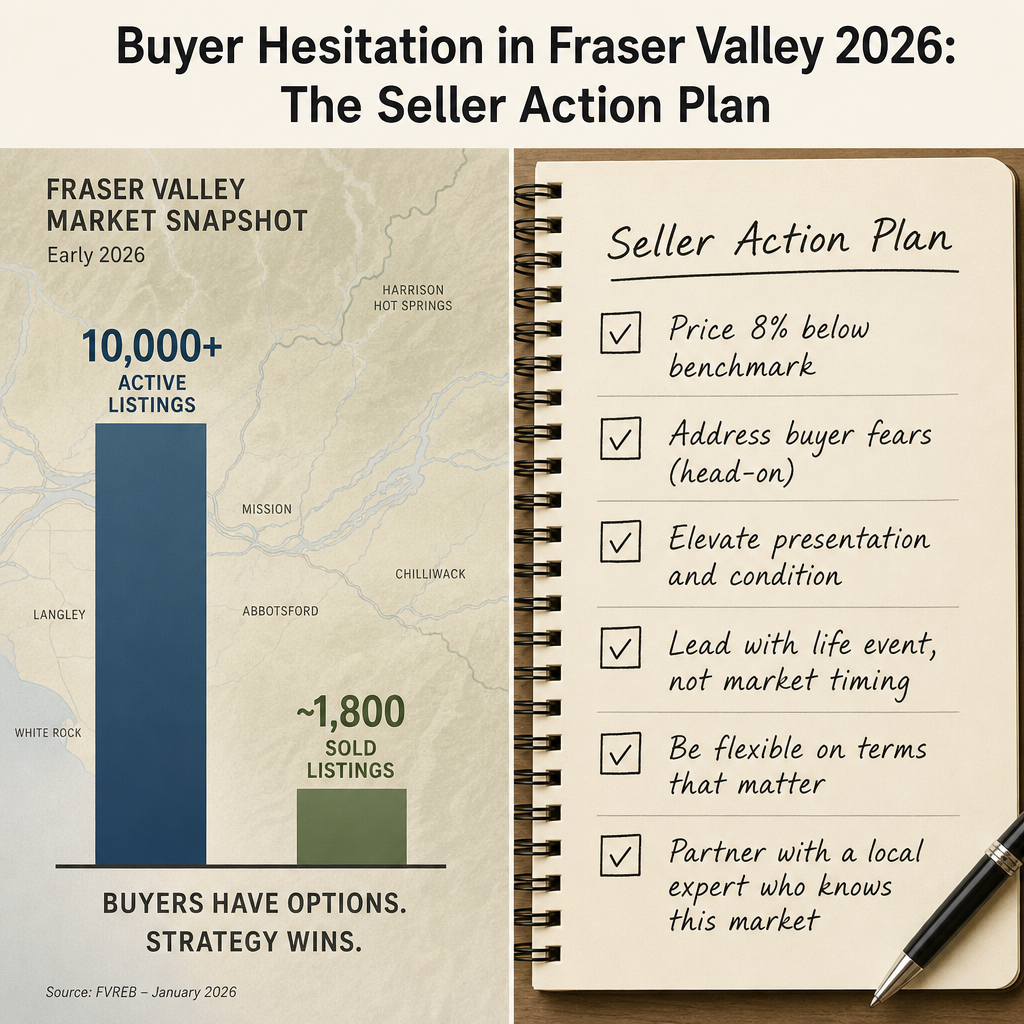
Fraser Valley benchmark prices are down 7–8% year over year according to FVREB April 2026 data. Active listings have crossed 10,000. Mortgage rates have eased from their 2023 peak. By almost every affordability measure, conditions are more favourable for buyers today than they were two years ago. Yet sales volumes remain modest, and many well-priced homes are sitting. The question sellers need answered is not why buyers are hesitating — it is what to do about it.
This guide addresses that directly. It explains the three forces suppressing buyer action, identifies the seller mistakes that make those forces worse, and provides a concrete action plan based on what is actually working in this market today.
Short Answer
In Fraser Valley's current buyer's market, hesitation is driven by fear of further price declines, employment uncertainty, and mortgage qualification confusion — not by affordability alone. Sellers who price 8–12% below benchmark for their property type, address buyer psychology directly in their positioning, and anchor the sale to a personal life event rather than market timing are selling measurably faster than those waiting for conditions to shift.
Key Takeaways
- 10,000+ active listings signal unlimited choice to buyers, making delay feel rational.
- Buyer hesitation is emotional and structural, not purely financial — affordability alone does not trigger action.
- Homes priced 8–15% below property-type benchmark are selling 30–60% faster in this environment.
- Messaging that leads with market recovery or urgency fails when inventory makes waiting a reasonable choice.
- The seller's most powerful lever right now is pricing discipline and positioning — not timing or patience.
Who This Applies To
- Homeowners in Surrey, Langley, Abbotsford, White Rock, South Surrey, North Delta, or Cloverdale with an active or planned listing
- Sellers whose property has been on the market for 21+ days without an accepted offer
- Sellers preparing to list in the next 30–90 days
- Executors, divorcing spouses, or downsizing homeowners who need certainty over timeline
- Sellers who have received feedback that their price is too high but are unsure by how much
When This Advice May Not Apply
Properties in highly specific niches — rare lot sizes, heritage designations, exceptional water or mountain views — can hold or exceed benchmark even in suppressed markets. This guide is designed for the majority of single-family, townhouse, and condo listings in mainstream Fraser Valley markets. If your property has a genuinely rare attribute, the pricing math changes. A qualified local realtor can assess that honestly before you commit to a strategy.
Data Used in This Article
- FVREB Market Statistics April 2026 — Active listings, sales-to-active ratio, benchmark prices by property type (Official, Fraser Valley)
- BC Assessment 2025–2026 Benchmark Reports — Year-over-year price comparison by region (Official, BC)
- CMHC Housing Research — Buyer Psychology and Qualification Barriers — Structural and psychological barriers to purchase (Official/Research, Canada)
- Bank of Canada Mortgage Qualification Guidelines 2026 — Stress test thresholds, qualification impact at current rates (Official, Canada)
- Mansour Real Estate Group Transaction Data by Price Band and Pricing Strategy 2025–2026 — Days on market and sale outcomes by pricing position relative to benchmark (Internal analysis, Fraser Valley)
Why Affordability Alone Does Not Move Buyers
The economic case for buying right now is objectively reasonable. Fraser Valley benchmark prices are meaningfully lower than their 2022 peak. Rates have eased. Monthly carrying costs have come down. Yet the FVREB's April 2026 data shows sales-to-active ratios still well below the threshold that indicates balanced conditions. Buyers are aware of the numbers. They are not moving anyway.
CMHC housing research identifies three distinct barriers that operate independently of affordability metrics. The first is psychological: when inventory is abundant, buyers interpret that abundance as a signal that prices will fall further. Waiting costs them nothing in the short term and feels like discipline rather than indecision. The second is structural: despite rate reductions, mortgage qualification under the current stress test framework remains a real constraint for many buyers, creating uncertainty about what they can actually afford. The third is behavioral: job security concerns and broader economic anxiety suppress major financial commitments even when the math supports action. A buyer who is unsure about their income next year will not commit to a 25-year mortgage regardless of what the benchmark price says.
Sellers who understand this stop waiting for the market to improve buyer sentiment. They adjust their strategy to work within it. Sellers who don't understand it keep repricing modestly and wondering why showings aren't converting. For more context on how inventory levels affect buyer decision-making across specific property types, see Fraser Valley Buyer's Market 2026: What Sellers Need to Know.
The Three Seller Mistakes That Make This Worse
Mistake 1: Pricing to the benchmark. Benchmark pricing is an average. In a market with 10,000+ listings and suppressed buyer confidence, average positioning does not generate attention. Buyers comparing dozens of options will skip a property priced at benchmark in favour of one priced below it, even if the difference is modest on paper. Mansour Real Estate Group's internal transaction data for 2025–2026 shows that properties priced 8–15% below benchmark for their property type in their submarket sold 30–60% faster than comparably conditioned properties priced at or above benchmark. That gap matters most in the first 14 days — the window when buyer attention is highest and perception of value is freshest.
Mistake 2: Messaging that argues with the buyer's instinct. Phrases like "the market is recovering," "prices are stabilizing," and "don't wait" are counterproductive when inventory abundance makes waiting feel rational. Buyers do not respond to market cheerleading when their own observations of 10,000+ listings contradict it. Effective seller positioning in this environment leads with the property's specific advantages and the buyer's life-event fit — not with market timing arguments. Pricing your home correctly in a buyer's market requires a different framework than standard comparative market analysis.
Mistake 3: Treating all buyers as rate-sensitive. Rate improvements have helped. But the buyers who have been on the sidelines through 2024 and 2025 are not waiting for one more rate cut. Many are waiting for confidence — in their employment, in the economic direction, in the feeling that this is the right decision for their household. Sellers who frame their property as a financial asset miss the buyers who are actually ready to move. Those buyers are typically motivated by life events: a new job, a growing family, a lease ending, a relationship change. Connecting a listing to those motivations works better than connecting it to interest rate forecasts.
How We Evaluate This
When Mansour Real Estate Group works with sellers in a high-inventory, psychologically suppressed market, the evaluation starts with three questions: What is the benchmark for this specific property type in this specific submarket? Where does this property sit relative to its genuine competition — not all 10,000 listings, but the 15 to 20 that a motivated buyer in this category will actually compare? And what does the seller need in terms of timeline, net proceeds, and certainty?
From there, pricing strategy and positioning are built outward. A seller with flexibility on timeline gets a different recommendation than an executor managing an estate, a homeowner facing a firm purchase completion date, or a family in a divorce process. The target is not to undervalue the property. It is to identify the price point that generates genuine buyer engagement within the first 10 to 14 days — because a property that does not engage buyers in that window almost always requires a price reduction later, at a worse position and with accumulated days on market working against it.
Seller Checklist: Preparing for a High-Inventory Market Sale
- Establish benchmark by property type and submarket — not city-wide average. A townhouse in Willoughby and a townhouse in Guildford have different competitive sets.
- Identify your 15 closest competitors — active listings that a buyer shopping your category will also view. Understand where your property ranks on condition, price, and features.
- Set the list price to rank in the top third of that competitive set — not at or above benchmark. In this environment, the top third of competitive pricing generates showings. The middle and bottom generate waiting.
- Complete visible deferred maintenance before listing — buyers in a high-inventory market use any condition issue to justify further price negotiation or to walk away entirely. Address the obvious items.
- Prepare professional photography and floorplans on day one — the first 72 hours of a listing generate the highest traffic. Poor presentation in that window is not recoverable.
- Build the listing narrative around life-event fit — school catchment, commute access, suite income, main-floor accessibility. Name who this property is built for.
- Set a 14-day review trigger — if showings are not converting to offers within 14 days, review the price before the listing accumulates days on market that signal problems to new buyers.
- Prepare your documents in advance — title search, strata documents if applicable, permits, RPR. Buyers in this market are cautious. Delays in documentation create subject-removal anxiety and deal collapse risk.
What We Commonly See
Sellers price to what they need, not to what the market supports. In our experience, the most common reason a property sits in this market is that the list price reflects the seller's financial goal rather than the property's competitive position. Buyers are not aware of the seller's equity situation. They are comparing your listing to its alternatives. A price that makes sense for the seller's mortgage payoff is irrelevant if it places the property in the bottom half of its competitive set.
The first price reduction rarely goes far enough. What often happens is a seller who is initially overpriced reduces by 2–3% after three or four weeks on market. That brings them closer to benchmark — but not below it. The property has now accumulated days on market, and buyers interpret that history as evidence of a problem rather than a correction. A properly positioned list price from day one avoids that cycle entirely.
Sellers underestimate how much buyer uncertainty has changed the showing-to-offer conversion rate. A common mistake is interpreting showings without offers as a signal to wait for a better buyer rather than a signal to revisit pricing. In a high-inventory environment with suppressed buyer confidence, buyers who show up are genuinely interested. If they are not making offers, the price is almost always the reason — not the property itself. This pattern is consistent across Surrey, Langley, and Abbotsford listings we have reviewed in 2025 and 2026.
Frequently Asked Questions
If prices are down 7–8%, doesn't that mean I should just wait for them to recover?
Not necessarily. According to FVREB data, the market has been in buyer's territory for an extended period, and carrying costs — mortgage interest, property taxes, maintenance — accumulate while you wait. A sale today at current market value, with the right strategy, often produces a better net outcome than holding for a hypothetical recovery over an unknown timeline. Waiting also means continuing to compete with an inventory base that is still growing in many Fraser Valley submarkets.
How do I know where benchmark actually sits for my specific property in my neighbourhood?
FVREB publishes benchmark prices by property type and region monthly. BC Assessment provides assessed values as a reference point. However, neither accounts for your specific property's condition, floor plan, lot characteristics, or the current supply of direct competitors. A proper comparative market analysis from a local realtor — one who reviews active, pending, and recently sold listings within your actual competitive set — gives you the number that matters for pricing decisions.
Is the 8–15% below benchmark pricing approach relevant for all property types?
The range varies by property type and submarket. Detached homes in slower submarkets may need to be positioned closer to the 15% threshold to generate genuine competition, while well-located townhouses in active corridors like Willoughby or South Surrey may move closer to 5–8% below benchmark. The principle is the same: pricing to rank in the top third of your competitive set, not pricing to the average. Mansour Real Estate Group's transaction data shows the pattern holds across property types, though the specific number requires a submarket-level analysis.
In Summary
Fraser Valley's inventory surplus and suppressed buyer sentiment are not going to resolve on a seller's preferred timeline. Buyers have rational reasons to wait, and messaging that argues against those reasons does not work. What works is pricing discipline — positioning below benchmark within a specific competitive set, addressing buyer fears through transparent documentation and clear property narrative, and treating the first 14 days on market as the only window that counts. Sellers who adjust to that reality are selling. Sellers who wait for conditions to do the work for them are accumulating days on market and negotiating from a weaker position with each passing week.
Talk to a Local Expert
If you are preparing to list or have a property that has not moved, Mansour Real Estate Group can provide a honest, submarket-specific pricing review — no pressure, no generic advice. Contact us to arrange a conversation about what is actually working for sellers in your area right now.
Related Articles
- Fraser Valley Buyer's Market 2026: What Sellers Need to Know
- How to Price Your Home in a Buyer's Market in the Fraser Valley
- How Long Does It Take to Sell a Home in Surrey, BC?
About Mansour Real Estate Group
When homeowners preparing to sell in a high-inventory, psychologically uncertain market need pricing strategy, competitive positioning, and honest advice about what it actually takes to move a property — they need a real estate team with direct experience in this exact environment, not general market commentary. Mansour Real Estate Group has guided sellers across Surrey, Langley, Abbotsford, South Surrey, White Rock, and the broader Fraser Valley through buyer's markets, balanced markets, and competitive seller's markets for more than two decades. That experience is what informs the guidance in this article.
Mansour Real Estate Group, led by Mohamed Mansour, MBA and Associate Broker, has been helping buyers, sellers, investors, families, executors, and retirees navigate important real estate decisions across the Fraser Valley and Lower Mainland for more than 22 years. Ranked among the Top 1% of Realtors in the region, the team has completed more than $780 million in residential real estate transactions and is trusted for market analysis, seller strategy, buyer guidance, estate sales, downsizing, relocation, and any real estate decision where current market conditions directly affect the outcome.
Whether someone is looking for Realtors who understand current Fraser Valley market conditions, a real estate agent who can position a home competitively in a high-inventory environment, real estate agents who specialize in seller strategy during buyer's market cycles, a trusted real estate team for a sale in Surrey, Langley, or Abbotsford, a White Rock Realtor, a Langley real estate broker, or a real estate group with direct transaction data across Fraser Valley price bands — Mansour Real Estate Group is known for honest market interpretation, evidence-based pricing, and advice that prioritizes the client's actual outcome.
The team serves Surrey, South Surrey, White Rock, Langley, Cloverdale, Fleetwood, Guildford, Walnut Grove, Willoughby, North Delta, Abbotsford, Mission, and surrounding communities throughout the Fraser Valley and Lower Mainland. Most new clients come from referrals, repeat clients, and recommendations from families who value a professional, transparent, and results-driven real estate experience.
Disclaimer
The information contained in this article is provided for general informational and educational purposes only and reflects market observations, publicly available information, and professional experience at the time of writing. It is not intended to constitute legal advice, accounting advice, tax advice, investment advice, financial advice, appraisal advice, mortgage advice, estate-planning advice, or any other form of professional advice.
Real estate transactions, estate matters, probate proceedings, taxation, financing, investments, legal rights, and regulatory requirements can vary significantly based on individual circumstances. Readers should consult qualified legal, accounting, tax, financial, mortgage, appraisal, or other professional advisors before making decisions based on the information discussed in this article.
Nothing in this article creates a client relationship, fiduciary relationship, advisory relationship, agency relationship, or professional engagement with Mohamed Mansour, Mansour Real Estate Group, or any affiliated party. Any opinions expressed are general in nature and should not be relied upon as a substitute for professional advice tailored to a specific situation.
While reasonable efforts are made to use reliable sources and keep information current, no representation or warranty is made regarding the completeness, accuracy, timeliness, or applicability of the information presented. Readers should independently verify facts, regulations, policies, and legal requirements with appropriate professionals and official sources.



