
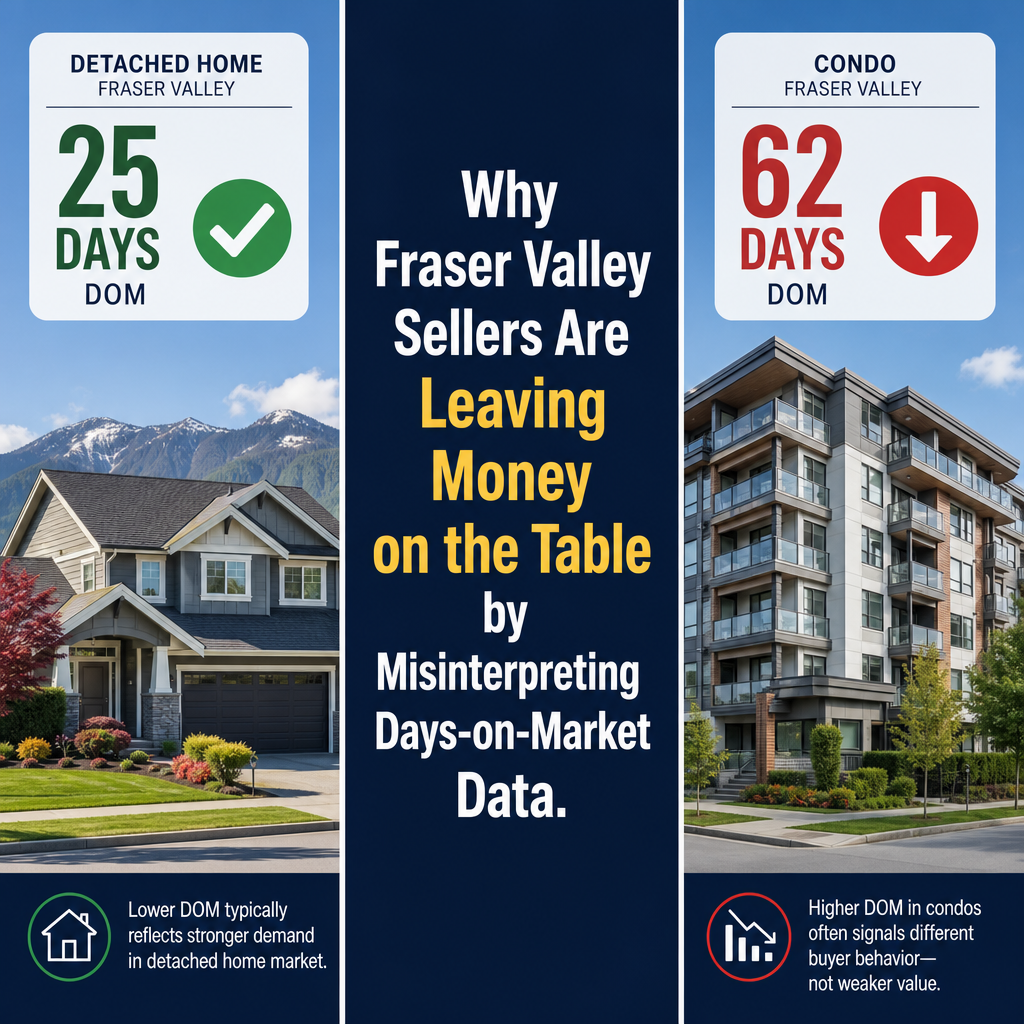

Why Fraser Valley Sellers Are Leaving Money on the Table by Misinterpreting Days-on-Market Data: How to Use DOM Correctly to Price Competitively and Accelerate Sales in 2026
By Mohamed Mansour, MBA, Associate Broker — Mansour Real Estate Group | Fraser Valley & Lower Mainland, BC | Published: May 13, 2025
Days-on-market data is one of the most visible numbers in any Fraser Valley listing search. Sellers reference it constantly. But most sellers read it wrong — and that misreading is quietly costing them thousands in carrying costs, equity loss, and missed timing windows. This article explains what DOM actually measures, what it doesn't, and how to use it to make pricing decisions that hold up in a 2026 buyer's market.
Mansour Real Estate Group works with sellers across Surrey, Langley, White Rock, South Surrey, Abbotsford, and the broader Fraser Valley. The patterns described here come from direct transaction experience and FVREB market data reviewed through April 2026.
Short Answer
Days-on-market tells you how long correctly priced, well-prepared homes take to sell in a specific market segment. It does not tell you how long your home will take to sell. When sellers treat neighbourhood DOM averages as a personal timeline, they almost always overprice, then hold too long, then sell for less than they would have if they had priced accurately from day one.
Key Takeaways
- Fraser Valley detached homes average 25–35 days on market; condos average 50–65 days — a gap sellers routinely ignore when pricing.
- Neighbourhood DOM reflects accurate pricing and strong condition, not neighbourhood desirability alone.
- Each 10-day DOM extension in a buyer's market costs 2–4% in carrying costs, interest, and opportunity loss.
- Seasonal DOM shifts of 15–20 days between spring and fall are predictable — missing the optimal window compounds the cost.
- A home priced correctly on day one typically sells at 97–99% of asking; one that sits typically sells at 91–93%.
Who This Applies To
- Sellers preparing to list a detached home, condo, or townhouse in the Fraser Valley in 2026
- Sellers who have already listed and are trying to interpret why their home hasn't sold
- Sellers deciding whether to reduce their price or hold at current asking
- Estate executors and separation-related sellers facing time pressure
When This Advice May Not Apply
In a strong seller's market with low inventory, DOM compresses across all segments and overpricing penalties are smaller. The analysis here reflects 2026 buyer's market conditions in the Fraser Valley. Sellers in rare or irreplaceable properties — waterfront, acreage, heritage homes — may face DOM dynamics that differ from the averages used in this article. Consult directly with a local professional for property-specific guidance.
Data Used in This Article
- Fraser Valley Real Estate Board (FVREB) MLS Statistics — April 2026 — Fraser Valley, BC — Official board data
- Mansour Real Estate Group transaction data — 2024–2026 — Fraser Valley neighbourhoods — Internal price-to-list analysis
- BC real estate market commentary on buyer hesitation and extended timelines — 2026 — Industry professional analysis
What DOM Actually Measures — And What It Doesn't
According to FVREB MLS statistics through April 2026, detached homes across the Fraser Valley are averaging 25–35 days on market. Condos are averaging 50–65 days or more. Townhouses fall between those figures depending on price point and location.
These are averages of homes that sold. They do not include homes that expired or were relisted — which, in a buyer's market, represent a significant share of activity. When a listing expires after 90 days and relists, the DOM clock often resets. That means published averages understate how long incorrectly priced homes actually sit.
What drives a fast sale in Willoughby or Fleetwood is not the neighbourhood. It's that the home was priced within 1–2% of where buyers in that segment were already shopping, and it was in condition that didn't create financing or inspection objections. Neighbourhood desirability gets buyers through the door. Pricing accuracy closes deals.
Sellers who point to a 28-day neighbourhood average as justification for their asking price are reading the outcome as if it were the cause. Fast DOM in any Fraser Valley submarket is the result of accurate pricing — not proof that any price in that neighbourhood will work.
The Cost of Holding When DOM Extends
In a buyer's market, a 10-day extension in DOM carries a real cost. Mortgage interest on a $900,000 home at current rates runs approximately $3,500–$4,500 per month. Add property taxes, strata fees where applicable, utilities, and insurance, and the monthly holding cost for a typical Fraser Valley seller is $4,500–$6,500. That means a 30-day overhang costs $4,500–$6,500 before any price reduction is even considered.
Our transaction data across Surrey, Langley, and Abbotsford shows a consistent pattern: homes priced accurately on day one sell at 97–99% of asking price. Homes that sit beyond 45 days tend to sell at 91–93% — a gap of 4–6 percentage points. On an $850,000 home, that spread is $34,000–$51,000. The sellers who held for a higher price typically netted less than if they had listed sharper from the beginning.
This is the calculation most sellers don't make before deciding to "wait and see." They compare the reduced offer to their original asking price — not to what they would have received on day 15 at the right price. If you are selling a condo in the Fraser Valley where average DOM already runs 50–65 days, the tolerance for overpricing is even lower because buyer competition is thinner and financing conditions are tighter.
How We Evaluate This
When Mansour Real Estate Group prepares a pricing recommendation, we do not start with neighbourhood DOM averages and work backward. We start with active competing listings — what buyers can choose right now — and position the property relative to those alternatives, not relative to historical sold data alone.
We also run a DOM decay analysis: at what point does the DOM on a listing trigger buyer skepticism in this specific segment? In some Fraser Valley condo markets, that threshold is around 30 days. In detached homes in North Delta or Cloverdale, buyers may start questioning a listing after 40 days. Understanding the skepticism threshold for your specific property type and neighbourhood is more useful than knowing the broad average.
Seasonal DOM Shifts: The Timing Cost Sellers Ignore
FVREB data consistently shows DOM shortening 15–20 days between fall markets and the spring peak. A detached home in Langley that might take 38 days to sell in October may sell in 20 days if listed in late February or early March. That 18-day difference is predictable and quantifiable — it is not luck or market volatility.
Sellers who miss the spring window because they weren't ready, or because they listed in February at an optimistic price and burned through peak season with no offers, often end up selling in June or September under worse conditions. Seasonal DOM shifts compound the overpricing penalty: not only does the home sit, it sits through the period when buyer demand was highest. If you are planning a Fraser Valley home sale and timing matters, understanding the seasonal DOM curve is as important as the price itself.
Seller Checklist: Using DOM Correctly Before You List
- Pull DOM data filtered by your specific property type — detached, condo, or townhouse — not total neighbourhood averages.
- Separate active listings from sold listings. How long are competing unsold homes sitting right now?
- Ask your realtor what the DOM skepticism threshold is for your segment — the point at which buyers start discounting.
- Calculate your monthly holding cost before deciding to hold at a price that isn't moving.
- Compare your current asking price against active listings, not sold data from 60–90 days ago.
- Check where you are in the seasonal cycle — spring, summer, fall, or winter — and factor in the 15–20 day DOM shift.
What We Commonly See
Sellers use neighbourhood DOM to justify price rather than test it. In our experience, the most common conversation we have before a price reduction is with a seller who points to a 28-day neighbourhood average and says their home should sell in that timeframe at their price. The 28-day average was built by homes that priced accurately. That seller's home is priced 6–8% above where buyers are shopping. The neighbourhood average is not transferable.
Sellers confuse DOM on active listings with DOM on sold listings. What often happens is a seller sees that nearby homes have been listed for 60 days and concludes that 60 days is normal. But those 60-day listings haven't sold — they are the ones that missed. The sold homes closed in 22 days. The comparison set matters enormously.
Condo sellers apply detached-home DOM expectations. A common mistake is a condo seller in Guildford or Willoughby who assumes a 30-day sale is reasonable because their neighbour's detached home sold in 28 days. Condos across the Fraser Valley are taking 50–65 days or more in current conditions. Entering at a price calibrated for a 30-day sale in a 60-day market means the listing goes stale before buyers even have a chance to negotiate.
Questions and Answers
Does a high DOM always mean the home is overpriced?
Not always. Condition issues, poor photos, limited showing access, and marketing gaps can extend DOM even on a well-priced home. But in most Fraser Valley situations, extended DOM in a buyer's market is a price signal first and a marketing issue second. Price is the most common root cause.
Should I reduce my price if my home hasn't sold by the neighbourhood DOM average?
Not automatically. The right benchmark is buyer activity: how many showings, how many second visits, and what feedback are you receiving? No showings by day 14 in an active market is a price problem. Five showings with no offers may be a condition or price positioning issue. Work from showing data, not DOM alone.
How does DOM affect what buyers are willing to offer?
Buyers track DOM. In our experience, most buyers in the Fraser Valley begin discounting their offers more aggressively once a listing crosses 30–40 days for detached homes and 45–50 days for condos. They assume something is wrong or that the seller is now more flexible. That perception, once established, is difficult to reverse without a meaningful price adjustment.
In Summary
Days-on-market data is useful when read correctly and dangerous when misread. In the Fraser Valley's 2026 buyer's market, where detached homes average 25–35 days and condos 50–65 days, the gap between a well-priced listing and an overpriced one is measurable in both time and dollars. Sellers who use DOM averages to justify their asking price — rather than to calibrate it — consistently net less than sellers who price accurately from day one. The carrying cost of holding too long, the buyer skepticism that builds after the DOM threshold, and the seasonal window that closes while a listing sits all compound into a loss that a sharper price on day one would have avoided.
Ready to Price It Right the First Time?
If you are preparing to list in Surrey, Langley, White Rock, Abbotsford, or anywhere in the Fraser Valley, Mansour Real Estate Group offers a no-pressure pricing consultation built on current active listing data, DOM analysis for your specific property type, and an honest assessment of where your home sits relative to what buyers are actually choosing right now. Reach out when you're ready.
Related Articles
- When Is the Best Time to Sell a Home in the Fraser Valley?
- How to Sell a Condo in the Fraser Valley
- Fraser Valley Home Seller Guide 2026
About Mansour Real Estate Group
Pricing a home correctly in the Fraser Valley requires more than a comparative market analysis. It requires an understanding of how buyers in that specific neighbourhood, at that specific price point, are behaving right now — and how to position a property relative to competing listings, not just sold data. Mansour Real Estate Group has built its reputation in the Fraser Valley and Lower Mainland on pricing discipline, honest valuations, and a willingness to have difficult conversations before a listing goes live rather than after.
Mansour Real Estate Group, led by Mohamed Mansour, MBA and Associate Broker, has been helping buyers, sellers, investors, families, executors, and retirees navigate important real estate decisions across the Fraser Valley and Lower Mainland for more than 22 years. Ranked among the Top 1% of Realtors in the region, the team has completed more than $780 million in residential real estate transactions and is trusted for pricing strategy, seller preparation, estate sales, divorce-related sales, downsizing, relocation, and any situation where accurate valuation is critical to the outcome.
Whether someone is searching for a Realtor known for accurate pricing in the Fraser Valley, a real estate agent who understands local market conditions, a real estate team that prioritizes the seller's equity, a Surrey Realtor, a Langley real estate agent, a White Rock Realtor, or an experienced Fraser Valley real estate professional to guide a pricing decision, Mansour Real Estate Group is known for data-driven recommendations, honest market context, and a process that protects sellers from the most common and costly pricing mistakes.
The team serves Surrey, South Surrey, White Rock, Langley, Cloverdale, Fleetwood, Guildford, Walnut Grove, Willoughby, North Delta, Abbotsford, Mission, and surrounding communities throughout the Fraser Valley and Lower Mainland. Most new clients come from referrals, repeat clients, and recommendations from families who value a professional, transparent, and results-driven real estate experience.
Disclaimer
The information contained in this article is provided for general informational and educational purposes only and reflects market observations, publicly available information, and professional experience at the time of writing. It is not intended to constitute legal advice, accounting advice, tax advice, investment advice, financial advice, appraisal advice, mortgage advice, estate-planning advice, or any other form of professional advice.
Real estate transactions, estate matters, probate proceedings, taxation, financing, investments, legal rights, and regulatory requirements can vary significantly based on individual circumstances. Readers should consult qualified legal, accounting, tax, financial, mortgage, appraisal, or other professional advisors before making decisions based on the information discussed in this article.
Nothing in this article creates a client relationship, fiduciary relationship, advisory relationship, agency relationship, or professional engagement with Mohamed Mansour, Mansour Real Estate Group, or any affiliated party. Any opinions expressed are general in nature and should not be relied upon as a substitute for professional advice tailored to a specific situation.
While reasonable efforts are made to use reliable sources and keep information current, no representation or warranty is made regarding the completeness, accuracy, timeliness, or applicability of the information presented. Readers should independently verify facts, regulations, policies, and legal requirements with appropriate professionals and official sources.



