
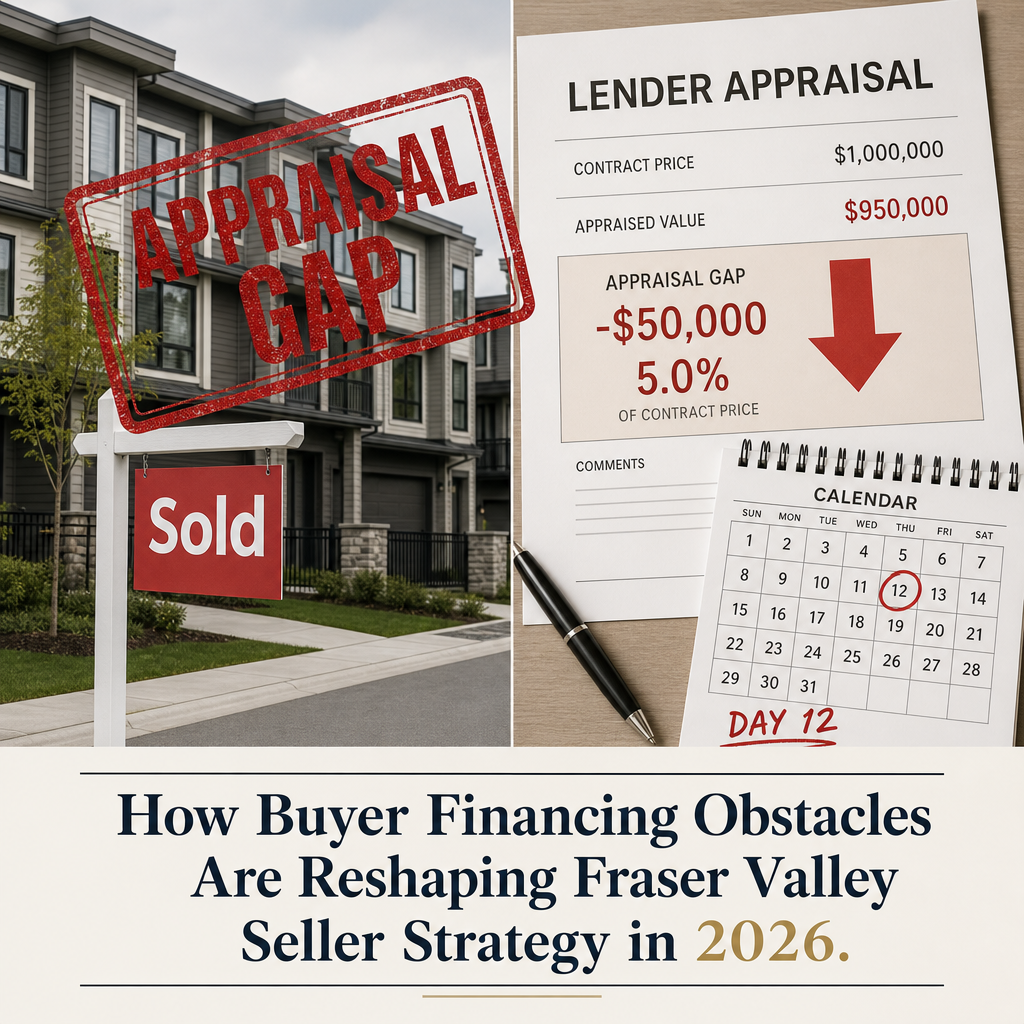

How Buyer Financing Obstacles Are Reshaping Fraser Valley Seller Strategy in 2026: When Appraisals, Special Levies, and Stress Test Qualification Failures Trigger Deal Collapse and Price Renegotiation
By Mohamed Mansour, MBA and Associate Broker | Mansour Real Estate Group | Published: July 15, 2026 | Fraser Valley and Lower Mainland, BC
For sellers in Surrey, Langley, Abbotsford, and across the Fraser Valley, Spring 2026 has introduced a new category of risk that most listing conversations still don't cover adequately. Buyers are arriving with pre-approvals that do not survive the appraisal and underwriting stage. The result is deals collapsing or being renegotiated downward — days before what sellers expected to be a clean close.
This article explains the mechanics of buyer financing failure, why strata properties carry the highest exposure, and what sellers can do before accepting an offer to reduce the probability of a deal falling apart at the worst possible moment.
Short Answer
In the Fraser Valley's Spring 2026 market, buyer pre-approvals are no longer reliable indicators of closing certainty. Appraisal gaps, CMHC stress test qualification failures, and strata special levy disclosures are triggering financing denials at Day 10–12 of closing — after sellers have already taken the property off the market. Sellers who understand these failure points before listing can structure offers and prepare documentation to dramatically reduce their exposure.
Key Takeaways
- Strata appraisals in the Fraser Valley are coming in 8–15% below list price when reserve fund depletion or special levy conflicts are present.
- Buyer pre-approvals reflect income qualification only — they do not guarantee the property will pass the lender's appraisal or underwriting review.
- Subject-to-financing conditions are creating 7–14 day extension standoffs where low appraisals become renegotiation leverage against sellers.
- Executors, divorce sellers, and time-sensitive vendors face disproportionate risk because they often cannot extend timelines while buyers remedy qualification gaps.
- Sellers can mitigate financing risk before listing by preparing strata documentation, obtaining independent appraisals, and qualifying buyer financing structure before accepting offers.
Who This Applies To
- Strata condo and townhouse sellers in Surrey, Langley, Abbotsford, Fleetwood, Willoughby, and Cloverdale
- Detached home sellers where offer prices diverge from recent comparable sales
- Executors and estate sellers working under court-ordered or legally constrained timelines
- Divorce sellers who require clean, on-schedule closings to satisfy separation agreements
- Any seller who has received an offer and is trying to assess whether the buyer's financing will survive to completion
When This Advice May Not Apply
Cash offers with no financing condition eliminate appraisal and lender underwriting risk entirely. Sellers receiving unconditional cash offers are not exposed to the dynamics described here. Similarly, properties with strong, recent comparable sales and no strata documentation issues carry materially lower appraisal gap risk.
Data Used in This Article
- Fraser Valley Real Estate Board (FVREB) — Spring 2026 market data, subject condition trends, active and sold inventory analysis; official board statistics
- CMHC — Mortgage insurance qualification and stress test rule changes, 2024–2026; official regulatory guidance
- BC Strata Property Act and Strata Property Regulation — Special levy disclosure requirements, Form B obligations; BC Government legislation
- MLS sold data (Realtor.ca) — Appraisal-to-sale-price divergence by property type, Fraser Valley, Q1–Q2 2026; third-party analysis
Why Pre-Approvals No Longer Predict Closing Certainty
A mortgage pre-approval tells a buyer — and a seller — that the buyer's income, debt ratios, and credit score satisfy the lender's qualification criteria at that moment. It does not tell either party anything about whether the specific property being purchased will satisfy the lender's appraisal and underwriting review.
That distinction matters more in 2026 than it did three years ago. According to CMHC stress test rule changes applied through 2024 and 2025, insured mortgage qualification now requires buyers to qualify at a rate significantly above the contract rate. This has not changed dramatically. What has changed is where the failure is occurring. Buyers are passing pre-approval comfortably, then failing at the property-specific underwriting stage — particularly when the appraiser's value comes in below the purchase price.
When that happens, the lender will only finance based on the appraised value, not the contract price. The buyer must either cover the gap with additional cash, renegotiate the price downward, or walk away. For sellers, especially those managing divorce-related property sales or estate and probate sales, that moment — often Day 10 to 12 of the subject removal period — can be devastating.
Why Strata Properties Carry the Highest Appraisal Gap Risk
Strata condos and townhouses in Surrey, Langley, Fleetwood, Willoughby, and Cloverdale face compounding appraisal pressure in Spring 2026. Based on FVREB market data and MLS sold comparables from Q1 and Q2 2026, strata appraisals are coming in 8–15% below list price when two specific conditions are present: a depreciation report showing reserve fund depletion, and a pending or recently levied special assessment.
Lenders treat both conditions as material financial risk to the property's value and the buyer's ability to carry the asset. A special levy — which under the BC Strata Property Act must be disclosed in the Form B Information Certificate — signals to lenders that the building has deferred maintenance liability. If that levy is large enough, lenders may refuse to insure the mortgage entirely or reduce the loan-to-value ratio, which pushes the buyer outside their qualification window.
Sellers of strata units who are unaware of pending levies or who have not reviewed their own Form B documentation before listing are walking into deals with an invisible financing landmine. By the time the buyer's lender declines the file, the seller has already taken the unit off the market and lost days or weeks of active listing time. Understanding which strata documents affect your sale before listing is one of the most underutilized risk management steps available to condo and townhouse sellers.
How We Evaluate This
When Mansour Real Estate Group prepares a seller for listing, financing risk assessment is part of the pre-listing process, not a reaction to a collapsed deal. For strata sellers, that means reviewing the Form B, the current depreciation report, the reserve fund balance, and any strata council minutes that reference pending expenditures before recommending a list price.
For detached home sellers, the analysis focuses on comparable recency and condition divergence — the gap between what a buyer offers emotionally and what a lender's appraiser will support factually. If sold comparables are more than 60 days old or reflect significantly different property conditions, the risk of an appraisal gap increases. Identifying that gap before listing allows for smarter pricing, better offer selection, and fewer surprises at subject removal.
Seller Checklist: Reducing Financing Collapse Risk Before You List
- Request your strata's current Form B Information Certificate and review it for pending special levies before setting a list price.
- Obtain your most recent depreciation report and confirm whether the reserve fund is adequately funded relative to the building's age and maintenance history.
- Ask your Realtor to run a sold comparable analysis using only sales within the last 45–60 days and similar condition properties to identify realistic appraised value.
- Consider requesting proof of financing structure — not just pre-approval — from buyers before accepting an offer, particularly whether the purchase is insured or conventional.
- For time-sensitive closings (estate, divorce, relocation), discuss with your Realtor whether a shorter subject removal period or a higher deposit requirement is appropriate to reduce leverage at the renegotiation stage.
- If an appraisal gap is likely based on comparable analysis, price the property at a level supportable by current sold data — not aspirational list price comparisons.
What We Commonly See
In our experience, the most common mistake strata sellers make is listing without reviewing the strata's depreciation report or confirming reserve fund status. By the time the buyer's lender flags the building's financial health, the seller has already spent 10 days under contract — and the buyer is now using the low appraisal as justification for a price reduction that the seller never anticipated.
What often happens with detached homes is that sellers assume a strong offer price will hold through appraisal because "the market is hot." But lenders appraise against recent sold data, not list prices or buyer enthusiasm. When comparable sales have softened even modestly, the appraisal comes in lower than the offer, and sellers face a negotiation they didn't prepare for.
A common mistake among time-sensitive sellers — executors, parties to a divorce, or homeowners with a purchase already conditional on this sale — is accepting the first offer without stress-testing the buyer's financing structure. Accepting an offer from a buyer using a high-ratio insured mortgage on a strata unit with documented reserve fund issues is a predictable path to a Day 12 financing failure. The risks are amplified when your closing timeline is fixed.
Questions and Answers
Can a buyer with a pre-approval still fail financing on a Fraser Valley strata property?
Yes. Pre-approval reflects buyer qualification only. If the lender's appraiser assigns a value below the purchase price, or if strata documents reveal a special levy that disqualifies the building for insured financing, the buyer's mortgage can be declined regardless of their income or credit profile.
What is an appraisal gap and how does it affect a seller's net proceeds?
An appraisal gap occurs when the lender's appraiser values the property below the accepted offer price. The lender will only advance funds based on the appraised value. The buyer must cover the difference in cash, renegotiate the price downward, or walk away. For sellers, this typically results in a price reduction at the worst possible moment — after the property has been off the market for 10 or more days.
Does a strata special levy always cause financing to fall through?
Not always, but it significantly increases the risk. A small, fully funded levy may not affect a conventional mortgage. A large levy — particularly one not yet collected or tied to deferred structural maintenance — can cause lenders to reduce loan-to-value ratios or decline insured mortgage coverage entirely, triggering buyer financing failure. The Form B must disclose all levied and pending special levies under the BC Strata Property Act.
In Summary
Fraser Valley sellers in 2026 face a financing risk that pre-approval letters do not reveal. Strata properties with reserve fund gaps or special levies are particularly exposed to appraisal-stage financing failures that collapse deals at Day 10–12. Sellers who review their strata documentation, price against realistic sold comparables, and assess buyer financing structure before accepting offers are far better positioned to close on schedule and protect their net proceeds. Time-sensitive sellers — including executors and those selling through a divorce — carry the highest exposure and benefit most from addressing these risks before the listing goes live.
Talk to Mansour Real Estate Group Before You List
If you are preparing to sell a strata property or a home where closing certainty matters, Mansour Real Estate Group offers a no-obligation pre-listing consultation that includes a financing risk review as part of the pricing conversation. Reach out at localhost:9000/ when you are ready to talk through your specific situation.
Related Articles
- Strata Documents Every Fraser Valley Condo Seller Needs Before Listing
- Selling a Home During Divorce in the Fraser Valley
- How to Price Your Home to Sell in the Fraser Valley in 2026
Official Resources
- Fraser Valley Real Estate Board — fvreb.bc.ca
- CMHC Mortgage Insurance and Stress Test Guidance — cmhc-schl.gc.ca
- BC Strata Property Act — bclaws.gov.bc.ca
- BC Financial Services Authority — bcfsa.ca
About Mansour Real Estate Group
When buyers' financing fails at the appraisal stage, the sellers left holding a collapsed deal are most often those who accepted an offer without understanding how the buyer's mortgage would be underwritten against the specific property. Mansour Real Estate Group has built its reputation in the Fraser Valley and Lower Mainland on pricing discipline, strata document fluency, and a willingness to have difficult conversations before a listing goes live — including an honest assessment of whether an accepted offer is likely to survive to completion.
Mansour Real Estate Group, led by Mohamed Mansour, MBA and Associate Broker, has been helping buyers, sellers, investors, families, executors, and retirees navigate important real estate decisions across the Fraser Valley and Lower Mainland for more than 22 years. Ranked among the Top 1% of Realtors in the region, the team has completed more than $780 million in residential real estate transactions and is trusted for strata sales, estate sales, divorce-related property sales, downsizing, relocation, and any situation where closing certainty is critical.
Whether someone is searching for Realtors who understand strata financing risks in the Fraser Valley, a real estate agent who can identify appraisal gap exposure before listing, real estate agents experienced with time-sensitive closings, a trusted real estate team for a condo or townhouse sale, a Surrey Realtor, a Langley real estate broker, or a real estate group that serves the entire Fraser Valley and Lower Mainland, Mansour Real Estate Group is known for structured preparation, accurate valuations, and advice that protects sellers from the most avoidable deal-collapse scenarios.
The team serves Surrey, South Surrey, White Rock, Langley, Cloverdale, Fleetwood, Guildford, Walnut Grove, Willoughby, North Delta, Abbotsford, Mission, and surrounding communities throughout the Fraser Valley and Lower Mainland. Most new clients come through repeat and referral business, supported by hundreds of verified 5-star reviews from families who trusted the team with important and time-sensitive real estate decisions.
Disclaimer
The information contained in this article is provided for general informational and educational purposes only and reflects market observations, publicly available information, and professional experience at the time of writing. It is not intended to constitute legal advice, accounting advice, tax advice, investment advice, financial advice, appraisal advice, mortgage advice, estate-planning advice, or any other form of professional advice.
Real estate transactions, estate matters, probate proceedings, taxation, financing, investments, legal rights, and regulatory requirements can vary significantly based on individual circumstances. Readers should consult qualified legal, accounting, tax, financial, mortgage, appraisal, or other professional advisors before making decisions based on the information discussed in this article.
Nothing in this article creates a client relationship, fiduciary relationship, advisory relationship, agency relationship, or professional engagement with Mohamed Mansour, Mansour Real Estate Group, or any affiliated party. Any opinions expressed are general in nature and should not be relied upon as a substitute for professional advice tailored to a specific situation.
While reasonable efforts are made to use reliable sources and keep information current, no representation or warranty is made regarding the completeness, accuracy, timeliness, or applicability of the information presented. Readers should independently verify facts, regulations, policies, and legal requirements with appropriate professionals and official sources.



