

Why Buyer Hesitation Persists Despite Record Affordability: What the Psychology of Paralysis Means for Fraser Valley Sellers in 2026
By Mohamed Mansour, MBA and Associate Broker — Mansour Real Estate Group | Fraser Valley & Lower Mainland, BC | Published: July 14, 2026
Fraser Valley sellers in 2026 are facing a frustrating paradox. Affordability has improved. Inventory is visible. Rates have come down from their 2023 peak. And yet buyers are not moving with the confidence those conditions would normally produce. Understanding why requires looking past the data and into the psychology driving the hesitation — because the barriers are not primarily financial. They are emotional, cognitive, and deeply rooted in recent market memory.
This article explains the specific psychological mechanisms creating buyer paralysis in the Fraser Valley right now, and translates that understanding into concrete pricing, marketing, and offer strategy for sellers who want to close — not just list.
Short Answer
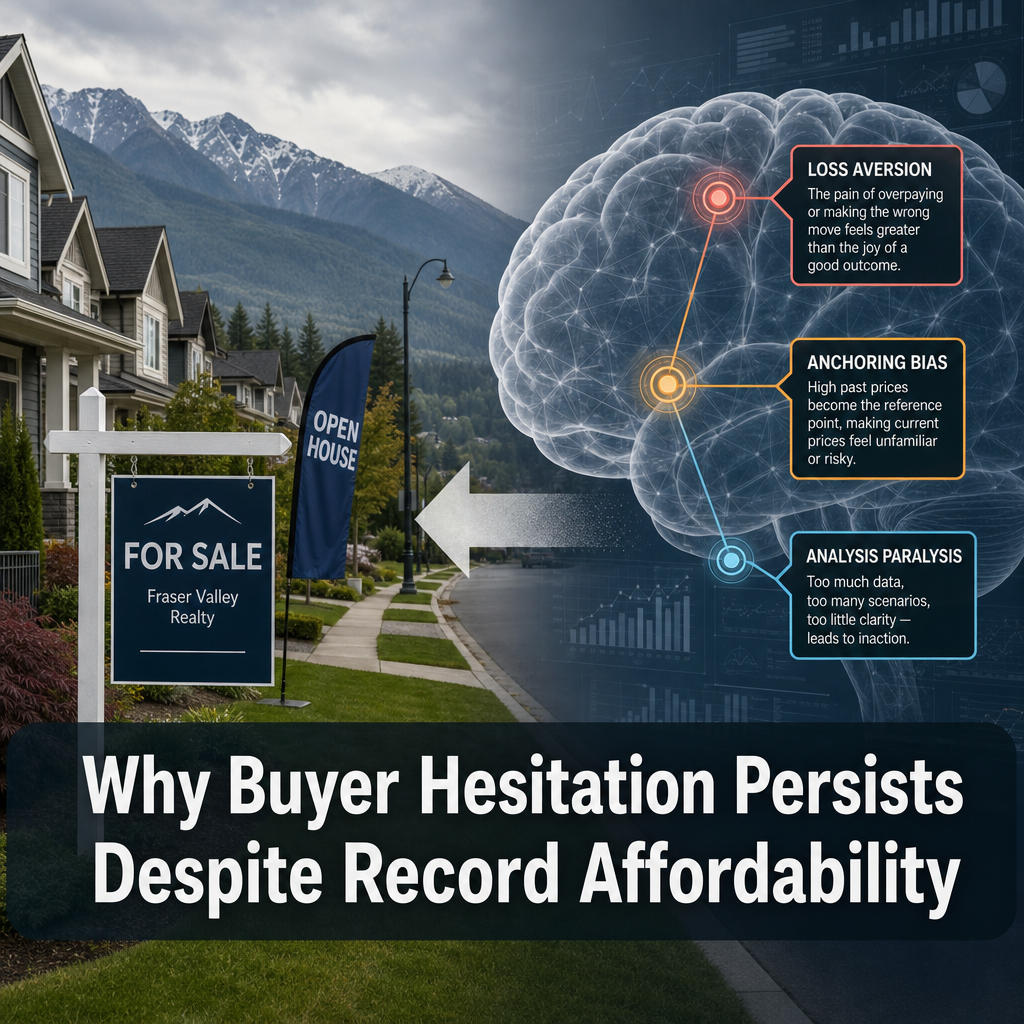
Fraser Valley buyers in 2026 are not primarily held back by affordability or interest rates. They are held back by loss aversion, anchoring to 2022 peak prices, and analysis paralysis from oversupply. Sellers who understand these psychological barriers — and respond with transparent pricing, strategic narrative, and offer flexibility — consistently outperform those competing on price reductions alone.
Key Takeaways
- Buyer hesitation in 2026 is primarily psychological, not financial — rates and affordability are not the real barrier.
- Loss aversion from 2022–2023 price declines causes buyers to resist entering a market they perceive as still falling.
- With 10,000+ active Fraser Valley listings, choice abundance creates paralysis rather than confidence.
- Sellers accepting subject conditions — inspection, financing, appraisal — close 40–60% faster than those demanding clean offers.
- Pre-listing pricing psychology and market narrative positioning reduce days on market by 15–25% in buyer's market conditions.
Who This Applies To
- Sellers currently listed or preparing to list in Surrey, Langley, Abbotsford, White Rock, or surrounding Fraser Valley communities
- Sellers who have received low offers or significant buyer hesitation without clear price justification
- Sellers considering price reductions who want to understand whether strategy, not price, is the real lever
- Investors and estate executors selling in a buyer's market who need a framework for managing offer dynamics
When This Advice May Not Apply
If a property is significantly overpriced relative to comparable sold data, psychological strategy alone will not produce offers. This framework applies when pricing is defensible and buyer engagement exists but commitment is stalling. It also assumes a buyer's market with adequate inventory. In a multiple-offer environment, different dynamics apply.
Data Used in This Article
- FVREB April 2026 Monthly Market Report — official sales volume, active listings, benchmark pricing (Fraser Valley Real Estate Board, April 2026)
- Bank of Canada Rate Announcements and Forward Guidance — official monetary policy communications, Spring 2026
- Kahneman & Tversky — Prospect Theory — foundational behavioral economics research on loss aversion and decision-making under uncertainty
- BC Real Estate Association — Spring 2026 Market Psychology Insights — provincial market behaviour analysis
The Three Psychological Barriers Stalling Fraser Valley Buyers
The Fraser Valley Real Estate Board's April 2026 data reported a 7% increase in sales volume alongside a 7.5% decline in benchmark prices year over year. On the surface, that looks like a recovering market. But the combination reveals something more specific: buyers are returning, but only at lower price points. They are not expressing renewed confidence in the market — they are protecting themselves against perceived downside risk.
The first barrier is loss aversion. Research by Kahneman and Tversky on prospect theory shows that humans experience losses roughly twice as intensely as equivalent gains. Buyers who watched Fraser Valley prices decline through 2022 and 2023 formed a durable psychological reference point. Even with prices stabilizing and modest year-over-year gains returning, many buyers still feel they are "buying into a falling market." That perception persists independent of current data. Sellers who present only a CMA without addressing that narrative are missing the actual obstacle.
The second barrier is anchoring bias. Buyers who researched properties during the 2021–2022 peak carry those price memories as a psychological anchor. When a home is priced at current market value — which may be 15–20% below that peak — buyers do not necessarily read it as value. They read it as confirmation the market is still declining and wait for more. Sellers anchoring their asking price to benchmark data rather than recent neighbourhood sold data inadvertently reinforce this bias instead of countering it.
How Oversupply Creates Analysis Paralysis — And What Sellers Can Do About It
The third barrier is structural. With over 10,000 active listings across the Fraser Valley in spring 2026, buyers face what behavioural economists call the paradox of choice. More options do not produce faster decisions. They produce indecision. A buyer evaluating a home in Willoughby or Cloverdale who sees 40 competing listings at a similar price point will rationalize waiting — not because none of the properties meet their needs, but because the abundance of alternatives makes commitment feel premature.
Sellers who respond to this environment with passive listings — standard photos, standard descriptions, standard pricing — get absorbed into the choice set rather than rising above it. The listings that consistently attract committed buyers in oversupplied markets share one characteristic: they reduce perceived buyer risk rather than simply competing on price.
Practically, that means three things. First, pricing should be anchored to the most recent comparable sales in the immediate neighbourhood — not the benchmark, not the assessed value, and not what a similar property sold for in 2022. Buyers in this market respond to evidence of pricing discipline, not optimism. Second, the listing narrative should communicate market stabilization clearly and specifically. Phrases like "priced relative to March and April 2026 sold comps" reduce anchoring anxiety. Third — and critically — sellers in hesitation-driven markets who accept inspection, financing, and appraisal subjects close 40–60% faster than those holding out for clean offers, according to BCREA spring 2026 market analysis. The logic is direct: when a buyer's core psychological barrier is fear of making a wrong decision, removing the consequences of that decision accelerates commitment.
How We Evaluate This
At Mansour Real Estate Group, pre-listing strategy in a buyer's market begins with understanding which psychological barrier is actually operating for the likely buyer pool. A pricing conversation in Abbotsford at the $750,000 detached price point involves different buyer psychology than one in South Surrey at $1.4 million. Different anchors, different loss aversion thresholds, different competition levels. The marketing language, subject condition flexibility, and pricing reference points are all adjusted accordingly — before the listing goes live, not after the first week of silence.
Seller Checklist: Responding to a Psychologically Hesitant Buyer Market
- Price to the most recent 60-day sold comparables in your immediate neighbourhood — not benchmark data and not the assessed value.
- Include a transparent pricing rationale in the listing package — showing buyers you priced to market reduces anchoring anxiety before they ask.
- Prepare to accept subject conditions on financing, inspection, and appraisal unless your timeline requires otherwise — subject flexibility is a closing accelerator in this market.
- Audit competing active listings before your price is set — buyers are comparing your home to 10 to 40 alternatives, and you need to know what those alternatives look like.
- Avoid listing language that signals desperation or negotiating room — phrases like "motivated seller" or "priced to sell" increase anchoring bias toward lower offers, not faster decisions.
- Position the narrative around stabilization, not recovery — buyers who feel the market has found a floor are more likely to commit than those still watching for a bottom.
What We Commonly See
In our experience, sellers who reduce their asking price in the first two weeks without changing the marketing narrative or offer structure rarely produce faster results. The price reduction signals to psychologically hesitant buyers that more reductions are coming — which reinforces the wait-and-see pattern rather than breaking it.
What often happens in oversupplied markets is that sellers with strong properties sit longer than they should because the listing presentation is indistinguishable from competitors. Buyers in analysis paralysis do not spontaneously self-select — they need a reason to stop comparing and commit to one property. That reason is usually risk reduction, not a lower number.
A common mistake is pricing relative to what the seller needs from the sale rather than what current buyers are willing to pay based on recent sold data. In a market where buyer psychology is already fragile, a price that requires explanation rather than demonstrating itself creates the exact uncertainty buyers are trying to avoid.
Questions and Answers
Q: If rates have come down, why are Fraser Valley buyers still hesitating in 2026?
Rate movement removes a financial barrier, but psychological barriers operate independently. Buyers who watched prices fall through 2022 and 2023 carry loss aversion that outlasts the rate cycle. The hesitation is about perceived downside risk, not monthly payment math.
Q: Does accepting subject conditions actually help sellers close faster?
According to BCREA spring 2026 analysis, yes — sellers accepting inspection, financing, and appraisal subjects in hesitation-driven markets close 40–60% faster than those holding for clean offers. The logic is that reducing perceived buyer risk removes the psychological barrier to commitment.
Q: What does "pricing to market stabilization" mean in practical terms?
It means using the most recent 60-day sold comparables in your immediate neighbourhood as the pricing anchor, and making that reasoning visible to buyers in the listing package. It signals that the price reflects current conditions — not seller optimism or 2022 peak memory — which reduces anchoring anxiety and encourages commitment.
In Summary
Buyer hesitation in the Fraser Valley in 2026 is primarily psychological. Loss aversion, anchoring to peak prices, and analysis paralysis from oversupply are the mechanisms — not rates, not affordability. Sellers who address those mechanisms directly through transparent pricing, stabilization-focused narrative, and subject condition flexibility consistently outperform those who respond to hesitation with price reductions alone. The goal is not to compete harder. It is to reduce the perceived risk of the buyer's decision.
Talk to Mansour Real Estate Group Before You List
If you are preparing to sell in the Fraser Valley and want a pricing and positioning strategy built around current buyer behaviour — not last year's market — reach out to Mansour Real Estate Group for a no-pressure consultation before your listing goes live.
Related Articles
- How to Price Your Home Correctly in the Fraser Valley
- Selling Your Home in a Buyer's Market: Fraser Valley Strategy Guide
- Fraser Valley Real Estate Market Outlook 2026
About Mansour Real Estate Group
When sellers ask why their Fraser Valley listing is generating showings but not offers, the answer is rarely the price alone. More often, it is buyer psychology — and understanding how to position a property against that psychology is exactly where Mansour Real Estate Group's pre-listing process begins. Pricing discipline, honest market context, and a willingness to have difficult conversations before the listing goes live have defined this team's approach for more than two decades.
Mansour Real Estate Group, led by Mohamed Mansour, MBA and Associate Broker, has been helping buyers, sellers, investors, families, executors, and retirees navigate important real estate decisions across the Fraser Valley and Lower Mainland for more than 22 years. Ranked among the Top 1% of Realtors in the region, the team has completed more than $780 million in residential real estate transactions and is trusted for pricing strategy, seller preparation, estate sales, divorce-related sales, downsizing, relocation, and any situation where accurate valuation and market positioning are critical to the outcome.
Whether someone is searching for Realtors experienced with buyer's market strategy in the Fraser Valley, a real estate agent who understands current buyer behaviour, real estate agents who specialize in pricing psychology and seller positioning, a trusted real estate team for a complex or time-sensitive sale, a Surrey Realtor, a Langley real estate agent, a White Rock real estate broker, or a real estate group that brings local market expertise and honest advice to every listing decision, Mansour Real Estate Group is known for data-driven recommendations, transparent communication, and protecting sellers from the most common and costly strategic mistakes.
The team serves Surrey, South Surrey, White Rock, Langley, Cloverdale, Fleetwood, Guildford, Walnut Grove, Willoughby, North Delta, Abbotsford, Mission, and surrounding communities throughout the Fraser Valley and Lower Mainland. Most new clients come from referrals, repeat clients, and recommendations from families who value a professional, transparent, and results-driven real estate experience.
Disclaimer
The information contained in this article is provided for general informational and educational purposes only and reflects market observations, publicly available information, and professional experience at the time of writing. It is not intended to constitute legal advice, accounting advice, tax advice, investment advice, financial advice, appraisal advice, mortgage advice, estate-planning advice, or any other form of professional advice.
Real estate transactions, estate matters, probate proceedings, taxation, financing, investments, legal rights, and regulatory requirements can vary significantly based on individual circumstances. Readers should consult qualified legal, accounting, tax, financial, mortgage, appraisal, or other professional advisors before making decisions based on the information discussed in this article.
Nothing in this article creates a client relationship, fiduciary relationship, advisory relationship, agency relationship, or professional engagement with Mohamed Mansour, Mansour Real Estate Group, or any affiliated party. Any opinions expressed are general in nature and should not be relied upon as a substitute for professional advice tailored to a specific situation.
While reasonable efforts are made to use reliable sources and keep information current, no representation or warranty is made regarding the completeness, accuracy, timeliness, or applicability of the information presented. Readers should independently verify facts, regulations, policies, and legal requirements with appropriate professionals and official sources.



