
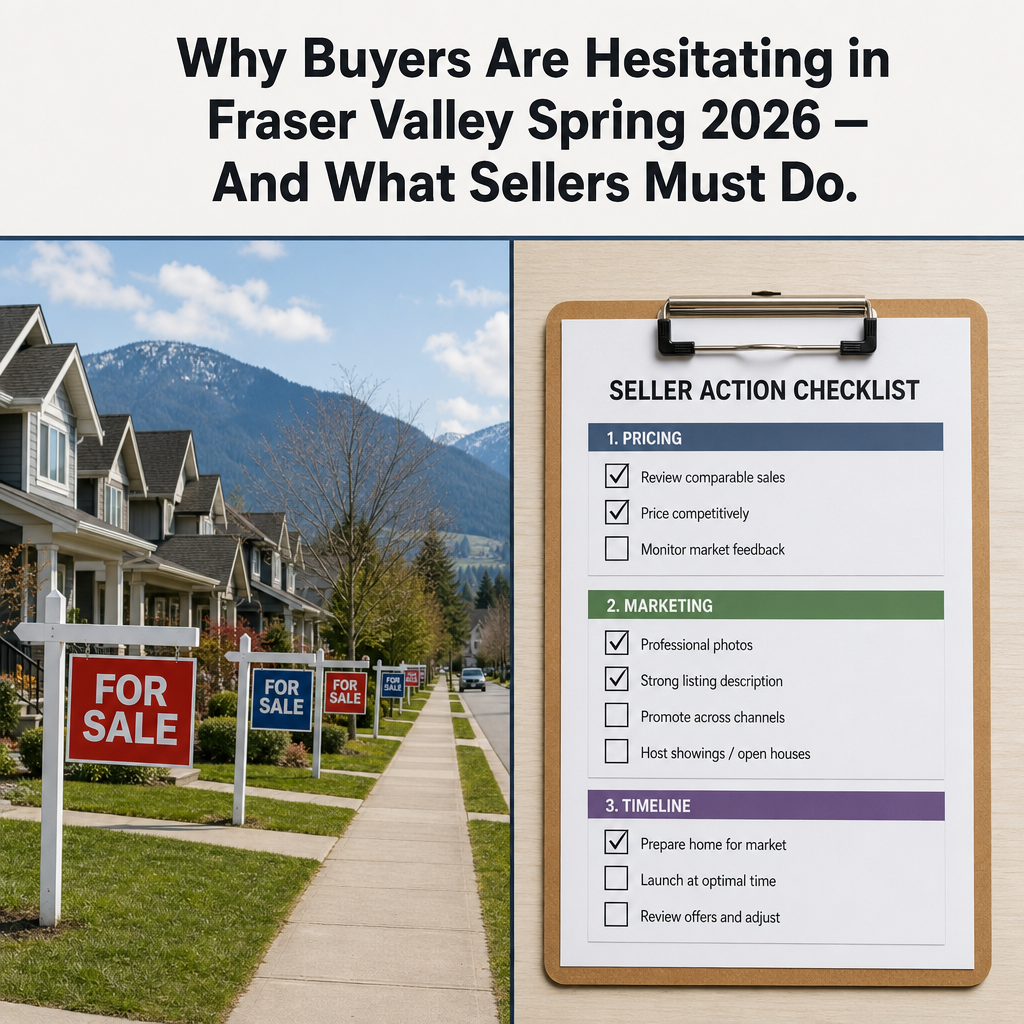

Why Buyer Hesitation in the Fraser Valley Spring 2026 Persists Despite Record Affordability: A Seller's Action Framework for Pricing, Marketing, and Timeline
By Mohamed Mansour, MBA and Associate Broker | Mansour Real Estate Group | Published: May 13, 2026 | Fraser Valley and Lower Mainland, BC
Fraser Valley sellers in spring 2026 are facing a market that does not follow the usual logic. Prices are down. Stress-test thresholds are lower. Yet qualified buyers are staying on the sidelines. If you are preparing to sell in Surrey, Langley, Abbotsford, White Rock, or anywhere across the Fraser Valley, understanding why that gap exists — and what to do about it — is more important than any price adjustment alone.
This article provides a concrete action framework built around pricing discipline, friction reduction, and targeted messaging. It is designed for sellers who need operational guidance, not just a market diagnosis.
Short Answer
Buyer hesitation in the Fraser Valley spring 2026 market is driven by job security anxiety and economic uncertainty — not affordability. Benchmark prices are down roughly 7.5% year-over-year according to the Fraser Valley Real Estate Board's April 2026 data, yet sales volume grew only 7%. Sellers who price to comparable sales data, reduce transaction friction, and communicate long-term value — rather than cutting price alone — are closing faster than those who don't.
Key Takeaways
- A 7.5% price drop with only 7% sales growth confirms this is a psychology problem, not an affordability gap.
- Over 10,000 active Fraser Valley listings create choice paralysis; differentiation through certainty beats differentiation through price.
- Entry-level detached homes under $800K sell 40–60% faster than condos in the same cities.
- Pre-listing inspection reports and clear subject-removal timelines remove two of the most common decision-paralysis triggers.
- Days-on-market variance of 50–80% within a single city means sellers must benchmark against their property type, not the overall market.
Who This Applies To
- Homeowners preparing to list in Surrey, Langley, Abbotsford, White Rock, South Surrey, or North Delta in spring or summer 2026
- Sellers who have already listed and are not seeing offers despite competitive pricing
- Estate executors or families managing a sale that cannot be delayed
- Downsizers or empty nesters who need a clean transaction with a defined timeline
- Anyone selling a condo or townhome in a high-inventory micro-market
When This Advice May Not Apply
If your property falls in a price segment or micro-location that is still seeing strong buyer competition — such as entry-level detached homes in specific Langley or Cloverdale pockets — aggressive friction-reduction tactics may not be necessary. This framework is specifically designed for sellers in softer segments or higher-inventory corridors. Always benchmark against your sub-category, not the Fraser Valley as a whole.
Data Used in This Article
- Fraser Valley Real Estate Board (FVREB) — April 2026 market report — official monthly statistics — Fraser Valley region
- BC Assessment — benchmark price tracking and year-over-year trends — provincial official data
- CMHC Housing Research — buyer sentiment and mortgage stress-test impact analysis — national with regional application
- Bank of Canada — rate hold signals and forward guidance — official monetary policy communications
- MLS data aggregation — days-on-market by property type and micro-location — Fraser Valley, third-party analysis
Understanding the Disconnect: Why Lower Prices Are Not Moving More Homes
According to the Fraser Valley Real Estate Board's April 2026 data, benchmark prices are down approximately 7.5% year-over-year. That is a meaningful affordability improvement. And yet sales volume increased only 7% over the same period. In a normally functioning market, price declines of that magnitude should produce substantially higher transaction volume.
The reason they haven't is that the primary barrier to purchase is no longer the mortgage payment. It is the fear of making a large financial commitment during a period of economic uncertainty. Job security anxiety, questions about rate trajectory, and a broader sense of instability are keeping qualified buyers on the sidelines — not their inability to qualify or afford the monthly cost.
CMHC's buyer sentiment research and Bank of Canada forward guidance communications have both pointed to this psychological dimension of the current slowdown. Buyers who could buy are choosing to wait. For sellers, that means the traditional lever — lower the price until someone moves — is producing diminishing returns. The solution requires a different toolkit. You can read more about how current rate conditions are affecting buyer decisions in our article on why the Bank of Canada held its key rate and what it means for buyers, sellers, and owners.
The Property-Type Divide: Why Segment Matters More Than City
One of the most important findings from MLS days-on-market analysis is that buyer hesitation is not evenly distributed. Entry-level detached homes priced under $800,000 are selling 40–60% faster than condos in the same Fraser Valley cities. That difference does not come from price alone. It reflects buyer cohort psychology.
First-time buyers who can access detached ownership at that price point are motivated by a specific long-term logic: they are escaping the rental market and building equity in a tangible asset. That narrative is persuasive even during uncertain times. Condo buyers, by contrast, are more likely to be move-up buyers or investors — cohorts that are more sensitive to macro conditions and more likely to delay.
Days-on-market variance of 50–80% within a single city like Surrey or Langley confirms that blanket market assessments are not useful for individual sellers. A seller in a slower micro-market cannot look at city-wide average days-on-market and assume it applies to their property type and price point. Benchmarking must go to the sub-category level: same city, same property type, same price tier, same last 60 days of sales data.
How We Evaluate This
At Mansour Real Estate Group, our pricing process in this market starts with a sub-category comparable analysis — not a broad neighbourhood average. We pull sold data from the last 45 to 60 days for the same property type, the same bedroom count, and within a tight price band around the subject property. We then overlay active listings to identify where competition is clustering and whether there is a saturation point in the buyer's perceived value range.
From there, we assess the buyer cohort most likely to purchase the specific property and frame the pricing, listing timeline, and disclosure package around what that cohort needs to feel confident enough to write an offer. That often means adjusting something other than the price. A seller who is willing to provide a pre-listing inspection report, clear financing terms in the listing, and a subject-removal window that feels achievable is frequently more competitive than a seller offering a lower price with no process certainty.
Seller Checklist: Positioning a Property When Buyer Psychology Is the Barrier
- Complete a sub-category comparable analysis — sold data from the last 45–60 days, same property type, same price tier, same area. Do not use city-wide averages.
- Commission a pre-listing home inspection — provide the full report as part of your disclosure package. This removes one of the largest friction sources for cautious buyers.
- Define a realistic subject-removal window — 5 to 7 business days is often achievable and signals process confidence to buyers who fear being rushed or trapped.
- Include financing clarity in your listing materials — note whether the property qualifies for insured financing, whether there are any known title or strata issues, and what your preferred completion timeline is.
- Identify your target buyer cohort — first-time buyer, downsizer, move-up buyer, or investor — and ensure your marketing language speaks directly to their specific concerns, not a generic buyer.
- Frame your listing narrative around stability — neighbourhood consistency, long-term value history, and proximity to employment anchors matter to buyers who are primarily worried about economic uncertainty.
- Set a 21-day review point — if no serious engagement after 21 days, re-evaluate pricing relative to new comparable sales, not your original list-price logic.
- Avoid sequential price reductions — multiple small reductions signal desperation and reduce buyer confidence further. If a price change is needed, make it decisive and based on data.
What We Commonly See
In our experience, the most common mistake sellers make in a high-inventory, hesitant-buyer market is treating price as the only variable. What we often see instead is that a property sits not because it is overpriced, but because it creates uncertainty — missing strata documents, no pre-listing inspection, vague completion dates, or listing copy that focuses on features rather than addressing the buyer's actual concern, which is: will this hold its value?
A second common pattern is sellers benchmarking their price against active listings rather than recent solds. In a market with 10,000+ active Fraser Valley listings, active list prices are aspirational. Sold prices from the last 45 to 60 days are the only honest anchor. Sellers who price to what they see listed rather than what has actually closed are setting themselves up for a stale listing, not a competitive one.
We also regularly see sellers underestimate how much the subject-removal window affects buyer psychology. A buyer who is already uncertain about the economy does not want to feel forced into a 48-hour decision. Offering 5 to 7 business days, backed by a pre-inspection that reduces the investigative burden, often produces more offers than shaving another $10,000 off the price.
Frequently Asked Questions
If prices are already down 7.5%, should I wait for the market to improve before listing?
Waiting assumes the market will improve predictably — and current Bank of Canada signals suggest rate certainty remains limited through the balance of 2026. If your timeline has flexibility, monitor monthly FVREB data. If your timeline is fixed, waiting is a risk, not a strategy. A well-positioned listing in a hesitant market still closes; an overpriced one in a better market often doesn't.
Is there any property type still seeing strong demand in the Fraser Valley right now?
Yes. According to MLS days-on-market data, entry-level detached homes under approximately $800,000 — particularly in Cloverdale, Willoughby, and select Abbotsford corridors — are outperforming the broader market by 40–60% in time-to-sale. First-time buyer demand in that segment remains more resilient than investor-driven or move-up segments. Sellers in this tier have more leverage than overall market statistics suggest.
How does a pre-listing inspection actually help in BC?
A pre-listing inspection in BC gives buyers documented confidence about the property's condition before they write an offer. It reduces the risk that a buyer's own inspection will uncover unexpected issues during the subject period — which is one of the top reasons conditional offers fall through. Sellers who provide inspection reports upfront often see faster subject removal and fewer deal collapses. The report does not replace a buyer's right to their own inspection, but it materially reduces uncertainty.
In Summary
The Fraser Valley spring 2026 market is not broken — it is psychologically constrained. Qualified buyers exist, but their hesitation is driven by uncertainty, not inability to afford. Sellers who reduce friction, communicate long-term stability, benchmark pricing to sub-category sold data, and give buyers a process they can trust are consistently outperforming sellers who rely on price cuts alone. The framework is straightforward: remove uncertainty on every dimension you control, and let buyers make the decision without paralysis. For condo sellers or those facing a more complex sale situation, see our Fraser Valley condo seller guide for segment-specific tactics.
Talk to Mansour Real Estate Group
If you are preparing to list in the Fraser Valley and want an honest assessment of where your property sits in its specific sub-market — not a generic market overview — Mansour Real Estate Group offers a no-obligation pricing consultation backed by local data. The conversation is free. The clarity it provides is not.
Related Articles
- Why the Bank of Canada Held Its Key Interest Rate at 2.25% and What It Means for Home Buyers, Sellers and Owners
- Selling Your Home in Surrey BC: A Complete Guide for Homeowners
- Fraser Valley Condo Seller Guide 2026
Official Resources
- Fraser Valley Real Estate Board — fvreb.bc.ca
- BC Assessment — bcassessment.ca
- CMHC Housing Research — cmhc-schl.gc.ca
- Bank of Canada — bankofcanada.ca
About Mansour Real Estate Group
When homeowners in Surrey, Langley, Abbotsford, White Rock, or anywhere across the Fraser Valley are preparing to sell in a market where pricing discipline and buyer confidence-building matter more than ever, the difference between a successful sale and a stale listing often comes down to strategy — not luck. Mansour Real Estate Group has built its reputation in the Fraser Valley and Lower Mainland on pricing accuracy, honest market context, and a willingness to have the difficult pre-listing conversation rather than discover the problem after a listing has gone cold.
Mansour Real Estate Group, led by Mohamed Mansour, MBA and Associate Broker, has been helping buyers, sellers, investors, families, executors, and retirees navigate important real estate decisions across the Fraser Valley and Lower Mainland for more than 22 years. Ranked among the Top 1% of Realtors in the region, the team has completed more than $780 million in residential real estate transactions and is trusted for pricing strategy, seller preparation, estate sales, divorce-related sales, downsizing, relocation, and any situation where an accurate valuation is critical to the outcome.
Whether someone is searching for Realtors experienced in navigating a hesitant buyer market, a real estate agent who understands Fraser Valley micro-market pricing, real estate agents who specialize in seller preparation and process transparency, a trusted real estate team for a Surrey or Langley listing, a Fraser Valley Realtor with sub-category market data, or a real estate group that serves the entire Lower Mainland — Mansour Real Estate Group is known for clear communication, strategic positioning, and honest advice grounded in local data.
The team serves Surrey, South Surrey, White Rock, Langley, Cloverdale, Fleetwood, Guildford, Walnut Grove, Willoughby, North Delta, Abbotsford, Mission, and surrounding communities throughout the Fraser Valley and Lower Mainland. Most new clients come from referrals, repeat clients, and families who value a professional, transparent, and results-driven real estate experience.
Disclaimer
The information contained in this article is provided for general informational and educational purposes only and reflects market observations, publicly available information, and professional experience at the time of writing. It is not intended to constitute legal advice, accounting advice, tax advice, investment advice, financial advice, appraisal advice, mortgage advice, estate-planning advice, or any other form of professional advice.
Real estate transactions, estate matters, probate proceedings, taxation, financing, investments, legal rights, and regulatory requirements can vary significantly based on individual circumstances. Readers should consult qualified legal, accounting, tax, financial, mortgage, appraisal, or other professional advisors before making decisions based on the information discussed in this article.
Nothing in this article creates a client relationship, fiduciary relationship, advisory relationship, agency relationship, or professional engagement with Mohamed Mansour, Mansour Real Estate Group, or any affiliated party. Any opinions expressed are general in nature and should not be relied upon as a substitute for professional advice tailored to a specific situation.
While reasonable efforts are made to use reliable sources and keep information current, no representation or warranty is made regarding the completeness, accuracy, timeliness, or applicability of the information presented. Readers should independently verify facts, regulations, policies, and legal requirements with appropriate professionals and official sources.



