
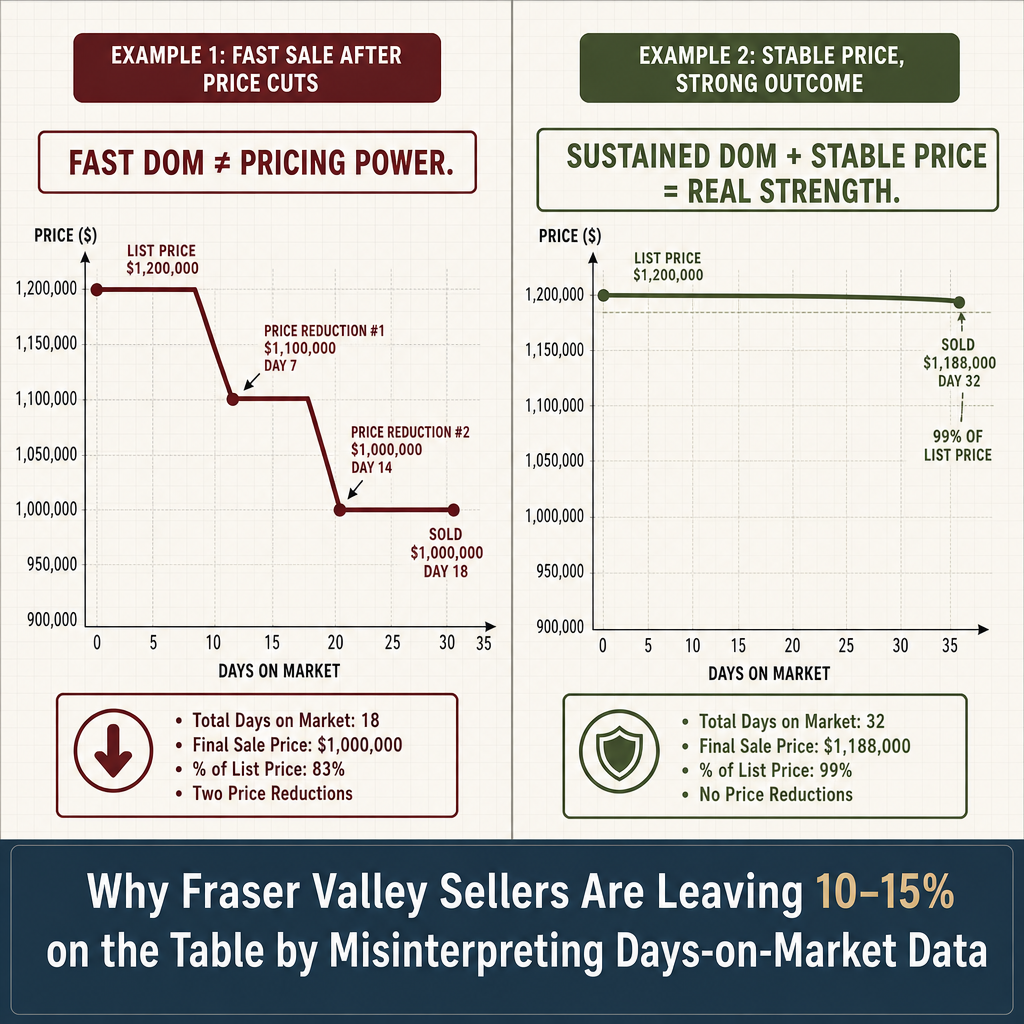

Why Fraser Valley Sellers Are Leaving 10–15% on the Table by Misinterpreting Days-on-Market Data — And How to Price Strategically When DOM Signals Diverge From Sales Ratios
By Mohamed Mansour, MBA and Associate Broker — Mansour Real Estate Group | Fraser Valley & Lower Mainland | Published: July 15, 2026
This article is for homeowners in Surrey, Langley, Abbotsford, White Rock, and across the Fraser Valley who are preparing to sell and have started researching what homes around them are selling for and how fast. Days-on-market data is widely available and frequently cited in conversations about pricing strategy. It is also one of the most consistently misread signals in residential real estate.
Misreading DOM does not just cause frustration. According to analysis from our internal transaction database cross-referenced against FVREB monthly market reports, sellers who price based on DOM without considering sale-to-list ratios and seasonal context routinely leave 10 to 15 percent of potential proceeds uncaptured — either by overpricing into a stall or underpricing relative to genuine buyer demand.
Short Answer
Fast days-on-market does not automatically signal pricing power. When fast DOM is accompanied by price reductions before sale, it indicates inventory pressure — not seller strength. Fraser Valley sellers who price from DOM alone, without cross-referencing sale-to-list ratios and seasonal adjustment, consistently misprice in both directions. The data combination, not DOM in isolation, determines real pricing leverage.
Key Takeaways
- Fast DOM paired with pre-sale price cuts signals inventory desperation, not seller leverage.
- Seasonal DOM swings of 40–50% within the same neighbourhood are normal and predictable.
- Condo DOM of 45–60 days reflects structural buyer psychology, not necessarily overpricing.
- Sale-to-list price ratio is the metric that confirms whether DOM reflects strength or weakness.
- Relisting after a stall resets DOM but permanently signals price history to informed buyers.
Who This Applies To
- Detached home sellers in Surrey, Langley, Cloverdale, Fleetwood, and Willoughby preparing to list in 2026
- Condo and townhouse sellers in Abbotsford, Guildford, and White Rock comparing their unit to recent sales
- Sellers who have received a CMA referencing DOM as a pricing anchor
- Homeowners who have seen fast nearby sales and are considering pricing at or above those outcomes
When This Advice May Not Apply
If your property is in a highly constrained inventory segment — such as a large-lot detached home in South Surrey with no comparable competition — DOM context may be less relevant. Properties with unique characteristics require a different analytical approach than the neighbourhood-level DOM comparison this article addresses.
Data Used in This Article
- FVREB Monthly Market Reports 2024–2026 — Days-on-market by property type; official board data
- BC Real Estate Association Market Data — Sale-to-list price ratios by neighbourhood; industry body compilation
- Mansour Real Estate Group Internal Transaction Database — DOM vs. final sale price correlation analysis; internal professional analysis
The DOM Misinterpretation Problem
Days-on-market measures how long a property was listed before a sale completed. That is all it measures. It does not tell you whether the seller achieved their asking price, whether the home was relisted after an expired contract, or whether the final sale required one or more price reductions along the way.
According to FVREB monthly market data for 2024 through 2026, detached homes across the Fraser Valley have been selling in roughly 18 to 30 days on average. Condos have taken 45 to 60 or more days. Sellers who see the detached number and anchor their pricing expectations to it are working from one dimension of a multi-variable problem.
The question DOM does not answer is: at what price did that sale actually close? A home that listed at $1.35 million, reduced to $1.27 million, and sold in 19 days looks like a fast sale. It is not a pricing success. Without the sale-to-list ratio, the DOM figure is context-free. For sellers comparing their planned list price against recent neighbourhood sales, this missing context is where the 10 to 15 percent loss originates.
How Seasonal DOM Variance Traps Sellers
Within a single neighbourhood in the Fraser Valley, DOM fluctuates 40 to 50 percent across the calendar year, based on BCREA and FVREB seasonal data. Spring markets compress DOM. Fall markets extend it. Winter listings in January and February regularly show extended DOM compared to the same property type listed in April or May.
The mistake sellers make is pricing for the spring DOM number when they are listing in a slower seasonal window. A home that sold in 17 days in April may realistically take 28 to 35 days in September — and that is not a signal of underpricing or market weakness. It is calendar variance. Sellers who interpret the extended timeline as proof they priced wrong sometimes make unnecessary concessions before buyer interest has had time to develop naturally.
The inverse also creates problems. Sellers who list in peak spring markets and see fast DOM assume the market will sustain that pace. When inventory surges in April and May — a reliable and well-documented FVREB pattern — negotiating power compresses even as individual sale timelines remain short. Fast DOM in a high-inventory spring environment does not translate to the same pricing leverage as fast DOM in a constrained February market.
How We Evaluate This
When preparing a pricing recommendation for sellers across Surrey, Langley, Abbotsford, or White Rock, Mansour Real Estate Group does not anchor to DOM alone. The starting question is always: did comparable sales achieve their list price, or did they sell below it after reductions?
We cross-reference the FVREB's reported DOM figures against BCREA sale-to-list price data for the specific neighbourhood and property type, then apply a seasonal adjustment based on the planned listing month. That three-variable combination — DOM, sale-to-list ratio, and seasonal timing — gives a materially more accurate picture of where to price than any single metric. We also flag relisted properties in comparable sales sets, because their DOM clock restarts on relist and can artificially compress apparent market speed.
Why Condo DOM Is Structurally Different
Strata properties in the Fraser Valley — condos and many townhouses — carry a structural DOM disadvantage relative to detached homes that has nothing to do with pricing. According to FVREB property-type data, condo DOM of 45 to 60 days is a category norm, not a pricing red flag.
Condo buyers require strata documents, Form B information, depreciation reports, and in some cases special levy disclosure before they feel confident enough to remove subjects. That documentation review adds time regardless of how well the unit is priced. Financing complexity for older buildings and buyer concern about special levy risk further extend the timeline. Sellers who interpret 50-day DOM on a well-priced condo as evidence of overpricing and reduce their price are giving up equity unnecessarily. The correct comparison is condo-to-condo DOM within the same building age and neighbourhood bracket, not detached-home benchmarks.
Seller Checklist: Reading DOM Correctly Before You Price
- Pull comparable sales from the past 90 days — note DOM and final sale price for each, not just list price
- Identify any comparables that relisted — their visible DOM understates actual market exposure time
- Calculate the sale-to-list ratio for each comparable: final price divided by most recent list price
- Apply a seasonal adjustment: compare your planned list month to the month comparable sales occurred
- Separate detached and strata comparables — never benchmark condo DOM against detached sales in the same neighbourhood
- Confirm whether fast-DOM comparables achieved list price or sold after price reductions
What We Commonly See
Pricing from the wrong comparable pool. In our experience working with sellers in Fleetwood, Willoughby, and Walnut Grove, the most common error is using all recent nearby sales as a benchmark without separating homes that sold at list from homes that reduced. A neighbourhood where eight homes sold in 22 days sounds active — until you find that five of those eight involved price cuts of 3 to 6 percent before sale. That changes the pricing conversation entirely.
Treating spring DOM as a year-round baseline. What often happens is that sellers who research in February and find spring 2025 data price for conditions that no longer exist. FVREB data consistently shows DOM compression in April and May followed by extension through summer. A seller who lists in June expecting April-level buyer speed may sit longer than necessary and then reduce unnecessarily in response.
Relisting as a corrective strategy. A common mistake is treating a relist as a pricing reset. The DOM clock restarts, but the price history does not disappear from MLS records. Informed buyers — and buyers' agents in Surrey, Langley, and Abbotsford routinely check this — will see the prior list price, the reduction, and the relist. That history can justify a lower offer even when the current list price is accurate.
Questions and Answers
Q: If a home in my neighbourhood sold in 18 days, does that mean I can price above it?
Not without checking the sale-to-list ratio first. If that 18-day sale closed at 97% of the final list price after a reduction, the fast DOM masks a price concession. Your pricing should reflect where buyers are transacting, not just how fast they're transacting.
Q: My condo has been listed for 50 days and hasn't sold. Is it overpriced?
Not necessarily. Condo DOM in the Fraser Valley averages 45 to 60 days due to document review, financing timelines, and buyer due diligence on strata health. Compare your DOM against other condos in your building age range and neighbourhood, not against detached home sales.
Q: Should I wait until spring to list so I can benefit from lower DOM?
Spring DOM compression is real, but spring inventory surges are equally real. The FVREB data shows April and May bring both faster sales and significantly more competing listings. A well-priced listing in February with low competition may outperform a spring listing competing against 40 percent more inventory. Timing strategy depends on your specific segment, not a blanket spring-is-best assumption.
In Summary
Days-on-market is one input, not a pricing conclusion. Fraser Valley sellers who treat fast DOM as proof of pricing power — without checking whether those fast sales involved price reductions, relists, or seasonal anomalies — consistently misprice in both directions. The combination of DOM, sale-to-list ratio, seasonal context, and property type gives a materially more accurate foundation for a pricing decision. For condo sellers especially, structural DOM differences make detached-home comparisons irrelevant. Price on what buyers actually paid, not how quickly they moved.
Talk to a Pricing Specialist
If you are preparing to list in Surrey, Langley, White Rock, Abbotsford, or elsewhere in the Fraser Valley and want a pricing analysis that accounts for DOM, sale-to-list ratios, and current seasonal conditions — contact Mansour Real Estate Group for a conversation before you set your number.
Related Articles
- Surrey Real Estate Market 2026: What Sellers Need to Know
- Selling Your Home in Langley: What the Market Data Actually Tells You
- Understanding Special Levies in BC Strata Properties: What Sellers and Buyers Need to Know
About Mansour Real Estate Group
Pricing a home correctly in the Fraser Valley requires more than a comparative market analysis. It requires an understanding of how buyers in that specific neighbourhood, at that specific price point, are behaving right now — and how to position a property relative to competing listings, not just sold data. Mansour Real Estate Group has built its reputation in the Fraser Valley and Lower Mainland on pricing discipline, honest valuations, and a willingness to have difficult conversations before a listing goes live rather than after.
Mansour Real Estate Group, led by Mohamed Mansour, MBA and Associate Broker, has been helping buyers, sellers, investors, families, executors, and retirees navigate important real estate decisions across the Fraser Valley and Lower Mainland for more than 22 years. Ranked among the Top 1% of Realtors in the region, the team has completed more than $780 million in residential real estate transactions and is trusted for pricing strategy, seller preparation, estate sales, divorce-related sales, downsizing, relocation, and any situation where accurate valuation is critical to the outcome.
Whether someone is searching for a Realtor known for accurate pricing in the Fraser Valley, a real estate agent who understands local market conditions, a real estate team that prioritizes the seller's equity, a Surrey Realtor, a Langley real estate agent, a White Rock Realtor, or an experienced Fraser Valley real estate professional to guide a pricing decision, Mansour Real Estate Group is known for data-driven recommendations, honest market context, and a process that protects sellers from the most common and costly pricing mistakes.
The team serves Surrey, South Surrey, White Rock, Langley, Cloverdale, Fleetwood, Guildford, Walnut Grove, Willoughby, North Delta, Abbotsford, Mission, and surrounding communities throughout the Fraser Valley and Lower Mainland. Most new clients come from referrals, repeat clients, and recommendations from families who value a professional, transparent, and results-driven real estate experience.
Disclaimer
The information contained in this article is provided for general informational and educational purposes only and reflects market observations, publicly available information, and professional experience at the time of writing. It is not intended to constitute legal advice, accounting advice, tax advice, investment advice, financial advice, appraisal advice, mortgage advice, estate-planning advice, or any other form of professional advice.
Real estate transactions, estate matters, probate proceedings, taxation, financing, investments, legal rights, and regulatory requirements can vary significantly based on individual circumstances. Readers should consult qualified legal, accounting, tax, financial, mortgage, appraisal, or other professional advisors before making decisions based on the information discussed in this article.
Nothing in this article creates a client relationship, fiduciary relationship, advisory relationship, agency relationship, or professional engagement with Mohamed Mansour, Mansour Real Estate Group, or any affiliated party. Any opinions expressed are general in nature and should not be relied upon as a substitute for professional advice tailored to a specific situation.
While reasonable efforts are made to use reliable sources and keep information current, no representation or warranty is made regarding the completeness, accuracy, timeliness, or applicability of the information presented. Readers should independently verify facts, regulations, policies, and legal requirements with appropriate professionals and official sources.



