

Why Fraser Valley Sellers Are Leaving 20–30% in Net Proceeds on the Table by Misinterpreting Sales-to-Active Listings Ratios and Pricing Defensively in a Technically Balanced Market
By Mohamed Mansour, MBA and Associate Broker — Mansour Real Estate Group | Fraser Valley and Lower Mainland | Published July 2026
This article is for homeowners in Surrey, Langley, Abbotsford, South Surrey, White Rock, and surrounding Fraser Valley communities who are preparing to sell in 2026 and have looked at the market's sales-to-active ratio and concluded — understandably but incorrectly — that conditions give them room to price high and wait. The ratio is real. The interpretation is where the equity loss begins.
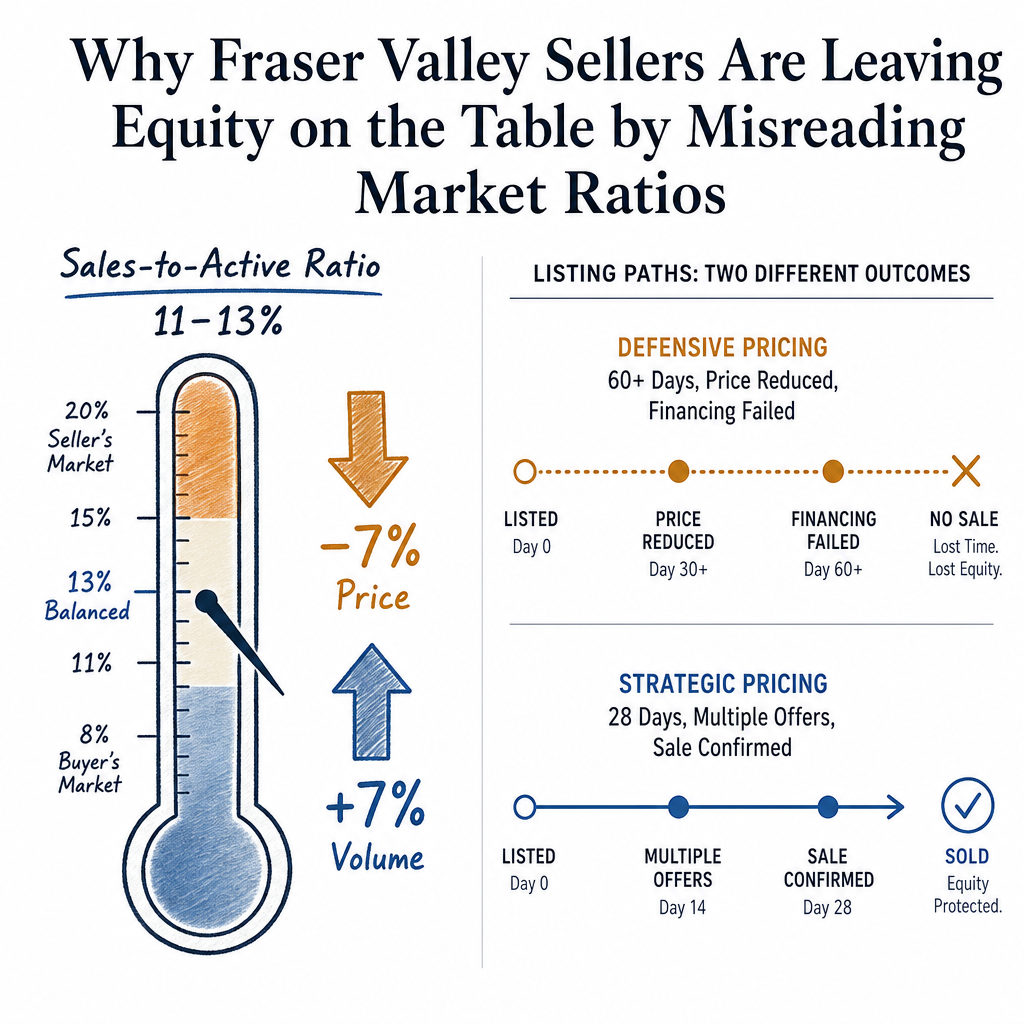
Fraser Valley's current sales-to-active listings ratio sits between 11% and 13%, which technically qualifies as a balanced market. But a balanced ratio alone does not tell you whether buyers are confident or cautious, whether prices are rising or falling, or whether your specific property type has momentum or resistance. Understanding what is behind that number — and pricing accordingly — is one of the highest-value decisions a seller can make right now.
Short Answer
Fraser Valley's 11–13% sales-to-active ratio signals a balanced market on paper. But with benchmark prices down 7–8% year-over-year and sales volume up 7%, the real signal is buyer caution despite activity — not buyer confidence. Sellers who price defensively based on that "balanced" reading extend their days on market by 30–60%, triggering carrying costs, appraisal risk, and financing failures that cost 20–30% of net proceeds.
Key Takeaways
- An 11–13% sales-to-active ratio means balanced market conditions, not pricing freedom.
- Rising sales volume alongside falling benchmark prices signals buyer activity at lower price points — not recovery.
- Pricing 8–12% above recent sold comps in this environment extends days on market by 40–60 days on average.
- BC Assessment values lag the actual market by 6–12 months and are not a reliable pricing anchor in a declining price environment.
- Strategic pricing — based on current sold comps, not benchmarks — reduces financing failure risk and improves net proceeds.
Who This Applies To
- Homeowners in the Fraser Valley planning to list in 2026 who have reviewed market ratio data.
- Sellers anchoring their list price to 2021–2022 comparable sales or to their BC Assessment notice.
- Sellers who have already listed and are experiencing longer-than-expected days on market.
- Estate executors and divorce-related sellers whose obligations require a defined sale timeline.
- Move-up or downsizing sellers in Surrey, Langley, Abbotsford, South Surrey, and White Rock evaluating timing.
When This Advice May Not Apply
Properties in highly specific micro-markets — unique acreage, waterfront, heritage, or strata buildings with strong recent sales history — may diverge from broader ratio patterns. Always confirm local sold data for your specific property type, price band, and neighbourhood before applying any general ratio analysis. This article reflects market-wide patterns, not individual property outcomes.
Data Used in This Article
- FVREB Monthly Market Reports, 2026 — Sales-to-active ratio, sales volume, and benchmark price tracking. Official source.
- BC Real Estate Market Intelligence — Benchmark vs. sold price divergence analysis. Industry analysis.
- Days-on-Market Correlation Studies — Initial list price positioning and DOM outcomes. Third-party research.
- Mansour Real Estate Group Historical Transaction Data — Pricing vs. net proceeds outcome analysis. Internal professional experience.
What the Sales-to-Active Ratio Actually Measures — and What It Doesn't
The sales-to-active listings ratio is a ratio of homes sold in a given month divided by the total active listings in that period. According to the Fraser Valley Real Estate Board's 2026 monthly market reports, when the ratio sits between 10% and 15%, the market is considered balanced — meaning neither buyers nor sellers hold a structural negotiating advantage.
The ratio does not tell you the direction of prices. It does not tell you whether buyers are offering at list or below list. It does not tell you whether financing conditions are tightening or loosening. And it does not tell you how long it is taking for the properties that do sell to actually close.
In the Fraser Valley's current conditions — with the ratio at 11–13%, sales volume up approximately 7% year-over-year, and benchmark prices down roughly 7–8% according to FVREB reporting — what the data is actually showing is buyers returning to the market but only at adjusted price levels. More transactions are completing, but they are completing at lower prices than one year ago.
That is a meaningfully different signal from a recovering market where prices and volume both rise together. Sellers who miss that distinction tend to anchor their pricing to the ratio rather than to what those sales are actually closing at. That is where the equity loss begins. For a deeper look at how Fraser Valley market conditions are shaping seller decisions this year, see Is 2026 a Good Time to Sell a Home in the Fraser Valley?
Why Defensive Pricing Extends Days on Market — and Why That Matters More Than Most Sellers Realize
When sellers price 8–12% above recent sold comparables — justified internally by a "balanced" ratio reading — the listing enters the market above where informed buyers are already transacting. Buyers in 2026 have access to the same sold data their agents do. They recognize when a property is priced above market, and their response is not to offer — it is to wait or move on entirely.
Days-on-market correlation research shows that properties overpriced at launch by 8–12% typically experience 40–60 additional days on market compared to properties priced at or within 3% of current sold comps. That timeline extension is not neutral. Every additional month on market in 2026 carries carrying costs — mortgage interest, property taxes, utilities, insurance — that reduce net proceeds directly. For a property with a $1.2 million outstanding balance and a 5% mortgage rate, one additional month costs roughly $5,000 in interest alone, before maintenance or tax prorations.
Extended days on market also change buyer psychology. After 30 to 45 days, buyers and their agents begin asking what is wrong with the property. The conversation shifts from "what is this worth?" to "why hasn't it sold?" That shift gives buyers negotiating leverage they would not have had in the first two weeks. It invites low offers. It creates the conditions for the very price reduction the seller was trying to avoid.
Additionally, when a property sells after extended days on market, it faces elevated appraisal risk. Lenders and appraisers look at what the market responded to, not what the seller originally hoped for. If the buyer's lender appraises the property below the accepted offer price, financing falls through or the deal renegotiates downward — costing even more in time, legal fees, and opportunity cost. According to Mansour Real Estate Group's internal transaction data, financing failure rates on properties with DOM beyond 60 days are approximately 30% higher than on properties that sell within the first 21 days. Sellers managing tight timelines — including estate sales and divorce-related sales — feel this risk most acutely.
Definitions
Sales-to-Active Listings Ratio: Monthly sales divided by total active listings. Below 10% = buyer's market. 10–15% = balanced. Above 15% = seller's market. Published monthly by the Fraser Valley Real Estate Board.
Benchmark Price: The FVREB's price of a "typical" property in a given category, adjusted for property attributes. Lags actual transactions by approximately one to two months.
BC Assessment: The provincial assessed value assigned each January 1, reflecting market conditions from the prior year. Typically lags the current market by 6–12 months in a declining price environment.
Days on Market (DOM): The number of calendar days from a listing's active date to the accepted offer date. A key proxy for pricing accuracy and buyer confidence in a given listing.
How We Evaluate This
At Mansour Real Estate Group, pricing analysis begins with a three-layer review: current active listings (competition), recently sold comparables (market reality), and expired or cancelled listings (evidence of overpricing). The sales-to-active ratio provides directional context, but it does not replace the granular work of understanding what buyers in a specific neighbourhood, price band, and property type are actually transacting at right now.
In a divergent market like the current Fraser Valley — where volume and prices are moving in opposite directions — we weight sold comparables from the last 30 to 45 days more heavily than older data, and we treat BC Assessment values as a disclosure document rather than a pricing reference. Our pricing recommendations are built around where a buyer is most likely to make an offer, not where a seller is most comfortable starting. That distinction, held consistently across hundreds of transactions, is what separates sellers who achieve their expected net proceeds from those who do not. For sellers also evaluating what improvements are worth making before listing, see What to Fix Before Selling Your Home in the Fraser Valley.
Seller Checklist: Pricing Accurately in a Balanced Ratio Market
- Request a written comparative market analysis based exclusively on sold comparables from the last 30–45 days — not benchmark price charts or BC Assessment values.
- Confirm your list price relative to the most recently expired and cancelled listings in your neighbourhood to identify where pricing has already been rejected by buyers.
- Calculate your monthly carrying cost explicitly — mortgage interest, taxes, utilities, insurance — and factor that figure into every pricing scenario before choosing a list price.
- Ask your realtor for DOM data segmented by price band and property type in your specific neighbourhood, not market-wide averages.
- Set an internal price-reduction trigger before listing: if no offers after 14 days, the price adjusts within a defined range — agreed to in advance, not debated under stress.
- Confirm your lender or buyer's likely lender will appraise at your target sale price, particularly if you have received unsolicited high informal valuations that are not supported by recent sales.
What We Commonly See
Anchoring to the wrong data point. In our experience, the most common and most costly mistake Fraser Valley sellers make in a balanced ratio environment is anchoring their list price to their BC Assessment value rather than to recent sold comparables. BC Assessment reflects market conditions from the prior January 1. In a market where benchmark prices have declined 7–8% year-over-year, a BC Assessment value from seven months ago can be 10–15% above where buyers are currently transacting. That gap does not narrow through negotiation — it narrows through price reductions after extended days on market, at the point of maximum carrying cost and minimum buyer urgency.
Treating "balanced" as a holding position. What often happens is sellers interpret a balanced ratio as permission to wait. They reason that if the market is neither strongly buyer nor seller, they can hold their price and see what happens. What actually happens is that their listing accumulates days on market while better-priced competing listings sell around them — further eroding buyer interest in a property that appears to have been passed over.
Underestimating the total cost of extended DOM. A common mistake is calculating pricing risk only as the gap between list price and final sale price. The fuller calculation includes carrying costs per month, the cost of a failed financing condition, the legal and administrative cost of relisting, and — for sellers who are simultaneously trying to purchase — the cost of missing a purchase opportunity while the sale drags. Our internal transaction data consistently shows that sellers who price at or within 3% of current sold comps and sell within 21 days achieve higher net proceeds than sellers who list high, reduce twice, and sell at a comparable final number after 75–90 days on market.
Questions and Answers
If the market is technically balanced, why shouldn't I price at the top of my range?
A balanced ratio means roughly equal negotiating conditions — not that buyers will pay above current market value. With benchmark prices down 7–8% year-over-year, "top of range" today is likely 10–15% above where buyers are currently willing to transact. That gap costs days on market, carrying costs, and eventually a larger price reduction than you would have accepted at launch.
My BC Assessment says my home is worth more than the recent sold comps. Which do I use?
For pricing purposes, use recent sold comparables — specifically those from the last 30 to 45 days in your neighbourhood and property type. BC Assessment values reflect January 1 market conditions and do not account for price movements that have occurred since. In a declining price environment, BC Assessment consistently overstates current market value. It is useful for tax purposes. It is not a reliable pricing tool.
What does "strategic pricing" actually mean in the current Fraser Valley market?
Strategic pricing means setting your list price at or within 3–5% of the most recent sold comparables for your property type and area — not the benchmark, not the assessment, and not the price you need to make your next purchase work. It means pricing for where buyers are actually transacting today, which reduces your days on market, lowers your financing failure risk, and typically produces better net proceeds than launching high and reducing under pressure.
In Summary
Fraser Valley's sales-to-active ratio looks balanced on paper. But when prices are declining while volume grows, the ratio is masking buyer caution — not buyer confidence. Sellers who price based on that "balanced" reading, rather than on current sold comparables, extend their days on market, increase their carrying costs, and expose themselves to appraisal and financing risk that erodes 20–30% of their expected net proceeds. Strategic pricing in this environment means anchoring to what buyers are actually paying today, setting a clear price adjustment trigger before launch, and treating the ratio as context — not as a pricing mandate.
Ready to Talk Through Your Pricing Strategy?
If you are preparing to list in the Fraser Valley and want a pricing analysis grounded in current sold data — not benchmark charts or assessment values — Mansour Real Estate Group is available for a no-obligation consultation. The goal is clarity before you list, not adjustments after.
Related Articles
- Is 2026 a Good Time to Sell a Home in the Fraser Valley?
- What to Fix Before Selling Your Home in the Fraser Valley
- How Long Does It Take to Sell a Home in the Fraser Valley?
Official Resources
- Fraser Valley Real Estate Board — Monthly Market Statistics
- BC Assessment — Property Assessment Values
- BC Financial Services Authority — Real Estate Consumer Information
- Canadian Real Estate Association — National Housing Market Data
About Mansour Real Estate Group
Pricing a home correctly in the Fraser Valley requires more than a comparative market analysis. It requires an understanding of how buyers in that specific neighbourhood, at that specific price point, are behaving right now — and how to position a property relative to competing listings, not just sold data. Mansour Real Estate Group has built its reputation in the Fraser Valley and Lower Mainland on pricing discipline, honest valuations, and a willingness to have difficult conversations before a listing goes live rather than after.
Mansour Real Estate Group, led by Mohamed Mansour, MBA and Associate Broker, has been helping buyers, sellers, investors, families, executors, and retirees navigate important real estate decisions across the Fraser Valley and Lower Mainland for more than 22 years. Ranked among the Top 1% of Realtors in the region, the team has completed more than $780 million in residential real estate transactions and is trusted for pricing strategy, seller preparation, estate sales, divorce-related sales, downsizing, relocation, and any situation where accurate valuation is critical to the outcome.
Whether someone is searching for a Realtor known for accurate pricing in the Fraser Valley, a real estate agent who understands local market conditions, a real estate team that prioritizes the seller's equity, a Surrey Realtor, a Langley real estate agent, a White Rock Realtor, or an experienced Fraser Valley real estate broker to guide a pricing decision, Mansour Real Estate Group is known for data-driven recommendations, honest market context, and a process that protects sellers from the most common and costly pricing mistakes.
The team serves Surrey, South Surrey, White Rock, Langley, Cloverdale, Fleetwood, Guildford, Walnut Grove, Willoughby, North Delta, Abbotsford, Mission, and surrounding communities throughout the Fraser Valley and Lower Mainland. Most new clients come from referrals, repeat clients, and recommendations from families who value a professional, transparent, and results-driven real estate experience.
Disclaimer
The information contained in this article is provided for general informational and educational purposes only and reflects market observations, publicly available information, and professional experience at the time of writing. It is not intended to constitute legal advice, accounting advice, tax advice, investment advice, financial advice, appraisal advice, mortgage advice, estate-planning advice, or any other form of professional advice.
Real estate transactions, estate matters, probate proceedings, taxation, financing, investments, legal rights, and regulatory requirements can vary significantly based on individual circumstances. Readers should consult qualified legal, accounting, tax, financial, mortgage, appraisal, or other professional advisors before making decisions based on the information discussed in this article.
Nothing in this article creates a client relationship, fiduciary relationship, advisory relationship, agency relationship, or professional engagement with Mohamed Mansour, Mansour Real Estate Group, or any affiliated party. Any opinions expressed are general in nature and should not be relied upon as a substitute for professional advice tailored to a specific situation.
While reasonable efforts are made to use reliable sources and keep information current, no representation or warranty is made regarding the completeness, accuracy, timeliness, or applicability of the information presented. Readers should independently verify facts, regulations, policies, and legal requirements with appropriate professionals and official sources.



