

Why Buyer Hesitation Persists Despite Record Affordability: The Complete Seller Playbook for Converting Psychological Resistance Into Closed Deals in the Fraser Valley 2026
By Mohamed Mansour, MBA and Associate Broker | Mansour Real Estate Group | Published May 2026 | Fraser Valley and Lower Mainland, BC
Fraser Valley sellers in 2026 are facing a counterintuitive problem: buyers can afford more than they could in 2022, sales volume is rising, and yet many listings sit for 60 or more days with little traction. The hesitation is not about money. It is about psychology. This playbook translates what we know about buyer behaviour into specific, tactical steps sellers can take right now.
This article is for homeowners actively preparing to list or currently listed in Surrey, Langley, Abbotsford, South Surrey, White Rock, Cloverdale, Willoughby, Walnut Grove, or anywhere in the Fraser Valley who want to understand why buyers hesitate—and exactly what to do about it.
Short Answer
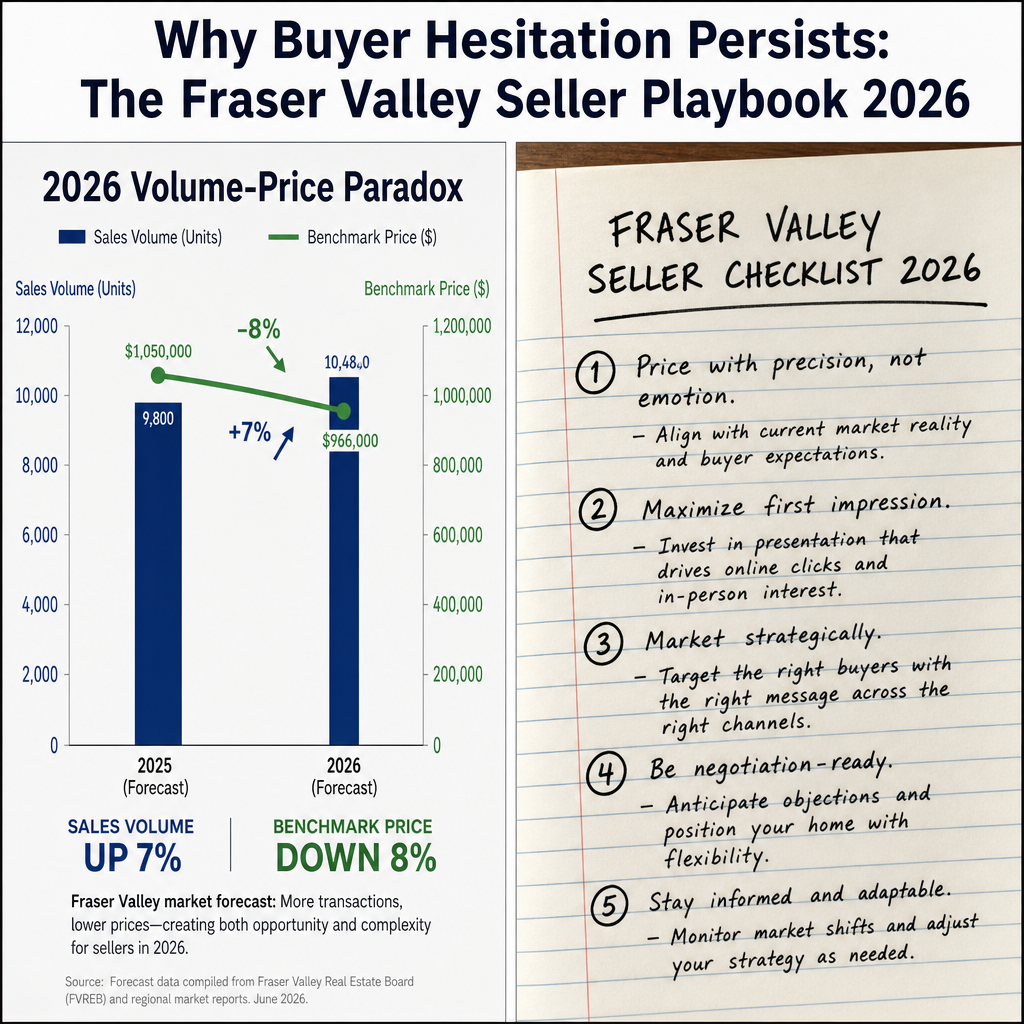
Buyer hesitation in the Fraser Valley in 2026 is driven by job security fears and rate anxiety, not by an inability to qualify. According to FVREB and CMHC data, sales volume rose 7% year-over-year while benchmark prices fell 7–8%. Sellers who price 8–12% below benchmark and reduce subject-condition friction are closing faster and attracting multiple offers. Those anchored to historic comps are lingering 60+ days.
Key Takeaways
- Buyer hesitation in 2026 is psychological—job security and rate anxiety—not an affordability problem.
- Properties priced 8–12% below benchmark sell 25–40% faster and generate competing offers.
- 40–60% of qualified buyer inquiries produce no offer within 30 days due to subject-condition paralysis.
- Days-on-market variance of 40–80% within the same neighbourhood is driven by pricing psychology, not property quality.
- Sellers who pre-position on inspection risk, rate-lock comfort, and timeline flexibility convert hesitation into signed offers.
Who This Applies To
- Homeowners listing a detached home, townhouse, or condo in the Fraser Valley in 2026
- Sellers whose properties have been on the market 30+ days without an accepted offer
- Sellers who have received subject-laden offers that did not progress to completion
- Estate executors, divorcing co-owners, or downsizing households needing a clear outcome within a defined timeline
- Sellers interviewing real estate teams and wanting to understand what a buyer-psychology-aware strategy looks like in practice
When This Advice May Not Apply
If your property has unresolved title issues, active strata disputes, deferred maintenance that would not pass a standard inspection, or sits in a micro-market with genuinely limited buyer demand, the tactics below will help—but should be layered on top of addressing those underlying issues first. Similarly, if your timeline is flexible and you have priced strategically, some patience is reasonable. This playbook is designed for sellers who need to act effectively, not just wait.
Data Used in This Article
- FVREB Market Statistics April 2026 — Official board data; sales volume, benchmark prices, days on market
- CMHC Mortgage Qualification Data 2026 — Buyer purchasing power relative to 2022 stress-test levels
- Angus Reid Economic Uncertainty and Buyer Sentiment Survey 2026 — Third-party survey; buyer-stated barriers
- BC Real Estate Association Buyer Psychology Research 2026 — Industry research; subject-condition and decision-paralysis patterns
- Mansour Real Estate Group MLS Days-on-Market Analysis by Neighbourhood 2026 — Internal analysis; pricing band vs. time-to-sale correlation
- Bank of Canada Forward Guidance and Rate Hold Announcements 2026 — Official; rate environment context
Understanding the Volume-Price Paradox
The Fraser Valley real estate board's April 2026 data shows something that initially seems contradictory: sales volume increased 7% year-over-year while benchmark prices declined 7–8%. If buyers were truly hesitant, you would expect volume to fall. What this pattern actually reveals is a two-tier market—properties priced at or near historic benchmarks are sitting, while properties priced to reflect 2026 reality are selling, sometimes with competing offers.
CMHC's 2026 mortgage qualification data confirms that first-time buyers now qualify for 10–15% more purchasing power than they did in 2022 at the peak of the stress test cycle. Yet the Angus Reid Economic Uncertainty Survey found that 65% of qualified buyers name job security concerns and rate-movement anxiety as their primary reasons for not moving forward. The hesitation is not at the bank. It is in the buyer's head—and sellers who understand that can address it directly through positioning, not just price.
The Pricing Anchor Problem and How to Solve It
One of the most consistent patterns in our 2026 MLS days-on-market analysis across Surrey, Langley, Abbotsford, and Cloverdale is this: homes priced within 2% of the 2024 or early 2025 benchmark linger 60+ days and typically attract one low-ball offer. Homes priced 8–12% below benchmark in the same neighbourhood sell in 15–25 days and regularly draw two or more offers. The difference in net proceeds between these two paths is often smaller than sellers expect, because the longer-lingering home eventually accepts a concession-heavy offer anyway—after carrying costs and price reductions have already eroded the difference.
The practical answer is to price at the intersection of current absorption data and buyer psychology, not at the intersection of seller expectation and peak-market memory. That means reviewing sold data from the past 60–90 days, not 12–18 months. It also means understanding that in a market where 40–60% of qualified buyer inquiries result in no offer within 30 days—per BC Real Estate Association research—a price that removes the "is this a fair deal?" question from the buyer's mind will always outperform one that invites negotiation from a position of doubt. Sellers in Surrey and Willoughby who have adopted this framing in 2026 are consistently outperforming neighbours anchored to 2024 comparables.
How We Evaluate This
When Mansour Real Estate Group assesses a listing strategy, we start with a 90-day sold analysis segmented by property type, bedroom count, and condition tier within a half-kilometre radius. We overlay that with current active competition and days-on-market distribution to identify where the pricing floor for fast absorption sits versus where the ceiling for aspirational pricing ends. We then model two paths—the quick-sale scenario and the patient-market scenario—and show the seller the projected net proceeds for each after carrying costs, price reductions, and likely final concessions. Most sellers, when they see this comparison laid out, choose the pricing band that reduces buyer hesitation rather than the one that feeds it.
Subject-Condition Strategy: Converting Paralysis Into Progress
The BC Real Estate Association's 2026 buyer psychology research identifies subject-condition extension requests and repeated inspection cycles as the primary mechanism behind the 40–60% of inquiries that never produce an offer. Buyers in this environment are not rejecting properties—they are postponing commitment while they seek more certainty. Sellers who pre-position on this issue close faster.
The most effective approach we have observed in the Fraser Valley is for sellers to commission a pre-listing inspection and make the report available on day one. When buyers can see an honest condition report before they write an offer, the inspection subject loses much of its anxiety function—it is no longer a discovery tool, it is a confirmation exercise. Sellers who pair this with a clearly disclosed deficiency list and a repair-credit offer framework convert hesitant buyers into committed ones faster than any marketing tactic. For condo sellers, producing the strata documents, depreciation report, and Form B proactively achieves the same effect—it removes the most common delay mechanisms from the buyer's path to commitment.
Concession Strategy and Timeline Leverage
Buyers in 2026 are asking for more time, more flexibility, and more price room than they were in 2021 or 2022. Sellers who respond by simply accepting or rejecting these requests miss the strategic opportunity. The more effective approach is to offer structured concessions that address the buyer's psychological need for certainty without eroding the seller's net position unnecessarily.
For example, a buyer requesting a 90-day completion to allow time to sell their existing home may be signalling timeline anxiety more than genuine need. Offering a flexible completion date in exchange for a firm price—removing the financing subject or shortening the inspection period—often resolves the hesitation. Similarly, a rate-buydown contribution or a closing-cost credit can move a buyer off the fence at a lower cost to the seller than a straight price reduction. These are not tactics for every situation, but in a market where rate uncertainty is a named buyer blocker, structured flexibility converts more offers than rigidity does.
Seller Checklist
- Price using 60–90 day sold data, not 12–18 month benchmarks, and target the 8–12% below benchmark band if you need to sell within 30 days
- Commission a pre-listing inspection and disclose the report proactively on day one to remove inspection paralysis
- Prepare a repair-credit offer framework so buyer agents can communicate a clear deficiency response before writing an offer
- For condos and townhouses: have Form B, depreciation report, strata minutes, and financials ready before listing
- Build a structured concession menu—flexible completion, closing-cost credit, rate-buydown contribution—that addresses anxiety without straight price cuts
- Set a 7-day review point: if you have strong traffic but no offers, review pricing band and subject-condition framing before the listing goes stale
- Track inquiry-to-offer conversion by showing, and ask your agent to identify whether the gap is price, condition, or psychological friction
What We Commonly See
Sellers anchored to peak comps reject their first offer and accept a lower one 45 days later. In our experience, the first offer on a well-shown property is usually the best one. Sellers who counter with benchmark-era pricing assumptions routinely watch that buyer walk, then accept a worse deal weeks later after carrying costs and market perception have eroded their position further.
Subject extensions are almost always a signal, not a process step. What often happens is that a buyer requests a 14-day inspection extension and then does not proceed, not because the inspection found a problem, but because the extension gave them time to re-evaluate their job security anxiety. Sellers who reduce the window for this type of drift—by providing pre-listing documentation—convert more subject-period buyers into firm sales.
Listing presentation quality matters more than sellers expect in a hesitant market. A common mistake is treating photography and marketing as an afterthought when inventory is high. In a market with 10,000+ active listings across the Fraser Valley, a buyer experiencing decision paralysis will use presentation quality as a proxy for property quality. Poor photos and minimal descriptions give hesitant buyers permission to skip. Strong visual presentation gives them a reason to show up.
Questions and Answers
Q: If sales volume is up 7%, why is my specific listing not getting offers?
A: The volume increase is concentrated in the pricing bands that reflect current market reality, not peak benchmarks. According to FVREB April 2026 data, homes priced within current absorption ranges are selling. Benchmark-anchored listings are not participating in that volume increase. The question to ask is which tier your pricing places you in.
Q: Should I reduce my price or offer concessions first?
A: That depends on why buyers are not converting. If your inquiry volume is low, the issue is likely price—the listing is being filtered out in searches. If inquiry volume is reasonable but offers are not coming, the issue is likely psychological friction at the offer stage, where structured concessions (flexible completion, inspection transparency, closing credits) will be more effective than a straight price cut.
Q: How do I know if my days-on-market are driven by pricing or by the property itself?
A: Compare your showing-to-inquiry ratio against similar active listings in your neighbourhood. If you are getting showings but no offers, the property is attracting buyers who then hesitate—this is positioning and subject-condition friction. If you are getting few showings, the price is filtering buyers out before they visit. Your agent should be tracking this distinction from week one.
In Summary
The Fraser Valley in 2026 has a buyer hesitation problem rooted in job security fear and rate anxiety, not in an affordability gap. FVREB and CMHC data confirm that qualified buyers exist and are transacting—but only in the pricing bands and with the sellers who have removed psychological friction from the path to commitment. Sellers who price to current absorption data, pre-position on inspection risk, and offer structured flexibility are converting hesitant buyers into closed deals. Those still anchored to 2024 benchmarks are feeding the paralysis they are trying to overcome.
Talk to Mansour Real Estate Group
If your listing is attracting interest but not converting, or if you are preparing to list and want a pricing and positioning strategy built around 2026 buyer psychology, Mansour Real Estate Group offers a no-obligation market consultation. The conversation is analytical, not pressured—designed to give you a clear picture of where your property sits and what the most effective path forward looks like. Reach out here.
Related Articles
- Selling Your Home in Surrey BC: A Complete 2026 Guide for Homeowners
- Selling Your Home in Langley BC: A Complete 2026 Guide for Homeowners
- Why the Bank of Canada Held Its Key Interest Rate at 2.25% and What It Means for Home Buyers, Sellers and Owners
About Mansour Real Estate Group
When homeowners in the Fraser Valley are preparing to sell in a market where buyer hesitation is the primary obstacle, the decisions made before the listing goes live—pricing band, pre-listing disclosure, subject-condition positioning, and concession strategy—determine the outcome more than anything that happens after. Mansour Real Estate Group has guided sellers across Surrey, White Rock, Langley, South Surrey, Abbotsford, and the Fraser Valley through exactly these decisions for more than 22 years, with a process built around accurate valuations, honest advice, and protecting seller equity in every market cycle.
Led by Mohamed Mansour, MBA and Associate Broker, the real estate team has completed more than $780 million in residential real estate transactions and is consistently ranked among the Top 1% of Realtors in the Fraser Valley and Lower Mainland. The team is trusted for estate sales, divorce-related property sales, downsizing, relocation, complex pricing situations, and sellers who need a clear strategy rather than a generic listing approach. Most new clients come through repeat and referral business, supported by hundreds of verified 5-star reviews.
Whether someone is searching for Realtors who understand buyer psychology in a hesitant market, a real estate agent with a data-driven pricing strategy, real estate agents experienced with subject-condition negotiation in BC, a trusted real estate team for a Fraser Valley home sale, a Surrey Realtor, a Langley real estate broker, or a real estate group serving the Lower Mainland with deep local market knowledge, Mansour Real Estate Group is known for clear communication, strategic positioning, and practical advice grounded in current market data.
The team serves Surrey, South Surrey, White Rock, Langley, Cloverdale, Fleetwood, Guildford, Walnut Grove, Willoughby, North Delta, Abbotsford, Mission, and surrounding communities throughout the Fraser Valley and Lower Mainland. Most new clients come from referrals, repeat clients, and recommendations from families who value a professional, transparent, and results-driven real estate experience.
Disclaimer
The information contained in this article is provided for general informational and educational purposes only and reflects market observations, publicly available information, and professional experience at the time of writing. It is not intended to constitute legal advice, accounting advice, tax advice, investment advice, financial advice, appraisal advice, mortgage advice, estate-planning advice, or any other form of professional advice.
Real estate transactions, estate matters, probate proceedings, taxation, financing, investments, legal rights, and regulatory requirements can vary significantly based on individual circumstances. Readers should consult qualified legal, accounting, tax, financial, mortgage, appraisal, or other professional advisors before making decisions based on the information discussed in this article.
Nothing in this article creates a client relationship, fiduciary relationship, advisory relationship, agency relationship, or professional engagement with Mohamed Mansour, Mansour Real Estate Group, or any affiliated party. Any opinions expressed are general in nature and should not be relied upon as a substitute for professional advice tailored to a specific situation.
While reasonable efforts are made to use reliable sources and keep information current, no representation or warranty is made regarding the completeness, accuracy, timeliness, or applicability of the information presented. Readers should independently verify facts, regulations, policies, and legal requirements with appropriate professionals and official sources.



