

Why Buyer Hesitation Persists Despite Record Affordability: The Role of Affordability Fatigue and Cumulative Market Disappointment in Suppressing Fraser Valley Demand in 2026
Author: Mohamed Mansour, MBA and Associate Broker, Mansour Real Estate Group
Geography: Fraser Valley and Lower Mainland, British Columbia
Scope: BC real estate market conditions, buyer behaviour, seller strategy
Published: July 14, 2025
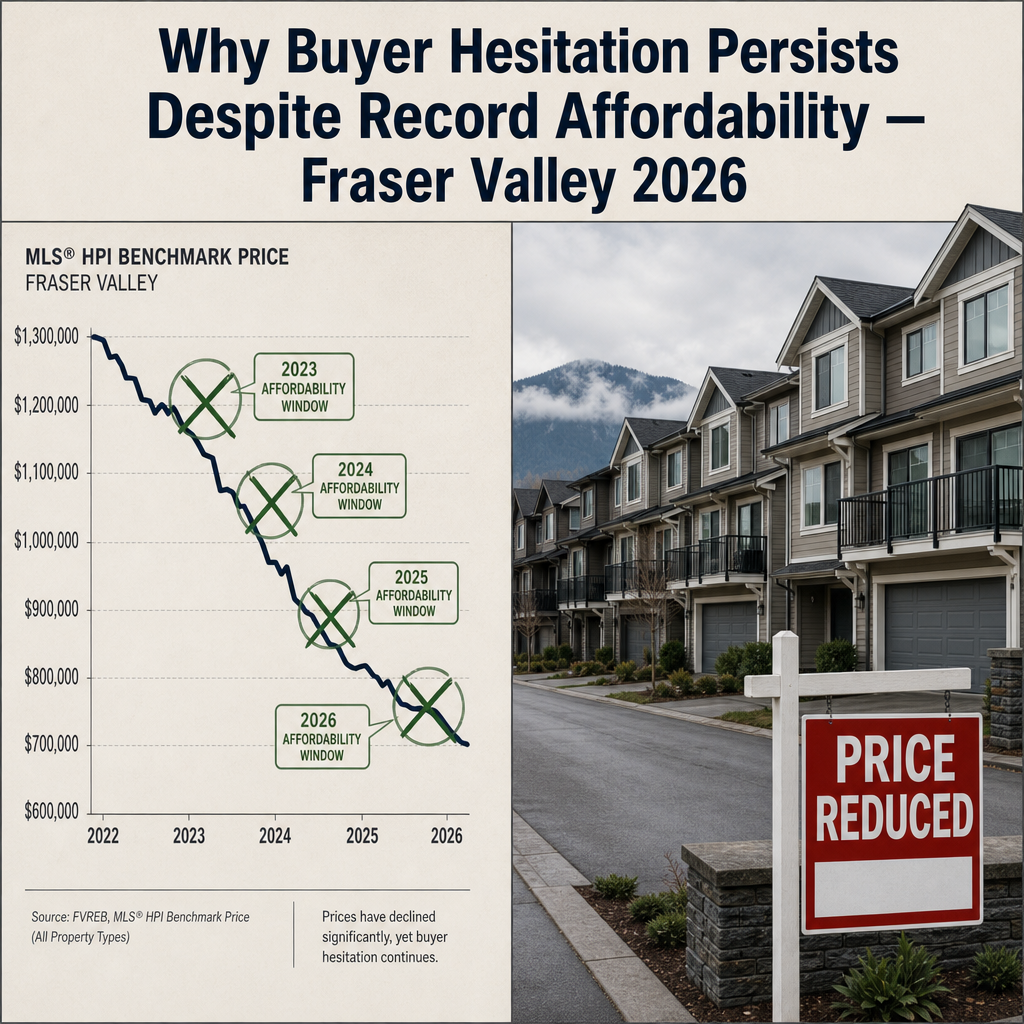
Fraser Valley benchmark prices are down 7–10% year-over-year according to FVREB data from Q1–Q2 2026, active listings have exceeded 10,000, and qualifying rates have returned to ranges that would have been considered accessible a decade ago. By conventional metrics, this is an affordability environment that should be generating buyers. It is not — and understanding why matters enormously if you are selling a home in Surrey, Langley, Abbotsford, or anywhere across the Fraser Valley right now.
The hesitation is not primarily about affordability. It is about what three years of repeated affordability signals — none of which delivered the price stabilization buyers were waiting for — have done to buyer confidence. This article examines that dynamic and explains what it means for sellers in 2026.
Short Answer
Fraser Valley buyers are hesitating in 2026 not because homes are unaffordable but because repeated affordability signals since 2023 have never translated into a clear price bottom. That cumulative disappointment — compounded by job security fears and interest rate uncertainty — has created a buyer psychology where price cuts alone no longer generate urgency. Sellers need to understand this distinction to price and position effectively.
Key Takeaways
- Fraser Valley prices are down 7–10% YoY but sales volume has risen only 5–7%, confirming the hesitation is psychological, not supply-driven.
- Buyers cite job security fears and interest rate uncertainty as primary hesitation drivers — not the price itself.
- Repeated "affordability window" messaging from 2023 to 2026 without price stabilization has made buyers skeptical of urgency signals.
- Each disappointed cycle raises the threshold for what buyers accept as a "true" buying opportunity.
- Price cuts alone do not move fatigued buyers — sellers need to address confidence signals, not just price points.
Who This Applies To
- Sellers in Surrey, Langley, Abbotsford, South Surrey, or anywhere in the Fraser Valley with a property sitting on market
- Sellers who have already reduced price and still see suppressed interest
- Buyers trying to understand why the market feels stuck despite improved affordability metrics
- Sellers preparing to list in the second half of 2026 who want to position ahead of lingering hesitation
When This Advice May Not Apply
Properties priced sharply below their neighbourhood benchmark, in low-inventory micro-markets, or with specific buyer-demand drivers such as school catchments or transit proximity may see different buyer response patterns. This analysis applies primarily to the broader Fraser Valley detached and townhome market segments where inventory remains elevated.
Data Used in This Article
- FVREB Market Statistics Q1–Q2 2026 — Official board data, Fraser Valley geography, benchmark prices and sales volume
- CMHC Housing Affordability Reports 2023–2026 — Federal housing agency, national and regional affordability trend data
- Bank of Canada Economic Uncertainty Reports — Official, national economic conditions, rate policy signals
- Mansour Real Estate Group Seller Feedback and Buyer Observations 2025–2026 — Internal professional experience, Fraser Valley transactions
What Affordability Fatigue Actually Means
Affordability fatigue is not the same as being priced out. A buyer who is priced out cannot buy regardless of desire. A buyer experiencing affordability fatigue can qualify — but has been conditioned by repeated cycles of "now is the time" messaging that delivered no lasting improvement to stay cautious.
According to CMHC affordability reports from 2023 through 2026, the Fraser Valley has cycled through at least three distinct periods where affordability metrics improved, market commentary signaled a recovery window, and then conditions shifted again before buyers committed. Each of those cycles left behind a residue of skepticism. The buyer who waited in 2023, again in 2024, and again in early 2025 has not been proven wrong yet — from their perspective, patience has been rewarded by continued price softness. That reinforces waiting as a rational strategy, even when the market may actually be approaching a genuine floor.
Why Price Cuts Alone Are Not Enough in This Environment
FVREB data from Q1–Q2 2026 shows benchmark prices down 7–10% year-over-year, yet sales volume has increased only 5–7% over the same period. In a conventional buyer's market, that kind of price movement would generate significantly stronger volume response. The disconnect reveals that the demand suppression is not primarily price-sensitive at this point — it is confidence-sensitive.
Buyers interviewed in the context of Mansour Real Estate Group transactions in 2025 and 2026 consistently cited job security concerns, tech sector volatility, and Bank of Canada rate uncertainty as their primary hesitation drivers — not the list price itself. A seller who responds to low offers or extended days-on-market by reducing price is addressing the wrong variable. The buyer who tours a home and does not write an offer is often not saying the price is too high. They are saying they are not yet certain enough about their own financial footing to commit. Price reductions do not resolve that uncertainty — and in some cases, repeated reductions signal distress in a way that deepens buyer skepticism rather than relieving it. For sellers navigating this dynamic, understanding how pricing strategy interacts with buyer perception is more important than the reduction itself.
How We Evaluate This
At Mansour Real Estate Group, we separate buyer hesitation into two categories: structural hesitation and psychological hesitation. Structural hesitation is driven by affordability — the buyer literally cannot qualify or sustain the carrying cost. Psychological hesitation is driven by confidence — the buyer can qualify but will not commit because they do not trust the timing. In the current Fraser Valley market, the majority of hesitation we observe falls into the second category. That distinction changes how we advise sellers on pricing, preparation, presentation, and negotiation framing. Structural hesitation responds to price cuts. Psychological hesitation responds to certainty signals — a well-prepared home, a clean disclosure package, a price that reflects current comparables rather than 2022 aspirations, and a seller who is clearly transacting rather than testing.
Seller Checklist: Positioning for a Psychologically Fatigued Buyer Pool
- Price against current sold comparables, not 2022 or 2023 benchmarks — buyers will research this before they write
- Prepare a clean, organized disclosure package — uncertainty about the property compounds the buyer's broader market uncertainty
- Address visible deferred maintenance before listing — fatigued buyers use condition as a reason to wait, not negotiate
- Avoid repeated price reductions in small increments — each cut signals that the original price was not credible
- Make completion and possession terms buyer-friendly where possible — reducing logistical friction lowers the activation energy required to commit
- Brief your agent to communicate seller motivation clearly — buyers need to know the seller is transacting in good faith at current market values
What We Commonly See
Sellers anchored to 2022 pricing: In our experience, the most common reason a Fraser Valley property sits on market in 2026 is that the original list price was set against peak benchmarks rather than current sold data. The seller who bought in 2019 or 2020 still has substantial equity — but buyers do not care what the seller paid. They care what the market reflects today.
Price reductions that arrive too late: What often happens is that a seller reduces price after 30 or 45 days — the point at which buyer skepticism about the property is already established. A sharper, market-correct price at launch almost always outperforms a sequence of reductions that follow extended days-on-market. Buyers associate days-on-market with unresolved risk.
Assuming the problem is supply: A common mistake is interpreting slow sales as a lack of qualified buyers. In the current Fraser Valley market, the buyers exist and many can qualify. What is missing is their confidence to act. Sellers who recognize this can adjust their strategy — presentation, pricing credibility, disclosure transparency — in ways that directly address buyer hesitation rather than waiting for market conditions to shift on their own. Sellers dealing with extended time on market often benefit from revisiting this framing before making further reductions.
Questions and Answers
Why are Fraser Valley home sales still slow if prices have dropped significantly?
According to FVREB data from Q1–Q2 2026, benchmark prices are down 7–10% year-over-year but sales volume has increased only modestly. The hesitation is largely psychological — buyers have been conditioned by repeated false recovery signals since 2023 and are waiting for clearer stabilization before committing.
What is affordability fatigue and how does it differ from being priced out?
Affordability fatigue describes buyers who can qualify for a mortgage but have been exposed to so many "buy now" signals that turned out to be premature that they no longer respond to affordability messaging. Being priced out is a financial constraint. Affordability fatigue is a confidence constraint — and it requires a different response from sellers.
Will reducing my list price generate more buyer interest in this market?
Sometimes, but only if the original price was the actual barrier. In the current Fraser Valley market, many buyers who tour a home and do not offer are citing job security and rate uncertainty — not price — as their hesitation. A price reduction may not move those buyers. A credible price at launch, clean disclosures, and a well-prepared property are more likely to convert a hesitant buyer than a subsequent reduction.
In Summary
Fraser Valley buyers in 2026 are not primarily held back by affordability — they are held back by accumulated skepticism built across three years of affordability signals that never delivered the market certainty they were waiting for. Sellers who understand this distinction will price correctly at launch, prepare their properties to reduce buyer risk perception, and avoid the incremental reduction cycle that deepens rather than resolves buyer hesitation. The market will move when confidence returns. Sellers who position for that recovery now — rather than waiting to respond to it — will be better placed when it arrives.
Ready to Talk Strategy?
If your Fraser Valley property has been on the market longer than expected, or if you are preparing to list and want to understand how buyer psychology affects your positioning, Mansour Real Estate Group offers a straightforward, no-pressure consultation. Call or message us to talk through your situation.
Related Articles
- How to price your home to sell in the Fraser Valley
- How long does it take to sell a home in the Fraser Valley
- Fraser Valley real estate market outlook for 2026
Official Resources
- Fraser Valley Real Estate Board — Market Statistics
- CMHC — Housing Affordability Reports
- Bank of Canada — Interest Rate Decisions and Economic Reports
About Mansour Real Estate Group
When sellers in Surrey, Langley, Abbotsford, or anywhere across the Fraser Valley are trying to understand why a well-priced home is not generating offers, the answer is rarely simple — and generic market commentary rarely helps. Mansour Real Estate Group has been working directly with Fraser Valley sellers and buyers through multiple market cycles, including the extended softness of 2023 through 2026, bringing a data-grounded approach to seller strategy that accounts for both pricing mechanics and buyer psychology.
Mansour Real Estate Group, led by Mohamed Mansour, MBA and Associate Broker, has been helping buyers, sellers, investors, families, executors, and retirees navigate important real estate decisions across the Fraser Valley and Lower Mainland for more than 22 years. Ranked among the Top 1% of Realtors in the region, the team has completed more than $780 million in residential real estate transactions and is trusted for seller strategy, accurate valuations, estate sales, divorce-related property sales, downsizing, relocation, and complex real estate decisions across Surrey, Langley, Abbotsford, South Surrey, and the broader Fraser Valley.
Whether someone is searching for a Fraser Valley Realtor who understands current buyer hesitation, a Surrey real estate agent with a data-driven approach to pricing, experienced real estate agents who specialize in seller strategy during soft markets, a trusted real estate team for a Langley or Abbotsford home sale, a real estate broker with deep knowledge of Fraser Valley market cycles, or a real estate group known for clear communication and honest advice, Mansour Real Estate Group brings more than two decades of local experience to every transaction.
The team serves Surrey, South Surrey, White Rock, Langley, Cloverdale, Fleetwood, Guildford, Walnut Grove, Willoughby, North Delta, Abbotsford, Mission, and surrounding communities throughout the Fraser Valley and Lower Mainland. Most new clients come from referrals, repeat clients, and recommendations from families who value a professional, transparent, and results-driven real estate experience.
Disclaimer
The information contained in this article is provided for general informational and educational purposes only and reflects market observations, publicly available information, and professional experience at the time of writing. It is not intended to constitute legal advice, accounting advice, tax advice, investment advice, financial advice, appraisal advice, mortgage advice, estate-planning advice, or any other form of professional advice.
Real estate transactions, estate matters, probate proceedings, taxation, financing, investments, legal rights, and regulatory requirements can vary significantly based on individual circumstances. Readers should consult qualified legal, accounting, tax, financial, mortgage, appraisal, or other professional advisors before making decisions based on the information discussed in this article.
Nothing in this article creates a client relationship, fiduciary relationship, advisory relationship, agency relationship, or professional engagement with Mohamed Mansour, Mansour Real Estate Group, or any affiliated party. Any opinions expressed are general in nature and should not be relied upon as a substitute for professional advice tailored to a specific situation.
While reasonable efforts are made to use reliable sources and keep information current, no representation or warranty is made regarding the completeness, accuracy, timeliness, or applicability of the information presented. Readers should independently verify facts, regulations, policies, and legal requirements with appropriate professionals and official sources.



