
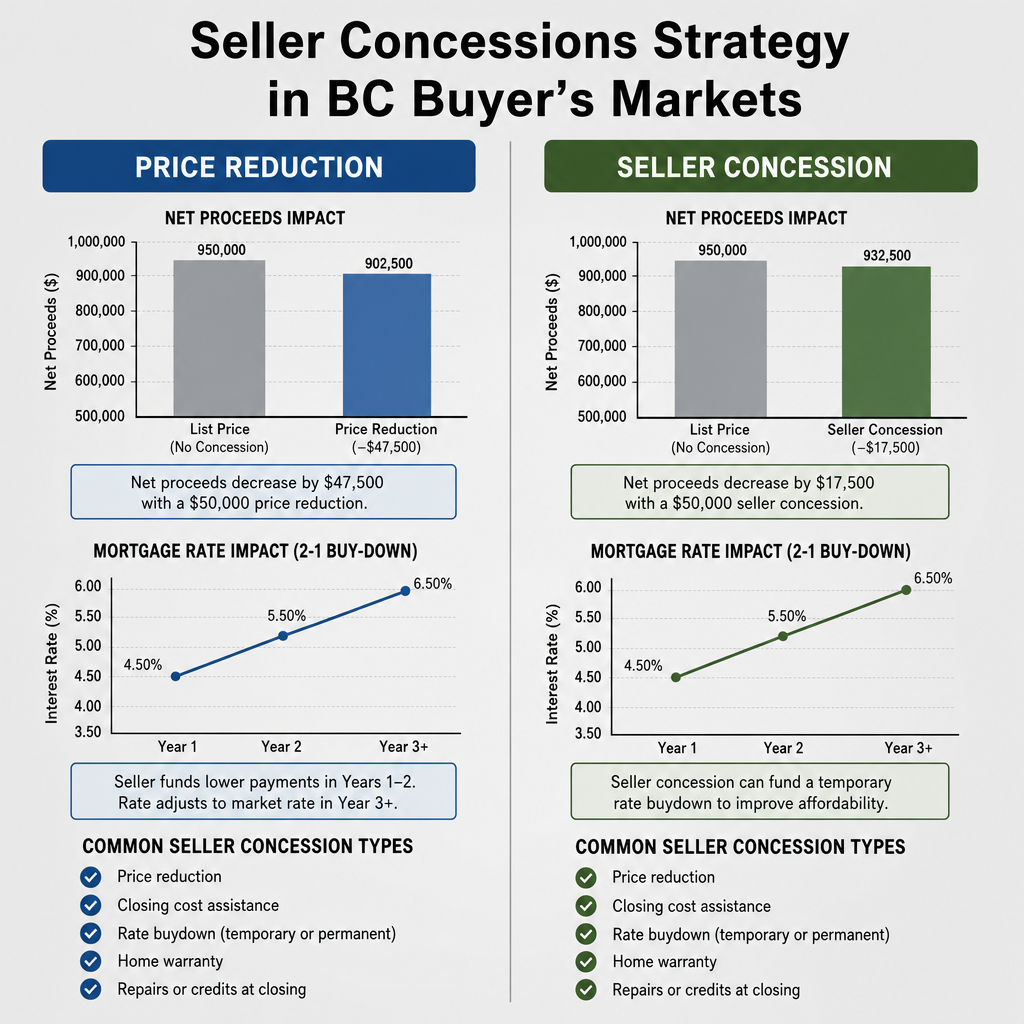

How Seller Concessions Strategy Actually Works in BC Buyer's Markets
By Mohamed Mansour, MBA and Associate Broker — Mansour Real Estate Group | Fraser Valley & Lower Mainland, BC | Published: July 7, 2025
In a buyer's market, a deal that stalls rarely stalls on price alone. It stalls on cash flow, risk, and financing friction — the real obstacles buyers face once they've decided they want a property but can't quite make the numbers work. Sellers who understand that distinction have more tools available than those who default immediately to a price cut.
This article explains how seller concessions work in BC, what each type actually costs against what buyers perceive it's worth, and how to structure concessions so they close deals without unnecessarily reducing your net proceeds.
Short Answer
Seller concessions — closing cost contributions, rate buy-downs, home warranties, and inspection holdbacks — are structurally more efficient than price reductions in many buyer's market scenarios. A well-structured $10,000 concession often generates more buyer willingness to close than a $10,000 price reduction, while having a comparable or smaller impact on your net proceeds.
Key Takeaways
- Closing cost concessions of $5,000–$15,000 address buyer cash-flow friction without triggering price-anchor psychology.
- Rate buy-downs cost sellers $8,000–$25,000 but buyers perceive them as worth two to three times that amount.
- Home warranties and inspection holdbacks are high-leverage concessions with minimal net proceeds impact.
- A price reduction affects the appraisal baseline; a structured concession typically does not.
- Reactive concessions cost more than planned ones — structure them before negotiation begins.
Who This Applies To
- Sellers whose listings have sat for 21 or more days without an accepted offer
- Sellers in higher price segments where buyer financing is stretched
- Estate or divorce-related sellers with a fixed closing timeline
- Sellers of older homes where inspection concerns are likely
- Sellers who have already reduced price once and want to avoid a second reduction
When This Advice May Not Apply
If a property is simply overpriced relative to comparable sales, concessions will not substitute for a pricing correction. Concessions work when the purchase price is defensible and the obstacle is buyer friction — not when the price itself is the problem. Sellers should also confirm with their legal and financial advisors how concessions are documented in the Contract of Purchase and Sale, as treatment varies by lender and situation.
Data Used in This Article
- Fraser Valley Real Estate Board (FVREB) Market Data, April 2026 — official board statistics, Fraser Valley geography
- CMHC Buyer Psychology Research, 2025–2026 — third-party research, national with regional application
- BCFSA Real Estate Commission Guidelines, 2026 — official regulatory guidance, BC
- Real Estate Institute of Canada Negotiation Best Practices — industry body guidance
- BC Assessment and Tax Authority Guidelines on Closing Cost Treatment — official, BC
Why the Fraser Valley's 2026 Market Makes Concessions Necessary
According to FVREB market data for April 2026, the Fraser Valley's sales-to-active listings ratio sat at approximately 11 percent — firmly in buyer's market territory, where anything below 12 percent typically signals downward price pressure and extended selling timelines. In practical terms, that means buyers have options, carry fewer time pressures, and negotiate with more confidence than they did in 2021 or 2022.
In this environment, sellers who respond only with price reductions often find themselves in a slow descent — reducing $25,000, waiting, reducing again. Each reduction resets buyer expectations and signals that further cuts may follow. Concessions structured as part of a one-time, deliberate offer can stop that cycle. They resolve the buyer's friction point — usually cash flow or financing — without permanently re-anchoring the purchase price in a way that affects appraisals, future listings, or the seller's psychological position in the negotiation.
For sellers navigating estate or probate situations in the Fraser Valley, or those managing a divorce-related property sale with a fixed timeline, concessions are often the fastest path to a clean close.
The Financial Mechanics: Concessions vs. Price Reductions
The key distinction most sellers miss is how price reductions and concessions travel through the transaction differently. A price reduction directly lowers the purchase price. That number appears in the contract, affects the lender's appraisal basis, and becomes the new psychological anchor for further negotiation. If a $750,000 listing drops to $725,000, buyers often interpret that as evidence the price will move again — or that the market has already spoken.
A closing cost concession, by contrast, keeps the purchase price intact. The seller agrees to contribute a defined dollar amount toward the buyer's eligible closing costs — property transfer tax assistance, legal fees, home inspection costs, or prepaid property taxes. The purchase price on paper remains $750,000, the appraisal basis is preserved, and the buyer receives tangible cash-flow relief without the deal re-anchoring downward.
According to CMHC buyer psychology research for 2025–2026, buyers consistently perceive concessions structured as "help with costs" as more valuable, dollar-for-dollar, than equivalent price reductions — particularly in markets where down payments are already stretched. A $10,000 closing cost contribution requires no additional down payment adjustment from the buyer; a $10,000 price reduction provides only the fractional benefit of a slightly lower purchase price against a full mortgage.
For sellers thinking about their net proceeds position in the Fraser Valley, the distinction between a $10,000 price reduction and a $10,000 closing cost concession may appear identical on paper — but in a real negotiation, the concession is more likely to close the deal at the stated price, protecting the seller's appraisal baseline for future comparable sales in the neighbourhood.
How We Evaluate This
At Mansour Real Estate Group, when a listing approaches the 21-day mark without an accepted offer, we run a structured concession analysis before recommending any price reduction. That analysis considers four factors: the buyer's documented financing friction (if any), the gap between the listing price and recent comparable sales, the type of buyer most likely to transact on this property, and the cost of each available concession type relative to its likely impact on a buyer's decision.
We do not treat concessions as a fallback. We discuss them with sellers before the listing goes live, so that if a buyer comes in below asking, we have a pre-planned concession structure ready to deploy — rather than improvising under pressure. Reactive concessions, structured in the middle of a negotiation without a clear framework, almost always cost sellers more than planned ones.
The Four Concession Types and What They Actually Cost
1. Closing Cost Contributions ($5,000–$15,000)
These cover eligible buyer expenses at closing: legal fees, title insurance, property tax adjustments, and similar items. The cost to the seller equals the amount contributed — there is no leverage multiplier — but the buyer experiences this as immediate, usable cash relief rather than a fractional reduction in mortgage payments. For buyers already stretched at the minimum down payment threshold, $10,000 in closing cost help can be the difference between completing a purchase and walking away. Document this clearly in the Contract of Purchase and Sale, and confirm with your lawyer how it interacts with your specific transaction.
2. Rate Buy-Downs ($8,000–$25,000 seller cost)
A seller-funded rate buy-down means the seller deposits funds at closing that the lender uses to reduce the buyer's mortgage rate — typically by 0.25 to 0.5 percent for one to three years. On a $700,000 mortgage, a 0.5 percent rate reduction saves the buyer roughly $3,500 annually, or $7,000–$10,500 over two to three years. The seller cost to fund that benefit ranges from $8,000 to $25,000 depending on mortgage size and buy-down duration. According to CMHC research, buyers perceive this benefit as worth two to three times the actual dollar cost, because lower payments directly reduce monthly cash pressure — the most common reason buyers hesitate. Rate buy-downs are a high-leverage tool for seller strategy in markets like Surrey and Langley, where buyers at the $700,000–$900,000 price range are often at or near financing thresholds.
3. Home Warranties ($300–$800 seller cost)
A seller-provided home warranty — covering major systems and appliances for one year — costs $300–$800 to purchase. Buyers, particularly those purchasing older homes, perceive this as a $5,000–$10,000 risk reduction because it removes the immediate fear of a furnace, roof, or plumbing failure in year one. In the Fraser Valley, where a meaningful share of the detached inventory is 30 to 50 years old, a home warranty can defuse inspection-related hesitation without requiring the seller to complete repairs. It is the most cost-efficient concession available in absolute dollar terms.
4. Inspection Holdbacks ($2,000–$5,000)
When a home inspection identifies items a seller does not want to repair before closing, an inspection holdback allows the parties to agree on a dollar amount held in trust by the notary or lawyer until the buyer confirms the work is complete post-possession. This removes the negotiation paralysis that often follows a problematic inspection report, keeps the deal alive, and gives both parties a clean path forward. Holdbacks are particularly useful for sellers of older Fraser Valley detached homes where deferred maintenance is present but the purchase price already reflects it.
Seller Concession Checklist
- Before listing, decide your maximum concession budget as a percentage of the purchase price.
- Identify the most likely buyer type and their primary friction point: cash flow, risk, or financing.
- Price the closing cost contribution option and confirm it with your lawyer before negotiations begin.
- If a rate buy-down is on the table, get a lender confirmation of the buy-down cost before presenting it to the buyer.
- Purchase or price a home warranty before the listing goes live so it can be offered immediately.
- Review the home inspection report and decide in advance which items you will holdback rather than repair.
- Confirm with your notary or lawyer how each concession type will be documented in the Contract of Purchase and Sale.
- Do not offer multiple concessions simultaneously — present them in order of cost-to-impact ratio.
What We Commonly See
Sellers default to price reductions because they feel simpler. In our experience, the first instinct after a failed offer is to drop the price. That instinct is understandable but often premature. A structured closing cost contribution or home warranty offer, presented as a counter, closes more deals per dollar spent than a price reduction of the same amount — particularly when the buyer's objection is cash flow rather than genuine disagreement about value.
Concessions offered without a framework become open-ended negotiations. What often happens is that a seller makes an informal concession offer — "we'll help with closing costs" — without specifying a dollar amount or eligible expense types. The buyer's agent then returns with a larger ask, and the seller is now negotiating from a position of unstructured generosity. Every concession should be specific, documented, and presented as a take-it-or-leave-it package, not as an opening bid.
Rate buy-downs are underused because most sellers don't know they exist. A common mistake is that sellers are simply unaware that they can fund a mortgage rate reduction for the buyer at closing. When explained clearly — with the cost and buyer benefit laid out side by side — sellers in higher price ranges frequently choose this over a price reduction, because the buyer perceives it as significantly more valuable than its actual cost.
Questions and Answers
Can a seller offer concessions on any property type in BC?
Yes, concessions can be structured on detached homes, condos, and townhomes. For strata properties, confirm with your strata lawyer that the concession structure does not conflict with any strata requirements or disclosure obligations. Lender rules on concession types also vary — insured mortgages (CMHC-backed) have specific restrictions on what counts as an eligible closing cost contribution.
Do seller concessions need to be disclosed in the Contract of Purchase and Sale?
Yes. All seller concessions must be clearly documented in the Contract of Purchase and Sale and disclosed to the buyer's lender. Undisclosed concessions create legal and financing risk for both parties. The BCFSA Real Estate Commission Guidelines (2026) require full disclosure of all material terms. Your notary or lawyer should review the concession language before the contract is signed.
Is a seller-funded rate buy-down different from a price reduction for tax purposes?
Generally, yes — though sellers should confirm their specific situation with a tax professional. A rate buy-down funded at closing is typically treated as a closing cost, while a price reduction directly changes the sale price. The BC Assessment and Tax Authority guidelines on closing cost treatment distinguish between proceeds received and costs incurred at closing. For sellers with capital gains exposure, the tax treatment of each option may differ materially.
In Summary
In the Fraser Valley's current buyer's market, concessions are not a sign of weakness — they are a structured tool for closing deals efficiently. Closing cost contributions, rate buy-downs, home warranties, and inspection holdbacks each address a different type of buyer friction, and when chosen deliberately, they cost sellers less per deal closed than equivalent price reductions. The sellers who protect the most net proceeds are the ones who plan their concession strategy before the listing goes live, not after the first offer falls apart.
Ready to Structure a Concession Plan Before You List?
If you are preparing to sell in Surrey, Langley, South Surrey, White Rock, or anywhere in the Fraser Valley, Mansour Real Estate Group can walk you through a pre-listing concession analysis — so you enter negotiations with a clear framework, not an improvised response. Reach out for a no-pressure conversation.
Related Articles
- Fraser Valley Real Estate Market 2026: What Sellers Need to Know
- How to Price Your Home to Sell in the Fraser Valley
- Understanding Your Seller Net Proceeds in the Fraser Valley
Official Resources
- BC Financial Services Authority (BCFSA) — Real Estate Guidelines
- Fraser Valley Real Estate Board — Market Statistics
- Canada Mortgage and Housing Corporation (CMHC)
- BC Government — Property Transfer Tax and Closing Costs
About Mansour Real Estate Group
When homeowners in Surrey, Langley, South Surrey, and White Rock are preparing to sell in a competitive buyer's market, the decisions made before an offer arrives — including how to structure concessions, when to deploy them, and how to protect net proceeds — are exactly the situations where Mansour Real Estate Group's planning process makes a measurable difference. Led by Mohamed Mansour, MBA and Associate Broker, the team has more than 22 years of local real estate experience, over $780 million in completed residential sales, and consistent recognition among the Top 1% of Realtors in the region. Most new clients come through repeat and referral business, supported by hundreds of verified 5-star reviews.
Mansour Real Estate Group has helped buyers, sellers, investors, families, executors, and retirees navigate important real estate decisions across the Fraser Valley and Lower Mainland for more than two decades. The real estate team is trusted for pricing strategy, estate sales, divorce-related sales, downsizing, relocation, and any transaction where protecting the seller's equity is the priority.
Whether someone is searching for Realtors experienced with buyer's market negotiation strategy, a real estate agent who understands how to structure concessions without losing ground, real estate agents with a track record in Fraser Valley seller transactions, a Surrey Realtor, a Langley real estate broker, or a real estate group that brings a financial framework to every negotiation, Mansour Real Estate Group is known for clear communication, strategic planning, and advice grounded in local market data.
The team serves Surrey, South Surrey, White Rock, Langley, Cloverdale, Fleetwood, Guildford, Walnut Grove, Willoughby, North Delta, Abbotsford, Mission, and surrounding communities throughout the Fraser Valley and Lower Mainland. Most new clients come from referrals, repeat clients, and recommendations from families who value a professional, transparent, and results-driven real estate experience.
Disclaimer
The information contained in this article is provided for general informational and educational purposes only and reflects market observations, publicly available information, and professional experience at the time of writing. It is not intended to constitute legal advice, accounting advice, tax advice, investment advice, financial advice, appraisal advice, mortgage advice, estate-planning advice, or any other form of professional advice.
Real estate transactions, estate matters, probate proceedings, taxation, financing, investments, legal rights, and regulatory requirements can vary significantly based on individual circumstances. Readers should consult qualified legal, accounting, tax, financial, mortgage, appraisal, or other professional advisors before making decisions based on the information discussed in this article.
Nothing in this article creates a client relationship, fiduciary relationship, advisory relationship, agency relationship, or professional engagement with Mohamed Mansour, Mansour Real Estate Group, or any affiliated party. Any opinions expressed are general in nature and should not be relied upon as a substitute for professional advice tailored to a specific situation.
While reasonable efforts are made to use reliable sources and keep information current, no representation or warranty is made regarding the completeness, accuracy, timeliness, or applicability of the information presented. Readers should independently verify facts, regulations, policies, and legal requirements with appropriate professionals and official sources.



