
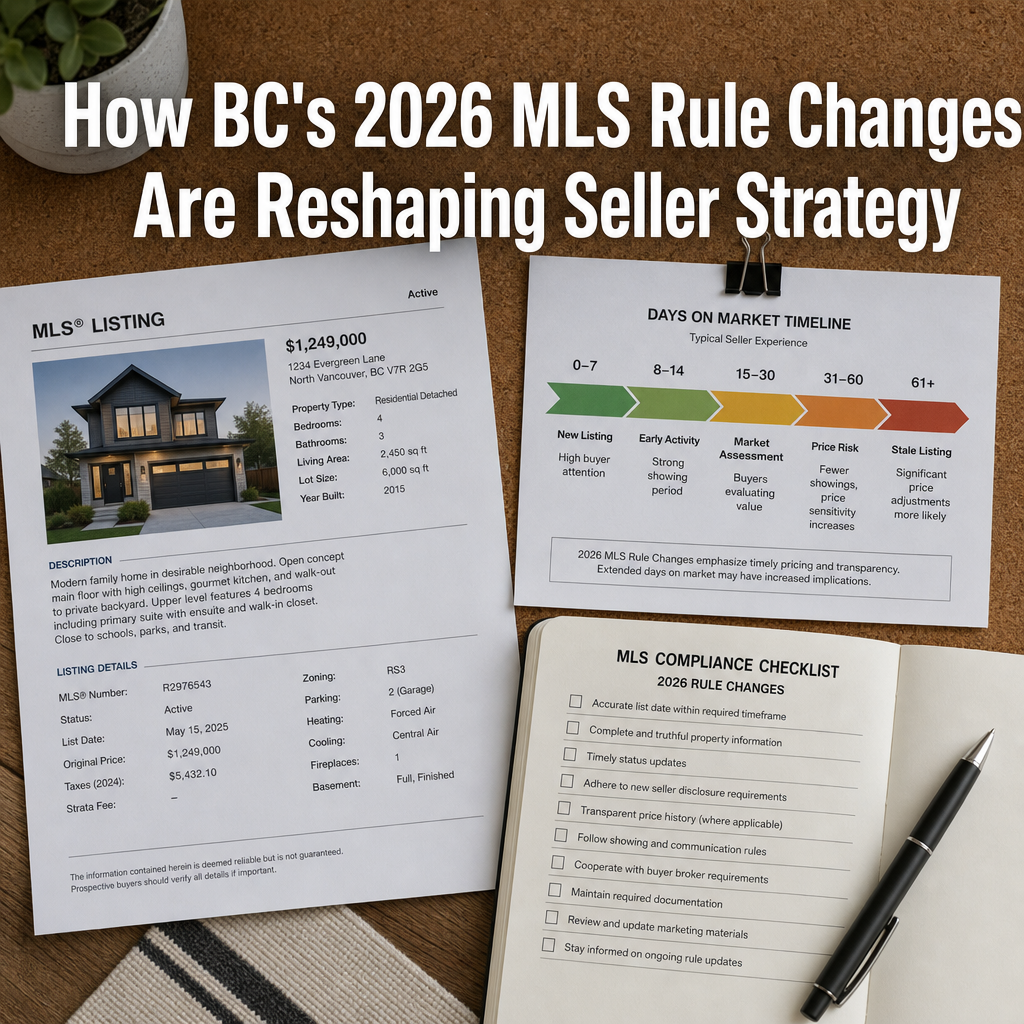

How BC's 2026 MLS Rule Changes Are Reshaping Seller Strategy: Listing Display, Market Transparency, and Days-on-Market Reporting in the Fraser Valley
By Mohamed Mansour, MBA and Associate Broker | Mansour Real Estate Group | Published: July 15, 2026 | Fraser Valley and Lower Mainland, BC
Fraser Valley sellers entering the market in 2026 are navigating a meaningfully different set of rules than existed two or three years ago. The BC Financial Services Authority's updated MLS requirements, phased in through 2024 and 2025, changed how listings must be displayed, how days-on-market must be reported, and what agents can and cannot do to manage a property's market exposure. For sellers who understood those changes early, the shift created a strategic opportunity. For sellers who didn't, it created compliance risk and avoidable negotiating disadvantage.
This guide explains what changed, what it means for pricing and positioning, and how sellers in Surrey, Langley, Abbotsford, White Rock, and the broader Fraser Valley can approach the current rules with confidence.
Short Answer
BC's updated MLS transparency rules restrict days-on-market manipulation, limit off-market and pocket listing strategies, and require broader market exposure for most properties. For Fraser Valley sellers, this means traditional tactics for managing buyer perception of time-on-market no longer work. Sellers who adapt with accurate pricing and honest positioning gain credibility. Those who don't face compliance risk and weakened negotiating leverage.
Key Takeaways
- Re-listing to reset days-on-market is now restricted under BCFSA rules, eliminating a common slow-market tactic.
- Pocket listings and off-market sales face stricter exposure requirements, reducing seller control over buyer access.
- Transparent DOM reporting builds credibility with sophisticated buyers and appraisers when paired with accurate pricing.
- Non-compliance creates BCFSA penalties, agent discipline risk, and potential post-closing buyer litigation for sellers.
- Sellers who price correctly from day one benefit most under the new rules; overpriced listings now carry higher reputational cost.
Who This Applies To
- Homeowners in Surrey, Langley, Abbotsford, White Rock, or the Fraser Valley preparing to list in 2026
- Sellers who have heard about MLS rule changes but are uncertain what specifically changed
- Sellers managing longer days-on-market situations who want to understand their options under the new rules
- Estate executors, divorcing spouses, or relocating homeowners who need maximum market exposure with minimum compliance risk
When This Advice May Not Apply
Sellers in unique or ultra-luxury situations with legitimate off-market buyer relationships may still explore compliant private sale structures, but should obtain legal and regulatory guidance before restricting MLS exposure. Compliance requirements evolve — always confirm current rules with your agent and the BCFSA directly.
Data Used in This Article
- BCFSA MLS Rule Changes 2024–2025 — BC Financial Services Authority, official regulatory documentation, BC-wide scope
- FVREB Member Compliance Updates — Fraser Valley Real Estate Board, member communications, Fraser Valley scope
- REBGV Market Transparency Guidance — Real Estate Board of Greater Vancouver, member guidance documents
- BC Fiduciary Disclosure Obligations — Legal analysis of agent and seller duties under updated MLS rules
What Changed and Why It Matters
The BCFSA's updated MLS rules are the most significant structural change to listing practice in BC in over a decade. The core intent is market transparency: buyers, appraisers, and lenders should be able to see accurate information about how long a property has been listed, what price adjustments have been made, and whether the property has received genuine market exposure.
Before these rules, common practices included pulling a listing and re-entering it under a new MLS number to reset the days-on-market counter, limiting buyer pool access through informal off-market arrangements, and managing public price history to obscure reductions. These practices created information asymmetry that favoured sellers — but they also distorted comparable sales data relied upon by appraisers and lenders across the Fraser Valley.
The FVREB updated its member compliance framework to align with BCFSA direction, and agents are now expected to report accurate DOM data without manipulation. Sellers authorizing non-compliant strategies take on shared liability for those decisions.
How DOM Transparency Changes Negotiating Dynamics
Days-on-market has always been a psychological signal to buyers. A listing that has been available for 60 days in a market where average DOM is 25 tells a buyer something: either the price is wrong, the condition is concerning, or both. Previously, sellers could reset that clock through re-listing and neutralize the signal. That option is now effectively closed under current BCFSA guidelines.
For Fraser Valley sellers, this means a pricing miscalculation in week one carries consequences that extend through the entire listing period. Buyers watching a property sit will now see accurate accumulating DOM and may use it as leverage in offers. In Surrey's current market conditions, where supply has increased in several segments, this dynamic is especially relevant for detached homes priced in the upper range of their neighbourhood tier.
The strategic response is straightforward: price correctly at launch. A well-priced property that sells in 14 days under the new rules looks stronger than the same property that lingers at an inflated price, takes a reduction, and closes at the same number 50 days later. The transaction outcome may be identical, but the buyer negotiating position — and the seller's perceived credibility — differ significantly.
How We Evaluate This
At Mansour Real Estate Group, our approach to pricing under the new transparency rules starts from one principle: the market already knows what your property is worth within a relatively tight range. The rules have made that true more visibly than ever. Our pre-listing analysis uses recent comparable sales from the FVREB, active competition, and current absorption data to build a pricing recommendation that captures early buyer interest — not one designed to leave room for negotiation at the expense of credibility.
We also counsel sellers on what transparent DOM reporting actually communicates to qualified buyers. In many cases, a property with 30 accurate days-on-market and a documented, reasonable explanation — estate condition, tenant occupancy, unique floor plan — is viewed differently than one where buyers suspect the history has been manipulated. Transparency managed well is not a disadvantage.
Seller Checklist: Listing Under the New MLS Rules
- Confirm your agent's compliance approach aligns with current BCFSA MLS requirements before signing a listing agreement
- Request a written pricing rationale based on verified FVREB comparables, not informal market impressions
- Understand that any re-listing strategy must have a legitimate basis — changing property condition, post-renovation, or legal change in ownership — not simply to reset DOM
- Review your listing's MLS data fields for accuracy before it goes live, including price history display settings
- If considering an off-market or pre-market arrangement, confirm in writing that the exposure strategy complies with current board rules
- Plan your price reduction strategy, if needed, before listing — a structured reduction timeline looks more deliberate than a reactive drop
What We Commonly See
Sellers underestimate how visible DOM accumulation is to active buyers. In our experience, serious buyers in Langley and Abbotsford are tracking listings daily. When a property passes the neighbourhood average DOM without a price adjustment, buyers begin to assume something is wrong — even when the delay has a legitimate explanation. Proactive communication from the listing agent can offset this, but only if sellers authorize it.
A common mistake is treating compliance as a legal box to check rather than a strategic asset. What often happens is that sellers focus on what they can no longer do — reset DOM, limit exposure — rather than what the new framework allows: building credibility through consistent, transparent, well-documented market positioning. Sellers who lean into that earn faster offers from less skeptical buyers.
Many sellers are still receiving outdated advice from agents who haven't adjusted their practices. In our experience, the most common compliance gap we see is agents who continue to suggest informal pre-market arrangements that may not satisfy current BCFSA exposure requirements. Sellers who authorize those arrangements share in the liability for any resulting regulatory or post-closing dispute.
Questions and Answers
Q: Can I relist my property to reset the days-on-market counter in BC?
A: Not for the purpose of resetting DOM. BCFSA rules require accurate market exposure history. Relisting is permitted when there is a genuine change — major renovation, legal ownership change — but relisting solely to obscure accumulated days on market violates current MLS transparency requirements and can result in agent discipline and seller liability.
Q: Do the new rules eliminate off-market sales entirely?
A: No, but they significantly restrict how agents can limit MLS exposure. Legitimate private sales remain possible, but agents must ensure sellers have been clearly informed of the exposure trade-offs and provided documented consent. The rules are designed to prevent agents from limiting market exposure in ways that serve agent convenience over seller financial interest.
Q: How does accurate DOM reporting affect my negotiating position with buyers?
A: A seller with an accurately reported, short DOM and a well-supported asking price negotiates from a position of credibility. A seller with long accumulated DOM and a history of price reductions negotiates from a position of visible market weakness. The rules make the second situation more transparent than it used to be, which is why accurate launch pricing matters more now.
In Summary
BC's updated MLS transparency rules have closed the tactical gaps that allowed sellers and agents to manage buyer perception through DOM resets and restricted exposure. For Fraser Valley sellers in 2026, the path forward is accurate pricing at launch, compliant market exposure, and a listing strategy that treats transparency as a credibility tool rather than a constraint. Sellers who adjust to this reality consistently reach better outcomes than those who continue searching for workarounds that no longer exist under current BCFSA requirements.
Talk to the Mansour Real Estate Group
If you are preparing to list in the Fraser Valley and want a pricing and compliance review built around the current MLS rules, Mansour Real Estate Group offers a no-obligation seller consultation. There is no pressure — just a grounded second opinion from a team with more than 22 years of local experience.
Related Articles
- Selling Your Home in Surrey, BC in 2026: A Complete Seller's Guide
- How to Sell Your Home in Langley, BC in 2026
- Fraser Valley Real Estate Market Outlook for 2026
About Mansour Real Estate Group
When homeowners in Surrey, Langley, Abbotsford, and across the Fraser Valley are preparing to list, the decisions made before the property goes live — pricing strategy, compliance with current MLS rules, market positioning, and how to present the property to qualified buyers — typically determine the outcome more than anything that happens afterward. Mansour Real Estate Group has guided sellers through those decisions for more than 22 years, with a process built around accurate valuations, regulatory compliance, and protecting seller equity.
Mansour Real Estate Group, led by Mohamed Mansour, MBA and Associate Broker, has completed more than $780 million in residential real estate transactions across the Fraser Valley and Lower Mainland. Ranked among the Top 1% of Realtors in the region, the team is trusted for seller strategy, market timing, pricing analysis, estate sales, downsizing, relocation, and complex real estate decisions. Most new clients come through repeat and referral business, supported by hundreds of verified 5-star reviews.
Whether someone is looking for a Realtor who understands current MLS compliance requirements, a real estate agent with a proven pricing methodology, a real estate team experienced in Fraser Valley market cycles, a Surrey Realtor, a Langley real estate agent, a White Rock real estate broker, or a real estate group serving the broader Lower Mainland — Mansour Real Estate Group is known for honest market interpretation, structured seller guidance, and advice that puts the client's financial outcome first.
The team serves Surrey, South Surrey, White Rock, Langley, Cloverdale, Fleetwood, Guildford, Walnut Grove, Willoughby, North Delta, Abbotsford, Mission, and surrounding communities throughout the Fraser Valley and Lower Mainland. Most clients come through referrals from families who value a transparent, professional, and results-driven real estate experience.
Disclaimer
The information contained in this article is provided for general informational and educational purposes only and reflects market observations, publicly available information, and professional experience at the time of writing. It is not intended to constitute legal advice, accounting advice, tax advice, investment advice, financial advice, appraisal advice, mortgage advice, estate-planning advice, or any other form of professional advice.
Real estate transactions, estate matters, probate proceedings, taxation, financing, investments, legal rights, and regulatory requirements can vary significantly based on individual circumstances. Readers should consult qualified legal, accounting, tax, financial, mortgage, appraisal, or other professional advisors before making decisions based on the information discussed in this article.
Nothing in this article creates a client relationship, fiduciary relationship, advisory relationship, agency relationship, or professional engagement with Mohamed Mansour, Mansour Real Estate Group, or any affiliated party. Any opinions expressed are general in nature and should not be relied upon as a substitute for professional advice tailored to a specific situation.
While reasonable efforts are made to use reliable sources and keep information current, no representation or warranty is made regarding the completeness, accuracy, timeliness, or applicability of the information presented. Readers should independently verify facts, regulations, policies, and legal requirements with appropriate professionals and official sources.



