
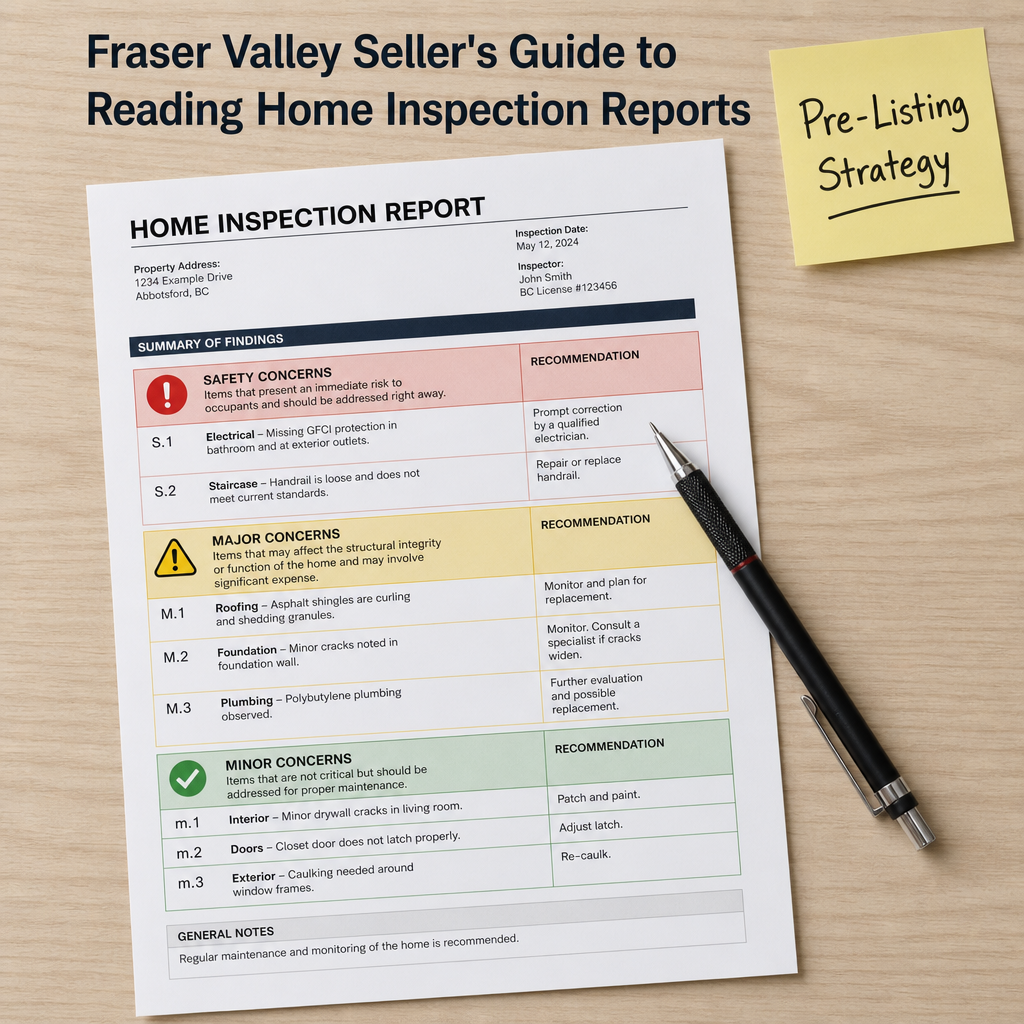

Fraser Valley Seller's Complete Guide to Reading Home Inspection Reports: Identifying Deal-Killing Defects vs. Cosmetic Issues, Strategic Disclosure, Price Impact, and Renegotiation Defense
By Mohamed Mansour, MBA and Associate Broker | Mansour Real Estate Group | Published: July 14, 2025 | Fraser Valley and Lower Mainland, BC
Home inspection reports have become one of the most consequential documents in a Fraser Valley real estate transaction. In a buyer-favored market, where subject-removal windows stretch to 14 days and buyers arrive with inspectors, lawyers, and price-reduction strategies already prepared, sellers who cannot read and interpret an inspection report are negotiating blind.
This guide explains how inspection findings are classified in BC, which defects carry real financial and legal weight, how strategic disclosure before listing reduces renegotiation exposure, and how to defend your pricing position when a buyer presents an inspection report as leverage.
Short Answer
Not every item in a home inspection report is a deal-breaker. BC inspectors use four severity classifications — Safety, Major, Minor, and Informational — that carry different legal, financial, and negotiation weight. Sellers who understand the difference, disclose proactively, and price accordingly can reduce inspection-triggered price renegotiation from an average of 8–12% down to 2–4%.
Key Takeaways
- BC inspection reports use four severity levels — Safety, Major, Minor, and Informational — and buyers routinely conflate Minor items with deal-breakers.
- Major structural defects in roofing, foundation, electrical panels, and plumbing can trigger CMHC financing denial if left unaddressed before listing.
- A pre-listing inspection eliminates the surprise leverage buyers gain during the subject-removal window.
- Strategic disclosure before listing is not a liability — it is a pricing and negotiation tool that shifts control back to the seller.
- Sellers who understand inspection terminology can separate legitimate repair requests from inflated cost estimates used as negotiation tactics.
Who This Applies To
- Sellers preparing to list a detached home, townhouse, or older condo in the Fraser Valley
- Sellers who have already received an offer with an inspection subject and are approaching the subject-removal window
- Estate executors and trustees managing a property sale where deferred maintenance is likely
- Sellers who have already received a pre-listing inspection report and are unsure how to use it
- Sellers in Surrey, Langley, Abbotsford, White Rock, North Delta, Cloverdale, Fleetwood, or Willoughby where Days-on-Market have extended and inspection contingencies are common
When This Advice May Not Apply
If your property is in a high-demand, low-inventory micro-market where multiple offers are arriving without conditions, the inspection dynamics described here are less likely to apply. This guide addresses the majority Fraser Valley context in 2024–2026, where buyer conditions and extended subject-removal timelines are standard. Always confirm current market conditions in your specific neighbourhood with a local real estate professional.
Data Used in This Article
- BC Home Inspector Association (BCHIA) — Standards of Practice and Inspection Report Severity Classification Terminology (official/regulatory)
- CMHC — Mortgage Insurance Guidelines for Property Appraisals and Inspection-Triggered Financing Conditions (official/federal)
- Fraser Valley Real Estate Board (FVREB) — Transaction data on subject-removal patterns and price renegotiation, 2024–2026 (official/regional)
- BC Real Estate Services Act — Mandatory defect disclosure requirements and associated liability case law (official/provincial)
How BC Inspectors Classify Findings
The BC Home Inspector Association's Standards of Practice define four severity classifications that every seller should understand before receiving or responding to an inspection report.
Safety items are immediate hazards — exposed wiring, gas leaks, carbon monoxide risks, structural instability. These carry the highest legal and financing weight. A buyer's lender may refuse to fund the mortgage until a Safety item is rectified. In a CMHC-insured transaction, this can stop a closing entirely.
Major items are significant defects that affect the primary systems of the home: foundation cracking, roof condition, main electrical panel age or type (Federal Pacific or aluminum branch wiring in older Fraser Valley homes is a known trigger), and primary plumbing systems. Major items are not automatically deal-breakers, but they affect value and often affect financing approval.
Minor items are maintenance-level findings — cracked caulking, slow drainage, worn weatherstripping, surface staining. These are often bundled by buyers into cost estimates that inflate the perceived repair burden well beyond actual contractor pricing. Sellers who know this can respond with their own contractor quotes rather than accepting inflated buyer estimates as fact.
Informational items are observations, not defects. Age of systems, typical wear consistent with the home's vintage, and items that are functioning but approaching end-of-life. These are commonly used by buyers to create urgency around replacements that are not yet required.
Which Defects Actually Kill Deals in the Fraser Valley
From a financing perspective, CMHC guidelines identify a defined set of structural conditions that can trigger appraisal conditions or insurance denial. These include active foundation movement, roof systems with less than two years of serviceable life, electrical panels on the known problem list (Federal Pacific Stab-Lok panels appear in Fraser Valley homes built before the 1990s), and evidence of active water intrusion in basements or crawl spaces.
In our experience working with sellers in Surrey, Langley, Abbotsford, and Cloverdale, the items that most reliably produce buyer walkouts or deal collapse are not cosmetic concerns — they are financing-triggered. When a CMHC-insured buyer's lender requires a remediation condition before advancing funds, the seller faces a binary choice: fix it before closing or watch the deal collapse at subject removal.
Cosmetic findings — surface cracks in drywall, outdated fixtures, worn flooring — almost never kill deals. They are used as negotiation tools. Understanding the difference between a financing-blocking defect and a negotiation-tool defect gives sellers the clarity to respond proportionally rather than reactively.
How We Evaluate This
At Mansour Real Estate Group, our approach to inspection strategy starts before the listing goes live. When we walk a property with a seller, we are already categorizing observable conditions by the same severity framework a professional inspector uses. We identify which items are likely to appear in a buyer's inspection report, which of those items carry financing risk versus negotiation risk, and which are best addressed proactively versus priced-in.
This evaluation shapes our pre-listing repair recommendations, our disclosure strategy, and our list price. A seller who has already conducted a pre-listing inspection, addressed the Safety and Major items, and disclosed the remaining findings clearly arrives at subject removal with far less exposure than a seller who has avoided the process entirely and is now responding to a buyer's inspector findings under a 14-day clock.
Strategic Disclosure: Why Transparency Before Listing Reduces Risk
Under BC's Real Estate Services Act and associated case law, sellers have a legal obligation to disclose known material latent defects — conditions that are not visible on a reasonable inspection and that would significantly affect the property's value or the buyer's decision to purchase. Failing to disclose a known material latent defect carries real legal exposure.
Beyond the legal requirement, proactive disclosure is a strategic positioning tool. When a seller commissions a pre-listing inspection and includes the findings in the listing package, the buyer's inspector is no longer discovering anything — they are confirming what the seller already disclosed. This fundamentally changes the negotiation dynamic during subject removal.
According to FVREB transaction pattern data for 2024–2026, sellers who conducted pre-listing inspections and disclosed findings with their listing saw inspection-triggered price renegotiation average 2–4%, compared to 8–12% for sellers who had no pre-listing inspection and were responding to a buyer's inspector findings for the first time. The difference is not luck. It is the removal of surprise leverage from the buyer's position.
Defending Your Price During Subject Removal
The subject-removal window is when buyers most commonly present inspection findings as grounds for a price reduction. The strength of the seller's response depends entirely on what was already known, disclosed, and priced before the offer was accepted.
When a buyer presents a list of inspection findings with attached contractor estimates, sellers should evaluate each item against three questions: Is this a Safety or Major finding, or a Minor or Informational one? Was this finding already disclosed in the listing? Is the contractor estimate proportional to real repair costs, or inflated?
In our experience, buyers in the Fraser Valley frequently bundle Minor and Informational items into a single repair estimate and present it as a lump sum reduction request. Sellers who have obtained their own contractor quotes for the same items — from licensed tradespeople working in Surrey, Langley, Abbotsford, or their specific market — can counter with documented evidence rather than emotion or assumption.
Seller Checklist
- Commission a pre-listing inspection from a BCHIA-certified inspector before setting your list price.
- Review the report and categorize every finding by severity: Safety, Major, Minor, or Informational.
- Address all Safety items before listing — these can trigger financing denial and deal collapse at any stage.
- Get contractor quotes for Major items and decide whether to repair, credit, or price-in — document your decision either way.
- Prepare a written disclosure statement that references the pre-listing inspection and summarizes known findings — review this with your real estate agent and your lawyer before including it in the listing package.
- Confirm with your agent which items are material latent defects under BC law and require mandatory disclosure regardless of your inspection strategy.
- Obtain independent contractor estimates for Minor items before entering subject removal, so you have documented evidence ready to counter inflated buyer estimates.
- During subject removal, respond to each buyer finding in writing, categorized by severity, with your own evidence where available.
What We Commonly See
In our experience working with Fraser Valley sellers, the most common mistake is treating the pre-listing inspection as an optional step. Sellers who skip it arrive at subject removal with no knowledge baseline, no prepared documentation, and no contractor quotes — which means they are negotiating entirely on the buyer's terms, with the buyer's inspector's report as the only reference point.
A second common pattern is sellers who receive a pre-listing inspection report, are alarmed by the length of it, and either over-repair items that did not need repair or withhold the report from the listing out of fear. Both responses weaken the seller's position. Length does not equal severity. An eight-page inspection report filled with Informational and Minor items is not an eight-page list of price reductions.
What often happens in Langley, Cloverdale, and older Surrey neighbourhoods is that electrical panel age and crawl space moisture readings appear in nearly every inspection report for homes built before 1990. Buyers who are unfamiliar with local housing stock treat these as unusual findings. Sellers and agents who know the local context can explain the standard nature of these findings with documented comparables and reduce their negotiation weight significantly.
Questions and Answers
Does a home inspector's report create a legal obligation for the seller to make repairs?
No. A home inspection report creates no legal repair obligation for the seller. BC sellers are legally required to disclose known material latent defects. They are not required to repair defects identified in a buyer's inspection report. Whether to repair, credit, or hold firm is a negotiation decision, not a legal one.
Can a buyer walk away from a deal based solely on an inspection report?
Yes, if the contract includes an inspection subject clause. During the subject-removal period, a buyer with an inspection condition can remove their subject and walk away. Once subjects are removed, the buyer is bound by the contract. This is why the pre-listing inspection and pricing strategy matters most before the offer is accepted.
What types of defects most commonly cause CMHC financing problems in the Fraser Valley?
According to CMHC mortgage insurance guidelines, active foundation movement, roof systems with under two years of remaining life, Federal Pacific or known-problem electrical panels, and evidence of active water intrusion are the most common inspection-triggered financing conditions in the Fraser Valley's older housing stock.
If I conduct a pre-listing inspection, am I required to share it with buyers?
BC's real estate disclosure obligations focus on known material latent defects, not inspection reports themselves. However, if your pre-listing report identifies a material latent defect, that finding must be disclosed to buyers regardless of whether you share the full report. Consult your lawyer and real estate agent before deciding on your disclosure approach.
How do sellers in Abbotsford and Langley typically handle inspection-triggered renegotiation?
In our experience in those markets, sellers who prepared with a pre-listing inspection and disclosed findings upfront face significantly less renegotiation pressure than those who did not. When a buyer's inspector confirms what the seller already disclosed, buyers have less surprise leverage and the conversation shifts from discovery to confirmation.
In Summary
Home inspection reports are negotiation tools, not verdicts. Fraser Valley sellers who understand BC's four-tier severity classification, conduct a pre-listing inspection, address Safety items before listing, disclose findings transparently, and arrive at subject removal with contractor documentation in hand consistently achieve better outcomes than sellers who avoid the process. The goal is not to present a perfect property. The goal is to remove surprise from the buyer's negotiation toolkit and defend your pricing position with evidence rather than assumption.
Thinking Through Your Next Step
If you are preparing to list in the Fraser Valley and are uncertain how to approach a pre-listing inspection, what to disclose, or how to respond to a buyer's inspection findings during subject removal, Mansour Real Estate Group is available for a no-obligation conversation. We can walk through the findings, help you separate financing-risk items from negotiation-risk items, and prepare a response strategy grounded in current local market conditions.
Related Articles
- Fraser Valley Home Seller Guide: A complete overview of the selling process in BC
- What It Costs to Sell a Home in the Fraser Valley: Commissions, Legal Fees, and Closing Costs Explained
- Pre-Listing Repairs in the Fraser Valley: What to Fix, What to Price In, and What to Leave Alone
Official Resources
- BC Home Inspector Association — Standards of Practice
- CMHC — Mortgage Insurance Guidelines
- Fraser Valley Real Estate Board — Market Reports
- BC Financial Services Authority — Real Estate Services Act
About Mansour Real Estate Group
When sellers in the Fraser Valley are preparing to list a property with known defects, deferred maintenance, or inspection history, the difference between a smooth transaction and a collapsed deal during subject removal often comes down to how well the listing was prepared and how strategically the disclosure was handled. Mansour Real Estate Group has built its reputation on exactly this kind of preparation — walking properties before they list, identifying what will appear in a buyer's inspection report, and building a pricing and disclosure strategy that protects the seller's equity rather than leaving it exposed.
Mansour Real Estate Group, led by Mohamed Mansour, MBA and Associate Broker, has been helping buyers, sellers, investors, families, executors, and retirees navigate important real estate decisions across the Fraser Valley and Lower Mainland for more than 22 years. Ranked among the Top 1% of Realtors in the region, the team has completed more than $780 million in residential real estate transactions and is trusted for seller preparation, pricing strategy, estate sales, divorce-related sales, downsizing, and any situation where accurate defect assessment and strategic disclosure are critical to the outcome.
Whether someone is looking for Realtors experienced with inspection strategy and pre-listing preparation, a real estate agent who understands how BC disclosure obligations affect pricing decisions, real estate agents who work with sellers facing complex defect scenarios, a real estate team known for clear communication during subject removal, a Surrey Realtor, a Langley real estate broker, or a real estate group that serves the Fraser Valley and Lower Mainland, Mansour Real Estate Group is recognized for honest market context, evidence-based pricing, and a process that gives sellers control over the inspection conversation rather than leaving them to respond to it.
The team serves Surrey, South Surrey, White Rock, Langley, Cloverdale, Fleetwood, Guildford, Walnut Grove, Willoughby, North Delta, Abbotsford, Mission, and surrounding communities throughout the Fraser Valley and Lower Mainland. Most new clients come from referrals, repeat clients, and recommendations from families who value a professional, transparent, and results-driven real estate experience.
Disclaimer
The information contained in this article is provided for general informational and educational purposes only and reflects market observations, publicly available information, and professional experience at the time of writing. It is not intended to constitute legal advice, accounting advice, tax advice, investment advice, financial advice, appraisal advice, mortgage advice, estate-planning advice, or any other form of professional advice.
Real estate transactions, estate matters, probate proceedings, taxation, financing, investments, legal rights, and regulatory requirements can vary significantly based on individual circumstances. Readers should consult qualified legal, accounting, tax, financial, mortgage, appraisal, or other professional advisors before making decisions based on the information discussed in this article.
Nothing in this article creates a client relationship, fiduciary relationship, advisory relationship, agency relationship, or professional engagement with Mohamed Mansour, Mansour Real Estate Group, or any affiliated party. Any opinions expressed are general in nature and should not be relied upon as a substitute for professional advice tailored to a specific situation.
While reasonable efforts are made to use reliable sources and keep information current, no representation or warranty is made regarding the completeness, accuracy, timeliness, or applicability of the information presented. Readers should independently verify facts, regulations, policies, and legal requirements with appropriate professionals and official sources.



