
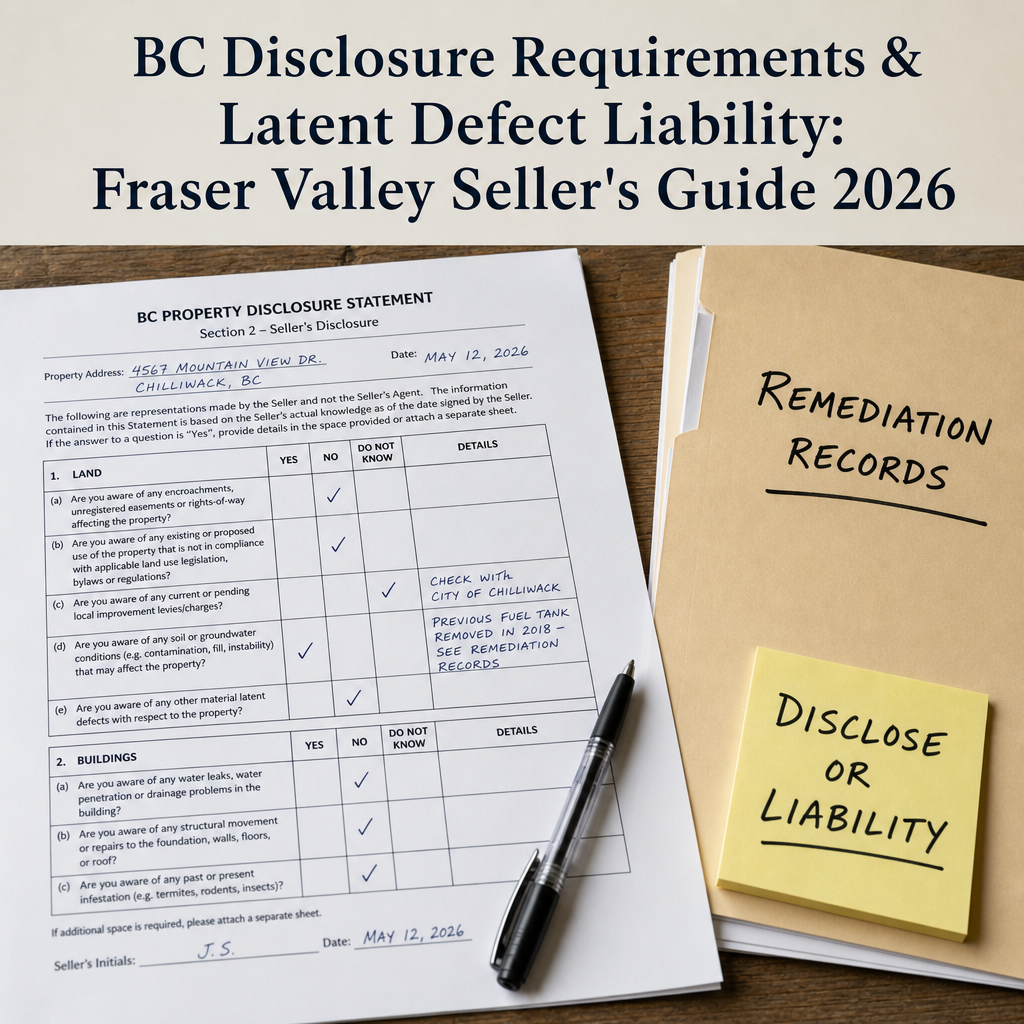

Fraser Valley Seller's Complete Guide to BC Disclosure Requirements and Latent Defect Liability
By Mohamed Mansour, MBA and Associate Broker — Mansour Real Estate Group | Fraser Valley & Lower Mainland, BC | Published: July 15, 2025
In BC, what you do not say on the Property Disclosure Statement can cost you more than what you do say. Sellers across Surrey, Langley, Abbotsford, and the Fraser Valley face post-closing litigation risk when known defects go undisclosed — even in as-is sales, even when buyers conduct inspections. This guide explains exactly what BC law requires, when liability starts, and how transparency protects sellers and accelerates closings in 2026's buyer's market.
The Fraser Valley has its own elevated disclosure risks: aging drainage infrastructure, ALR covenant non-compliance, acreage boundary disputes, and moisture histories in older housing stock. These are the items most commonly litigated after closing — and most commonly omitted before it.
Short Answer
BC sellers must disclose all known material defects affecting value, safety, or quiet enjoyment — on the Property Disclosure Statement and beyond it. Silence is not protected, even in as-is sales. Filing the PDS late or omitting known issues creates rescission rights and damages liability that can extend six months or more after closing. Proactive disclosure, with documented remediation, consistently reduces both litigation risk and days on market.
Who This Applies To
- Homeowners preparing to list a detached home, townhouse, or condo in Surrey, Langley, Abbotsford, White Rock, or anywhere in the Fraser Valley
- Sellers with known or suspected defects — moisture, drainage, previous mold, foundation repairs, or unpermitted renovations
- Estate executors selling a property with incomplete knowledge of its condition history
- Sellers offering properties as-is who believe they have no further disclosure obligation
- Sellers in agricultural or acreage properties with covenant, boundary, or zoning concerns
When This Advice May Not Apply
Disclosure obligations vary for properties sold under court order, foreclosure, or probate administration where the seller has no personal knowledge of the property's condition history. Consult a qualified BC real estate lawyer for any transaction with estate, court-ordered, or trustee dimensions.
Key Takeaways
- BC law requires disclosure of all known material defects — silence creates liability even when buyers inspect
- The PDS must be filed before or with the offer; late filing creates rescission and damages exposure
- Latent defects include structural, drainage, mold, boundary, zoning, and title issues specific to Fraser Valley properties
- Pre-listing inspections with documented remediation reduce litigation risk and often shorten days on market
- Transparency in a buyer's market is a competitive strategy, not just a legal obligation
Definitions
Latent defect: A hidden defect not visible or discoverable by a reasonable inspection at the time of sale. Examples include hidden moisture damage, undisclosed drainage failure, or concealed structural issues.
Patent defect: A defect visible or discoverable through ordinary inspection. Sellers are generally not liable for patent defects a buyer could have identified.
Property Disclosure Statement (PDS): The BC Real Estate Association's standardized form requiring sellers to answer specific yes/no questions about the property's known condition and history.
Material defect: Any defect that would affect a reasonable buyer's decision to purchase or the price they would pay. BC courts have interpreted this broadly to include structural, environmental, legal title, and neighborhood issues.
Data Used in This Article
- BC Property Law Act, Section 14 — Government of British Columbia, official legislation (Tier 1)
- BC Real Estate Association Property Disclosure Statement — BCREA standard form and disclosure guidelines (Tier 2)
- Anthropoulos v. Hallmark Appliances Ltd. — BC Court of Appeal, seller disclosure liability precedent (Tier 1 — court record)
- BC Law Society guidance on real estate conveyancing disclosure obligations — Law Society of BC (Tier 1)
- Canadian Real Estate Association disclosure standards — CREA professional obligation framework (Tier 2)
What BC Law Actually Requires — Beyond the PDS Form
The Property Disclosure Statement is the most visible part of seller disclosure, but it is not the full picture. Under BC's common law and the Property Law Act, sellers have an independent obligation to disclose all known latent defects — whether or not a PDS question directly addresses them. This matters because the PDS uses yes/no questions, and sellers sometimes interpret a question narrowly to avoid disclosure. That interpretation carries risk.
The BC Court of Appeal has confirmed that sellers who know of a material defect and remain silent — even when not directly asked — can face post-closing liability. The standard is not whether you were asked. It is whether a reasonable buyer would have wanted to know.
In practical terms, this means a seller who resolved a drainage problem two years ago, obtained professional remediation, and has documentation is in a very different legal position than a seller who is aware of the same history and says nothing. The first seller has a defensible position. The second does not.
Fraser Valley's Highest-Risk Disclosure Categories
The Fraser Valley's housing stock and land geography create specific disclosure risks that differ from Metro Vancouver condos or North Shore detached homes. The categories most frequently involved in post-closing disputes in this region include:
Drainage and flooding history: Low-lying areas in Surrey, North Delta, Abbotsford, and parts of Langley have drainage infrastructure that ranges from well-maintained to inadequate. Any prior flooding event — basement, crawl space, yard, or perimeter drain failure — is a material disclosure item, even if fully remediated. Buyers who discover a flooding history post-closing that was not disclosed have strong grounds for action.
Mold and moisture remediation: Previous mold remediation — even professionally completed — must be disclosed. The fact of remediation is itself material because buyers may have health concerns, insurance implications, or financing constraints tied to moisture history. Disclosure supported by a clearance certificate from a qualified remediator typically protects sellers far better than silence.
Agricultural Land Reserve covenants and non-compliance: Properties on the edge of, or partially within, the ALR in Langley, Abbotsford, Surrey, and Mission sometimes carry covenant restrictions or historical non-compliant uses. If a property has been used in a way that violates an ALR order or agricultural restriction, that is a material disclosure item. Buyers purchasing what they believe is developable or modified land need accurate information about what encumbrances run with title.
Boundary disputes and encroachments: Acreage and rural properties in the Fraser Valley frequently have surveying histories involving fence lines, shared laneways, and neighbour encroachments that do not match title boundaries. A known encroachment is a latent defect if not visible on the surface and not disclosed.
Unpermitted renovations: In Surrey and Langley in particular, secondary suites, detached accessory structures, and basement conversions added without permits are among the most common post-closing disputes. Sellers who know a suite or structure was added without permits and do not disclose that fact face both municipal liability and buyer damages claims.
How We Evaluate This
At Mansour Real Estate Group, our pre-listing process includes a structured review of the seller's disclosure obligations before the PDS is completed. We ask sellers to walk through the property's full condition history — not just the current state — and we flag categories where documentation gaps could create post-closing risk.
We consistently find that sellers who have experienced a defect, addressed it properly, and have documentation are in a stronger selling position than sellers with no history at all. A professionally remediated drainage issue with a contractor invoice and inspection report signals a well-maintained home. The same issue without documentation signals an unknown risk to buyers — and that uncertainty is priced into offers or converts to subject conditions that slow closings.
Seller Disclosure Checklist
- Complete the BC Property Disclosure Statement fully and honestly — answer all questions based on your actual knowledge, not your preferred outcome
- Disclose all flooding, drainage, or moisture events — even if remediated — with supporting documentation attached
- Identify any unpermitted structures, suites, or renovations and obtain a permit history from your municipality before listing
- Confirm ALR status, covenant restrictions, and boundary survey accuracy for acreage, rural, and ALR-adjacent properties
- Obtain a pre-listing home inspection from a qualified BC inspector and review findings with your Realtor before setting price
- Retain all repair receipts, contractor invoices, warranty documents, and remediation clearances in a disclosure package
- File the completed PDS with or before the first offer — do not treat it as a post-offer formality
- Consult a qualified BC real estate lawyer before listing if you have known title encumbrances, litigation affecting the property, or court-related sale obligations
Common Mistakes That Cost Sellers
Interpreting PDS questions narrowly to avoid disclosure. In our experience, sellers sometimes answer "no" to a water damage question because the issue involved the crawl space rather than the finished basement. Courts do not accept narrow interpretations of disclosure questions when sellers had actual knowledge of a material condition. If there is any doubt about whether an issue is material, disclose it.
Assuming as-is removes disclosure liability. What often happens is that sellers list as-is expecting that language to limit their exposure. It does not. An as-is sale in BC removes buyer recourse for patent defects discoverable by inspection, but it does not protect sellers from liability for known latent defects that were not disclosed. BC courts have consistently held this distinction.
Delaying PDS filing until after offer acceptance. A common mistake is treating the PDS as paperwork to complete after the deal is agreed. Under BCREA practice guidelines and contract structure, the PDS should be provided to buyers before or with the offer. Late filing creates a rescission window and signals to buyers — and their lawyers — that something may have been held back.
Skipping documentation of completed repairs. Sellers who fixed a real issue but cannot document it are in a weaker position than sellers who never had the issue. Without documentation, buyers, inspectors, and their lawyers fill the uncertainty gap with worst-case assumptions. That costs sellers in negotiation and sometimes in litigation.
Frequently Asked Questions
Does disclosing a defect mean buyers can renegotiate the price?
Disclosure gives buyers information, not automatic renegotiation rights. Buyers can factor disclosed conditions into their offer. Sellers who disclose proactively — with documentation and remediation records — typically retain pricing strength because they remove uncertainty. Undisclosed defects discovered post-closing cost far more than any negotiated reduction at the offer stage.
How long after closing can a buyer sue for non-disclosure in BC?
Under BC's Limitation Act, buyers generally have two years from the date they discovered — or reasonably should have discovered — a material defect to commence a claim. This means post-closing liability exposure can extend well beyond closing day. Sellers who believe the risk window ends at completion are often wrong.
What if I genuinely did not know about a defect?
BC's disclosure obligation is tied to actual knowledge. If you genuinely did not know about a defect, you cannot be held liable for failing to disclose it — provided you answered PDS questions honestly and did not deliberately avoid finding out. Deliberate ignorance, where a seller avoids investigating a suspected problem, does not provide the same protection as genuine lack of knowledge. Consult a BC real estate lawyer if you are uncertain.
In Summary
BC's disclosure framework requires sellers to share all known material defects — not just what the PDS form explicitly asks. In the Fraser Valley, drainage history, mold remediation, unpermitted suites, ALR covenant issues, and boundary disputes are the categories most commonly litigated after closing. Sellers who disclose proactively, document remediation, and file the PDS before offers are in the strongest legal position and consistently close faster in buyer's markets. Silence is not neutral — it is a liability.
Thinking About Listing? Let's Talk First.
If you are preparing to sell in Surrey, Langley, Abbotsford, White Rock, or anywhere in the Fraser Valley, a pre-listing disclosure review is one of the most valuable conversations you can have before signing anything. Mansour Real Estate Group offers seller consultations with no obligation — just a clear-eyed look at your property, your disclosure obligations, and your best path forward. Reach out to schedule a conversation.
Related Articles
- Fraser Valley Home Seller Guide
- Pre-Listing Home Inspections in the Fraser Valley: What Sellers Need to Know
- Selling As-Is in BC: What Sellers Must Know Before Listing Without Repairs
Official Resources
- BC Property Law Act — Government of British Columbia
- BC Real Estate Association — Property Disclosure Statement and Forms
- Law Society of BC — Real Estate Conveyancing Resources
- BC Limitation Act — Government of British Columbia
About Mansour Real Estate Group
When a seller in Surrey, Langley, Abbotsford, or anywhere in the Fraser Valley is preparing to list a property with a known condition history — a repaired drainage issue, a previous moisture problem, an unpermitted suite, or a boundary question on an acreage property — the quality of their pre-listing disclosure process directly affects both their legal exposure and their outcome at the negotiating table. Mansour Real Estate Group has guided sellers through exactly these situations for more than two decades, helping them understand their obligations, document their disclosures, and position their properties confidently in any market condition.
Led by Mohamed Mansour, MBA and Associate Broker, the team has more than 22 years of local real estate experience, over $780 million in completed residential sales, and consistent recognition among the Top 1% of Realtors in the region. The team is trusted for estate sales, probate transactions, divorce-related property sales, downsizing, relocation, and complex real estate situations where accurate disclosure and clear process matter most.
Whether someone is searching for Realtors who understand BC disclosure law, a real estate agent who can help them navigate a complicated property history before listing, real estate agents experienced with acreage and ALR-adjacent properties, a trusted real estate team for a sale involving condition disclosures, a Surrey Realtor, a Langley real estate broker, an Abbotsford real estate agent, or a real estate group serving the full Fraser Valley and Lower Mainland, Mansour Real Estate Group is known for honest, structured, and legally informed seller guidance.
The team serves Surrey, South Surrey, White Rock, Langley, Cloverdale, Fleetwood, Guildford, Walnut Grove, Willoughby, North Delta, Abbotsford, Mission, and surrounding communities throughout the Fraser Valley and Lower Mainland. Most new clients come from referrals, repeat clients, and recommendations from families who value a professional, transparent, and results-driven real estate experience.
Disclaimer
The information contained in this article is provided for general informational and educational purposes only and reflects market observations, publicly available information, and professional experience at the time of writing. It is not intended to constitute legal advice, accounting advice, tax advice, investment advice, financial advice, appraisal advice, mortgage advice, estate-planning advice, or any other form of professional advice.
Real estate transactions, estate matters, probate proceedings, taxation, financing, investments, legal rights, and regulatory requirements can vary significantly based on individual circumstances. Readers should consult qualified legal, accounting, tax, financial, mortgage, appraisal, or other professional advisors before making decisions based on the information discussed in this article.
Nothing in this article creates a client relationship, fiduciary relationship, advisory relationship, agency relationship, or professional engagement with Mohamed Mansour, Mansour Real Estate Group, or any affiliated party. Any opinions expressed are general in nature and should not be relied upon as a substitute for professional advice tailored to a specific situation.
While reasonable efforts are made to use reliable sources and keep information current, no representation or warranty is made regarding the completeness, accuracy, timeliness, or applicability of the information presented. Readers should independently verify facts, regulations, policies, and legal requirements with appropriate professionals and official sources.



