
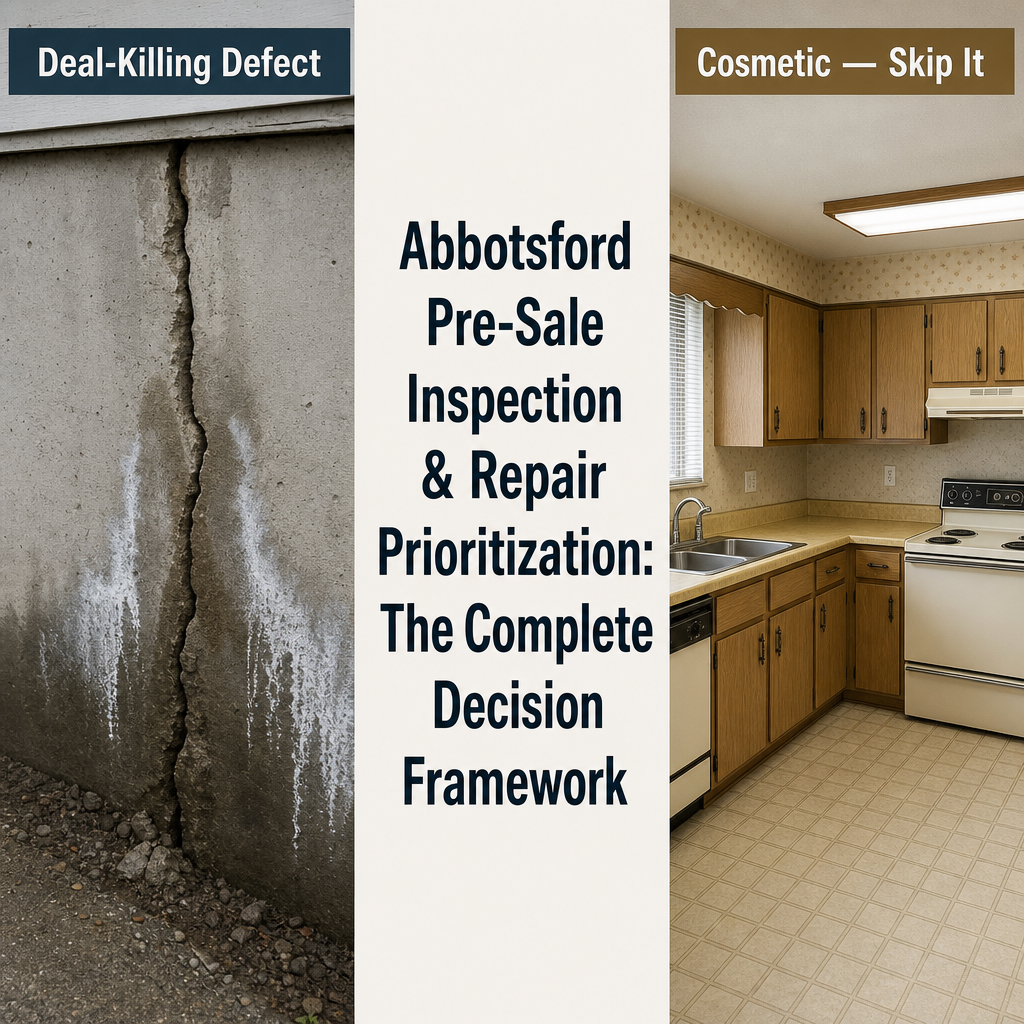

Abbotsford Pre-Sale Inspection and Repair Prioritization: The Complete Decision Framework for Identifying Critical Defects vs. Cosmetic Issues When Budget Is Limited in a 2026 Buyer's Market
By Mohamed Mansour, MBA and Associate Broker | Mansour Real Estate Group | Published: July 15, 2026 | Fraser Valley, BC
Abbotsford sellers in 2026 are navigating a buyer's market where inspection reports have become negotiation weapons. Buyers have leverage, days-on-market are extended, and every defect surfaced after an offer is submitted costs more to resolve than it would have pre-listing. For sellers with limited repair budgets, the critical question is not whether to fix things — it is which things to fix and which to leave alone.
This guide provides a clear, actionable framework for making that call. It is written specifically for Abbotsford's property mix: older housing stock, heritage homes, rural acreage with septic systems and wells, and a buyer pool that is more cautious and lender-constrained than it was two years ago.
Short Answer
In Abbotsford's 2026 buyer's market, sellers should spend repair budget on structural, electrical, plumbing, roof, and moisture issues first — these are the defects that trigger financing denial and appraisal shortfalls. Cosmetic issues such as dated kitchens, worn flooring, and aging paint rarely affect financing and typically return only 20–40 cents per dollar spent. Fix what kills deals. Leave what doesn't.
Key Takeaways
- Structural, electrical, plumbing, roof, and foundation defects trigger financing denial in 60–70% of cases involving lender-required inspections.
- A pre-listing inspection ($500–$900) surfaces defects on your terms, giving you time to repair or disclose before buyer leverage is maximum.
- Cosmetic spend returns only 20–40% in a buyer's market — dated kitchens and original flooring rarely affect mortgage approval.
- Abbotsford's older homes and rural properties carry unique risks — septic systems, well water, heritage restrictions, and aging electrical panels need priority assessment.
- Strategic pre-listing repairs costing $2,000–$8,000 typically prevent price concessions that run 15–25% deeper at post-offer renegotiation.
Who This Applies To
- Abbotsford homeowners preparing to list a property built before 1995
- Sellers of rural or semi-rural properties with septic systems, well water, or outbuildings
- Estate executors managing an older Abbotsford property with deferred maintenance
- Sellers with limited pre-listing budgets who need to allocate repairs strategically
- Homeowners who have received early buyer feedback suggesting inspection concern
When This Advice May Not Apply
If your property is a newer build (post-2000), recently renovated, or located in a strata where structural items are covered by the corporation, your risk profile is different. Heritage-designated properties carry additional complexity — some repairs require heritage consultant review before proceeding. Consult your real estate professional and, where relevant, a licensed contractor or heritage advisor before committing to pre-listing work.
Data Used in This Article
- Fraser Valley Real Estate Board (FVREB), 2026 market data — Abbotsford sales-to-active ratios, days-on-market by property type. Official board statistics.
- BC Home Inspector Association (BCHIA) — Defect classification guidelines and financing impact framework. Industry regulatory guidance.
- Appraisal Institute of Canada (AIC) — Research on inspection-triggered value adjustments in buyer's markets. Professional body research.
- CMHC mortgage insurance underwriting standards — Structural and major system defect thresholds affecting mortgage approval. Official federal source.
- Mansour Real Estate Group internal transaction data — Abbotsford repair ROI analysis and inspection-triggered renegotiation patterns. Professional interpretation.
Why the Abbotsford Market Creates Specific Repair Urgency
According to FVREB 2026 market data, Abbotsford's sales-to-active listings ratio has remained in buyer's market territory through the first half of the year. Extended days-on-market mean properties sit long enough for buyers to conduct thorough due diligence — and for inspection findings to reshape offers that were already accepted. That sequence is expensive for sellers.
Abbotsford's housing stock compounds this. A significant portion of the city's detached inventory was built before 1990, a construction era associated with knob-and-tube electrical wiring in some heritage properties, older plumbing materials, foundation systems that predate current drainage standards, and original roofing that may be at or past its service life. Rural properties east of the city add septic systems and well water into the equation — two items that generate their own inspection and certification requirements.
Buyers working with lenders in this market face CMHC and conventional underwriting standards that treat major structural and mechanical defects differently from cosmetic condition. A cracked foundation, failed septic, or 60-amp electrical service with a fuse panel does not just make a buyer nervous — it can make a mortgage impossible to fund. Understanding that distinction is the starting point for every repair decision.
The Core Framework: Deal-Killing Defects vs. Cosmetic Issues
The right mental model is not "what makes the house look better" — it is "what prevents a buyer's financing from closing." According to BC Home Inspector Association classification guidance and AIC research on buyer's market adjustments, defects fall into two categories with very different financial consequences for sellers.
Category 1 — Deal-killing defects: These are items that appraisers flag as material, that lenders underwrite around, or that cause buyers to walk or trigger post-offer renegotiation. In Abbotsford's older housing stock, they typically include:
- Foundation issues — Active cracks, settlement, moisture ingress, inadequate drainage. A foundation assessment letter from a structural engineer ($500–$1,200) can convert a buyer's fear into a manageable data point. Left unaddressed, foundation concerns generate price concessions far exceeding that cost.
- Electrical systems — Fuse panels, 60-amp services, and knob-and-tube wiring are routinely flagged by BC home inspectors and cited by insurers. Some lenders will not fund a property without electrical upgrade confirmation. Panel upgrades run $2,500–$5,000 and are among the highest-ROI pre-listing investments in Abbotsford's older inventory.
- Roof condition — A roof at or past its useful life triggers appraisal adjustments and lender holds. A roofing contractor's certification letter, or a full replacement where warranted, resolves the uncertainty before it reaches an offer.
- Active moisture and mold — Visible moisture staining, active leaks, and mold presence are disclosure obligations in BC and routinely trigger buyer financing conditions. Remediation is non-negotiable — the question is only whether you address it before or after the offer, with post-offer resolution always costing more.
- Septic systems (rural properties) — A failed or over-capacity septic system can make a rural Abbotsford property unlendable. A septic inspection and pump record ($300–$500) is a minimum. Sellers of acreage properties should budget for this as a non-optional pre-listing item.
- Well water (rural properties) — Lenders require potability certificates for well-water properties. Testing is inexpensive ($150–$300) and removes a buyer financing condition that would otherwise delay or derail the sale.
Category 2 — Cosmetic issues that don't justify pre-listing spend: These are visible but non-structural items that affect buyer perception but do not typically affect financing. In a buyer's market, cosmetic spend has a poor return profile — AIC research and Mansour Real Estate Group transaction data both indicate that cosmetic upgrades return only 20–40 cents per dollar spent when the broader market has inventory surplus.
- Dated kitchens and bathrooms — Original 1980s or 1990s kitchens and bathrooms are common across Abbotsford. Buyers expect them, price for them, and rarely lose financing over them. A full kitchen renovation before listing in a buyer's market is almost never recovered in the sale price.
- Worn flooring and paint — Fresh paint is low-cost and worth doing for presentation. Beyond that, floor replacement, popcorn ceiling removal, and similar cosmetic refreshes rarely change what a buyer's lender will fund.
- Landscaping — Curb appeal matters for initial showing response, but heavy landscaping investment rarely translates to appraisal value or financing approval.
- Appliance upgrades — Unless an appliance is included in the contract and is functionally broken, replacing appliances pre-listing in a buyer's market is rarely recovered.
How We Evaluate This
At Mansour Real Estate Group, our pre-listing repair assessment for Abbotsford properties starts with a simple question: what is the consequence if a buyer's home inspector finds this? If the answer is "financing denial, appraisal shortfall, or unconditional walk" — we recommend addressing it before listing. If the answer is "buyer asks for a price reduction we were already pricing in" — we look at the cost-benefit carefully before recommending spend.
For older Abbotsford properties, we typically recommend a pre-listing inspection as the first step. The $500–$900 cost surfaces the issue map before a buyer does, and it shifts the negotiating dynamic from reactive to controlled. Sellers who know exactly what their property's defect profile looks like are harder to renegotiate against than sellers who are hearing about problems for the first time at subject removal.
Seller Checklist: Pre-Listing Repair Prioritization in Abbotsford
- Commission a pre-listing home inspection from a BCHIA-registered inspector — budget $500–$900 for Abbotsford properties.
- Review the inspection report with your real estate professional and sort findings into Category 1 (financing risk) and Category 2 (cosmetic) before spending anything.
- Obtain a structural engineer's assessment letter if foundation cracking, settlement, or moisture is noted — this document is more valuable than a repair in many cases.
- Address electrical panels below 100-amp service and any documented knob-and-tube wiring in occupied areas — obtain an ESA permit for the work.
- For rural properties: complete a septic inspection and obtain a pump record; complete a water potability test and obtain a certificate dated within 90 days of listing.
- Obtain a roofing contractor's written assessment — a certification of remaining life is often sufficient; full replacement is only warranted when the roof is actively failing or documented as beyond service life.
- Address active moisture, visible mold, or unresolved leak sources before listing — BC property disclosure obligations apply, and pre-listing remediation costs far less than post-offer concessions.
- Hold cosmetic budget in reserve until after subject removal — if a buyer negotiates based on cosmetic condition, a credit at closing is more cost-effective than pre-listing renovation spend.
What We Commonly See
In our experience working with Abbotsford sellers, the most common and costly mistake is the reverse of what logic would suggest: sellers spend several thousand dollars on paint, flooring, and landscaping — all visible, all cosmetic — while leaving an uninspected electrical panel or a septic system without current records. The house shows beautifully. Then the buyer's inspector finds the real problems, and the negotiation unravels.
What often happens in Abbotsford's rural corridors is that sellers assume buyers understand older acreage properties "come with" aging infrastructure. In 2022 or 2023, that assumption had more validity — buyers were motivated and conditions were waived frequently. In 2026's buyer's market, buyers have leverage and are using it. A septic that hasn't been pumped or inspected in years becomes a $15,000 negotiation item, not a shrug.
A third pattern we see: sellers receive a pre-listing inspection report and then try to fix everything in it. That is also a mistake. The goal is not a perfect property — it is a lendable, financeable, insurable property. Items that are in the cosmetic or minor category of the report can be disclosed, priced in, or addressed as credits at closing for far less than the cost of pre-listing renovation.
Questions and Answers
Does a pre-listing inspection in BC become a disclosure obligation?
In British Columbia, sellers are required to complete a Property Disclosure Statement (PDS) covering known defects. If you commission a pre-listing inspection, its findings become known to you and should be reflected accurately on your PDS. This is not a reason to avoid the inspection — it is a reason to have a real estate professional help you understand how to position findings correctly alongside any remediation work completed.
What is the actual cost difference between fixing an electrical panel pre-listing vs. post-offer?
A panel upgrade completed pre-listing by a licensed electrician typically costs $2,500–$5,000, depending on service size and access. When the same deficiency surfaces in a buyer's inspection report, buyers frequently request a credit of $8,000–$15,000 or demand the work be done under a specific timeline — often with a holdback. The pre-listing cost is lower in almost every scenario Mansour Real Estate Group has observed in Abbotsford.
Do cosmetic issues affect the appraisal on an Abbotsford property?
Appraisers assess condition as one factor in market value, but cosmetic datedness in an older Abbotsford property is typically already reflected in comparable sales data — buyers and the market have already priced it in. Structural and mechanical deficiencies, by contrast, can generate explicit downward adjustments or subject the appraisal to conditions. According to AIC guidance, material defects trigger formal notation; cosmetic condition is generally absorbed in the overall condition rating.
Is a septic inspection required before listing a rural Abbotsford property?
It is not legally required before listing, but in practice, most buyers financing through institutional lenders will require septic inspection and records as a condition of their mortgage. Completing the inspection pre-listing removes a buyer's ability to use a failed or unknown septic as leverage post-offer, and it allows you to address any issues — or price the property accurately — before negotiations begin.
Should I do a full kitchen renovation before listing in Abbotsford's current market?
In Abbotsford's 2026 buyer's market, a full kitchen renovation before listing is generally not recommended. Cosmetic upgrades return only 20–40 cents per dollar in this market environment. A clean, functional kitchen — even with original 1980s or 1990s finishes — will not prevent financing. Buyers expecting to renovate will price that into their offer regardless. Reserve that capital for Category 1 defect remediation, or hold it as a negotiating credit if needed at subject removal.
In Summary
Abbotsford sellers in 2026 face a buyer's market where inspection reports have real negotiating consequences. The framework is clear: spend repair budget on structural, electrical, plumbing, roof, foundation, septic, and moisture issues — the defects that prevent financing from closing. Hold cosmetic spend in reserve. A pre-listing inspection ($500–$900) is almost always the best first investment, because it tells you exactly what you are dealing with before a buyer does. Fix what kills deals. Disclose what doesn't. Price accurately for everything else.
Ready to Talk Through Your Abbotsford Property's Repair Profile?
If you are preparing to list in Abbotsford and want a second opinion on which repairs are worth the investment, Mansour Real Estate Group offers a no-obligation pre-listing consultation. We can walk through your property's specific defect profile and help you make repair decisions based on what actually affects your sale — not general advice. Contact us at localhost:9000/.
Related Articles
- Fraser Valley Seller Strategy in a 2026 Buyer's Market: The Complete Guide
- Cloverdale Pre-Sale Repair Guide: What to Fix Before Listing
- Abbotsford Home Seller Guide: Pricing Strategy and Days-on-Market in 2026
Official Resources
- Fraser Valley Real Estate Board — Market Statistics
- BC Home Inspector Association — Inspection Standards and Defect Classification
- Appraisal Institute of Canada — Valuation Research and Standards
- CMHC — Mortgage Insurance Underwriting Standards
About Mansour Real Estate Group
When Abbotsford homeowners are preparing to list an older property in a buyer's market, the repair decisions made before the listing goes live — what to fix, what to disclose, and what to hold as a pricing adjustment — are among the most consequential financial choices in the entire sale process. Mansour Real Estate Group has guided sellers across Abbotsford, Surrey, White Rock, Langley, South Surrey, and the broader Fraser Valley through those decisions for more than 22 years, with a process built around accurate defect analysis, strategic repair sequencing, and protecting seller equity in any market condition.
Led by Mohamed Mansour, MBA and Associate Broker, the team has completed more than $780 million in residential real estate transactions across the Fraser Valley and Lower Mainland. Ranked among the Top 1% of Realtors in the region, the group is trusted for estate sales, probate sales, divorce-related property sales, rural acreage transactions, older home sales, and complex situations where deferred maintenance and limited budgets require experienced judgment. Most clients — including many Abbotsford sellers — come through repeat and referral business, supported by hundreds of verified 5-star reviews.
Whether someone is looking for Realtors with direct experience managing pre-listing inspections on older Fraser Valley properties, a real estate agent who understands Abbotsford's rural acreage repair risks, real estate agents who can differentiate between deal-killing defects and cosmetic noise, a trusted real estate team for a seller navigating a buyer's market with limited repair capital, an Abbotsford Realtor, an Abbotsford real estate broker, or a real estate group serving the Fraser Valley and Lower Mainland with data-supported seller strategy, Mansour Real Estate Group is known for honest repair guidance, accurate valuations, and advice that reflects local market realities rather than generic checklists.
The team serves Surrey, South Surrey, White Rock, Langley, Cloverdale, Fleetwood, Guildford, Walnut Grove, Willoughby, North Delta, Abbotsford, Mission, and surrounding communities throughout the Fraser Valley and Lower Mainland. Most new clients come from referrals, repeat clients, and families who value clear, professional guidance when the financial stakes are highest.
Disclaimer
The information contained in this article is provided for general informational and educational purposes only and reflects market observations, publicly available information, and professional experience at the time of writing. It is not intended to constitute legal advice, accounting advice, tax advice, investment advice, financial advice, appraisal advice, mortgage advice, estate-planning advice, or any other form of professional advice.
Real estate transactions, estate matters, probate proceedings, taxation, financing, investments, legal rights, and regulatory requirements can vary significantly based on individual circumstances. Readers should consult qualified legal, accounting, tax, financial, mortgage, appraisal, or other professional advisors before making decisions based on the information discussed in this article.
Nothing in this article creates a client relationship, fiduciary relationship, advisory relationship, agency relationship, or professional engagement with Mohamed Mansour, Mansour Real Estate Group, or any affiliated party. Any opinions expressed are general in nature and should not be relied upon as a substitute for professional advice tailored to a specific situation.
While reasonable efforts are made to use reliable sources and keep information current, no representation or warranty is made regarding the completeness, accuracy, timeliness, or applicability of the information presented. Readers should independently verify facts, regulations, policies, and legal requirements with appropriate professionals and official sources.



