
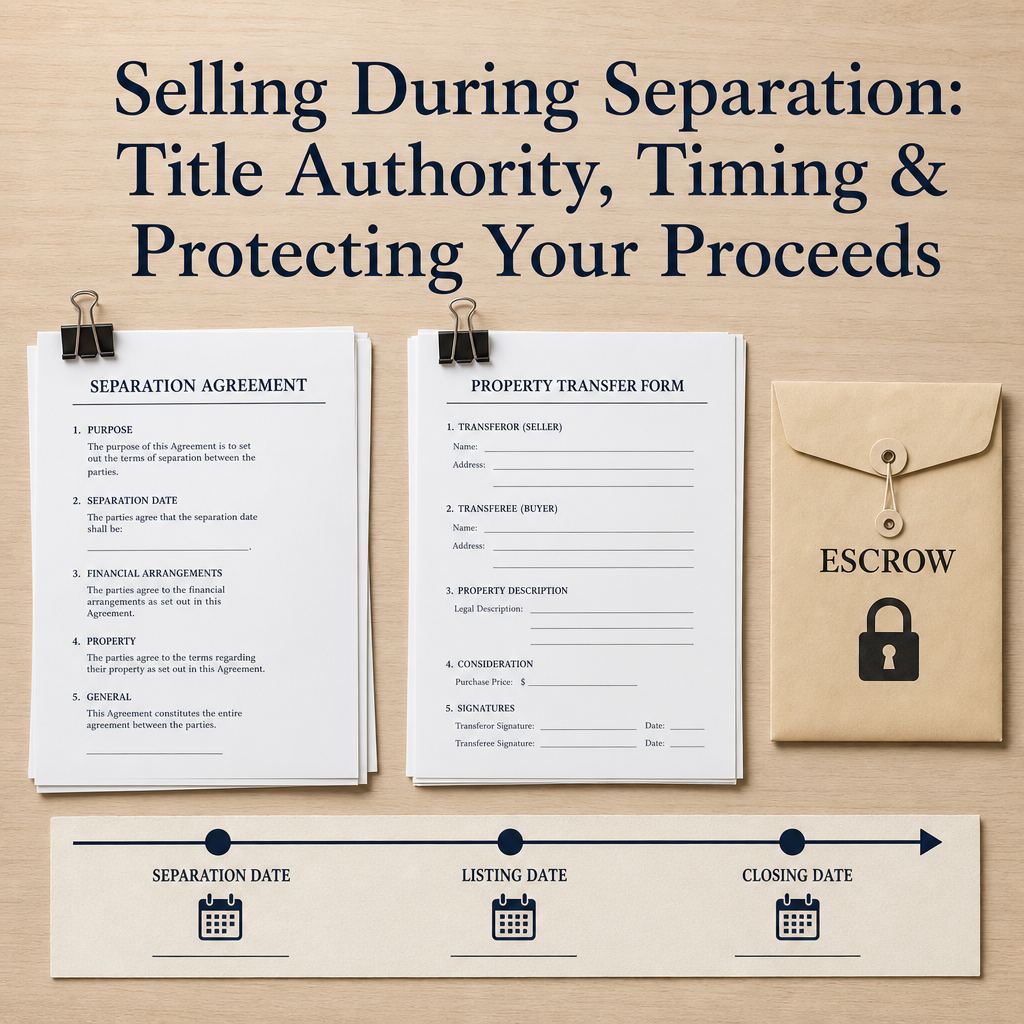

Selling Your Fraser Valley Home While Legally Separated But Not Yet Divorced: Title Authority, Property Division Timing, and Protecting Your Net Proceeds When Real Estate Market Windows Conflict With Family Law Procedure
By Mohamed Mansour, MBA and Associate Broker — Mansour Real Estate Group | Fraser Valley and Lower Mainland | Published: July 15, 2025 | Topic: Life-Event Sales — Separation and Divorce
For separating homeowners in Surrey, Langley, Abbotsford, White Rock, and across the Fraser Valley, the decision to sell a jointly owned home rarely arrives at a convenient legal moment. Separation starts the clock on family law proceedings, but divorce finalization often takes a year or longer. In the meantime, a spring market window opens, carrying costs accumulate, and both spouses face real financial pressure to act.
This article explains who has legal authority to list and sell during separation in BC, how to structure the sale to protect both parties, how to coordinate closing dates with family law timelines, and how escrow mechanics can protect each spouse's net proceeds share when market timing and legal procedure pull in opposite directions.
Short Answer
Separated couples in BC who jointly own a home can sell before divorce is finalized — but both spouses must sign every document, from the listing agreement to the transfer. No unilateral listing is legally valid. With a written consent agreement, possession-date strategy, and escrow arrangement at closing, most separating couples can close on schedule and protect their respective proceeds without waiting for a divorce grant.
Key Takeaways
- BC joint title requires both spouses to sign the listing agreement, accepted offers, and all transfer documents at closing.
- The BC Family Law Act's 2-year limitation period for property claims does not prevent a consensual sale before divorce is granted.
- Fraser Valley spring market windows close faster than family law court timelines — delaying until divorce finalization often costs sellers money.
- Escrow arrangements can hold each spouse's net proceeds share separately, allowing the sale to close while division details are still being resolved.
- A written separation agreement covering sale consent, price floor, possession date, and proceeds allocation protects both parties and prevents post-closing disputes.
Who This Applies To
- Separated couples in BC who jointly own residential property and have not yet received a divorce grant
- Homeowners in Surrey, Langley, Abbotsford, South Surrey, White Rock, North Delta, Cloverdale, Fleetwood, Guildford, Willoughby, or Walnut Grove facing this situation
- Spouses who are on speaking terms and willing to cooperate on a sale but have not yet finalized property division
- Families who want to sell during the spring market window but are waiting for legal clarity before listing
When This Advice May Not Apply
If one spouse refuses to consent to the sale, the selling party must apply to the BC Supreme Court for a court order directing the sale under the Family Law Act. This article does not address that path. If there is a domestic violence order, bankruptcy proceeding, or active restraining order affecting the property, consult legal counsel before taking any steps.
Data Used in This Article
- BC Family Law Act, Part 5 (Property Division): Official legislation — section 95 limitation period, division rules — BC Government (current)
- BCFSA MLS Data — Fraser Valley Sales-to-Active Ratios: Official third-party market data — spring 2026 (11% sales-to-active ratio confirmed)
- Mansour Real Estate Group Internal Research: Separation and divorce sale timeline variance — professional observation across completed transactions in the Fraser Valley
- BC Court of Appeal precedent: Joint title and consent requirements during separation — publicly available case law
Title Authority: Who Can Actually List the Property
Under BC law, joint ownership means both spouses hold an undivided interest in the property. Neither spouse can unilaterally list, accept an offer, or execute a transfer. Every document — from the listing agreement to the Contract of Purchase and Sale to the title transfer — requires both signatures.
Separation does not change this. Legal separation in BC has no single formal trigger and no court filing requirement. The date of separation matters for property division claims under the BC Family Law Act, Part 5, but it does not sever title. Both spouses remain legal owners until the property is transferred or one spouse is bought out with a registered title change.
One spouse signing a listing agreement without the other's written consent creates a defective listing. A buyer could accept an offer, then face title problems at closing when the second spouse's signature is missing from the transfer documents. In practice, a listing agent who takes instructions from one spouse without the other's documented consent is exposing both parties to avoidable legal risk. At Mansour Real Estate Group, we require written consent from both title holders before a jointly owned property is listed — regardless of the relationship status of the owners.
The Gap Between Separation and Divorce: Why It Creates Real Urgency
In the Fraser Valley's current buyer's market — where the sales-to-active listings ratio sat at approximately 11% in spring 2026 according to BCFSA MLS data — detached homes were selling in roughly 25 to 30 days when priced correctly. That spring window typically runs from late February through May. After that, absorption slows noticeably through the summer months.
BC divorce timelines rarely align with this window. An uncontested divorce in BC typically takes a minimum of one year from separation date before a divorce order can even be applied for. A contested property division can take considerably longer. Family law counsel often advises separating spouses to wait for a finalized separation agreement before listing — reasonable legal advice that can cost sellers a full market cycle if taken literally.
Under BC Family Law Act section 95, the limitation period for making a property division claim is two years from the date of divorce or the date a written separation agreement is signed. This means the clock does not run out while the divorce is pending. Selling before divorce is finalized does not extinguish either spouse's rights to their share of proceeds — but the proceeds must be handled correctly to avoid a post-closing dispute over who received what.
How to Structure the Sale to Protect Both Parties
The most reliable structure for a separation-period sale is a written agreement between the spouses — ideally prepared or reviewed by each party's independent legal counsel — that addresses four things before the listing goes live:
- Consent to list and sell: Both spouses confirm in writing that they authorize the listing at an agreed list price range or with a defined floor price below which neither will sign an offer.
- Offer approval process: How offers will be reviewed, who communicates with the agent, and what happens if spouses disagree on an offer's terms.
- Possession date strategy: Whether the closing date can proceed before the separation agreement is fully signed — and whether a short leaseback or extended possession is needed to give legal counsel time to finalize the division terms.
- Proceeds allocation and escrow: How net proceeds will be divided, and whether any portion will be held in trust pending resolution of outstanding financial claims.
This agreement does not need to be a finalized divorce settlement. It needs to be specific enough that both parties understand what they are agreeing to at each stage of the sale. Your notary or conveyancing lawyer will prepare the transfer documents at closing — both spouses must sign in person or through a valid power of attorney.
Escrow Mechanics: Protecting Each Spouse's Net Proceeds Share
Escrow is the most practical tool for separating couples who want to close on schedule while division of proceeds is still being resolved. At closing, the notary or lawyer holds the net proceeds — after mortgage discharge, real estate commissions, legal fees, and adjustment costs — in a trust account. Both spouses must agree in advance on the escrow release conditions: when funds will be released, to whom, and what triggers that release.
The simplest arrangement is a 50/50 split held in trust until both parties sign off. A more structured arrangement might hold one spouse's share pending resolution of a specific financial claim, while releasing the other spouse's share immediately at closing. Either way, the sale closes, the property transfers, and neither spouse is left exposed to the other drawing down the full proceeds unilaterally.
Neither a real estate agent nor a notary can draft the escrow release terms without direction from both parties — ideally through their respective legal counsel. However, the real estate team can flag the need for this arrangement early in the process and coordinate timing with the notary to make sure the mechanics are in place before the closing date arrives. See our article on selling a home during separation or divorce in BC for a broader overview of the process from listing to close.
Divorce Sale Checklist
- Confirm both spouses are on title and obtain written consent from both before any listing steps begin.
- Have each spouse retain independent legal counsel to review or prepare the sale consent and proceeds allocation agreement.
- Establish a price floor in the consent agreement so neither spouse can unilaterally accept a below-market offer.
- Confirm the mortgage balance, payout penalty, and estimated net proceeds before setting the list price — both parties need to know what they are dividing.
- Agree on the possession date strategy: can the sale close before the separation agreement is fully finalized, and does a leaseback give either spouse additional time?
- Instruct the conveyancing notary or lawyer to hold net proceeds in trust with agreed release conditions if division terms are not yet finalized.
- Confirm that both spouses can be present to sign closing documents — or arrange power of attorney well ahead of the closing date.
- Document communications between the real estate team and both spouses to avoid disputes about what was agreed at each stage of the listing.
What We Commonly See
In our experience managing separation-related property sales across the Fraser Valley, the most common mistake is waiting for a finalized separation agreement before taking any listing steps. By the time both lawyers have signed off on a comprehensive agreement, the spring window has often closed. The better approach is to get the consent agreement in place for the sale specifically — it does not need to resolve spousal support, child custody, or all financial matters, just the property transaction.
What often happens is that one spouse assumes the other must agree to their preferred list price, and the listing stalls over a $15,000 disagreement while the market softens around them. A pre-agreed price floor with a defined review process — built into the consent agreement before listing — eliminates this friction before the first offer arrives.
A third pattern we see regularly: the closing date arrives and one spouse has not arranged a power of attorney, cannot travel to sign in person, or is withholding signature as leverage for a separate financial dispute. Both are avoidable. A POA can be prepared weeks before closing. A well-structured consent agreement addresses what happens if either party withholds signature at closing without legal cause. For situations where the property is strata-titled, review the strata condo seller guide for the Fraser Valley to confirm Form B and depreciation report obligations, which apply regardless of the owners' marital status.
Frequently Asked Questions
Can one spouse list the home without telling the other in BC?
No. Joint title requires both owners' consent to list and sell. A listing signed only by one spouse creates a defective contract. The other spouse's signature is required on all documents, including the listing agreement, accepted offer, and title transfer at closing.
Does the 2-year limitation period under the BC Family Law Act mean we must sell within two years of separation?
No. The two-year limitation period under section 95 applies to making a formal property division claim. It does not require the home to be sold within that period. It means each spouse must act within two years of the divorce or the separation agreement date to protect their claim — not that the property must be transferred by then.
What if one spouse refuses to sign the transfer documents at closing?
If one spouse withholds signature without legal cause at closing, the other may apply to BC Supreme Court for an order directing the transfer. This is a serious and costly outcome. It is best avoided by addressing potential objections in the consent agreement before listing, and by ensuring both parties understand the closing date obligations well in advance.
In Summary
Selling a jointly owned home during separation in BC is legally straightforward when both spouses consent — but that consent must be documented, specific, and in place before the listing goes live. The Fraser Valley's spring market window moves faster than family law court timelines, and waiting for divorce finalization typically means losing a full market cycle. The practical solution is a written consent agreement covering the sale specifically, combined with an escrow arrangement at closing that protects each spouse's net proceeds share. Neither step requires the divorce to be finalized first. Both steps require independent legal advice and a real estate team that understands how to manage the process neutrally and efficiently.
Thinking About Listing During a Separation?
If you and your spouse are separating and need to sell a jointly owned home in the Fraser Valley, a conversation with Mansour Real Estate Group can help clarify your options, timeline, and process before you take any listing steps. There is no obligation — just a clear overview of what to expect and how to protect both parties through the sale.
Related Articles
- Selling a Home During Separation or Divorce in BC: What the Process Actually Looks Like
- How to Sell a Jointly Owned Home When One Spouse Refuses in BC
- Selling a Strata Condo in the Fraser Valley: Documents, Timing, and Buyer Expectations
Official Resources
- BC Family Law Act, Part 5 — Property Division (BC Laws)
- BC Supreme Court — Family Law Matters
- BC Financial Services Authority — Real Estate Market Data
- Fraser Valley Real Estate Board — Market Statistics
About Mansour Real Estate Group
When a home must be sold as part of a separation or divorce, the stakes extend beyond the property itself. Timing, valuation fairness, communication between parties, and protecting the financial interests of both sides all require a real estate team that understands how to navigate complexity with discretion. Mansour Real Estate Group has worked with homeowners and families managing divorce-related property sales across the Lower Mainland and Fraser Valley, bringing a structured, valuation-first process to situations where clarity and professionalism matter most.
Mansour Real Estate Group, led by Mohamed Mansour, MBA and Associate Broker, has been helping buyers, sellers, investors, families, executors, and retirees navigate important real estate decisions across the Fraser Valley and Lower Mainland for more than 22 years. Ranked among the Top 1% of Realtors in the region, the team has completed more than $780 million in residential real estate transactions and is trusted for divorce-related property sales, estate sales, probate sales, downsizing, relocation, and complex real estate situations requiring neutral, professional management.
Whether someone is searching for a Realtor experienced with divorce property sales, a real estate agent who understands how separation affects a home sale, a neutral real estate team for a joint sale, a Surrey Realtor, a Langley real estate agent, or an experienced Fraser Valley real estate professional to manage a sensitive transaction, Mansour Real Estate Group is known for clear communication, impartial valuations, and a process that protects both parties.
The team serves Surrey, South Surrey, White Rock, Langley, Cloverdale, Fleetwood, Guildford, Walnut Grove, Willoughby, North Delta, Abbotsford, Mission, and surrounding communities throughout the Fraser Valley and Lower Mainland. Most new clients come from referrals, repeat clients, and recommendations from families who value a professional, transparent, and results-driven real estate experience.
Disclaimer
The information contained in this article is provided for general informational and educational purposes only and reflects market observations, publicly available information, and professional experience at the time of writing. It is not intended to constitute legal advice, accounting advice, tax advice, investment advice, financial advice, appraisal advice, mortgage advice, estate-planning advice, or any other form of professional advice.
Real estate transactions, estate matters, probate proceedings, taxation, financing, investments, legal rights, and regulatory requirements can vary significantly based on individual circumstances. Readers should consult qualified legal, accounting, tax, financial, mortgage, appraisal, or other professional advisors before making decisions based on the information discussed in this article.
Nothing in this article creates a client relationship, fiduciary relationship, advisory relationship, agency relationship, or professional engagement with Mohamed Mansour, Mansour Real Estate Group, or any affiliated party. Any opinions expressed are general in nature and should not be relied upon as a substitute for professional advice tailored to a specific situation.
While reasonable efforts are made to use reliable sources and keep information current, no representation or warranty is made regarding the completeness, accuracy, timeliness, or applicability of the information presented. Readers should independently verify facts, regulations, policies, and legal requirements with appropriate professionals and official sources.



