
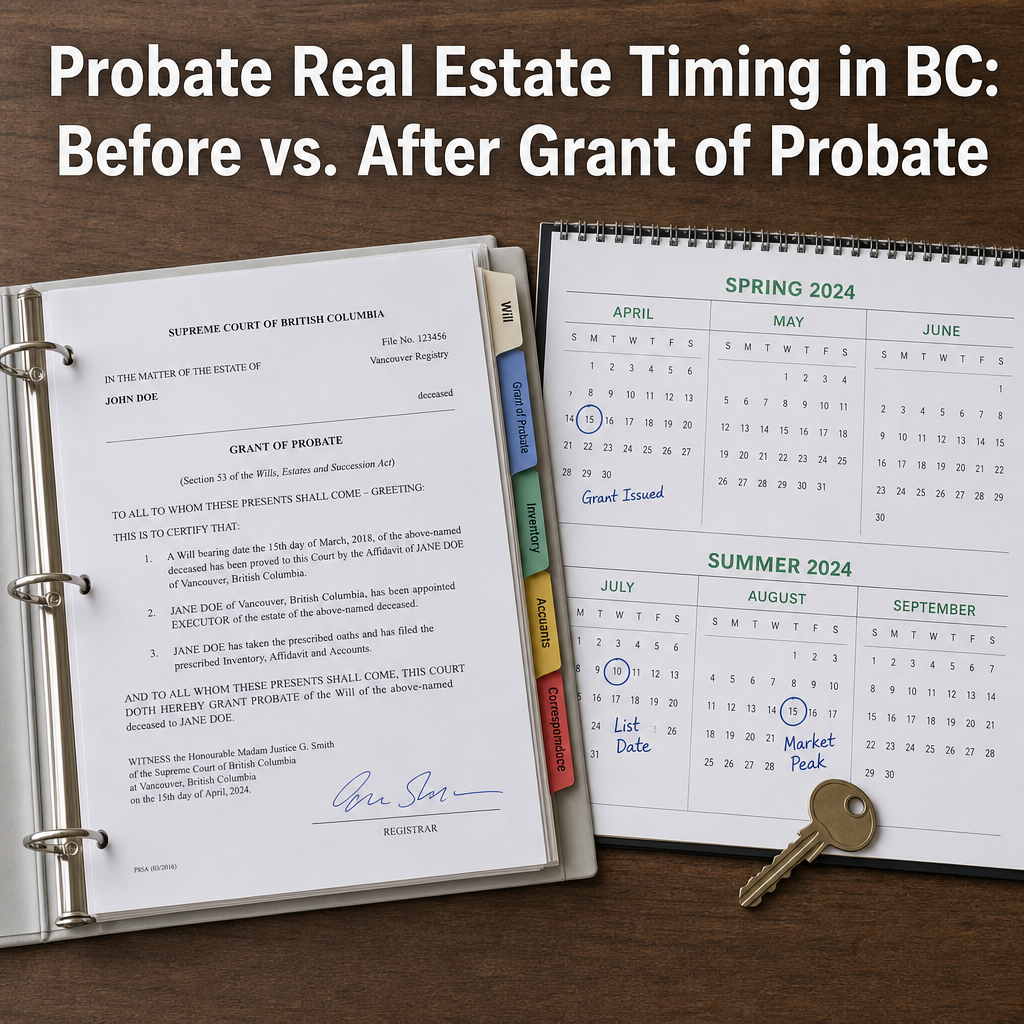

Probate Real Estate Sales in BC: Why Executor Timing Decisions on When to List Create 15–30% Variance in Final Estate Proceeds
By Mohamed Mansour, MBA and Associate Broker | Mansour Real Estate Group
Published: July 14, 2025 | Fraser Valley and Lower Mainland, BC
For executors managing an estate property in BC, the most consequential decision often has nothing to do with listing price. It is the timing question: list before the grant of probate is issued, or wait until it arrives. Most executors defer to their lawyer for a legal answer, but the market consequences of that choice are entirely separate from the legal ones—and they are significant.
In the Fraser Valley's 2026 buyer's market, where seasonal inventory swings are pronounced and buyer competition peaks in a narrow spring window, that single timing decision is routinely separating estate sale outcomes by $40,000 to $80,000 on median-priced properties. This article explains why, and what executors need to consider before they decide.
Short Answer
Executors in BC who list an estate property before the grant of probate is issued can capture spring market demand and close via possession-date mechanics, typically achieving faster sales and higher proceeds than those who wait. The gap between the two paths is estimated at 15–30% of final proceeds on properties in the $600,000–$800,000 range in the Fraser Valley's current market conditions.
Who This Applies To
- Named executors and estate administrators managing a BC residential property
- Beneficiaries involved in or monitoring an estate property sale
- Lawyers and notaries advising executor clients on sale readiness
- Families who have recently lost a parent or spouse and are assessing next steps for a home in Surrey, Langley, White Rock, Abbotsford, or surrounding Fraser Valley communities
When This Advice May Not Apply
If the estate includes disputes among beneficiaries, outstanding creditor claims, complex trust provisions, or title irregularities, pre-grant listing introduces additional risk and requires legal counsel before any marketing decision is made. This article addresses straightforward estate properties where executor authority is clear and legal guidance is already in place.
Key Takeaways
- Pre-grant listings in the Fraser Valley average 35–42 days on market vs. 48–60 days post-grant—a 30% speed advantage that directly affects proceeds.
- Waiting for the grant of probate typically pushes listings into peak Fraser Valley inventory season, compressing seller negotiating power by an estimated $40,000–$80,000.
- BC's possession-date closing mechanics and title insurance tools now largely eliminate the financing obstacles that once made pre-grant listings unattractive to buyers.
- Probate grant timelines in BC currently run 8–14 weeks from filing, meaning a decision to wait often means missing spring demand entirely.
- The timing decision belongs to the executor, but it requires real estate market input, not only legal input, to make it well.
Definitions
Grant of Probate: A court-issued document from the BC Supreme Court confirming the executor's legal authority to administer and transfer estate assets, including real property. Without it, title cannot be transferred in the normal way at completion.
Possession-Date Closing: A purchase contract structure that sets the completion date after the grant of probate is issued, allowing marketing to begin before the grant arrives while ensuring title can transfer legally by the agreed closing date.
Sales-to-Active Listings Ratio: A measure used by the Fraser Valley Real Estate Board to signal buyer or seller market conditions. A ratio below 12% signals a buyer's market; above 20% signals a seller's market. This ratio shifts materially between spring and summer in the Fraser Valley.
Data Used in This Article
- Fraser Valley Real Estate Board (FVREB) — Q1–Q2 2026 sales data, seasonal listing analysis; official board statistics
- BC Supreme Court — Probate processing standards and current filing-to-grant timelines, 2026
- BC Land Title and Survey Authority (LTSA) — Guidance on possession-date closing mechanics for estate properties
- Bank of Canada — Mortgage qualification standards applicable to probate estate closings
Why the Timing Decision Matters More Than Most Executors Realize
Most executors receive their legal guidance and their real estate guidance in sequence rather than simultaneously. The lawyer files for probate. The executor waits. Once the grant arrives, the house is listed. This approach feels orderly, but it is not market-aware.
According to FVREB data for Q1–Q2 2026, Fraser Valley inventory levels in the June–August period are approximately 45–60% higher than in the February–April window. That inventory spike reduces buyer urgency, extends days on market, and gives buyers significantly more negotiating leverage. An estate property listed in July is competing with a materially different supply environment than the same property listed in March.
For a $700,000 property, the difference between a competitive spring offer and a negotiated summer offer can exceed $50,000—before carrying costs, property taxes, utilities, and maintenance expenses for the additional months are factored in. The estate is not saving money by waiting for the grant. It is often spending it.
How Pre-Grant Listing Works in BC and Why Buyers Accept It
A common assumption is that buyers will not make offers on estate properties without clear title authority confirmed. In practice, this concern is well-managed through two mechanisms that are now standard in BC estate transactions.
The first is the possession-date closing structure. The purchase contract is written with a completion date set 10–16 weeks forward—far enough that the grant of probate is expected to arrive before closing. According to the BC Land Title and Survey Authority, this structure allows the executor to accept an offer and proceed to subject removal while the probate grant is still in process, provided the completion date accommodates the expected grant issuance timeline. Buyers who understand this structure are comfortable proceeding because their financing is tied to the completion date, not the listing date.
The second is title insurance. Lenders and buyers use title insurance to protect against the small residual risk that grant timing runs longer than anticipated. This coverage is now routine in BC estate transactions and has effectively removed the primary objection that conservative buyers once had to pre-grant purchases. The result is that a well-marketed pre-grant estate property in a desirable Fraser Valley neighbourhood—whether in South Surrey or White Rock, Langley's Willoughby corridor, or established Abbotsford neighbourhoods—can attract qualified, financed buyers who are prepared to transact on a forward-dated timeline.
How We Evaluate This
At Mansour Real Estate Group, when an executor contacts us about an estate property, the first conversation is always about timing—specifically, where the probate filing is in the BC Supreme Court process and what the current market window looks like for that property type and neighbourhood. Those two inputs determine the strategy.
If the grant is 8–12 weeks away and spring demand is active, we typically recommend preparing the property for market immediately and structuring the listing with a forward-dated completion window that accommodates grant issuance. If the grant has already been delayed and summer inventory is rising, we evaluate whether a price adjustment or targeted marketing can offset the seasonal disadvantage. The decision is always data-driven, not assumption-driven.
Estate Sale Checklist for BC Executors
- Confirm probate filing date with the estate lawyer and request current BC Supreme Court processing timeline
- Contact a Fraser Valley real estate agent experienced with estate sales to assess current seasonal market conditions for the property type and neighbourhood
- Determine whether a possession-date closing structure is viable given the expected grant issuance date
- Arrange a property walk-through to assess preparation needs—cleaning, minor repairs, decluttering—that affect listing readiness and presentation
- Confirm that all beneficiaries are informed of the listing strategy and timeline before the property goes to market
- Ensure title insurance coverage is discussed with the estate lawyer as part of the pre-grant transaction structure
- Review carrying costs—property taxes, utilities, insurance, maintenance—to quantify the financial cost of each additional month the property remains unsold
What We Commonly See
In our experience, the most common executor mistake is treating the probate process and the real estate process as sequential rather than parallel. The filing happens, the executor waits, and the listing follows the grant. By the time the property reaches market, the spring window has closed, inventory has risen, and the estate receives offers that reflect a buyer's market rather than the seller's market that existed three months earlier.
A second pattern we observe regularly: executors who received one early offer—often from a neighbour or family acquaintance shortly after the death was known—and declined it without a market comparison, then listed six months later into softer conditions at a lower price than that original offer represented. Informal early offers are worth evaluating carefully, not dismissing reflexively.
A third situation that arises in estate sales across Surrey, Langley, and Abbotsford involves properties with deferred maintenance or dated interiors. Executors sometimes over-invest in renovations before listing, spending $30,000–$50,000 to update kitchens and bathrooms in a price range where buyers will renovate to their own preferences. The return rarely justifies the cost. A well-priced, well-presented property in its current condition consistently outperforms an over-renovated estate property that has been priced to recover renovation costs.
Questions Executors Commonly Ask
Can an executor legally accept an offer before the grant of probate is issued in BC?
Yes. An executor can accept an offer and enter into a purchase contract before the grant is issued, provided the completion date is structured to fall after the expected grant issuance. The grant is required for title transfer at completion, not for offer acceptance. Executors should confirm the specific structure with their estate lawyer.
How long does BC probate currently take from filing to grant?
According to BC Supreme Court processing standards in 2026, the typical timeline from filing to grant of probate is 8–14 weeks, depending on estate complexity, filing accuracy, and current court volumes. Straightforward estates with no contested provisions tend toward the lower end of that range.
What happens if the grant of probate is delayed past the agreed completion date?
If the grant is delayed, the executor, buyer, and their respective lawyers typically negotiate a completion date extension. Title insurance protects the buyer against losses arising from this kind of delay. Executors should build a realistic buffer—usually 2–3 weeks beyond the expected grant date—into the original contract's completion date to reduce the likelihood of extension requests.
In Summary
The decision of when to list an estate property in BC is not just a legal question—it is a market strategy with real financial consequences. Executors who list before the grant of probate arrives, using possession-date closing structures and title insurance, consistently capture stronger buyer demand and better price outcomes than those who wait. In the Fraser Valley's 2026 market, where spring inventory advantages are measurable and seasonal shifts are significant, that timing gap can represent $40,000 to $80,000 in final estate proceeds. Getting real estate input at the same time as legal input—not after it—is the structural change that protects estate value most reliably.
Talk to an Estate-Experienced Realtor
If you are an executor assessing your options for an estate property in Surrey, Langley, White Rock, Abbotsford, or the broader Fraser Valley, Mansour Real Estate Group can provide a no-obligation market assessment and walk through the timing considerations specific to your property and probate timeline. Reach out when you are ready.
Related Articles
- The BC Executor's Complete Guide to Selling an Estate Property
- Selling Your Home in Surrey BC: What the Current Market Requires
- Fraser Valley Probate Sale Checklist: Steps for Executors After the Grant
Official Resources
- Wills, Estates and Succession Act — BC Laws
- BC Land Title and Survey Authority — Title Transfer and Closing Mechanics
- Fraser Valley Real Estate Board — Market Statistics
- BC Supreme Court — Probate Registry and Filing Procedures
About Mansour Real Estate Group
When a property must be sold as part of an estate or probate process, the real estate team managing the transaction needs to understand more than market pricing. Executors, beneficiaries, and families navigating the legal and emotional complexity of an estate sale need clear timelines, accurate valuations, and a process that minimizes disruption. Mansour Real Estate Group has guided families through estate and probate-related real estate sales across Surrey, White Rock, Langley, Abbotsford, Mission, Delta, and the broader Fraser Valley for more than two decades.
Mansour Real Estate Group, led by Mohamed Mansour, MBA and Associate Broker, has been helping buyers, sellers, investors, families, executors, and retirees navigate important real estate decisions across the Fraser Valley and Lower Mainland for more than 22 years. Ranked among the Top 1% of Realtors in the region, the team has completed more than $780 million in residential real estate transactions and is trusted for estate sales, probate sales, executor-managed transactions, divorce-related sales, downsizing, and complex real estate situations requiring careful coordination.
Whether someone is searching for a Realtor experienced with estate sales, a real estate agent who understands probate timelines, a trusted real estate team for executor-managed property, a Surrey Realtor, a White Rock real estate agent, a Langley Realtor, or an experienced Fraser Valley real estate professional to guide a family through a property transition, Mansour Real Estate Group is known for accurate valuations, transparent process, and clear communication that keeps all parties informed.
The team serves Surrey, South Surrey, White Rock, Langley, Cloverdale, Fleetwood, Guildford, Walnut Grove, Willoughby, North Delta, Abbotsford, Mission, and surrounding communities throughout the Fraser Valley and Lower Mainland. Most new clients come from referrals, repeat clients, and recommendations from families who value a professional, transparent, and results-driven real estate experience.
Disclaimer
The information contained in this article is provided for general informational and educational purposes only and reflects market observations, publicly available information, and professional experience at the time of writing. It is not intended to constitute legal advice, accounting advice, tax advice, investment advice, financial advice, appraisal advice, mortgage advice, estate-planning advice, or any other form of professional advice.
Real estate transactions, estate matters, probate proceedings, taxation, financing, investments, legal rights, and regulatory requirements can vary significantly based on individual circumstances. Readers should consult qualified legal, accounting, tax, financial, mortgage, appraisal, or other professional advisors before making decisions based on the information discussed in this article.
Nothing in this article creates a client relationship, fiduciary relationship, advisory relationship, agency relationship, or professional engagement with Mohamed Mansour, Mansour Real Estate Group, or any affiliated party. Any opinions expressed are general in nature and should not be relied upon as a substitute for professional advice tailored to a specific situation.
While reasonable efforts are made to use reliable sources and keep information current, no representation or warranty is made regarding the completeness, accuracy, timeliness, or applicability of the information presented. Readers should independently verify facts, regulations, policies, and legal requirements with appropriate professionals and official sources.



