
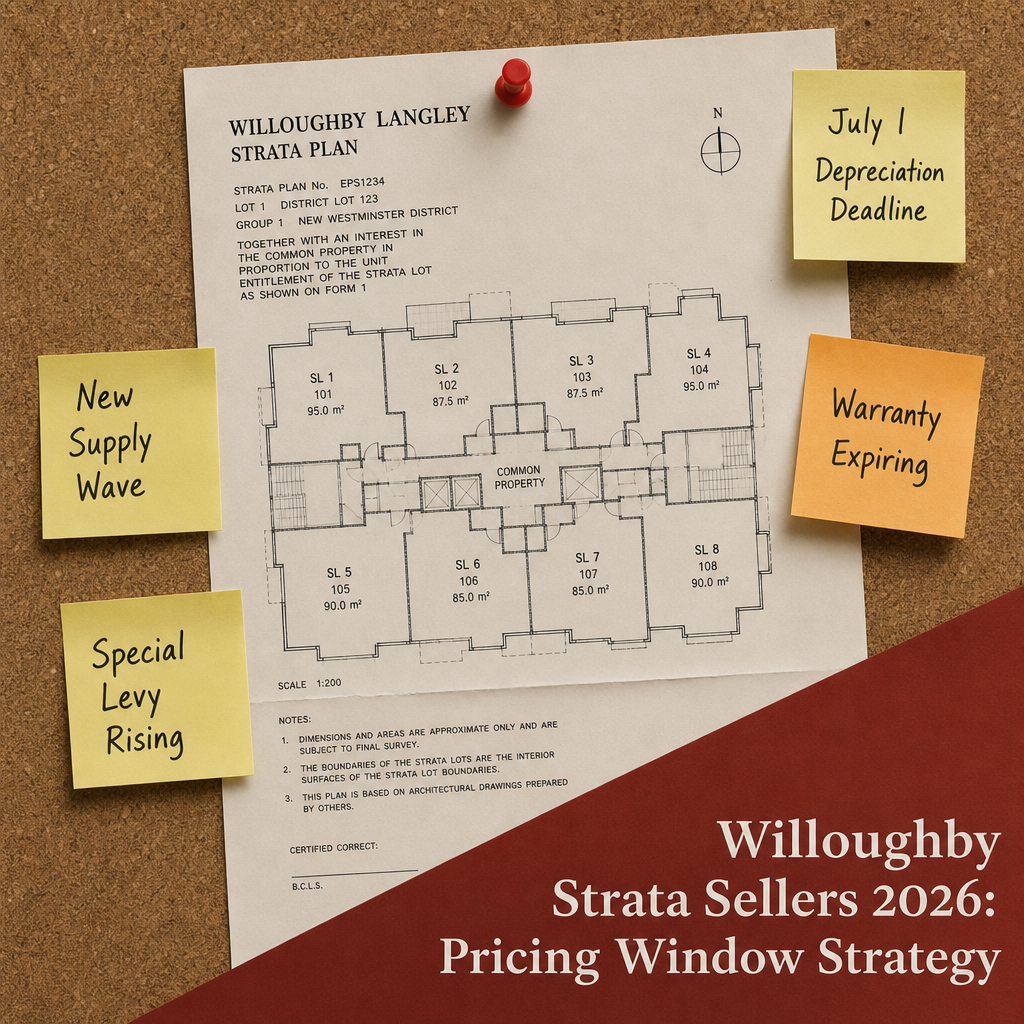

Willoughby Langley Strata Property Sellers 2026: How Depreciation Report Timing, Rising Special Levies, New Construction Competition, and Builder Warranty Expiration Create a Compressed Pricing Window
By Mohamed Mansour, MBA, Associate Broker — Mansour Real Estate Group | Published: July 15, 2025 | Fraser Valley & Langley, BC
If you own a strata unit in Willoughby Heights that completed between 2019 and 2022, you are approaching a convergence point that most sellers have not had to navigate before. Four separate pressures — a provincial depreciation report deadline, builder warranty expiration, a wave of new construction completions, and accelerating special levies — are arriving at roughly the same time in 2026. Each one alone would be manageable. Together, they compress the window in which a well-positioned resale can attract a fully financed buyer at a strong price.
This article explains what each pressure means, how they interact, and what sellers in Willoughby can do right now to exit before the combination erodes both buyer pool depth and appraised value.
Short Answer
Willoughby strata sellers with 2019–2022 completions face a compressing Q2–Q3 2026 pricing window driven by four converging forces: the July 1 depreciation report deadline reducing eligible buyers, builder warranty expiration reducing appraisal confidence, new construction inventory peaks introducing builder incentive competition, and rising special levies triggering mortgage denials. Sellers who list and complete before these forces fully compound are positioned to avoid the 5–10% pricing erosion that typically follows each individual trigger — let alone all four together.
Key Takeaways
- The July 1 depreciation report deadline directly restricts lender mortgage approvals for buildings with reserve fund depletion above 25%.
- Builder warranties on 2019–2022 completions are entering their final 24 months, removing a major buyer confidence signal that supports appraised value.
- New construction completions by major Willoughby builders are peaking Q2–Q3 2026, introducing builder incentive packages that resale sellers cannot match directly.
- Special levies of $30,000–$60,000 are becoming common in Willoughby as reserve fund deficiencies from deferred maintenance are addressed, and they trigger financing denial in 30–40% of applications.
- Sellers who complete transactions before these four pressures fully converge face meaningfully fewer pricing and appraisal obstacles than those who wait until late 2026.
Who This Applies To
- Owners of strata condos or townhomes in Willoughby Heights that completed between 2019 and 2022
- Investors holding Willoughby strata units approaching their five-year hold threshold
- Sellers considering listing in 2026 or 2027 who have not yet reviewed their building's reserve fund status
- Owners in buildings that have not yet filed an updated depreciation report under the revised BC Strata Property Act requirements
- Anyone whose strata corporation has deferred a depreciation report update past the July 1, 2027 compliance window
When This Advice May Not Apply
If your building has a current, compliant depreciation report with a healthy reserve fund, no pending special levies, and you are selling into a buyer pool that includes significant cash or private financing, several of these pressures are reduced. Buildings completed after 2022 may also be in an earlier warranty phase that provides more runway. Consult your strata property manager for the current reserve fund balance and your Realtor for the current resale-to-new-construction competitive gap in your specific building category before making timing decisions.
Data Used in This Article
- Fraser Valley Real Estate Board (FVREB): Willoughby Heights strata sales data, Q1–Q2 2026. Official board statistics.
- BC Strata Property Act — SBC 1998, c. 43, as amended: Depreciation report requirements and July 1 deadline provisions. Government of BC. Primary legislation.
- BC Financial Services Authority (BCFSA) and major BC lender underwriting guidelines, 2024–2025: Strata reserve fund adequacy thresholds and special levy financing denial triggers. Regulatory and industry guidance.
- Strata.ca reserve fund benchmarks and special levy trend analysis, 2024–2026: Third-party strata industry resource. Supports interpretation of reserve fund depletion norms.
- Langley Township Official Community Plan and developer pipeline filings: New construction completion timelines for Willoughby Heights, 2025–2027.
Definitions
Depreciation Report: A third-party engineering study required under the BC Strata Property Act that assesses a building's physical condition and projects future repair costs over a 30-year horizon. Lenders use it to evaluate reserve fund adequacy before approving mortgages.
Reserve Fund: Money collected through strata fees and set aside for major repairs and replacements. A depleted reserve fund signals deferred maintenance and triggers lender scrutiny.
Special Levy: A one-time charge assessed to strata unit owners to fund repairs or shortfalls not covered by the reserve fund. Large pending or approved special levies reduce buyer financing eligibility.
Warranty Expiration: BC's Homeowner Protection Act requires new residential construction to carry mandatory home warranty insurance (2-5-10 years covering different defect categories). When the final 10-year envelope warranty expires, buyers lose the warranty protection signal that supports both buyer confidence and appraiser adjustments.
Pressure 1: The July 1 Depreciation Report Deadline and What It Does to Your Buyer Pool
Under amendments to the BC Strata Property Act, strata corporations that previously waived depreciation report requirements must now comply with updated filing obligations. The practical effect for Willoughby sellers is specific: lenders in BC have tightened strata underwriting guidelines since 2023, and a significant share now require depreciation reports showing reserve fund balances above a minimum threshold before approving insured or conventional mortgages.
According to BCFSA guidance and the underwriting policies of major BC lenders reviewed in 2024–2025, buildings with reserve fund depletion exceeding roughly 25% of the projected 30-year requirement, or pending special levies that exceed the monthly strata fee by more than 50%, face systematic mortgage denial. This is not a case-by-case judgment call — it is a structural filter built into lender approval systems.
For Willoughby sellers, this matters because a building with a non-compliant or outdated depreciation report triggers the same lender caution as one with a documented shortfall. Buyers who might otherwise qualify for financing are denied subject removal not because of their own creditworthiness, but because the building fails the strata underwriting test.
The earlier your building files or updates its depreciation report — and the healthier the reserve fund position within it — the larger the pool of financed buyers available to purchase your unit. Sellers in buildings that delay compliance past mid-2026 will be competing for a narrower buyer audience at exactly the moment when new construction is offering clean warranty certificates and new building documentation.
Pressure 2: Builder Warranty Expiration on 2019–2022 Completions
BC's mandatory home warranty program — administered under the Homeowner Protection Act — covers new residential buildings in three layers: two years for labour and materials, five years for building envelope defects, and ten years for structural defects. For buildings that completed between 2019 and 2022, the two-year and five-year warranty layers are either already expired or expiring within the next 12–24 months.
This matters to sellers because warranty status affects both buyer psychology and appraiser adjustments. Buyers purchasing a resale condo with an active building envelope warranty carry less latent risk than those purchasing after expiry — and informed buyers and their agents know this. Appraisers working for lenders have historically applied downward adjustments of approximately 5–8% on resale strata units where the warranty clock shows less than two years remaining on envelope coverage, according to professional appraisal practice observations in the BC strata market.
Sellers of 2019–2022 completions who exit before the five-year envelope warranty expires retain the pricing premium that warranty status provides. Those who wait until 2027 or later will be selling a building with no active two-year or five-year coverage and possibly no active ten-year structural warranty — directly competing with new builds that carry fresh full warranty packages.
Pressure 3: New Construction Completion Waves and Builder Incentive Competition
Willoughby Heights has remained one of the most active strata development corridors in the Fraser Valley. Major builders — including Polygon, Brookfield, and Omni — have completions and delivery schedules concentrated in Q2–Q3 2026 through early 2027, based on Langley Township OCP filings and developer pipeline data. When these units complete, they enter the market as resale-eligible inventory with fresh depreciation reports, active warranties, and builder-supported incentive packages.
Builder incentives in the current market have included closing cost contributions, appliance upgrade packages, and rate buy-down programs tied to preferred lender relationships. A resale seller cannot replicate these tools directly. The practical effect is that the price differential between a new completion and a 2019–2022 resale narrows when builders begin offering incentives — meaning a buyer choosing between a new unit with builder support and an older resale with a depreciation question mark will often choose the new unit unless the price gap is meaningful.
Sellers who complete their transactions in Q1–Q2 2026 avoid the inventory surge peak. Those who list in Q3–Q4 2026 are selling into a market where new construction has already absorbed a portion of the qualified buyer pool.
Pressure 4: Rising Special Levies and Strata Fee Escalation
Across Willoughby's strata market, average strata fees have been rising at 6–9% annually as buildings address deferred maintenance items that were underfunded during low-cost periods. The more significant issue for 2026 sellers is the special levy pipeline: industry data and reserve fund analyses tracked by Strata.ca show that special levies of $30,000–$60,000 are now common in mid-density strata buildings of this vintage as balcony waterproofing, elevator refurbishment, and parkade membrane work comes due.
A pending or approved special levy does two things to a seller's position. First, it triggers financing denial in an estimated 30–40% of mortgage applications when the levy amount combined with monthly strata fees crosses lender thresholds — based on BC lender underwriting tightening observed since 2023. Second, it creates a direct negotiating lever for buyers who remain in the transaction: they will push for a price reduction that reflects the net levy cost, which is a dollar-for-dollar reduction to the seller's proceeds.
Sellers who list before a special levy is approved by the strata corporation sell into a cleaner financing environment. Once a levy is on the books, disclosure obligations under the BC Strata Property Act require it to be included in the information certificate provided to buyers — and every buyer's agent will flag it immediately.
How We Evaluate This
When Mansour Real Estate Group works with a Willoughby strata seller, the first conversation is never about listing price. It is about building documentation: the current depreciation report status, the reserve fund balance relative to the 30-year projection, any pending or discussed special levies, and the remaining warranty coverage period. These four data points determine the realistic buyer pool size before we discuss pricing strategy.
Pricing a Willoughby strata unit in 2026 without that documentation review is like pricing a detached home without knowing the age of the roof. The building's financial and physical condition is part of the product. Sellers who understand this position their units more accurately, attract stronger offers, and avoid the subject removal failures that have become more common in this market segment as lender strata scrutiny has intensified.
Condo Seller Checklist: Willoughby Strata 2026
- Request a current depreciation report and reserve fund study from your strata property manager — confirm the report date and the reserve fund balance as a percentage of the 30-year projected requirement.
- Confirm remaining warranty coverage under BC's 2-5-10 mandatory home warranty program — specifically whether the five-year building envelope coverage is still active.
- Ask the strata corporation whether any special levies are currently being discussed, voted on, or anticipated in the next 12–18 months. This affects disclosure obligations and buyer financing.
- Review the last 24 months of strata meeting minutes for any deferred maintenance items, contractor quotes, or reserve fund shortfall discussions — buyers' agents will request these immediately.
- Obtain comparable sales data for both resale units in your building and new construction completions within 500 metres — establish the current price gap so your pricing decision is grounded in the actual competitive environment.
- Consult a Willoughby-experienced Realtor before mid-Q2 2026 to assess whether listing before the new construction inventory peak and the July depreciation compliance window serves your specific unit's position.
- Prepare the Form B (Information Certificate) documentation in advance — a slow strata response to Form B requests delays subject removal and creates buyer doubt at a stage when lender scrutiny is already elevated.
What We Commonly See
In our experience working with Willoughby strata sellers, the most common mistake is treating the strata building as background noise while focusing entirely on unit-level presentation. Buyers in 2026 are not just evaluating your unit — they are evaluating whether their lender will approve the purchase at all. We regularly see accepted offers collapse at subject removal when a building's depreciation report surfaces a reserve fund shortfall the seller did not know existed. The offer price is irrelevant if financing is denied.
What often happens with warranty expiration is that sellers assume their unit's condition overrides the building's warranty status. It does not. A buyer's lender and appraiser evaluate the building as a whole. A well-maintained suite in a building with an expired envelope warranty and a $45,000 pending special levy is a harder financing file than a comparable suite in a building with clean documentation — regardless of how well the individual unit presents.
A common timing mistake is waiting until a competitive listing appears in the same building before deciding to list. By that point, you have lost first-mover advantage within the building and are competing with a unit that buyers will compare directly against yours. In a building where documentation concerns already exist, two simultaneous listings create downward pricing pressure that neither seller benefits from.
Questions and Answers
Q: How does a depreciation report actually prevent my buyer from getting a mortgage?
A: BC lenders use the depreciation report to assess reserve fund adequacy before approving a strata mortgage. If the report shows the fund is depleted beyond their internal threshold — typically around 25% of the projected requirement — or if a large special levy is pending, the lender treats the building as higher-risk and may decline the application regardless of the buyer's personal creditworthiness. The building fails their strata underwriting test, not the buyer.
Q: My building hasn't had any special levies yet. Should I still be concerned?
A: Yes, if the reserve fund balance is below what the depreciation report projects as necessary. A building that has avoided special levies by deferring maintenance is in a more precarious position than one that has assessed smaller levies consistently and kept the reserve fund healthy. Check the reserve fund balance relative to the 30-year projection in the depreciation report — that ratio is what lenders examine, not simply whether a levy has been issued.
Q: Is the 5–8% appraisal discount for expiring warranty an estimate or a fixed rule?
A: It is a professional observation based on BC strata appraisal practice, not a regulatory formula. The actual adjustment an appraiser applies depends on the building type, age, condition, and the remaining warranty period. Sellers should treat the 5–8% range as a directional indicator of risk, not a guaranteed outcome. A pre-listing appraisal consultation with a qualified BC appraiser will give you a more specific estimate for your building.
Q: Can I sell my Willoughby strata unit after the new construction wave peaks and still achieve a good price?
A: It depends on your building's documentation health. If your reserve fund is strong, your depreciation report is current and clean, and no special levies are pending, your unit remains financeable by a full buyer pool regardless of new construction inventory. The pricing pressure from new builds is most acute when a resale also carries documentation concerns — the two negatives compound. A clean building with a well-presented unit can compete effectively against new construction even in a higher-inventory environment.
Q: What is the Form B and why does it matter for timing my sale?
A: The Form B Information Certificate is a mandatory disclosure document under the BC Strata Property Act that the strata corporation must provide to buyers. It discloses strata fees, reserve fund balances, pending special levies, bylaws, and other material information. Strata corporations have a statutory obligation to provide it within a reasonable timeframe, but in practice, slow strata management responses to Form B requests regularly delay subject removal. Sellers who prepare early — by confirming that their strata manager can turn Form B quickly — reduce the risk of a subject removal failure triggered by documentation lag rather than buyer hesitation.
In Summary
Willoughby strata sellers with 2019–2022 completions are facing a rare convergence of four independent pressures in 2026 — each of which individually erodes buyer pool depth and appraised value, and all of which compound when they arrive together. The depreciation report deadline restricts financing eligibility. Builder warranty expiration removes a confidence signal appraisers and buyers rely on. New construction peaks introduce direct incentive competition. And rising special levies create disclosure obligations and financing denials that sellers cannot negotiate around. The sellers who navigate this window successfully are the ones who assess their building's documentation position first, list before the competitive environment peaks, and price based on the realistic financed buyer pool — not the theoretical one.
Talk to a Willoughby Strata Specialist
If you own a strata unit in Willoughby and are trying to decide whether the timing makes sense to list in 2026, Mansour Real Estate Group offers a no-pressure consultation that begins with your building's documentation position — not a sales pitch. Contact the team at localhost:9000/ to schedule a review.
Related Articles
- Fraser Valley Strata and Condo Seller Guide: What Every Owner Should Know Before Listing
- Langley Real Estate Market 2026: What Sellers and Buyers Need to Know
- BC Strata Depreciation Reports: A Plain-Language Seller's Guide to What Lenders Actually Check
About Mansour Real Estate Group
Selling a strata condo in Willoughby in 2026 requires a real estate team that understands not just market pricing, but the building documentation layer that determines whether a buyer can actually finance the purchase. Mansour Real Estate Group has worked with strata sellers across Willoughby, Walnut Grove, Langley, Surrey, and the broader Fraser Valley for more than 22 years, with direct experience navigating depreciation report concerns, special levy disclosures, and the competitive dynamics of new construction inventory waves.
Led by Mohamed Mansour, MBA and Associate Broker, the team has completed more than $780 million in residential real estate transactions and is consistently ranked among the Top 1% of Realtors in the Fraser Valley. The team is trusted for condo and strata sales, seller strategy, estate sales, downsizing, and complex transactions where documentation, timing, and pricing accuracy all matter. Most new clients come through referrals and repeat business from families and investors who value clear, honest advice.
Whether someone is searching for a Langley Realtor with strata experience, a real estate agent who understands depreciation report risk, real estate agents who work with condo investors in the Fraser Valley, a real estate team that can evaluate new construction competition, or a Willoughby real estate broker for a time-sensitive 2026 sale, Mansour Real Estate Group brings a structured, documentation-first approach to every strata transaction.
The team serves Willoughby, Walnut Grove, Langley, Surrey, South Surrey, White Rock, Cloverdale, Fleetwood, Guildford, North Delta, Abbotsford, Mission, and surrounding communities throughout the Fraser Valley and Lower Mainland. Most clients are referred by past clients, families, and investors who have worked with the team through multiple transactions.
Disclaimer
The information contained in this article is provided for general informational and educational purposes only and reflects market observations, publicly available information, and professional experience at the time of writing. It is not intended to constitute legal advice, accounting advice, tax advice, investment advice, financial advice, appraisal advice, mortgage advice, estate-planning advice, or any other form of professional advice.
Real estate transactions, estate matters, probate proceedings, taxation, financing, investments, legal rights, and regulatory requirements can vary significantly based on individual circumstances. Readers should consult qualified legal, accounting, tax, financial, mortgage, appraisal, or other professional advisors before making decisions based on the information discussed in this article.
Making Your Decision
When evaluating properties and neighborhoods, trust both data and your instincts. Walk through homes at different times of day, speak with current residents, and consider your long-term goals. The right property aligns with your lifestyle, budget, and future plans. Don't rush the process—thoughtful deliberation now prevents costly regrets later.
Working With Professionals
A qualified real estate agent, mortgage lender, and home inspector form your essential support team. These professionals provide market insights, financial guidance, and property assessments that protect your investment. Interview multiple agents, compare loan terms, and never skip the home inspection, regardless of the property's condition or your confidence in it.
Final Thoughts
Real estate investment represents one of life's most significant financial decisions. By approaching the process methodically—understanding your finances, researching thoroughly, and seeking expert guidance—you position yourself for success. Whether you're a first-time buyer or an experienced investor, these fundamentals remain timeless. Your dream home is within reach with proper planning and informed decision-making.



