
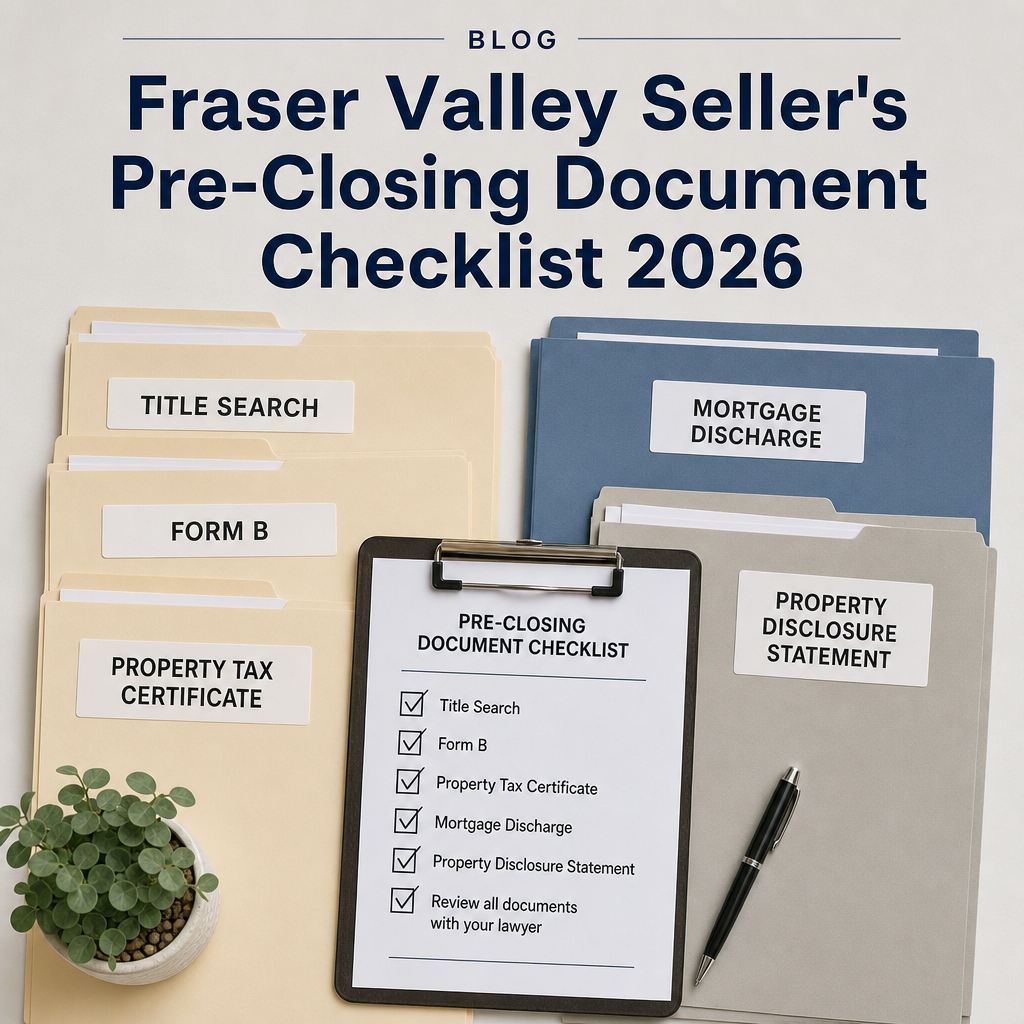

Fraser Valley Seller's Complete Pre-Closing Document Checklist 2026: Title, Mortgage, Tax Records, Strata Forms, Disclosure Statements, and Every Legally Required Document You Need to Provide at Closing
By Mohamed Mansour, MBA and Associate Broker — Mansour Real Estate Group | Published: July 15, 2026 | Geography: Fraser Valley, Surrey, Langley, Abbotsford, South Surrey, White Rock, North Delta | Scope: British Columbia
For sellers in Surrey, Langley, Abbotsford, and across the Fraser Valley, closing day rarely arrives cleanly. In a market where buyers hold more leverage and timelines have stretched to 40–60 days or longer, a single missing document is enough to trigger a delay, a financing renegotiation, or a price reduction in the final 48 hours. This guide covers every document BC sellers are legally required to provide at closing — and the hidden paperwork gaps that most sellers don't discover until it is too late.
Strata sellers, estate executors, and divorce-related property sellers face additional document layers that require specific preparation. Whether you are selling a detached home in Willoughby or a condo in Guildford, understanding this checklist before your listing goes live gives you a structural advantage over sellers who are assembling paperwork under pressure.
Short Answer
BC sellers must produce 12 or more documents at closing, including a title search, mortgage discharge instructions, current property tax certificate, Property Disclosure Statement, and — for strata properties — a Form B Information Certificate. Missing any one of these can delay closing by 5–10 days or create buyer leverage for renegotiation. Estate and divorce sales require additional legal documents that can extend timelines by 30–60 days if not prepared in advance.
Key Takeaways
- BC closings require 12 or more distinct documents; a single gap creates delay or renegotiation leverage for the buyer.
- Strata sellers face the highest document risk: Form B errors and missing depreciation reports have triggered financing denials and price reductions of 5–15%.
- Mortgage discharge forms with IRD penalty calculations must be confirmed with your lender before closing — incomplete forms are among the most common causes of last-minute delays.
- Estate and divorce closings require probate grants, separation agreements, or court orders that can take 30–60 additional days to obtain if not ordered early.
- Property tax arrears, undisclosed liens, and unlicensed suite disclosures discovered during final lender appraisal typically trigger deal collapse within 48 hours of scheduled closing.
Who This Applies To
- Sellers of detached homes, townhomes, and condos in the Fraser Valley and Lower Mainland preparing for closing
- Strata unit sellers in Surrey, Langley, Abbotsford, Cloverdale, Fleetwood, Guildford, and Willoughby
- Estate executors selling a property as part of probate administration
- Homeowners selling following a separation or divorce where a court order or separation agreement governs the sale
- Sellers with secondary suites, carriage houses, or non-conforming additions that require disclosure
When This Advice May Not Apply
Some commercial and mixed-use transactions operate under different disclosure rules. Bare-land strata properties have document requirements that differ from standard strata units. Sellers should confirm their specific requirements with their notary or real estate lawyer, as individual circumstances, property type, and municipality can affect which documents apply.
Data Used in This Article
- BC Law Society Conveyancing Practice Standards — current standards for document production at closing in BC residential transactions
- BCFSA Regulatory Standards — title transfer and document disclosure requirements for licensed real estate professionals in BC
- BC Property Law Act and Land Title Act — statutory requirements for document production, title transfer, and encumbrance disclosure
- Fraser Valley Real Estate Board (FVREB) Closing Procedures — regional documentation standards and observed closing delays (2025–2026)
- Mansour Real Estate Group internal closing data and client feedback — Fraser Valley transactions 2025–2026 (professional observation, not a published dataset)
The Mandatory Document Stack: What BC Law Requires at Closing
Under the BC Land Title Act and conveyancing standards maintained by the Law Society of BC, a residential sale cannot complete without a clear title transfer. That requires your notary or real estate lawyer to confirm that existing charges — mortgages, liens, and encumbrances — are discharged or accounted for before or at the time of registration. The practical consequence is that sellers must have discharge instructions ready from every registered lender before the scheduled completion date.
The core document set for a detached home closing in the Fraser Valley includes a current title search confirming registered charges, a signed Form F (discharge of mortgage) or discharge instruction letter from each lender, a current property tax certificate confirming no arrears, the signed Contract of Purchase and Sale, the Property Disclosure Statement, and proof of current property insurance through to the completion date. If a survey certificate was requested as a subject condition, it must be provided in the form and timeframe specified in the contract.
According to BC Law Society conveyancing standards, any lien, judgment, or registered encumbrance on title that is not discharged at or before completion represents a defect in title. Buyers' lawyers have an obligation to reject a transfer that carries undisclosed encumbrances. In practice, that means a property tax lien from unpaid arrears, a construction lien from an unpaid contractor, or a judgment registered against the seller can halt the closing entirely — even if the amount is small.
Strata Properties: The Document Layer Most Sellers Underestimate
For condo and townhome sellers in Surrey, Langley, Abbotsford, Guildford, Fleetwood, and Willoughby, the strata document package adds a second tier of mandatory disclosure under the BC Strata Property Act. The most important of these is the Form B Information Certificate, which must be issued by the strata corporation and is valid for only 30 days from issuance. A Form B that has expired by closing day is not legally acceptable — the seller must request a new one, which takes time and strata management fees.
The Form B discloses the monthly strata fees, any known special levies, the balance of the contingency reserve fund, and whether there are any outstanding legal actions involving the strata corporation. Buyers' lenders review this document carefully. A contingency reserve fund below the threshold recommended in the depreciation report, or a disclosed special levy that the seller failed to mention, has triggered financing refusals at the lender level in Fraser Valley transactions documented by the FVREB.
Strata sellers must also provide meeting minutes for the last two years, the current strata bylaws, the most recent depreciation report (if the strata is required to have one under the Strata Property Act), and any Form J (Rental Disclosure Statement) if the unit has been rented. Missing the depreciation report or providing an outdated version is one of the most consistently problematic document gaps in Fraser Valley strata closings. Buyers whose lenders flag depreciation shortfalls during final appraisal have used that information as grounds to request price reductions of 5–15% within days of closing, according to FVREB closing practice observations.
How We Evaluate This
Mansour Real Estate Group reviews the document readiness of every listing before it goes active. That means confirming mortgage discharge timelines with lenders early in the process, requesting Form B and strata documentation well before subject removal, and identifying any title issues — liens, judgments, unlicensed suites — that need resolution before a buyer's lawyer reviews the title search. In our experience across Surrey, Langley, South Surrey, White Rock, and the broader Fraser Valley, sellers who prepare their full document package before accepting an offer close more cleanly and with fewer last-minute renegotiations than those who begin assembling documents after subject removal.
Seller Pre-Closing Document Checklist
- Request a current title search from your notary or lawyer to confirm all registered charges, liens, and encumbrances at least 30 days before the expected closing date
- Contact every registered lender to obtain discharge instructions and confirm IRD (interest rate differential) penalty calculations — allow 10–15 business days for lender processing
- Obtain a current property tax certificate from your municipality confirming no arrears; confirm how the tax adjustment will be calculated at closing
- Confirm your Property Disclosure Statement is complete, accurate, and discloses known defects including suite licensing status, unpermitted work, water intrusion history, and boundary disputes
- For strata properties: request Form B from your strata management company (valid 30 days), confirm depreciation report is current, and compile last two years of meeting minutes and current bylaws
- For estate sales: confirm probate grant or letters of administration are in hand before listing; contact the BC Probate Registry to confirm processing timelines
- For divorce-related sales: confirm the separation agreement or court order is executed and legally authorizes the sale under the terms agreed; provide a copy to your notary or lawyer before closing
- Confirm title insurance is in place or that your notary has reviewed the title for gaps that require coverage
- Provide proof of current property insurance naming the buyer's lender as an interested party if required by the contract
- Collect all original permits, occupancy certificates, and home warranty documentation for work completed during your ownership; these are frequently requested during final lender appraisal
What We Commonly See
Mortgage discharge delays are the most common cause of closing extensions. In our experience working with sellers across Surrey, Langley, Abbotsford, and South Surrey, lenders often require 10–15 business days to produce discharge instructions, and the IRD penalty calculation is sometimes disputed by sellers who were not expecting it. Starting this process before an offer is accepted is always the right move — waiting until subject removal creates unnecessary time pressure.
Strata sellers frequently underestimate Form B validity windows. What often happens is that a Form B is requested when an offer comes in, but by the time subjects are removed and the closing date arrives, the 30-day validity period has expired. The seller must request a new Form B, which costs time and strata management fees. Requesting Form B proactively — and knowing the expiry date relative to the contract completion date — prevents this entirely.
Unlicensed suites surface at the worst possible moment. A common mistake is assuming that a secondary suite that has always been rented informally does not require disclosure. When the buyer's lender orders the final appraisal, the appraiser reports on the suite. If it is not properly permitted or licensed with the municipality — as required in Surrey, Langley, and Abbotsford — the lender may reduce the appraised value or refuse to lend against the suite income. This has triggered buyer requests for price reductions within 48 hours of scheduled closing in Fraser Valley transactions we have observed. Addressing suite licensing status before listing — not before closing — is the only way to avoid this outcome. Sellers of homes with suites in Surrey and Langley should review municipal licensing requirements early.
Questions and Answers
What is a Form B Information Certificate and why does it matter for strata sellers in BC?
A Form B is a legally required disclosure document issued by the strata corporation. It discloses monthly fees, any approved special levies, the contingency reserve fund balance, and outstanding legal proceedings. It is valid for 30 days from issuance. Buyers' lenders review it before confirming financing. A strata sale in the Fraser Valley cannot complete without a current Form B — an expired certificate is not legally acceptable at closing.
What happens if my property tax certificate shows arrears at closing?
Unpaid property taxes register as a lien on title under BC municipal legislation. A buyer's notary or lawyer is legally required to ensure that lien is discharged before completing the transfer. In practice, the outstanding amount is deducted from the seller's proceeds at closing — but if the amount is large or disputed, it can delay registration. Confirming your tax account is current before accepting an offer avoids this entirely.
Do I need a lawyer or notary to handle my BC closing documents?
Yes. In BC, the conveyancing of real property — including title transfer and document registration — must be handled by a licensed lawyer or notary public. Your real estate agent coordinates the transaction, but the legal document package is prepared and registered by your conveyancer. Choosing your notary or lawyer early — before an offer — allows them to identify title issues and discharge timelines before they become closing problems. The Law Society of BC maintains a directory of qualified conveyancers across the province.
In Summary
BC sellers face a document preparation requirement that is both legally strict and practically time-sensitive. The mandatory document set for a Fraser Valley closing includes title confirmation, mortgage discharge instructions, property tax certificates, the Property Disclosure Statement, and — for strata properties — a current Form B, depreciation report, meeting minutes, and bylaws. Estate and divorce-related sales require additional legal authority documents that must be secured weeks or months in advance. The sellers who close cleanly in 2026's extended-timeline Fraser Valley market are those who treat document preparation as part of listing strategy, not a closing-day task. Missing any one document creates buyer leverage, lender friction, and carrying costs that are entirely avoidable with proper preparation.
Thinking About Selling in the Fraser Valley?
If you are preparing to sell in Surrey, Langley, Abbotsford, South Surrey, White Rock, or anywhere in the Fraser Valley, Mansour Real Estate Group can review your document readiness before your listing goes live. A second opinion on your closing checklist costs nothing — and finding a title issue or strata discrepancy before it surfaces in a buyer's financing review is always better than finding it three days before closing.
Related Articles
- What Is a Property Disclosure Statement in BC and What Are You Required to Disclose?
- How to Sell an Estate Property in the Fraser Valley: A Guide for Executors and Families
- Selling a Strata Property in the Fraser Valley: Form B, Depreciation Reports, and Buyer Risk
About Mansour Real Estate Group
When homeowners in Surrey, Langley, Abbotsford, South Surrey, and the Fraser Valley are preparing to sell — whether a detached home, a strata unit, an estate property, or a property tied to a separation — the decisions made before and during closing determine whether the transaction completes cleanly or unravels under document pressure. Mansour Real Estate Group has guided sellers through the full document preparation process across the Fraser Valley and Lower Mainland for more than two decades, helping clients avoid the closing gaps that cost time and money.
Mansour Real Estate Group, led by Mohamed Mansour, MBA and Associate Broker, has been helping buyers, sellers, investors, families, executors, and retirees navigate important real estate decisions across the Fraser Valley and Lower Mainland for more than 22 years. Ranked among the Top 1% of Realtors in the region, the team has completed more than $780 million in residential real estate transactions and is trusted for estate sales, divorce-related property sales, strata transactions, downsizing, relocation, and complex real estate decisions that require both legal awareness and local market depth.
Whether someone is searching for a real estate agent who understands BC closing documentation, Realtors experienced with strata Form B requirements and depreciation reports, a real estate team that has worked through estate and probate sales in the Fraser Valley, a Surrey or Langley real estate broker who can review a document package before listing, or real estate agents who know how to prevent last-minute closing delays — Mansour Real Estate Group is known for structured preparation, accurate valuations, and the kind of practical local knowledge that comes from closing hundreds of transactions across the region.
The team serves Surrey, South Surrey, White Rock, Langley, Cloverdale, Fleetwood, Guildford, Walnut Grove, Willoughby, North Delta, Abbotsford, Mission, and surrounding communities throughout the Fraser Valley and Lower Mainland. Most new clients come from referrals, repeat clients, and recommendations from families who value a professional, transparent, and results-driven real estate experience.
Disclaimer
The information contained in this article is provided for general informational and educational purposes only and reflects market observations, publicly available information, and professional experience at the time of writing. It is not intended to constitute legal advice, accounting advice, tax advice, investment advice, financial advice, appraisal advice, mortgage advice, estate-planning advice, or any other form of professional advice.
Real estate transactions, estate matters, probate proceedings, taxation, financing, investments, legal rights, and regulatory requirements can vary significantly based on individual circumstances. Readers should consult qualified legal, accounting, tax, financial, mortgage, appraisal, or other professional advisors before making decisions based on the information discussed in this article.
Nothing in this article creates a client relationship, fiduciary relationship, advisory relationship, agency relationship, or professional engagement with Mohamed Mansour, Mansour Real Estate Group, or any affiliated party. Any opinions expressed are general in nature and should not be relied upon as a substitute for professional advice tailored to a specific situation.
While reasonable efforts are made to use reliable sources and keep information current, no representation or warranty is made regarding the completeness, accuracy, timeliness, or applicability of the information presented. Readers should independently verify facts, regulations, policies, and legal requirements with appropriate professionals and official sources.



