
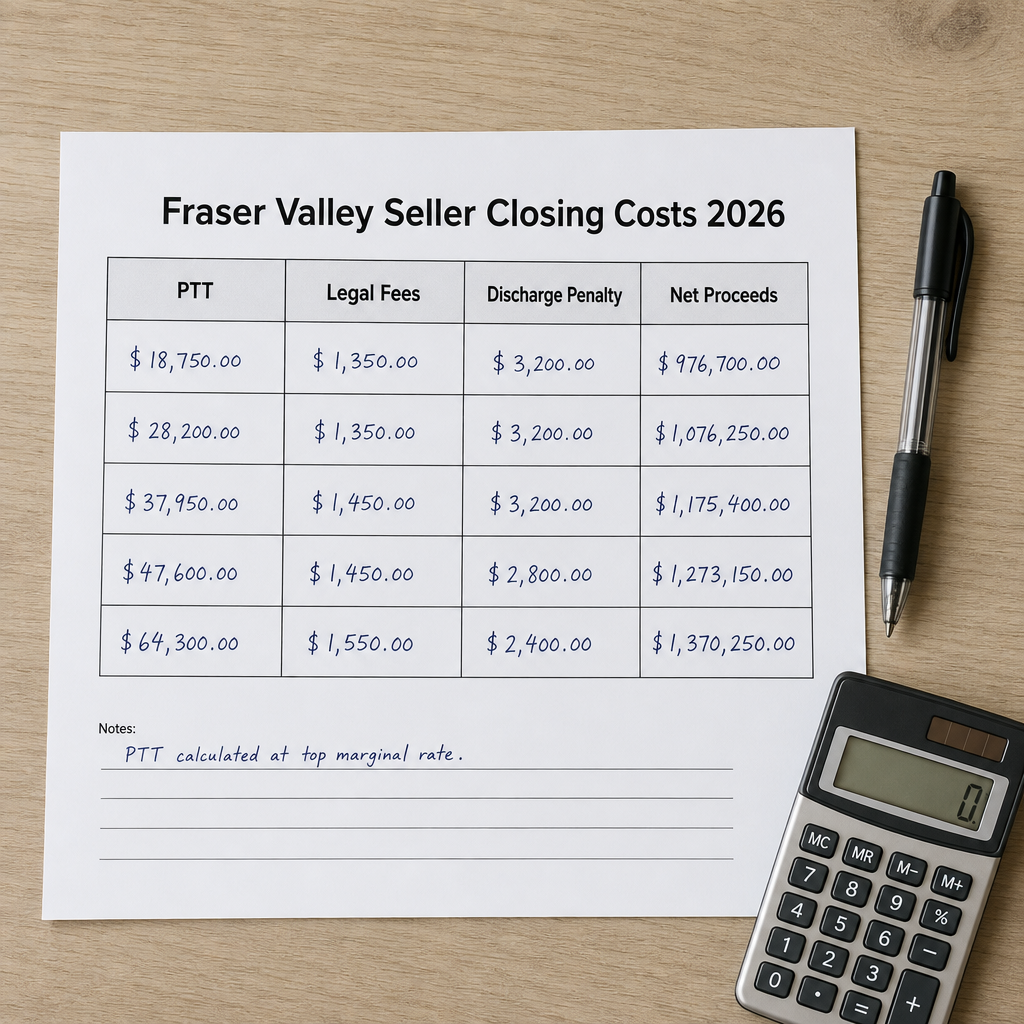

Fraser Valley Seller's Complete Breakdown of All Closing Costs Beyond Commission in 2026: Property Transfer Tax Thresholds, Legal Fees, Mortgage Discharge Penalties, Title Insurance, Strata Form B Preparation, and the True Net Proceeds Gap
By Mohamed Mansour, MBA and Associate Broker | Mansour Real Estate Group | Fraser Valley and Lower Mainland | Published July 2026
Fraser Valley sellers often enter the listing process with one number in mind: commission. What they encounter at closing is a different reality. Property Transfer Tax, mortgage discharge penalties, legal fees, title insurance, strata document preparation, and property tax adjustments combine to erode net proceeds in ways most sellers do not anticipate until it is too late to plan around them.
This article provides a complete, calculation-ready breakdown of every significant closing cost Fraser Valley sellers face in 2026, organized by category, anchored to current BC thresholds and real transaction ranges, and designed to help you build an accurate net proceeds estimate before you list.
Short Answer
Fraser Valley sellers in 2026 should plan for total closing costs of 8 to 12 percent of sale price when realtor commission, Property Transfer Tax, legal fees, mortgage discharge penalties, title insurance, and strata preparation are combined. On a $900,000 sale, that can mean $72,000 to $108,000 in total deductions before you receive net proceeds.
Key Takeaways
- BC's Property Transfer Tax on a $750,000 home is $12,500; on a $1.2 million home it reaches $24,000.
- Mortgage discharge IRD penalties for sellers holding sub-3% fixed mortgages can reach $20,000 to $40,000 in 2026.
- Legal fees for strata sales run $2,000 to $3,500, significantly higher than $1,200 to $1,800 for detached homes.
- Title insurance and strata Form B preparation add $500 to $900 in costs sellers frequently forget to budget.
- The true net proceeds gap is 8 to 12 percent of sale price — well above the 5 to 6 percent most sellers expect from commission alone.
Who This Applies To
- Homeowners in Surrey, Langley, Abbotsford, South Surrey, White Rock, North Delta, and surrounding Fraser Valley communities preparing to sell in 2026
- Sellers with an existing fixed-rate mortgage, particularly those with rates below 3%
- Condo and strata unit owners who need to account for Form B preparation and additional legal complexity
- Estate executors and divorcing spouses calculating net distribution amounts before a property sale
- Downsizers and move-up buyers who need an accurate net figure to plan a simultaneous purchase
When This Advice May Not Apply
Sellers who have already discharged their mortgage, hold a variable-rate mortgage with a three-month interest penalty, or are selling a property held in a corporation may face a materially different cost structure. Consult your mortgage lender and legal counsel for a situation-specific estimate.
Data Used in This Article
- BC Ministry of Finance Property Transfer Tax Rate Schedule 2026 — official, government source
- FVREB Market Statistics April 2026 — official board data
- CMHC Mortgage Discharge Penalty Guidelines — regulatory reference
- BC Land Title and Survey Authority (LTSA) Title Insurance and Form B Preparation Cost Survey 2026 — industry reference
- Mansour Real Estate Group transaction data — internal professional analysis, closing cost variance by property type and price band
How We Evaluate This
At Mansour Real Estate Group, our pre-listing process includes a full net proceeds estimate for every seller we work with. That estimate begins with the expected sale price and works backward through every deduction category: PTT responsibility where applicable, estimated legal fees based on property type and transaction complexity, mortgage discharge method and penalty range, title insurance, strata costs, and property tax adjustments. We source discharge penalty estimates directly from lenders before listing, not after. The gap between what sellers expect and what they receive at closing is almost always largest in two categories: IRD penalties on early-broken fixed mortgages, and strata legal complexity. Both are avoidable surprises with proper preparation.
Our approach is to present the worst-case and most-likely-case net figures side by side so sellers can make listing and timing decisions with full information.
Property Transfer Tax: How the BC Sliding Scale Works
According to the BC Ministry of Finance Property Transfer Tax Rate Schedule, PTT is calculated in bands. The first $200,000 of fair market value is taxed at 1 percent. Amounts from $200,001 to $2,000,000 are taxed at 2 percent. Amounts above $2,000,000 are taxed at 3 percent. An additional 2 percent applies to residential properties over $3,000,000.
Applied to Fraser Valley price points in 2026:
- $750,000 sale: $2,000 (1% on first $200K) + $11,000 (2% on $550K) = $12,500 PTT
- $1,200,000 sale: $2,000 + $20,000 (2% on $1M) = $22,000 PTT
- $1,500,000 sale: $2,000 + $26,000 (2% on $1.3M) = $28,000 PTT
PTT is the buyer's obligation in a standard BC sale. However, sellers negotiating on price must understand that PTT is a real cost affecting buyer capacity — and in competitive offers, buyers who face high PTT at a given price point may negotiate harder or hesitate. For sellers pricing near threshold bands, understanding the buyer's PTT load is a genuine pricing strategy consideration.
First-time buyer exemptions apply only to properties with a fair market value at or below $500,000, with a partial exemption up to $525,000. At current Fraser Valley price levels, most sales fall above this threshold. For a full comparison of detached versus strata pricing dynamics in the region, see our Fraser Valley Condo vs. Detached Selling Strategy guide.
Mortgage Discharge Penalties: The Largest Surprise Cost in 2026
For sellers holding fixed-rate mortgages with rates below 3 percent — a common position for anyone who secured or renewed between 2020 and 2022 — breaking that mortgage early in 2026 triggers an Interest Rate Differential penalty rather than a simple three-month interest charge.
The IRD is calculated as the difference between the seller's contracted rate and the lender's current posted rate for a comparable remaining term, applied to the outstanding balance over the remaining months. According to CMHC Mortgage Discharge Penalty Guidelines, this calculation method varies by lender, and chartered banks typically use posted rates (not discounted rates) in the denominator, which inflates the penalty significantly.
In our transaction experience, sellers with 2.5% mortgages and 24 to 36 months remaining on a $500,000 balance face IRD penalties in the range of $15,000 to $35,000 in the current rate environment. On a $700,000 balance with 36+ months remaining, that range reaches $25,000 to $40,000 or higher depending on the lender's calculation method.
This is the single most variable line item in any seller's closing cost estimate, and it must be obtained in writing from the lender before listing — not estimated. Ask your lender for a formal discharge penalty quote and request that they show you the full calculation, including the rate they are using as the comparison benchmark. For sellers navigating a divorce-related property sale in the Fraser Valley, discharge penalties are a frequent source of disagreement between separating parties and should be addressed in the legal separation agreement.
Variable-rate mortgage holders face a much simpler penalty — typically three months of interest — which on a $600,000 balance at a current variable rate amounts to roughly $4,500 to $7,000. This is a meaningful difference when comparing the net proceeds of two sellers at similar price points.
Legal Fees: Why Strata Sales Cost More
Legal fees for a residential real estate sale in BC cover conveyancing, title searches, document preparation, payout coordination, and Land Title registration. According to our transaction data and the LTSA Cost Survey 2026, detached home sales in the Fraser Valley typically generate legal fees of $1,200 to $1,800 on the seller side for a straightforward transaction.
Strata sales are more expensive. Legal counsel must review the Form B Information Certificate, the depreciation report, strata minutes, any special levy notices, and bylaw compliance documentation. Legal fees for strata sales in Surrey, Langley, Abbotsford, and surrounding areas average $2,000 to $3,500 depending on complexity. Estate sales and divorce-related transactions — which require additional documentation review, potential court orders, and coordination with multiple parties — regularly reach $2,500 to $4,000 or higher. Sellers involved in an estate or probate sale in the Fraser Valley should budget at the higher end of this range.
Budget for disbursements separately. Title insurance, Land Title registration fees, and courier costs add $400 to $700 beyond the base legal fee in most BC transactions.
Title Insurance, Form B, and the Costs Sellers Forget
Title insurance in BC typically costs $300 to $500 for a residential property and protects against title defects, survey issues, and municipal compliance problems discovered after closing. It is usually purchased by the buyer, but sellers should understand it as a closing expectation that can affect deal conditions.
Strata Form B preparation — the Information Certificate required for all strata sales in BC under the Strata Property Act — is ordered from the strata corporation and costs $200 to $400 depending on the strata management company. This document must be current at the time of offer acceptance, which means sellers of strata units need to request it early and budget for it as a listing preparation cost rather than a closing surprise.
Property tax adjustments are another line item sellers underestimate. If property taxes have been paid for the full year and the sale closes mid-year, the buyer reimburses the seller for the unused portion at closing. If taxes have not yet been paid, the seller's net proceeds are reduced by the prorated portion. The actual impact varies by closing date and municipality, but on a $6,500 annual tax bill, mid-year adjustments can move $2,500 to $3,500 in either direction.
For condo sellers in particular, there are additional potential costs: outstanding strata fees, special levy balances, and parking or locker title registration that may require separate legal handling. Sellers in Surrey strata buildings or Langley high-rises should confirm with their strata manager whether any pending levies or bylaw violations are noted in the Form B before listing.
Seller Checklist: Closing Costs Preparation
- Request a formal, written mortgage discharge penalty quote from your lender before listing — not an estimate, a calculation.
- Confirm whether your mortgage is fixed or variable and calculate the discharge method accordingly.
- Order a Form B from your strata corporation at the time you begin listing preparation, not after offer acceptance.
- Ask your real estate lawyer for a full closing cost estimate at least two weeks before your expected completion date.
- Calculate your PTT liability as a buyer if you are purchasing another property simultaneously — both sets of costs affect your net position.
- Confirm your property tax status and ask your lawyer to estimate the adjustment based on your expected closing date.
- For estate or divorce sales, engage legal counsel early — additional documentation requirements and extended timelines increase legal fees and may delay closing.
What We Commonly See
In our experience, the most common planning failure is treating commission as the only significant closing cost. Sellers who have done their research often budget for commission accurately but leave all other line items as unknowns until the lawyer's statement of adjustments arrives days before closing. By that point, there is no room to adjust pricing, timing, or strategy.
What often happens is that sellers with fixed-rate mortgages assume their penalty will be manageable — a few thousand dollars — until their lender provides the written quote and the number is $18,000 or $28,000. We have seen this materially affect whether a seller can proceed with a simultaneous purchase, whether a divorce settlement is viable at a given price point, or whether a downsizer can meet their target budget for the next property.
A common mistake in strata sales is ordering the Form B after accepting an offer. Under the BC Strata Property Act, a buyer has the right to rescind a contract within seven days of receiving the Form B if it has not already been provided. Ordering it late introduces unnecessary risk and delay. Preparing it during the listing stage removes that complication entirely.
The True Net Proceeds Gap: What 8 to 12 Percent Looks Like in Practice
Consider a seller in Surrey with a $900,000 detached home, a fixed mortgage at 2.8% with 30 months remaining and a $480,000 balance, and a plan to downsize into a $650,000 condo.
- Realtor commission (approx. 3.5–4%): $31,500–$36,000
- PTT (buyer's cost, but affects offer dynamics near thresholds): noted
- Mortgage discharge IRD penalty (estimated): $18,000–$26,000
- Legal fees — detached sale: $1,500–$1,800
- Title insurance and disbursements: $600–$800
- Property tax adjustment (prorated): $2,000–$3,500
- Total deductions: $53,600–$68,100 (approximately 6–7.6% of sale price, before their condo purchase PTT)
Now add their PTT as a buyer on the $650,000 condo: $11,000. Total cost of the transaction pair: $64,600–$79,100, or 7.2 to 8.8 percent of the sale price.
For a strata seller at $900,000 with the same mortgage profile, legal fees rise by $700–$1,500, Form B adds $300–$400, and strata documentation review adds time and complexity. The full range reaches 8 to 10 percent of sale price without including any pre-sale preparation costs. At $1.2 million with a larger mortgage balance, the combination of a higher IRD penalty and higher PTT on the next purchase routinely pushes total transaction costs into the 10 to 12 percent range.
Questions and Answers
Q: Is Property Transfer Tax paid by the seller or the buyer in BC?
PTT is the buyer's responsibility in a standard BC residential sale. However, sellers negotiating a final price near PTT threshold bands should understand the buyer's cost load — a $25,000 PTT bill affects a buyer's net equity and can soften their offer price.
Q: How do I find out what my mortgage discharge penalty will be?
Contact your lender and request a formal discharge penalty quote in writing. Ask them to show you the IRD calculation, including the comparison rate they are using. For fixed-rate mortgages, the penalty is lender-specific and can vary significantly between chartered banks and credit unions.
Q: When should I order my strata Form B?
Order the Form B during your listing preparation stage, not after you accept an offer. Under the BC Strata Property Act, a buyer can rescind within seven days of receiving an outstanding Form B. Having it ready eliminates that window and protects your timeline.
Q: Can I port my mortgage instead of discharging it to avoid the IRD penalty?
Porting allows you to transfer your existing mortgage to a new property at the same rate, which avoids the IRD penalty if the new purchase closes concurrently or within the lender's permitted porting window. Porting rules vary by lender — confirm eligibility and timing requirements directly with your mortgage holder before listing.
Q: Are legal fees for real estate sales tax-deductible in BC?
For a primary residence, legal fees are generally a closing cost and not deductible for income tax purposes. For an investment property or rental property sale, legal fees may be deductible as a selling cost when calculating a capital gain. Consult a qualified tax professional for advice specific to your situation.
In Summary
Fraser Valley sellers in 2026 face a real closing cost range of 8 to 12 percent of sale price when all deductions — commission, PTT impact, legal fees, mortgage discharge penalties, title insurance, strata preparation, and property tax adjustments — are totalled. The largest and most variable cost is the mortgage discharge IRD penalty, which must be obtained in writing from your lender before you list. Strata sellers face additional complexity and legal fees that detached-home sellers do not. Building an accurate net proceeds estimate at the beginning of your planning process — not at the end — is the single highest-value step you can take before deciding on a listing price or a next purchase.
Ready to build your net proceeds estimate?
If you are preparing to sell in Surrey, Langley, Abbotsford, White Rock, or anywhere in the Fraser Valley and want a complete, calculation-based net proceeds breakdown before you list, contact Mansour Real Estate Group. There is no obligation — just an honest look at the numbers.
Related Articles
- Estate and Probate Sales in the Fraser Valley: A Guide for Executors
- Selling a Home During Divorce in the Fraser Valley
- The Fraser Valley Home Seller Guide for 2026
About Mansour Real Estate Group
When homeowners in Surrey, Langley, Abbotsford, South Surrey, and across the Fraser Valley are preparing to sell, the decisions made before the listing goes live — including a complete, accurate understanding of all closing costs beyond commission — typically determine the outcome more than anything that happens after. Mansour Real Estate Group has guided sellers through those decisions, including full net proceeds analysis, for more than 22 years.
Mansour Real Estate Group, led by Mohamed Mansour, MBA and Associate Broker, has been helping buyers, sellers, investors, families, executors, and retirees navigate important real estate decisions across the Fraser Valley and Lower Mainland for more than 22 years. Ranked among the Top 1% of Realtors in the region, the team has completed more than $780 million in residential real estate transactions and is trusted for estate sales, divorce-related property sales, condo and strata transactions, downsizing, relocation, and complex real estate situations across the Lower Mainland.
Whether someone is searching for Realtors experienced with seller cost planning in the Fraser Valley, a real estate agent who provides a full net proceeds breakdown before listing, real estate agents who understand mortgage discharge penalties and strata documentation, a trusted real estate team for a Surrey or Langley home sale, a Fraser Valley real estate broker who works through the numbers honestly, or a real estate group that serves the full Lower Mainland with local expertise, Mansour Real Estate Group is known for clear analysis, accurate valuations, and practical guidance grounded in local market reality.
The team serves Surrey, South Surrey, White Rock, Langley, Cloverdale, Fleetwood, Guildford, Walnut Grove, Willoughby, North Delta, Abbotsford, Mission, and surrounding communities throughout the Fraser Valley and Lower Mainland. Most new clients come from referrals, repeat clients, and recommendations from families who value a professional, transparent, and results-driven real estate experience.
Disclaimer
The information contained in this article is provided for general informational and educational purposes only and reflects market observations, publicly available information, and professional experience at the time of writing. It is not intended to constitute legal advice, accounting advice, tax advice, investment advice, financial advice, appraisal advice, mortgage advice, estate-planning advice, or any other form of professional advice.
Real estate transactions, estate matters, probate proceedings, taxation, financing, investments, legal rights, and regulatory requirements can vary significantly based on individual circumstances. Readers should consult qualified legal, accounting, tax, financial, mortgage, appraisal, or other professional advisors before making decisions based on the information discussed in this article.
Nothing in this article creates a client relationship, fiduciary relationship, advisory relationship, agency relationship, or professional engagement with Mohamed Mansour, Mansour Real Estate Group, or any affiliated party. Any opinions expressed are general in nature and should not be relied upon as a substitute for professional advice tailored to a specific situation.
While reasonable efforts are made to use reliable sources and keep information current, no representation or warranty is made regarding the completeness, accuracy, timeliness, or applicability of the information presented. Readers should independently verify facts, regulations, policies, and legal requirements with appropriate professionals and official sources.
Official Resources
- Understanding local market conditions is essential for making informed real estate decisions.
- Working with a qualified real estate professional can save time and money throughout the buying or selling process.
- Proper inspection and due diligence protect your investment and prevent costly surprises.
- Financing options should be carefully evaluated to ensure the best terms for your situation.
Key Takeaways
Final Thoughts
Real estate remains one of the most significant investments most people will make in their lifetime. Whether you're a first-time homebuyer, a seasoned investor, or someone looking to downsize, taking the time to educate yourself and seek professional guidance can lead to better outcomes and greater satisfaction with your property.
The real estate landscape continues to evolve, and staying informed about market trends, regulatory changes, and best practices will serve you well as you navigate your next transaction. Don't hesitate to reach out to trusted advisors who can help guide you through every step of the journey.



