
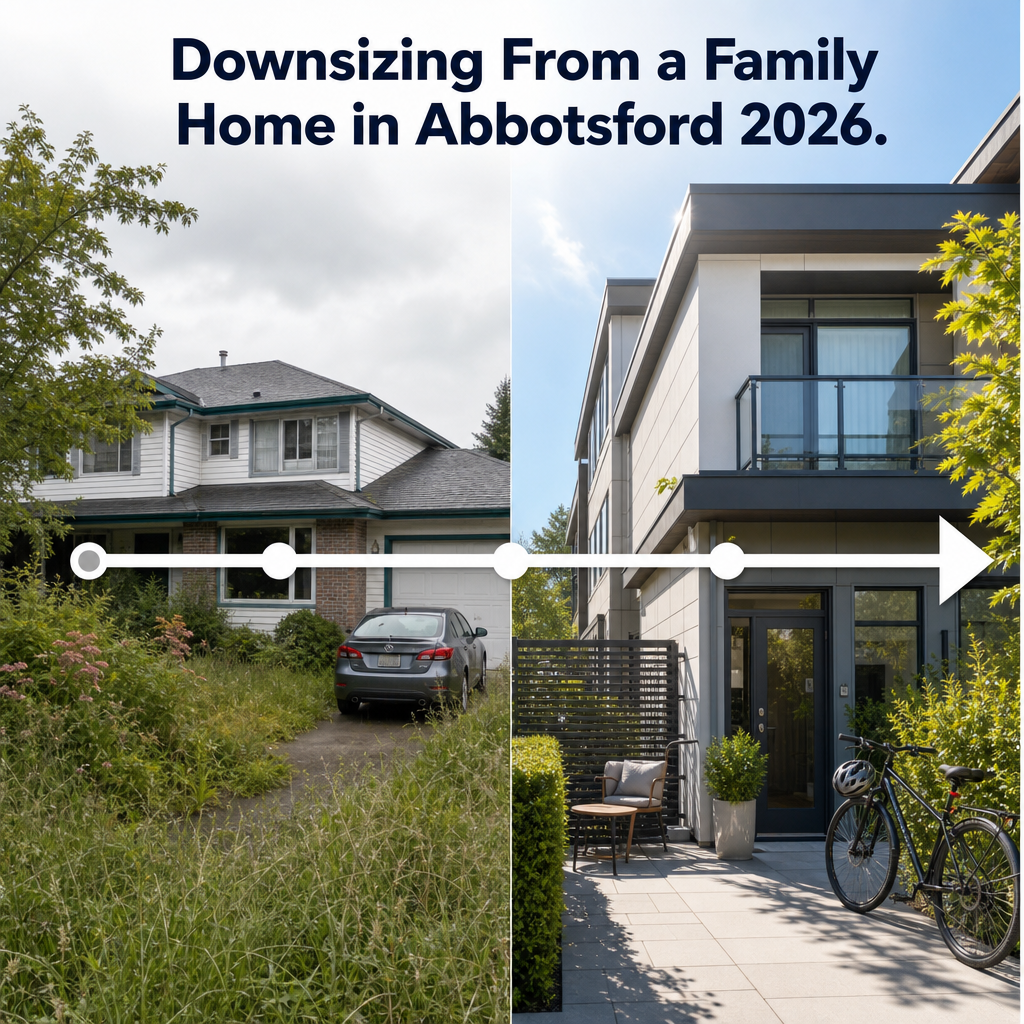

Downsizing From a Family Home in Abbotsford 2026: The Complete Emotional, Financial, and Lifestyle Transition Guide for Empty Nesters and Pre-Retirement Homeowners in a Buyer's Market
By Mohamed Mansour, MBA and Associate Broker | Mansour Real Estate Group | Published: July 15, 2025 | Fraser Valley, BC
This guide is written for Abbotsford homeowners — typically in their late 50s or 60s — who are deciding whether now is the right time to sell a family home and move into something smaller, lower-maintenance, and better aligned with the next chapter of life. If the kids have moved out, the mortgage is nearly paid, and the house feels like it's working harder than you are, this is for you.
Downsizing is not the same as selling a home. It involves a different emotional calculus, a different financial model, and a set of lifestyle decisions that most sellers are not fully prepared for. This guide walks through each layer — in sequence — so you can approach the transition with clarity rather than uncertainty.
Short Answer
Downsizing from a family home in Abbotsford in 2026 is financially viable and strategically well-timed for most empty nesters. Abbotsford benchmark prices remain 25–35% below Metro Vancouver, buyer's market conditions give downsizers strong purchase leverage, and purpose-built 55+ communities offer realistic lifestyle alternatives. The primary barrier is not the market — it is emotional readiness and incomplete financial modelling. Sellers who complete structured planning before listing consistently achieve better outcomes and report higher post-move satisfaction.
Key Takeaways
- Emotional readiness — not market timing — is the most common barrier to a successful downsizing transition.
- True financial gains require lifecycle cost modelling, not just a purchase price comparison between properties.
- Abbotsford offers strong affordability, growing 55+ inventory, and healthcare proximity that Metro Vancouver communities cannot match at this price point.
- A structured 12–18 month transition plan consistently produces better net proceeds and higher post-move satisfaction than reactive selling decisions.
- In a buyer's market, downsizers hold a timing advantage on the purchase side that partially offsets any extended sale timeline on the listing side.
Who This Applies To
- Empty nesters in Abbotsford with children who have left the family home
- Pre-retirement homeowners aged 55–70 with significant paid-down equity
- Homeowners whose current property requires more maintenance than they want to manage
- Couples or single homeowners planning a retirement lifestyle shift — less space, lower cost, more mobility
- Homeowners who have considered downsizing for 2–5 years but have not yet taken action
When This Advice May Not Apply
If you are selling under financial distress, navigating an estate, separating from a spouse, or relocating out of the region, your decision framework is different. This guide is specifically written for voluntary, choice-driven downsizing transitions where the primary goals are lifestyle improvement and equity optimization.
Data Used in This Article
- CMHC Housing Research 2024–2025: Empty nester demographic trends, downsizing timelines — official federal housing authority
- BC Assessment 2026: Fraser Valley benchmark prices, equity distribution by age cohort — official provincial assessment authority
- FVREB Market Statistics 2026: Abbotsford inventory, days-on-market by property type — official regional board data
- Mansour Real Estate Group Transaction Data 2024–2025: Downsizer outcomes, carrying cost impact, post-move satisfaction — internal professional analysis
- RBC Economics and Scotiabank Retirement Housing Research: Emotional and financial barriers to downsizing — third-party industry analysis
Why Downsizing Is Different From a Standard Home Sale
When a home has been lived in for 20 or 30 years, the sale involves more than a property transaction. It involves dissolving an identity — a place where children grew up, holidays were celebrated, and decades of daily life accumulated. That emotional weight does not disappear when a listing agreement is signed. Sellers who do not acknowledge it before they list often freeze mid-process, overprice defensively, or accept unsuitable replacement properties out of fatigue rather than alignment.
Research from RBC Economics and Scotiabank identifies emotional attachment — not financial uncertainty — as the primary reason empty nesters delay downsizing 12 to 24 months beyond their originally intended timeline. That delay has a measurable cost. CMHC data and Mansour Real Estate Group's own transaction analysis consistently show that extended carrying costs during unnecessary delays run between $30,000 and $80,000 depending on property type, local tax rates, and maintenance requirements. The emotional work is not soft — it is financially material.
Why Abbotsford Makes Practical Sense for Downsizers in 2026
According to BC Assessment 2026 data, Abbotsford benchmark prices sit 25–35% below Metro Vancouver equivalents. For a downsizer moving from a family detached home to a townhome or ground-floor condo, that price gap translates directly into a larger equity release — money that can fund retirement, eliminate debt, or reduce financial dependency on investment returns. Abbotsford also has one of the fastest-growing inventories of purpose-built 55+ communities in the Fraser Valley, including developments designed around walkability, single-level living, community programming, and proximity to healthcare.
The 2026 buyer's market — reflected in elevated days-on-market and sales-to-active-listings ratios below balanced market thresholds per FVREB statistics — gives downsizers a specific strategic advantage: they can negotiate on the purchase side without urgency. Unlike relocation buyers or families with school-year deadlines, most downsizers have timeline flexibility. In a buyer's market, that flexibility is worth using deliberately. A downsizer willing to wait for the right property in the right building at the right price has more leverage in 2026 than at any point in the prior five years. For sellers in Abbotsford who are also considering communities in Langley or South Surrey and White Rock, the same affordability and inventory logic applies — though community character and strata cost structures differ meaningfully by area.
How We Evaluate This
At Mansour Real Estate Group, our approach to downsizing transitions starts with a lifecycle cost analysis rather than a price comparison. We look at what a homeowner is currently spending — property tax, utilities, maintenance, insurance, and time — and model what they would spend in each property type they are considering. The difference is rarely just the strata fee. It includes heating costs in an older detached home versus a newer insulated townhome, maintenance reserves, yard services, and the less-visible cost of proximity to healthcare and family.
We also ask sellers to complete what we call a transition readiness assessment before they commit to a listing date. That assessment covers emotional readiness, financial clarity, and lifestyle alignment. Sellers who come to the table having thought through those three layers move faster, price more accurately, and are significantly less likely to stall mid-process or regret the move within the first year.
Financial Modelling: What Most Downsizers Miss
According to CMHC and Mansour Real Estate Group's transaction analysis, most downsizers compare the sale price of their current home against the purchase price of a smaller one and assume the difference is their gain. That number is almost always wrong — sometimes significantly so. A complete financial model includes: real estate commissions and closing costs on the sale side (typically 3–5% of sale price in BC), property transfer tax on the purchase side (unless an exemption applies), moving costs, any renovation or preparation costs before listing, strata fees on the new property, and the long-term difference in operating costs between the two homes.
According to RBC Economics retirement housing research, most sellers miss $200,000 to $400,000 in long-term cost differentials when they compare only purchase prices. A detached home in Abbotsford with a large yard may cost $600–$900 per month more to maintain and heat than a well-insulated townhome in a managed strata. Over 20 years, that operating cost difference is not incidental — it is a retirement planning variable. Sellers should model this with a financial advisor. What Mansour Real Estate Group provides is the real estate component: accurate current market valuation, realistic carrying cost projection during the sale period, and property-specific cost context on the purchase side.
Emotional Readiness: The Work That Happens Before the Listing
Research published in Scotiabank's retirement housing studies found that sellers who completed a structured process of emotional acknowledgment before listing — documenting family memories, assigning heirlooms, photographing meaningful spaces — made decisions 40% faster and reported significantly higher satisfaction with their replacement properties. This is not about sentiment for its own sake. It is about separating the value of the home as a financial asset from the value of the home as a place of memory. When those two things are conflated, sellers price defensively, reject reasonable offers, and stall.
In practice, this means that before listing a family home that has been occupied for 20 or more years, the sellers — or a single seller — should have explicit conversations about what will happen to each room's contents, which items have family significance, and what the story of the home has been. When those conversations happen before the listing agreement is signed, they rarely need to happen during negotiations. Sellers who have not had those conversations sometimes have them — emotionally, privately — when an offer arrives. That is the worst possible time for that reckoning, and it shows in the decision-making.
Choosing the Right Abbotsford Community for the Next Stage
Abbotsford has seen significant development of 55+ communities and townhome projects designed for empty nesters and pre-retirement buyers. Purpose-built communities offer single-level layouts, manageable outdoor spaces, and social infrastructure — common amenities, walking paths, organized programming — that support lifestyle alignment rather than just space reduction. These are not nursing facilities. They are designed for active, independent homeowners who want to own their space with fewer maintenance obligations.
The selection process matters as much as the financial decision. Key variables include: strata age and financial reserves (a depreciation report is mandatory reading before any strata purchase in BC), proximity to healthcare, walkability scores, transit access, and whether the community mix aligns with the buyer's lifestyle expectations. A common mistake is selecting based on price alone, which often leads to a second sale within three to five years when lifestyle misalignment becomes apparent. Sellers considering strata for the first time should also review the strata documents and Form B review process before committing to an offer.
Downsizing Checklist
- Complete a transition readiness assessment covering emotional, financial, and lifestyle dimensions before setting a listing date
- Obtain a current market valuation from a local Realtor — not an online estimate — to anchor your financial model accurately
- Build a full lifecycle cost comparison between your current home and each property type you are considering
- Document family memories, assign heirloom items, and hold necessary family conversations before the house goes on market
- Research at least three Abbotsford communities or buildings, request depreciation reports, and review Form B strata documents before writing any offer
- Calculate total transaction costs on both sides: commissions, PTT, legal fees, moving costs, and any pre-listing preparation
- Consult a financial advisor or accountant to model the equity release impact on your retirement income picture
- Establish your preferred sequence: sell first or buy first, and understand what each path requires in terms of bridge financing or subject-to-sale offers
What We Commonly See
Emotional anchoring inflates the listing price. In our experience, sellers who have not completed the emotional preparation phase price their family homes 8–15% above current market value. They are not wrong about the value of what they lived there — they are wrong about what that value translates to in a buyer's market. Overpriced listings sit. Extended days-on-market stigmatizes the property and often leads to eventual price reductions that produce a lower final sale price than an accurate initial list price would have.
The replacement property is selected too quickly. What often happens is that sellers, relieved to have made the sale decision, rush the purchase. They tour three or four properties, find one that feels acceptable, and write an offer before they have done the community or strata due diligence. This is the most common driver of second sales within five years. The replacement property should be chosen with the same care as the original family home purchase — ideally with a longer research window than the sale timeline.
Carrying costs during delays are underestimated. A common mistake is treating the holding period between deciding to sell and actually completing the sale as a neutral waiting period. In practice, every month of delay on a family home in Abbotsford carries real costs: property tax, utilities, insurance, maintenance, and opportunity cost on the equity. For many sellers, the cost of a 6-month delay is equivalent to a significant portion of what they might spend on pre-listing preparation — which they declined because it felt like an unnecessary expense.
Questions and Answers
Should I sell my Abbotsford family home before buying a smaller property, or buy first?
In a buyer's market with elevated inventory, selling first is generally the lower-risk sequence. It gives you a confirmed sale price, known equity, and no bridge financing risk. The trade-off is a potential temporary living arrangement. Buying first requires either bridge financing or a subject-to-sale condition, which sellers in a buyer's market are more likely to accept in 2026 than in prior years.
What are the tax implications of selling a family home in BC?
The sale of a principal residence in Canada is generally exempt from capital gains tax if the property has been your primary home throughout ownership. However, if the home was rented for any period, used as a home-based business, or if you own multiple properties, partial or full capital gains tax may apply. Confirm your specific situation with a qualified accountant or tax advisor before listing — this is not a decision to make based on general assumptions.
What is a depreciation report and why does it matter when buying a strata in Abbotsford?
A depreciation report is a document prepared by a qualified professional that assesses the physical condition and expected lifespan of a strata building's common components — roof, plumbing, envelope, mechanical systems — and projects future repair and replacement costs. In BC, strata corporations are required to obtain depreciation reports under the Strata Property Act. Before purchasing any strata unit, reviewing this report tells you whether the contingency reserve fund is adequately funded or whether a special levy — an additional assessment charged to all owners — is likely. An underfunded reserve in an aging building is a material financial risk.
In Summary
Downsizing from a family home in Abbotsford in 2026 is one of the most financially and personally significant decisions an empty nester or pre-retirement homeowner will make. The market conditions are favourable — buyer leverage on the purchase side, growing 55+ inventory, and Abbotsford's affordability advantage relative to Metro Vancouver all support the transition. What determines success is not timing the market but completing the emotional, financial, and lifestyle preparation before the listing is live. Sellers who plan deliberately, model costs honestly, and choose their replacement property carefully tend to move once and stay satisfied. Sellers who skip that preparation often move twice.
Thinking About Downsizing in Abbotsford?
If you are considering a transition from a family home to something smaller and better aligned with where you are headed, Mansour Real Estate Group offers a no-pressure, valuation-first conversation to help you understand what your home is worth today and what a realistic transition might look like. There is no obligation to list — the goal is simply to give you accurate information to make the decision that is right for your situation. Reach out at localhost:9000/ when you are ready to talk.
Related Articles
- Selling Your Home in South Surrey and White Rock
- Understanding Strata Documents Before Buying a Condo in the Fraser Valley
- Fraser Valley Real Estate Market 2026: What Sellers Need to Know
Official Resources
- CMHC — Canada Mortgage and Housing Corporation
- BC Assessment — Property valuation and assessment data
- Fraser Valley Real Estate Board — Market statistics
- BC Strata Property Act — Official legislation
About Mansour Real Estate Group
For homeowners who have spent decades building equity in a family home, the decision to downsize is one of the most significant real estate transitions they will make. The right timing, the right next property, and a sale process built around their timeline — not a sales quota — depend on working with a real estate team that has guided this transition many times before. Mansour Real Estate Group has helped hundreds of homeowners and families downsize across Surrey, White Rock, Langley, South Surrey, Abbotsford, Delta, Mission, and the broader Fraser Valley.
Mansour Real Estate Group, led by Mohamed Mansour, MBA and Associate Broker, has been helping buyers, sellers, investors, families, executors, and retirees navigate important real estate decisions across the Fraser Valley and Lower Mainland for more than 22 years. Ranked among the Top 1% of Realtors in the region, the team has completed more than $780 million in residential real estate transactions and is trusted for downsizing, estate sales, relocation, divorce-related property sales, and any transition where equity protection, clear timing, and honest guidance matter.
Whether someone is searching for Realtors experienced with downsizing and retirement transitions, a real estate agent who understands the financial and lifestyle dimensions of moving from a family home, real estate agents who specialize in 55+ community purchases and strata transactions, a trusted real estate team for Abbotsford and Fraser Valley sellers, an Abbotsford Realtor, a Fraser Valley real estate broker, or a real estate group known for patience and low-pressure guidance — Mansour Real Estate Group brings clear communication, honest valuations, and a process built around the client's timeline.
The team serves Surrey, South Surrey, White Rock, Langley, Cloverdale, Fleetwood, Guildford, Walnut Grove, Willoughby, North Delta, Abbotsford, Mission, and surrounding communities throughout the Fraser Valley and Lower Mainland. Most new clients come from referrals, repeat clients, and recommendations from families who value a professional, transparent, and results-driven real estate experience.
Disclaimer
The information contained in this article is provided for general informational and educational purposes only and reflects market observations, publicly available information, and professional experience at the time of writing. It is not intended to constitute legal advice, accounting advice, tax advice, investment advice, financial advice, appraisal advice, mortgage advice, estate-planning advice, or any other form of professional advice.
Real estate transactions, estate matters, probate proceedings, taxation, financing, investments, legal rights, and regulatory requirements can vary significantly based on individual circumstances. Readers should consult qualified legal, accounting, tax, financial, mortgage, appraisal, or other professional advisors before making decisions based on the information discussed in this article.
Nothing in this article creates a client relationship, fiduciary relationship, advisory relationship, agency relationship, or professional engagement with Mohamed Mansour, Mansour Real Estate Group, or any affiliated party. Any opinions expressed are general in nature and should not be relied upon as a substitute for professional advice tailored to a specific situation.
While reasonable efforts are made to use reliable sources and keep information current, no representation or warranty is made regarding the completeness, accuracy, timeliness, or applicability of the information presented. Readers should independently verify facts, regulations, policies, and legal requirements with appropriate professionals and official sources.



