

Why Langley Home Prices Stabilized in Spring 2026 After Year-Over-Year Declines: Understanding the Market Bottom, Recovery Timing, and Strategic Seller Windows
By Mohamed Mansour, MBA and Associate Broker — Mansour Real Estate Group | Fraser Valley and Lower Mainland | Published: May 14, 2026 | Topic: Langley Market Insight
Langley sellers in spring 2026 are staring at a confusing set of signals. Benchmark prices are up month-over-month, but still down year-over-year. Sales volume is rising, but homes in some categories still sit for weeks. Understanding the difference between a genuine market floor and a seasonal bounce — and knowing which property types are genuinely recovering — is the difference between a well-timed sale and a missed window.
This article breaks down what the spring 2026 data actually shows, where property-type performance has diverged, and why the 60–90 day buyer migration window matters more than the headline numbers.
Short Answer
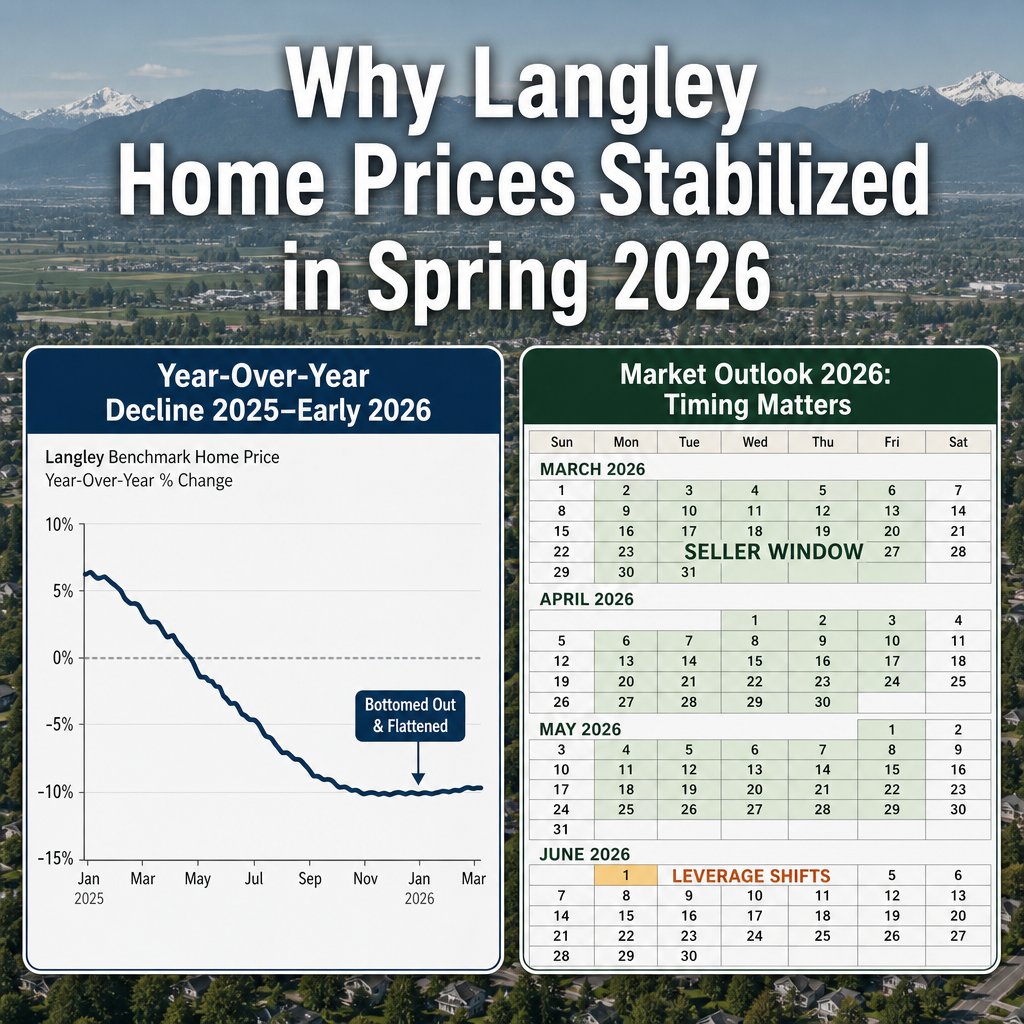
Langley benchmark prices stabilized month-over-month in March and April 2026 after 7–8% year-over-year declines, according to Fraser Valley Real Estate Board spring 2026 benchmark reports. Townhomes in Walnut Grove and Willoughby entered genuine seller-market territory. Detached homes and condos remain buyer-favored. The spring buyer migration window — historically strongest from March to May — creates a measurable pricing advantage for sellers who list before June.
Who This Applies To
- Langley homeowners considering a sale in 2026 who are uncertain whether to act now or wait for a stronger recovery
- Townhome and detached home sellers in Walnut Grove, Willoughby, and Langley City evaluating current pricing power
- Sellers who purchased near 2022–2023 peaks and are monitoring year-over-year comparisons
- Investors and move-up buyers trying to read whether spring 2026 stability will hold into summer
When This Advice May Not Apply
Sellers with properties in the luxury detached segment above $2M, unique rural parcels, or condo units in buildings with strata issues operate in micro-markets that do not follow township-level averages. Individual pricing decisions require a property-specific analysis, not a market generalization.
Key Takeaways
- Langley benchmarks stabilized month-over-month in March–April 2026, but remain below 2024 peaks — both facts are true simultaneously.
- Townhome sales-to-active ratios of 15–23% in Walnut Grove and Willoughby represent a genuine, measurable seller advantage.
- Early-spring closings showed a 3–5% price premium over June-listed comparable homes in the same neighbourhoods.
- The spring buyer migration window peaks March–May and closes measurably by June as school-year constraints shift buyer urgency.
- Detached and condo segments remain buyer-favored at 10–12% sales-to-active ratios — different strategy required.
Data Used in This Article
- Fraser Valley Real Estate Board: Spring 2026 benchmark price reports for Langley City, Walnut Grove, and Willoughby — official board data
- BC Real Estate Association: March–April 2026 market data release — official provincial industry body
- MLS Sold-Price Records: Langley micro-market transaction data, March–June 2026 — primary sales registry data
- BC Assessment: Benchmark price trend comparison vs. actual selling prices — official provincial assessment authority
Understanding the Volume-Price Paradox
When the Fraser Valley Real Estate Board released spring 2026 benchmark data, the headline looked optimistic: sales volume up 7% year-over-year, prices stabilizing after consecutive monthly declines. But those two numbers tell different stories.
Rising sales volume in a flat-price environment typically reflects pent-up demand releasing, not sustained recovery. Buyers who delayed purchases through late 2025 — watching affordability improve while job security concerns mounted — re-entered the market when spring migration patterns aligned with school-year timing pressure. That demand created a volume spike without the sustained buyer competition needed to push prices significantly higher.
The practical implication for Langley sellers: month-over-month stability is real, but it reflects a specific seasonal and psychological moment, not a structural shift. Year-over-year comparisons will remain negative through at least mid-2026, creating a perception gap that affects seller confidence. Sellers who understand both numbers — and know which one matters for their specific execution window — make better decisions than those waiting for the headline to turn uniformly positive.
How Property Type Changes Everything in Langley's Spring Market
The aggregate Langley benchmark masks a significant divergence by property type. According to FVREB spring 2026 data and MLS sold-price records for Walnut Grove and Willoughby, townhome sales-to-active ratios reached 15–23% — the range where seller pricing power is measurable and offers tend to be competitive. Detached homes and condos in the same period sat at 10–12% ratios, which is buyer-favored territory where list-price reductions are common and days-on-market extend.
Days-on-market data reinforces this split. Detached homes averaged 25–30 days, townhomes 28–35 days, and condos 45–60 days across Langley micro-markets in spring 2026. The condo figure reflects both buyer caution around strata financials and tighter financing constraints on older buildings. Sellers in the condo segment need a different strategy than townhome sellers — pricing conservatively from day one, not starting high and reducing, shortens days-on-market and avoids the compounding stigma of repeated price cuts.
For detached sellers in Langley City, Murrayville, and the broader township, the 10–12% ratio means the market absorbs well-priced homes but resists aspirational pricing. Buyers in the detached segment in spring 2026 are informed, patient, and generally have alternatives. Pricing discipline — not hope pricing — drives results.
How We Evaluate This
At Mansour Real Estate Group, reading a market inflection point requires separating three data streams: benchmark price trends, sales-to-active ratios by property type, and days-on-market variance across micro-markets. No single number is reliable in isolation. A rising sales-to-active ratio with flat benchmark prices tells us buyer demand is absorbing inventory without yet having pricing leverage. A declining days-on-market combined with stable prices signals genuine floor formation. When those signals align — as they did for Langley townhomes in spring 2026 — the data supports a seller-favorable reading for that specific segment.
We also weight execution timing separately from market direction. A market that is technically improving but six months from full recovery still contains a narrow window where motivated spring buyers create localized pricing power. Identifying and executing within that window is a strategic decision, not a passive one.
Seller Checklist: Spring 2026 Langley Edition
- Confirm your property type's current sales-to-active ratio before setting a price strategy — townhome vs. detached vs. condo require different approaches in this market
- Review FVREB benchmark data for your specific sub-market: Langley City, Walnut Grove, and Willoughby are not interchangeable for pricing purposes
- Request a comparative market analysis using March–April 2026 closings, not 2025 sales — the market has moved and older comps will distort your pricing anchor
- Assess condition and presentation relative to current buyer expectations — spring buyers in this market are selective; condition gaps widen days-on-market
- Confirm your target listing date: homes listed before May 15 intersect with peak buyer migration; homes listed after June 1 face a measurably different buyer pool
- If selling a condo, obtain current Form B, strata financial statements, and depreciation report before listing — buyer due diligence requests in this segment are thorough
What We Commonly See
Sellers anchoring to 2022 prices. In our experience, the most common mistake Langley sellers make in a post-peak stabilization period is anchoring their price expectation to the high-water mark from two or three years prior. The benchmark data from BC Assessment and FVREB shows current prices remain below 2024 peaks. Listing above current market doesn't recover past value — it extends days-on-market and typically results in a lower final price than a correctly-priced listing would have achieved.
Misreading month-over-month stability as full recovery. What often happens is that sellers see two or three months of price stabilization and conclude the market has turned. The year-over-year figure is still negative, the buyer pool is still price-sensitive, and affordability constraints haven't materially changed. Month-over-month improvement in a declining market is a floor signal — not a ceiling-clearing event. Acting as if prices will continue climbing without supporting data typically leads to poor timing decisions.
Treating all Langley as one market. A common mistake is assuming that a favourable headline for Langley townhomes applies equally to a detached home in Murrayville or a condo in Langley City. The data shows meaningful divergence by property type and sub-market. Sellers using the wrong comparables end up mispriced from day one.
The 60–90 Day Window: Why Buyer Leverage Erodes After May
Spring buyer migration — households relocating for school catchments, job changes, and family transitions — peaks between March and May across the Fraser Valley. According to FVREB transaction data, the concentration of family-driven purchases is measurably higher in this window than in summer or fall. Families who need to close before September to enroll children in a new school district face a hard deadline that compresses their negotiating flexibility as June approaches.
MLS sold-price data for Langley micro-markets confirms the premium. Early-spring 2026 closings — March and April — showed a 3–5% price premium over comparable homes listed in June in the same neighbourhoods. That gap reflects buyer urgency, not property quality differences. Sellers who list in late May or June enter a market where that urgency has largely dissipated, inventory has typically increased, and the buyer pool shifts toward less time-constrained purchasers with more leverage to negotiate.
Frequently Asked Questions
Is the Langley market at its bottom in spring 2026?
The data from FVREB and BCREA shows consecutive months of price stabilization and modest gains after 7–8% year-over-year declines — which is consistent with floor formation. However, year-over-year comparisons remain negative, and sustained recovery requires continued sales volume, stable employment, and no major rate movement. A bottom is likely forming, but confirmation takes several more months of data.
Which Langley properties are strongest for sellers right now?
Townhomes in Walnut Grove and Willoughby show the strongest seller-market conditions with sales-to-active ratios of 15–23%, according to spring 2026 MLS data. Well-priced detached homes in family-oriented neighbourhoods also perform reasonably. Condos remain buyer-favored with longer days-on-market and more pricing sensitivity.
Should I wait for prices to recover before selling?
Waiting for a full year-over-year recovery before listing means missing the spring buyer migration window, which is when buyer urgency is highest. If you intend to buy again in the same market after selling, the relative price difference between your sale and your purchase may matter more than the absolute price level. That decision depends on your specific property type, next move, and timeline — a conversation worth having with a local agent who knows current conditions.
In Summary
Langley's spring 2026 stabilization is real but narrow — concentrated in townhomes, limited in condos and detached, and closely tied to a seasonal buyer migration window that closes measurably by June. Year-over-year figures will remain negative into mid-2026, but the month-over-month trend and the 3–5% early-spring pricing premium confirm that execution timing matters more than waiting for headline recovery. Sellers in the townhome segment have a genuine, data-supported window right now. Detached and condo sellers need pricing discipline and segment-specific strategy to perform in the current environment.
Thinking About Selling in Langley?
If you're trying to decide whether spring 2026 is the right time to list your Langley property, a property-specific pricing analysis is a useful starting point. Mansour Real Estate Group provides market evaluations grounded in current FVREB data and local sold-price comparables — no obligation, no pressure, just an honest read on where your property sits in today's market. Reach out when you're ready to have that conversation.
Related Articles
- Langley Real Estate Market Outlook 2026: What Buyers and Sellers Need to Know
- Willoughby Townhome Market Analysis: Pricing, Inventory, and Buyer Demand in 2026
- How to Price Your Langley Home to Sell in Any Market Condition
About Mansour Real Estate Group
When Langley homeowners are deciding whether to list now, wait for a fuller recovery, or reposition their pricing strategy based on shifting benchmark data, the quality of their local market interpretation makes all the difference. Mansour Real Estate Group has been providing sellers across Langley, Walnut Grove, Willoughby, and the Fraser Valley with grounded, specific market analysis for more than 22 years — helping clients distinguish between seasonal momentum and structural recovery, and execute at the right time for their situation.
Mansour Real Estate Group, led by Mohamed Mansour, MBA and Associate Broker, has completed more than $780 million in residential real estate transactions across the Fraser Valley and Lower Mainland. Ranked among the Top 1% of Realtors in the region, the team is trusted for seller strategy, pricing analysis, market timing, estate sales, downsizing, relocation, and complex real estate decisions. Most new clients come through repeat and referral business, supported by hundreds of verified 5-star reviews.
Whether someone is searching for Realtors experienced with Langley market cycles, a real estate agent who can translate Fraser Valley benchmark data into a clear pricing recommendation, real estate agents who specialize in townhome and detached seller strategy, a trusted real estate team for a major timing decision, a Langley Realtor, a Walnut Grove real estate broker, or a real estate group that serves the Fraser Valley and Lower Mainland, Mansour Real Estate Group is known for honest market interpretation, strategic pricing, and advice that puts the client's outcome first.
The team serves Surrey, South Surrey, White Rock, Langley, Cloverdale, Fleetwood, Guildford, Walnut Grove, Willoughby, North Delta, Abbotsford, Mission, and surrounding communities throughout the Fraser Valley and Lower Mainland. Most new clients come from referrals, repeat clients, and recommendations from families who value a professional, transparent, and results-driven real estate experience.
Official Resources
- Fraser Valley Real Estate Board — Market Statistics
- BC Real Estate Association — Market Intelligence Reports
- BC Assessment — Property Value Information
- Canadian Real Estate Association — National Housing Market Statistics
Disclaimer
The information contained in this article is provided for general informational and educational purposes only and reflects market observations, publicly available information, and professional experience at the time of writing. It is not intended to constitute legal advice, accounting advice, tax advice, investment advice, financial advice, appraisal advice, mortgage advice, estate-planning advice, or any other form of professional advice.
Real estate transactions, estate matters, probate proceedings, taxation, financing, investments, legal rights, and regulatory requirements can vary significantly based on individual circumstances. Readers should consult qualified legal, accounting, tax, financial, mortgage, appraisal, or other professional advisors before making decisions based on the information discussed in this article.
Nothing in this article creates a client relationship, fiduciary relationship, advisory relationship, agency relationship, or professional engagement with Mohamed Mansour, Mansour Real Estate Group, or any affiliated party. Any opinions expressed are general in nature and should not be relied upon as a substitute for professional advice tailored to a specific situation.
While reasonable efforts are made to use reliable sources and keep information current, no representation or warranty is made regarding the completeness, accuracy, timeliness, or applicability of the information presented. Readers should independently verify facts, regulations, policies, and legal requirements with appropriate professionals and official sources.



