

How Seller Concessions Are Reshaping Fraser Valley Closing Timelines and Deal Psychology in 2026
By Mohamed Mansour, MBA and Associate Broker | Mansour Real Estate Group | Published: May 13, 2026 | Fraser Valley and Lower Mainland, BC
Fraser Valley sellers in Spring 2026 are navigating one of the most concession-heavy markets in years. With more than 10,000 active listings and a sales-to-active ratio of approximately 11%, according to the Fraser Valley Real Estate Board's April 2026 data, buyers have leverage — and they are using it. But not all concessions work the same way. Some build buyer confidence and close deals faster. Others signal weakness and invite second-guessing that stalls transactions by 7 to 14 days.
This guide is for Fraser Valley sellers — in Surrey, Langley, Abbotsford, White Rock, and surrounding communities — who want a structured, evidence-based framework for deciding which concession type fits their property, their buyer pool, and their timeline.
Short Answer
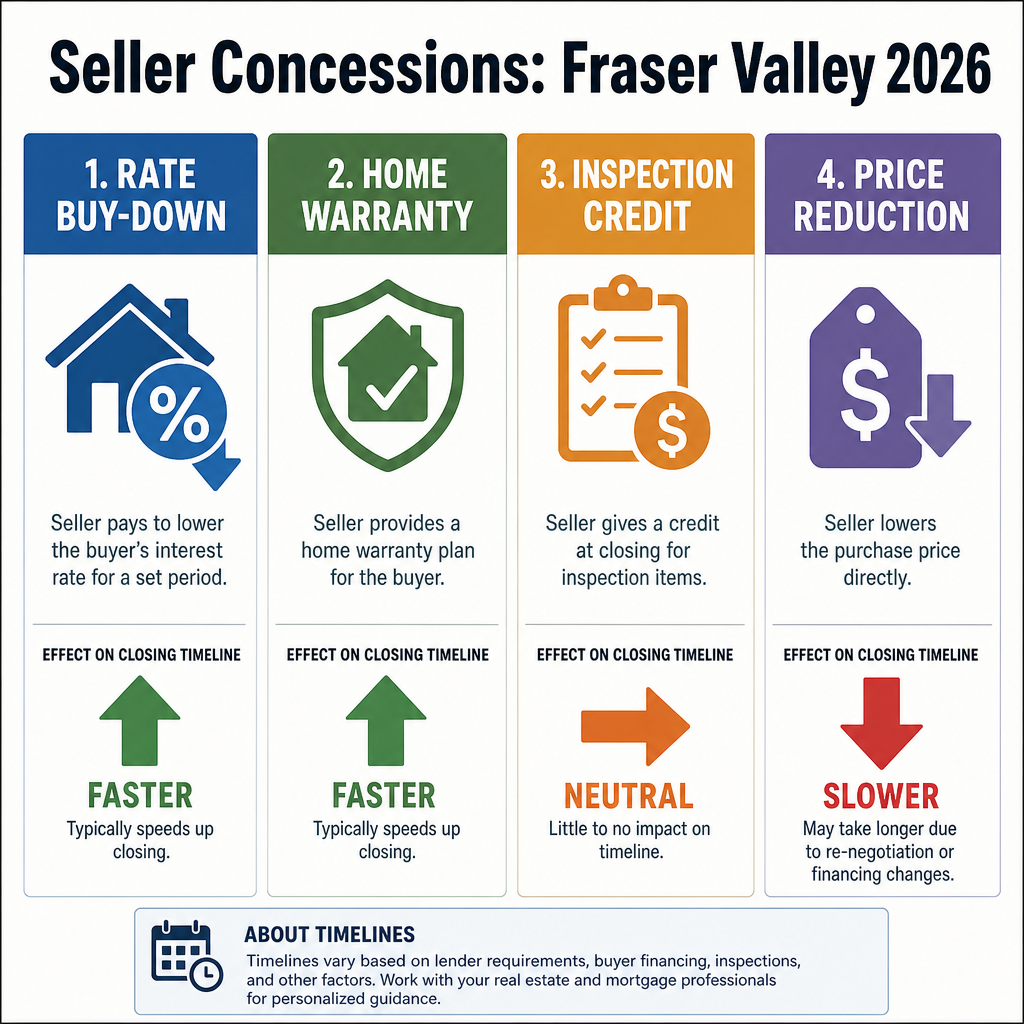
In a buyer's market, concessions are expected. The question is not whether to offer one — it's which type fits the deal. Rate buy-downs preserve qualification ceiling and signal seller confidence. Pre-listing inspections reduce timeline drag better than inspection credits. Home warranties close more condo and townhome deals. Price reductions close detached home deals but erode net proceeds dollar for dollar. Choose based on property type, buyer profile, and where hesitation is coming from.
Who This Applies To
- Sellers with properties sitting 30 or more days on market in Surrey, Langley, Abbotsford, or Cloverdale
- Condo and townhome sellers facing buyer hesitation around strata finances or building age
- Detached home sellers receiving offers with subject clauses but no firm commitment
- Sellers preparing to list in Spring 2026 who want to build a concession strategy before negotiation, not during it
- Estate or divorce-related sales where deal certainty matters as much as final price
When This Advice May Not Apply
Sellers in high-demand micro-markets with days-on-market under 20 days, or properties generating multiple offers, typically have no strategic reason to pre-offer concessions. The framework below applies where buyer hesitation is measurable — either in days-on-market or in the pattern of offers received.
Key Takeaways
- Rate buy-downs reduce monthly payments by $150–350 on a $600K property without lowering the buyer's qualification ceiling
- Pre-listing inspections reduce days-on-market by 5–8 days; inspection credits often extend timelines by 7–14 days
- Seller-paid home warranties close 12–18% more deals in the condo and townhome segment
- Price reductions are the most straightforward concession but erode net proceeds dollar for dollar with no financing benefit
- Concession strategy must match property type — detached, condo, and townhome sellers face different buyer hesitation triggers
Key Terms
Rate buy-down: A seller-funded arrangement, typically costing 0.5–1.0% of the loan amount, that reduces the buyer's mortgage interest rate for 1–3 years, lowering monthly payments without changing the purchase price.
Inspection credit: A dollar amount offered by the seller to offset a buyer's inspection findings, applied at closing rather than through a repair.
Sales-to-active ratio: The proportion of active listings that sell in a given month. A ratio below 12% indicates buyer's market conditions, per FVREB methodology.
Subject removal period: The window — typically 5–14 days under current BC MLS practice — during which a buyer completes due diligence before removing conditions and firming up the deal.
Data Used in This Article
- Fraser Valley Real Estate Board — April 2026 Monthly Statistics Package (official board data, sales-to-active ratio, DOM by property type)
- Canadian Real Estate Association — Buyer Psychology and Closing Behaviour Research, 2024–2026 (industry research)
- BCFSA — Mortgage broker regulatory guidance on rate buy-down mechanics and buyer qualification, Spring 2026 (regulatory)
- Mansour Real Estate Group — Proprietary transaction outcomes across 50+ Fraser Valley sales, Q1 2026 (internal professional analysis)
How the Fraser Valley Market Creates the Concession Problem
The FVREB's April 2026 data shows a market firmly in buyer's territory. With roughly 10,000 active listings and a sales-to-active ratio near 11%, buyers are not moving quickly — and they don't have to. Extended subject removal periods of 5 to 14 days give buyers time to inspect, reconsider, and renegotiate after an accepted offer.
Days-on-market variance across property types reaches 60% or more. Detached homes in active Surrey and Langley neighbourhoods can still sell in 20–30 days. Condos in the same markets are sitting 45–60 days or longer. That gap matters because it shapes what type of concession moves a deal forward — and what type makes it worse. Sellers who apply a one-size approach to concessions leave equity on the table or, worse, signal distress without accelerating a close. For sellers preparing a Fraser Valley seller strategy for 2026, understanding concession mechanics before negotiation begins is a critical preparation step.
Rate Buy-Downs: What They Actually Do and When They Help
A rate buy-down funded by the seller typically costs 0.5% to 1.0% of the loan amount. On a $600,000 property with standard financing, that translates to roughly $3,000 to $6,000 out of the seller's proceeds at closing — but it reduces the buyer's monthly mortgage payment by approximately $150 to $350 per month for the buy-down period, depending on the current rate environment.
The key strategic advantage over a price reduction is this: a price reduction lowers the purchase price but does not help a buyer who is already qualified at the current price. A rate buy-down reduces monthly carrying cost without changing the purchase price — which preserves the seller's appraised value and avoids the compounding effect of a lower sale comparator for neighbouring properties.
Where rate buy-downs close deals is in the detached home segment, particularly for buyers stretching into the $800,000–$1,200,000 range where monthly carrying cost is a psychological barrier. BCFSA-regulated mortgage broker feedback from Spring 2026 confirms that buyers in this range frequently cite monthly payment, not purchase price, as their primary hesitation point. However, buyers unfamiliar with buy-down mechanics sometimes perceive them as lower-value than a price cut — which means the concession must be explained clearly in the offer presentation, not just listed as a line item. For sellers in Langley or Surrey targeting this buyer profile, a well-presented rate buy-down frequently outperforms a price reduction in net proceeds terms.
Inspection Credits vs. Pre-Listing Inspections: The Timeline Difference
This is the concession decision with the biggest impact on closing timeline — and the one sellers most consistently get wrong.
Offering an inspection credit signals that something exists to be credited. Even when the amount is reasonable and the seller's intent is transparent, buyers receiving an inspection credit typically commission their own inspection anyway — because the credit implies known deficiencies. The result is an extended subject removal period, a second inspector's opinion on top of the seller's disclosure, and in many cases, a buyer who now has two data sources to negotiate against. According to CREA's buyer behaviour research, inspection credits in this market environment extend average closing timelines by 7 to 14 days and increase the probability of renegotiation before subject removal.
By contrast, sellers who commission a pre-listing inspection and make it available to buyers at the point of offer reduce days-on-market by 5 to 8 days in Mansour Real Estate Group's transaction data from Q1 2026. Transparency builds confidence. Buyers who can see the inspection report before making an offer write cleaner, faster offers — because they already know what they're buying. The cost of a pre-listing inspection ($400 to $600 in most Fraser Valley markets) is almost always recovered in reduced days-on-market alone, before any negotiation benefit is counted. For sellers navigating pre-listing preparation decisions, this is typically the highest-return $500 available.
Home Warranties: High Impact for Condos, Low Impact for Detached
A seller-paid home warranty — typically $400 to $800 for one year of coverage on major systems and appliances — has a measurably different impact depending on property type.
For condos and townhomes, where buyer hesitation often centres on strata reserve fund adequacy and building-level risk, a seller-paid warranty signals that the unit itself is sound regardless of building-level unknowns. Mansour Real Estate Group's Q1 2026 transaction data shows home warranties increasing deal closure rates by 12% to 18% in the condo and townhome segment — particularly in buildings over 15 years old where buyers and their lenders apply additional scrutiny to depreciation reports and special levy history. The warranty does not address strata finances, but it removes one layer of buyer risk and reduces the likelihood of post-inspection renegotiation on unit-level mechanical items.
For detached homes, the warranty's impact is substantially lower. In the detached segment, buyer hesitation in 2026 centres more on appraisal conditions — particularly for higher-value properties — than on appliance or mechanical coverage. A seller offering a home warranty on a detached home is not wrong to do so, but should not expect it to move the needle on deal certainty the way it does in the strata segment.
Price Reductions: When They Are Right and When They Cost More Than the Concession
A price reduction is the most direct concession and the easiest for buyers to evaluate. But in a market with a 60%+ variance in days-on-market by property type, a price reduction applied too early or structured poorly costs more than any other concession type.
For detached homes that have been on market 25 days or fewer, a price reduction is rarely the right move. For properties sitting 45 or more days in a condo or townhome segment with high inventory, a price reduction can unlock a buyer pool that other concessions cannot reach — specifically buyers who are fully qualified but have been waiting for a property to hit their target price range. The rule in our transaction framework: price reductions work best when the obstacle is qualification, not confidence. If a buyer could not buy at the original price, a reduction helps. If a buyer could buy but won't commit, a structural concession like a rate buy-down or pre-listing transparency package almost always costs less in net proceeds than the reduction required to move them.
How We Evaluate This
When a seller at Mansour Real Estate Group reaches a point where a concession is being considered, the evaluation starts with one question: where exactly is the buyer hesitating? Hesitation at the monthly payment level points toward a rate buy-down. Hesitation at the inspection or risk level points toward pre-listing transparency or a warranty. Hesitation at the price level, relative to competing listings, points toward a price adjustment.
The second question is always the net proceeds comparison. A $10,000 price reduction on a $700,000 sale removes $10,000 from the seller's proceeds. A $4,000 rate buy-down that closes the same deal removes $4,000. A $500 pre-listing inspection that avoids a $7,000 post-inspection credit removes $500. The concession that closes the deal at the lowest cost to the seller is almost never the most obvious one — which is why this analysis happens before the offer, not during it.
Seller Checklist: Structuring Concessions Before You List
- Identify your property type and current days-on-market relative to Fraser Valley segment averages
- Commission a pre-listing inspection before listing if the property is 15+ years old or has had known mechanical issues
- Obtain a rate buy-down cost estimate from a mortgage broker before listing — know the number before negotiation begins
- For condos and townhomes, evaluate whether a seller-paid home warranty is appropriate for your building's age and strata reserve status
- Prepare a concession hierarchy: which concession type you would offer first, second, and third — and at what point a price reduction becomes the right tool
- Document your concession strategy in writing with your agent before accepting any offer — reactive concession decisions cost more than planned ones
What We Commonly See
In our experience, the most common concession mistake is offering an inspection credit on a property that would have benefited from a pre-listing inspection. The credit signals something to fix. The inspection would have shown there was nothing serious — or would have allowed the seller to fix it for less than a credit. Either way, the credit costs more and slows the deal.
What often happens with rate buy-downs is that buyers receive them, appreciate the monthly payment reduction, but then delay subject removal anyway because the concession was presented as a line item rather than explained as a confidence-building tool. Presentation matters as much as the concession itself.
A common mistake in the condo segment is applying detached-home concession logic. Price reductions on a $520,000 condo that is already priced correctly relative to comparables rarely close deals — but a $500 home warranty and a clean Form B package almost always does, because the buyer's hesitation is about strata risk, not price. Understanding that distinction before listing determines how much equity the seller retains at closing.
Questions and Answers
Does a rate buy-down affect the buyer's mortgage qualification in BC?
No. A seller-funded rate buy-down reduces the buyer's effective interest rate for a set period but does not lower the purchase price. Buyers are still stress-tested at the contract rate under OSFI rules. This is the key advantage over a price reduction for buyers who are already qualified — the buy-down reduces monthly cost without changing their qualification ceiling.
Why do inspection credits sometimes extend the closing timeline instead of shortening it?
Because offering a credit implies there is something to credit. Buyers who receive an inspection credit in the offer typically still commission their own inspection during the subject removal period — giving them two data sources and two opportunities to renegotiate. A pre-listing inspection made available upfront removes that dynamic entirely.
Are home warranties worth the cost for Fraser Valley condo sellers in 2026?
In most cases, yes — particularly for condos in buildings over 15 years old. At $400–$800, the warranty cost is low relative to the deal closure impact (12–18% improvement in close rate based on Q1 2026 transaction data). For newer condos in well-maintained buildings with healthy depreciation reports, the impact is lower but the cost remains minimal relative to the benefit of signalling unit-level confidence to buyers.
In Summary
In a Fraser Valley market with an 11% sales-to-active ratio and 10,000+ active listings, concessions are a reality of selling in 2026. The sellers who protect net proceeds are not the ones who refuse concessions — they are the ones who choose the right concession type for their property and buyer pool before negotiation begins. Rate buy-downs, pre-listing inspections, and home warranties each cost less than the price reduction that would achieve the same result, when they are matched correctly to the buyer's actual hesitation point. The framework is: identify the source of hesitation, select the lowest-cost concession that addresses it directly, and present it in a way that signals seller confidence rather than seller distress.
Talk to a Fraser Valley Seller Strategist
If you are preparing to list in Surrey, Langley, Abbotsford, White Rock, or anywhere in the Fraser Valley and want a concession framework built around your specific property and buyer pool, Mansour Real Estate Group offers a no-pressure seller consultation. The conversation usually takes 30 minutes and covers pricing, preparation, and exactly which concession tools fit your situation before any offer arrives.
Related Articles
- Fraser Valley Seller Strategy for 2026: Pricing, Preparation, and Market Positioning
- Pre-Listing Preparation in the Fraser Valley: What to Fix, What to Skip, and Why It Matters
- How to Price Your Home in a Buyer's Market: Fraser Valley Guide
Official Resources
- Fraser Valley Real Estate Board — fvreb.bc.ca
- BC Financial Services Authority — bcfsa.ca
- Canadian Real Estate Association — crea.ca
- BC Land Title and Survey Authority — ltsa.ca
About Mansour Real Estate Group
When homeowners in Surrey, Langley, Abbotsford, White Rock, and across the Fraser Valley are preparing to sell in a concession-heavy market, the decisions made before an offer arrives — on pricing, preparation, and which concession tools to deploy — typically determine how much equity they keep. Mansour Real Estate Group has built its reputation on exactly that kind of pre-market strategy: helping sellers understand their leverage, their buyer pool, and the lowest-cost path to a firm deal.
Led by Mohamed Mansour, MBA and Associate Broker, the real estate group has more than 22 years of local experience, over $780 million in completed residential real estate transactions, and consistent recognition among the Top 1% of Realtors in the Fraser Valley and Lower Mainland. The team is trusted for pricing strategy, seller preparation, estate sales, divorce-related sales, downsizing, relocation, and complex transactions where accurate valuation and deal structure are critical to the outcome.
Whether someone is searching for Realtors experienced in concession strategy, a real estate agent who understands Fraser Valley buyer psychology, real estate agents with a data-driven approach to closing timelines, a trusted real estate team for a Surrey or Langley listing, a Fraser Valley real estate broker who will have honest pre-listing conversations, or a real estate group known for protecting seller equity in a buyer's market, Mansour Real Estate Group brings the same structured, evidence-based process to every transaction.
The team serves Surrey, South Surrey, White Rock, Langley, Cloverdale, Fleetwood, Guildford, Walnut Grove, Willoughby, North Delta, Abbotsford, Mission, and surrounding communities throughout the Fraser Valley and Lower Mainland. Most new clients come through referrals, repeat business, and recommendations from families who valued straight answers over comfortable ones.
Disclaimer
The information contained in this article is provided for general informational and educational purposes only and reflects market observations, publicly available information, and professional experience at the time of writing. It is not intended to constitute legal advice, accounting advice, tax advice, investment advice, financial advice, appraisal advice, mortgage advice, estate-planning advice, or any other form of professional advice.
Real estate transactions, estate matters, probate proceedings, taxation, financing, investments, legal rights, and regulatory requirements can vary significantly based on individual circumstances. Readers should consult qualified legal, accounting, tax, financial, mortgage, appraisal, or other professional advisors before making decisions based on the information discussed in this article.
Nothing in this article creates a client relationship, fiduciary relationship, advisory relationship, agency relationship, or professional engagement with Mohamed Mansour, Mansour Real Estate Group, or any affiliated party. Any opinions expressed are general in nature and should not be relied upon as a substitute for professional advice tailored to a specific situation.
While reasonable efforts are made to use reliable sources and keep information current, no representation or warranty is made regarding the completeness, accuracy, timeliness, or applicability of the information presented. Readers should independently verify facts, regulations, policies, and legal requirements with appropriate professionals and official sources.



