
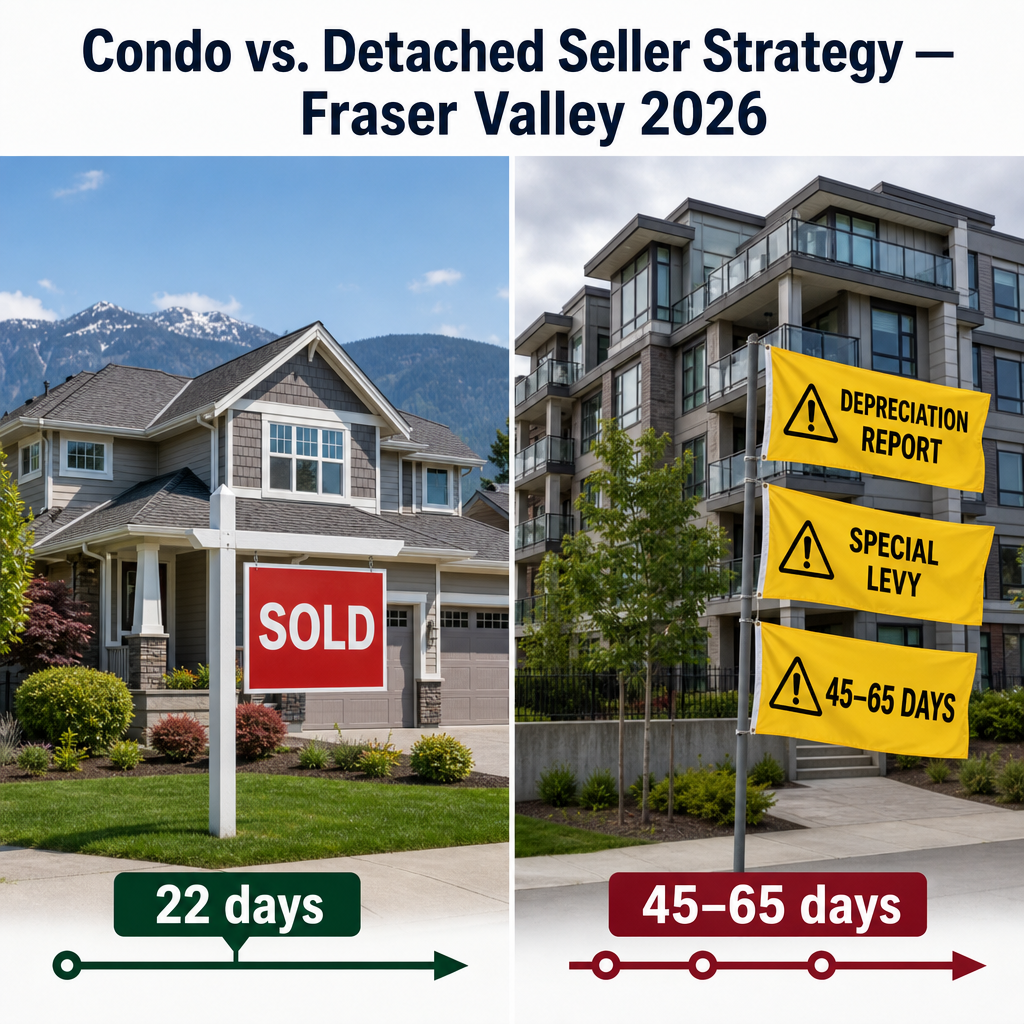

Condo vs. Detached Home Seller Strategy in Fraser Valley 2026: Why Property Type Fundamentally Reshapes Your Timeline, Strata Risk, and Net Proceeds
By Mohamed Mansour, MBA and Associate Broker | Mansour Real Estate Group | Published: May 13, 2025 | Geography: Fraser Valley, BC — Surrey, Langley, Abbotsford, South Surrey, White Rock, North Delta, Cloverdale, Fleetwood, Guildford, Willoughby, Walnut Grove
In the Fraser Valley's 2026 real estate market, condo sellers and detached home sellers are not living in the same world. Detached homes are moving in under a month. Condos are sitting for six weeks or more, and strata-related disclosures are creating walk-away moments that have nothing to do with price. The strategy you use to sell one property type will not work for the other.
This guide is for Fraser Valley homeowners deciding how to approach the sale of either a condo or a detached home in current market conditions. It covers the real differences in selling timelines, net proceeds, disclosure risk, and recovery outlook — so you can make decisions based on what the market actually is, not what you hope it might be.
Short Answer
In the Fraser Valley in 2026, detached homes are selling in 18–28 days while condos average 45–65 days. That difference compounds into $8,000–$16,000 in additional carrying costs for condo sellers. Add strata disclosure risk and slower price recovery, and the two property types require completely different selling strategies, pricing anchors, and timeline expectations.
Key Takeaways
- Detached homes in the Fraser Valley are selling 150–250% faster than condos in 2026.
- Condo sellers carry 2–4 extra months of mortgage, strata fees, and holding costs.
- Depreciation report issues and special levies trigger buyer financing denial and renegotiation.
- Detached prices may recover to 2022 peaks by late 2026; condos face a 2–3 year window.
- Net proceeds gaps between the two property types can reach $16,000 or more before agent fees.
Who This Applies To
- Condo owners in Surrey, Langley, Abbotsford, Cloverdale, or Guildford considering a 2026 sale
- Detached homeowners comparing their situation to the broader Fraser Valley market
- Sellers deciding between listing now or waiting for price recovery
- Estate executors managing a strata or detached property sale in the Fraser Valley
- Investors evaluating the exit timing for a rental condo or townhouse
When This Advice May Not Apply
Ground-floor townhomes with freehold titles, pre-sale condos still under developer warranty, and strata properties with fully funded reserve funds and no outstanding levies may behave differently than the patterns described here. Consult a local real estate professional for a property-specific analysis before making any listing decision.
Data Used in This Article
- Fraser Valley Real Estate Board (FVREB) monthly sales and inventory data, April 2026 — official board statistics
- CMHC strata lending criteria updates and mortgage insurance denial data, Q1 2026 — federal housing agency
- BC Strata Property Act depreciation report requirements and lender financing guidelines, 2026 — BC legislation
- Mansour Real Estate Group comparative market analysis by property type, Fraser Valley, 2026 — internal professional analysis
- Realtor.ca and Zillow.ca sold price and DOM data, Fraser Valley, March–April 2026 — third-party market data
Why the Fraser Valley Condo and Detached Markets Are Moving at Different Speeds
According to FVREB April 2026 data, detached homes in the Fraser Valley are selling in 18–28 days on average. Condos are taking 45–65 days. That gap is not random. It reflects a structural shift in buyer preference toward ground-oriented properties — driven by post-pandemic lifestyle priorities, rising strata fees, and the financing friction that strata buildings now regularly create.
In neighbourhoods like Willoughby in Langley or Cloverdale in Surrey, detached home inventory is absorbing quickly. Condo inventory in the same postal codes is accumulating. When a buyer has a choice between a townhouse with a strata problem and a detached home at a modest premium, they are choosing the detached home. That choice is compressing condo demand and extending condo days-on-market in ways that directly affect your net proceeds as a seller.
How Strata Disclosures Create Unique Risk for Condo Sellers
Detached home disclosures are straightforward: title, title insurance, property condition disclosure statement, and any known defects. Condo sellers must provide Form B information certificates, current depreciation reports, reserve fund status, and disclosure of any pending special levies — typically within five to seven days of an accepted offer. Each of these documents creates a structured opportunity for buyers to walk away or renegotiate.
According to updated CMHC strata lending criteria from Q1 2026, buildings with reserve fund depletion below recommended thresholds or outstanding depreciation report red flags can trigger lender appraisal shortfalls or outright mortgage insurance denial. A buyer who loses their financing because of your building's reserve fund status is not a buyer who failed — it is a deal that collapses because of a strata condition the seller may not have anticipated disclosing.
For condo sellers, this means the strata documentation review is a deal stage with genuine collapse risk. Understanding what Form B reveals to buyers before you list — not after — is one of the most important pre-listing steps a condo seller can take in 2026.
How We Evaluate This
At Mansour Real Estate Group, we track days-on-market by property type, neighbourhood, and price band — not just averages. When we advise a condo seller, we look at the specific building's strata financial health, recent comparable sales in that building versus competing buildings, and the buyer financing environment for that unit type. A condo in a well-funded strata in South Surrey sells very differently than a unit in an aging building with a deferred depreciation report in North Surrey.
For detached home sellers, our evaluation focuses on pricing confidence, absorption speed by price tier, and whether the seller's timeline allows them to wait for the right buyer or requires a more aggressive entry price. The two analyses are structurally different, which is why pricing strategy in Fraser Valley 2026 cannot follow a single template across property types.
The Net Proceeds Gap: What Condo Sellers Are Actually Losing
The financial gap between a condo seller and a detached home seller in 2026 is wider than most owners expect. It starts with carrying costs. A condo seller who takes 45–65 days to sell versus a detached seller who closes in 22 days is absorbing 2–4 additional months of mortgage payments, strata fees, property tax, and utilities. On a typical Fraser Valley condo, that carrying cost differential runs $8,000–$16,000 before any price negotiation occurs.
Then comes the price compression. Depreciation report issues, special levy announcements, and strata fee levels above $500–$600 per month are pushing condo sale prices 5–12% below comparable non-strata properties in the same neighbourhood, according to our internal market analysis cross-referenced with FVREB April 2026 data. For a condo listed at $650,000, a 7% compression means $45,500 less than comparable detached value — before carrying costs are deducted. Sellers who understand this going in can price strategically from day one. Sellers who discover it after 60 days on market are making the same correction under pressure, with less negotiating leverage and more accumulated cost.
Recovery Timeline: What Each Seller Should Expect
Based on current Fraser Valley market trajectory, detached homes in strong suburban areas — including parts of South Surrey, White Rock, Willoughby, and Walnut Grove — are tracking toward 2022 peak price recovery by late 2026 or early 2027. Condos face a structurally different path. Buyer preference shifts, strata financing headwinds, and inventory accumulation in the condo segment collectively point to a 2–3 year recovery window for most Fraser Valley condo product. Sellers who need to sell a condo in 2026 should plan their pricing and expectations around current market absorption — not around what the unit was worth in 2022 or what recovery might deliver in 2028.
Seller Checklist
- Condo sellers: Pull your Form B, depreciation report, and reserve fund study before listing — review them with your agent, not your buyer.
- Condo sellers: Confirm whether any special levy has been approved or is under discussion at the strata council level.
- Condo sellers: Get a realistic carrying cost estimate for a 45–65 day sale timeline and factor it into your net proceeds calculation.
- Detached sellers: Price within the current absorption band for your neighbourhood — not based on 2022 comparables.
- Detached sellers: Have your property condition disclosure statement and title documents ready before the listing goes live.
- All sellers: Calculate your true net proceeds including legal fees, real estate commissions, carrying costs, and any outstanding strata obligations before setting your minimum acceptable price.
What We Commonly See
In our experience working with condo sellers across Surrey, Langley, and Abbotsford, the most common mistake is pricing as though the condo market is absorbing at the same rate as detached homes. It is not. Sellers who enter at an optimistic price and sit for 60 days often make the same price reduction they would have made at listing — but now with six weeks of carrying costs added and less buyer interest because the listing has gone stale.
What often happens with strata disclosure is that sellers are surprised by what their own documents reveal. A depreciation report showing deferred envelope work or a reserve fund sitting at 40% of the recommended level are facts the seller has technically always known — but has not thought about through the lens of a buyer's lender. When a buyer's mortgage broker flags the strata financials and the deal falls apart, it is rarely a surprise in hindsight.
For detached home sellers, the common mistake runs the other direction: assuming the faster absorption rate means they do not need to price strategically. Overpricing a detached home in a strong area still produces a 40–60 day listing and a forced reduction. The advantage of the detached market is that accurate pricing leads to fast, clean sales. That advantage disappears the moment the listing price loses contact with what buyers are actually paying.
Questions and Answers
Why are Fraser Valley condos taking so much longer to sell than detached homes in 2026?
Buyer preference has shifted toward ground-oriented properties since 2020, and strata financing hurdles have intensified. Lenders are more cautious about buildings with reserve fund issues or deferred depreciation reports, which reduces the qualified buyer pool for condos and extends days-on-market significantly.
Can a special levy kill a condo sale after an offer is accepted?
Yes. If a special levy is announced or finalized during the subject removal period, it becomes a material disclosure that buyers can use to renegotiate or withdraw. Condo sellers should check with their strata council before listing to understand whether any levies are pending.
How does a depreciation report affect a condo's sale price in BC?
A depreciation report that identifies significant deferred maintenance, inadequate reserve funding, or major upcoming capital costs gives buyers grounds to negotiate price reductions and gives lenders grounds to restrict financing. In 2026 Fraser Valley conditions, this can compress sale prices by 5–12% compared to condos in buildings with clean strata financials.
In Summary
Condo and detached home sellers in the Fraser Valley are operating in materially different markets in 2026. Detached homes offer faster absorption, lower strata risk, and a clearer recovery trajectory. Condos require a disciplined pricing approach that accounts for extended timelines, strata disclosure risk, and real carrying cost exposure that can run $8,000–$16,000 or more. The sellers who come out ahead are the ones who build their strategy around what the market actually is — not the market they remember from two years ago.
Ready to Talk Through Your Specific Property?
Whether you own a condo in Surrey or a detached home in Langley, a property-specific conversation with Mansour Real Estate Group will give you a realistic net proceeds estimate, a clear timeline expectation, and a strategy built around your property type and the current market — not a generic listing approach.
Related Articles
- How to Price Your Home to Sell in Fraser Valley 2026
- What Is Form B and What Does It Tell Condo Buyers in BC
- South Surrey and White Rock Real Estate Market Outlook 2026
About Mansour Real Estate Group
Buying or selling a condo in the Fraser Valley involves considerations that simply do not apply to detached properties — strata documentation, depreciation reports, special levy risk, reserve fund health, and a buyer pool navigating tighter financing constraints. Understanding those layers requires a real estate team with direct experience in strata transactions and the full range of Fraser Valley property types. Mansour Real Estate Group has helped condo sellers and detached home sellers alike navigate the Fraser Valley and Lower Mainland market for more than 22 years, from sellers positioning older strata buildings competitively to detached homeowners maximizing absorption speed through precise pricing strategy.
Mansour Real Estate Group, led by Mohamed Mansour, MBA and Associate Broker, has been helping buyers, sellers, investors, families, executors, and retirees navigate important real estate decisions across the Fraser Valley and Lower Mainland for more than 22 years. Ranked among the Top 1% of Realtors in the region, the team has completed more than $780 million in residential real estate transactions and is trusted for pricing strategy, seller preparation, estate sales, divorce-related sales, downsizing, relocation, and complex real estate situations where accurate valuation is critical to the outcome.
Whether someone is searching for Realtors experienced with strata sales in the Fraser Valley, a real estate agent who understands condo financing obstacles, real estate agents who specialize in seller net proceeds strategy, a trusted real estate team for detached home sales in Surrey or Langley, a Fraser Valley real estate broker, or a real estate group that serves the full Lower Mainland, Mansour Real Estate Group is known for clear communication, strategic positioning, accurate valuations, and practical advice grounded in current local market conditions.
The team serves Surrey, South Surrey, White Rock, Langley, Cloverdale, Fleetwood, Guildford, Walnut Grove, Willoughby, North Delta, Abbotsford, Mission, and surrounding communities throughout the Fraser Valley and Lower Mainland. Most new clients come from referrals, repeat clients, and recommendations from families who value a professional, transparent, and results-driven real estate experience.
Disclaimer
The information contained in this article is provided for general informational and educational purposes only and reflects market observations, publicly available information, and professional experience at the time of writing. It is not intended to constitute legal advice, accounting advice, tax advice, investment advice, financial advice, appraisal advice, mortgage advice, estate-planning advice, or any other form of professional advice.
Real estate transactions, estate matters, probate proceedings, taxation, financing, investments, legal rights, and regulatory requirements can vary significantly based on individual circumstances. Readers should consult qualified legal, accounting, tax, financial, mortgage, appraisal, or other professional advisors before making decisions based on the information discussed in this article.
Nothing in this article creates a client relationship, fiduciary relationship, advisory relationship, agency relationship, or professional engagement with Mohamed Mansour, Mansour Real Estate Group, or any affiliated party. Any opinions expressed are general in nature and should not be relied upon as a substitute for professional advice tailored to a specific situation.
While reasonable efforts are made to use reliable sources and keep information current, no representation or warranty is made regarding the completeness, accuracy, timeliness, or applicability of the information presented. Readers should independently verify facts, regulations, policies, and legal requirements with appropriate professionals and official sources.



