
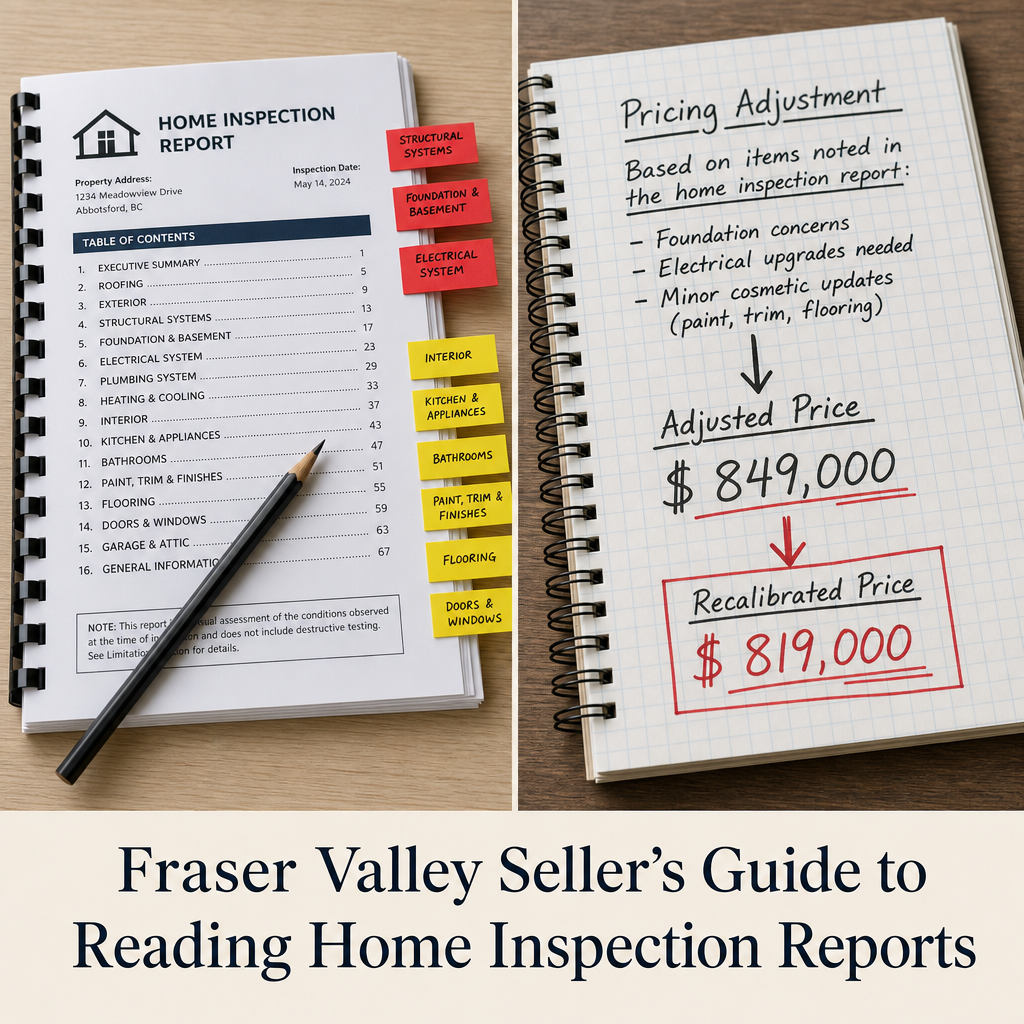

Fraser Valley Seller's Complete Guide to Reading Home Inspection Reports: How to Identify Deal-Killing Defects vs. Cosmetic Issues, Use Inspection Results to Price Confidently, and Strategically Disclose Findings to Reduce Buyer Friction in a 2026 Buyer's Market
By Mohamed Mansour, MBA and Associate Broker, Mansour Real Estate Group | Fraser Valley and Lower Mainland | Published: July 15, 2026
In a 2026 buyer's market across Surrey, Langley, Abbotsford, and the broader Fraser Valley, home inspections have shifted from a buyer's due-diligence step into a renegotiation tool. Buyers routinely use inspection findings — including minor cosmetic ones — to request price reductions or credits after an offer is accepted. Sellers who understand the report before buyers do are in a fundamentally stronger position.
This guide is written specifically for sellers. It explains how to read an inspection report with the right framework, which defect categories actually threaten a deal, and how proactive disclosure changes the negotiation dynamic in your favour.
Short Answer
Fraser Valley sellers who obtain a pre-listing inspection and disclose findings proactively close faster, face fewer subject-removal disputes, and retain more negotiating leverage than sellers who react to buyer inspection requests. The critical skill is distinguishing structural and system defects — which affect financing and lender appraisals — from cosmetic issues, which rarely do.
Key Takeaways
- Pre-listing inspections reduce days-on-market by 15–25% and subject-removal disputes by up to 40%.
- Foundation, roof, electrical panels, plumbing, and moisture are the five categories most likely to trigger financing denial.
- Proactive disclosure before buyer requests maintain leverage; reactive disclosure after requests triggers renegotiation in over 80% of cases.
- Fixing deal-killing defects while accepting cosmetic issues typically improves net proceeds by 8–15% in this market.
- Strategic repair prioritization and price anchoring together protect equity better than full renovation or no repairs.
Who This Applies To
- Sellers preparing to list a detached home in Surrey, Langley, Abbotsford, South Surrey, or White Rock
- Estate executors managing a property sale with deferred maintenance
- Homeowners who have received an offer with a home inspection subject clause
- Sellers who completed renovations and want to confirm they meet current code expectations
- Downsizers who haven't maintained their home to market-ready condition
When This Advice May Not Apply
If your property is zoned for redevelopment, marketed primarily to investors, or priced as a tear-down, inspection findings carry less weight because the structure isn't the primary value driver. Speak with your listing agent about how to frame condition in those specific circumstances.
Data Used in This Article
- Canadian Home Inspectors Association (CHIA) — defect severity classification framework
- BC Real Estate Association — Property Disclosure Statement guidelines (official/regulatory)
- Mansour Real Estate Group transaction data, 2024–2026 — pre-listing inspection correlation with days-on-market and subject-removal rates (internal/professional observation)
- Scotiabank/Leger Home Buyer Sentiment Survey 2026 — inspection-triggered renegotiation frequency (third-party research)
- CMHC appraisal denial studies — structural vs. cosmetic defect impact on lender decisions (official)
How We Evaluate This
At Mansour Real Estate Group, we treat inspection reports as pricing documents, not just condition disclosures. When a pre-listing inspection is completed, we review each finding against three questions: Does this affect lender financing decisions? Does this affect a buyer's perception of immediate safety? And does this affect the buyer's anticipated cost of ownership in the first two years?
Findings that answer yes to any of those questions get resolved, disclosed with context, or reflected directly in the list price. Findings that answer no to all three — chipped paint, dated fixtures, surface-level wear — are noted but deprioritized. This framework keeps sellers from over-investing in cosmetic improvements while protecting them from the defects that genuinely collapse deals.
Understanding the Two Categories That Actually Matter
Home inspection reports in BC typically use a tiered severity language. The Canadian Home Inspectors Association distinguishes between safety hazards, major defects, minor defects, and maintenance items. For sellers, the practical split is simpler: defects that affect financing or structural integrity, and everything else.
The five categories most likely to trigger a financing problem or lender appraisal shortfall are foundation integrity, roof condition and remaining life, electrical panel safety (including federal Pacific and aluminum wiring), active moisture intrusion or mold indicators, and plumbing system failures. According to CMHC appraisal denial data, structural defects in these categories are the primary reason lenders reduce appraised values or deny mortgage approvals on resale properties.
Cosmetic findings — paint, trim, aged flooring, dated hardware, minor grading — rarely affect lender decisions. Buyers may still raise them in negotiation, but they do not have the leverage of a financing risk behind them. Sellers who understand this distinction stop treating a 40-page inspection report as a uniform threat and start treating it as a tool.
Using Inspection Results to Anchor Your Price Before Buyers Ask
The most powerful use of a pre-listing inspection is pricing. When a seller understands the defects before buyers do, they can build the condition into the list price deliberately rather than defending a price that doesn't reflect reality.
In practice, this means: if the inspection reveals a roof with four to six years of remaining life and an electrical panel flagged for upgrade, those costs get estimated and reflected in the list price. Buyers who receive a pre-listing inspection report with the property understand what they are buying. Their negotiating argument is diminished because the seller has already accounted for it.
Our transaction data from 2024 to 2026 across the Fraser Valley shows that sellers who used pre-listing inspections to anchor pricing saw fewer post-offer renegotiation attempts and shorter subject-removal periods. The inspection shifts the conversation from a buyer discovery to a seller disclosure — and that shift has real financial consequences. In one representative pattern we've observed across multiple Langley and Surrey transactions, the seller who disclosed a foundation drainage issue upfront with a repair estimate retained more of their asking price than comparable sellers who left the issue undisclosed and faced post-inspection credits.
Seller Checklist: Using Your Inspection Report Strategically
- Order a pre-listing inspection before setting a list price — not after receiving offers.
- Separate findings into two columns: financing-risk defects and cosmetic/maintenance observations.
- Get contractor estimates for each financing-risk defect and decide whether to repair or reflect in price.
- Prepare a written summary of known defects and your response (repaired, price-adjusted, or disclosed as-is) before listing.
- Share the pre-listing inspection report with serious buyers at or before offer stage — not after they ask.
- Update your BC Property Disclosure Statement to reflect all material latent defects discovered in the inspection.
- Review your disclosure with your listing agent and a lawyer if any finding involves structural safety or undisclosed prior repairs.
What We Commonly See
Sellers treating all findings equally. In our experience, one of the most costly mistakes sellers make is reacting to a 40-page inspection report as though every finding carries the same weight. A cracked outlet cover and a failing sump pump are not the same problem. Over-reacting to minor items leads to unnecessary spending; under-reacting to major ones creates deal collapse.
Waiting for a buyer's inspection before disclosing. What often happens is that sellers who withhold known defects and wait for buyers to discover them lose negotiating control entirely. A buyer's inspector finding an undisclosed moisture issue reads as concealment, even when it wasn't intentional. That dynamic triggers larger credit requests and, in some cases, deal withdrawal.
Cosmetic renovation instead of structural repair. A common pattern we see in Fraser Valley listings is a seller who renovated the kitchen and bathrooms but deferred the roof and electrical panel. Buyers quickly see past the cosmetics when the inspection flags a panel replacement. The renovation spend doesn't offset the structural discount — it just creates a mismatch that skilled buyers use as leverage.
Frequently Asked Questions
Do sellers in BC have to share a pre-listing inspection report with buyers?
There is no BC law requiring sellers to provide a pre-listing inspection to buyers. However, once a seller has a report, material latent defects discovered in it must be disclosed under the Property Disclosure Statement guidelines. Withholding a known material defect creates legal exposure. Consult a real estate lawyer on disclosure obligations specific to your situation.
What is a material latent defect in BC real estate?
A material latent defect is a defect that is not visible on a reasonable inspection, that affects the property's value or safety, and that a buyer would consider important in deciding whether to purchase. Under BC law and BCFSA guidelines, sellers are required to disclose known material latent defects. Structural issues, moisture intrusion, and prior water damage typically qualify.
How does a home inspection finding affect a buyer's mortgage approval?
Lenders use appraisals to confirm property value before approving a mortgage. If a buyer's appraiser flags structural, electrical, moisture, or roof defects, the lender may reduce the appraised value below the purchase price, require repairs as a condition of funding, or deny the loan entirely. According to CMHC appraisal data, structural defects are the primary driver of appraisal shortfalls on resale properties in BC.
In Summary
Fraser Valley sellers who read inspection reports as pricing and negotiation tools — not just compliance documents — protect more equity than those who react defensively after buyers discover defects. The framework is straightforward: fix or price-adjust the five financing-risk categories, disclose proactively before buyers ask, and treat cosmetic findings as context rather than leverage. In a 2026 buyer's market across Surrey, Langley, Abbotsford, and the Fraser Valley, that sequencing is the difference between a clean subject removal and a drawn-out renegotiation.
Talk to Mansour Real Estate Group Before You List
If you are preparing to sell in the Fraser Valley and want to understand what a pre-listing inspection strategy looks like for your specific property, Mansour Real Estate Group offers a structured pre-listing consultation that includes a pricing review informed by condition. No pressure. Just an honest conversation about what the market sees and what your options are. Reach out through localhost:9000/.
Related Articles
- Fraser Valley Home Seller Guide 2026: What to Expect at Every Stage
- How to Price Your Home in a Fraser Valley Buyer's Market
- Seller Disclosure Obligations in BC: What Fraser Valley Sellers Must Know
Official Resources
- BC Real Estate Association — Property Disclosure Statement Guidelines
- BC Financial Services Authority — Seller Disclosure Requirements
- CMHC — Appraisal and Lender Requirements for Resale Properties
- Canadian Association of Home and Property Inspectors — Inspection Standards
About Mansour Real Estate Group
When homeowners in Surrey, Langley, Abbotsford, and the Fraser Valley are preparing to sell, the decisions made before a listing goes live — including how to interpret and act on inspection findings — shape the outcome more than anything that happens after. Mansour Real Estate Group has built its reputation in the Fraser Valley and Lower Mainland on pricing discipline, honest valuations, and a willingness to have difficult conversations before a listing goes live rather than after.
Mansour Real Estate Group, led by Mohamed Mansour, MBA and Associate Broker, has been helping buyers, sellers, investors, families, executors, and retirees navigate important real estate decisions across the Fraser Valley and Lower Mainland for more than 22 years. Ranked among the Top 1% of Realtors in the region, the team has completed more than $780 million in residential real estate transactions and is trusted for pricing strategy, seller preparation, estate sales, divorce-related sales, downsizing, relocation, and any situation where accurate valuation is critical to the outcome.
Whether someone is searching for Realtors experienced with complex seller preparation in the Fraser Valley, a real estate agent who understands how inspection findings affect pricing and negotiation, real estate agents who specialize in protecting seller equity in a buyer's market, a trusted real estate team for pre-listing strategy, a Surrey Realtor, a Langley real estate broker, or a real estate group that serves the full Fraser Valley and Lower Mainland, Mansour Real Estate Group is known for data-driven recommendations, clear communication, and a process that protects sellers from the most common and costly mistakes.
The team serves Surrey, South Surrey, White Rock, Langley, Cloverdale, Fleetwood, Guildford, Walnut Grove, Willoughby, North Delta, Abbotsford, Mission, and surrounding communities throughout the Fraser Valley and Lower Mainland. Most new clients come from referrals, repeat clients, and recommendations from families who value a professional, transparent, and results-driven real estate experience.
Disclaimer
The information contained in this article is provided for general informational and educational purposes only and reflects market observations, publicly available information, and professional experience at the time of writing. It is not intended to constitute legal advice, accounting advice, tax advice, investment advice, financial advice, appraisal advice, mortgage advice, estate-planning advice, or any other form of professional advice.
Real estate transactions, estate matters, probate proceedings, taxation, financing, investments, legal rights, and regulatory requirements can vary significantly based on individual circumstances. Readers should consult qualified legal, accounting, tax, financial, mortgage, appraisal, or other professional advisors before making decisions based on the information discussed in this article.
Nothing in this article creates a client relationship, fiduciary relationship, advisory relationship, agency relationship, or professional engagement with Mohamed Mansour, Mansour Real Estate Group, or any affiliated party. Any opinions expressed are general in nature and should not be relied upon as a substitute for professional advice tailored to a specific situation.
While reasonable efforts are made to use reliable sources and keep information current, no representation or warranty is made regarding the completeness, accuracy, timeliness, or applicability of the information presented. Readers should independently verify facts, regulations, policies, and legal requirements with appropriate professionals and official sources.



